Calendula
FlowerCalendula officinalis
Have seeds for this? Add to inventory →Calendula (pot marigold) is one of the most useful companion plants in the organic garden, repelling aphids and whiteflies with its sticky resinous stems while attracting hoverflies and beneficial wasps. Its edible flowers are also used in skin-care preparations.
Growing Conditions
Growing Conditions
Sunlight
Full Sun
Water Needs
Moderate
Soil
Well-draining loam; pH 5.5 - 7.0
Spacing
12 - 18 inches
Days to Maturity
45 - 60 days from direct sow to first flower
Growing Zones
Growing Zones
Thrives in USDA Zones 3 - 10
When to Plant
When to Plant
Direct Sow
2 - 4 weeks before last frost; self-seeds readily
Harvest
Deadhead spent flowers to maintain continuous bloom all season
Phenology (Natural Timing Cues)
Direct Sow
Sow calendula during cool windows at both ends of the season. Spring sowings should go in before daytime temperatures reliably push above 75°F - once summer heat settles in, plants decline. Autumn sowings can extend through mild weather and often establish plants that flower strongly from early spring.
- Early dandelions are beginning to bloom (spring sowing).
- Soil is workable, cool, and evenly moist.
- Daytime temperatures are reliably below 75°F.
- Summer heat has eased and first cool nights have returned (autumn sowing).
Start Dates (Your Location)
Average dates use your saved zone; readiness also checks your forecast when available.
Average Last Frost
Set your growing zone to see personalized calendar dates.
Use the average timing, but check your local forecast before planting.
Organic Growing Tips
Organic Growing Tips
Allow calendula to self-seed freely around vegetable beds for a self-maintaining companion planting system.
Sticky stems trap aphids and whiteflies physically - inspect and dispose of infested plants periodically.
Harvest flowers regularly in dry conditions for use in homemade skin salves, oils, and tinctures.
Let spent calendula decompose in place between vegetable rows - their decomposing biomass feeds soil biology, self-sown seedlings emerge as ready-made companions, and the whole system becomes progressively more self-sustaining with each season.
Care Guidance
Optional seasonal guidance for what you can do, even when nothing is urgent.
Care Guidance
Watering
If the top 2 inches of soil feel dry, a deep watering at the base may help more than frequent light watering. In healthy soil, rain may cover much of what it needs.
Feeding
Extra feeding is rarely required if soil is healthy. If growth looks pale or slow, a light compost top-dressing is often enough before adding anything stronger.
Seasonal care
During the main season, harvesting when the crop is ready and removing damaged growth can help keep the planting productive if it starts to look crowded or tired.
Known Varieties
Common cultivars worth knowing
Known Varieties
Resina
Resin-rich strain often grown for traditional herbal harvest.
Best for
flower drying
Pacific Beauty
Tall mixed colors from pale yellow to deep orange.
Best for
cut flowers
Orange King
Deep orange double flowers on sturdy plants.
Best for
bright petals
Zeolights
Soft peach, copper, and pink-toned flowers with dark centers.
Best for
ornamental borders
Strawberry Blonde
Blush, cream, and rose shades that shift with weather.
Best for
subtle color mixes
Companion Planting
Companion Planting
Good companions
Support & insectary plants
Nearby plants that attract pollinators, beneficial insects, or improve soil health.
- Yarrow
Attracts beneficial insects and produces nutrient-rich mulch
- Chamomile
Attracts beneficial insects and produces nutrient-rich mulch
- Echinacea
Attracts pollinators and beneficial insects
- Sweet Alyssum
Attracts pollinators and beneficial insects
Avoid planting near
No known conflicts
Common Pests
Common Pests
All pest management in Garden uses safe, organic, non-toxic methods only. No synthetic pesticides, ever.
Simple Ways to Use
Simple Ways to Use
Start here if you're not sure how to use this crop in the kitchen.
Quick recipes you can make right away
Calendula Tea
Pour 1 cup of hot water over 1 tablespoon of fresh petals or 2 teaspoons of dried petals, then steep 5 to 10 minutes until the tea turns yellow-gold. Strain before drinking so the petals do not keep soaking and lose their clean flavor.
Calendula Oil Infusion
Fill a clean jar loosely with fully dried calendula petals, cover them completely with oil, and keep the jar in a dark spot for 1 to 2 weeks, shaking it every day or two. Strain when the oil smells lightly floral, then use it as a simple skin oil or as the base for a salve recipe.
Calendula Salve Base
Warm 1/4 cup strained calendula-infused oil with about 1 tablespoon beeswax over very low heat until the wax melts, then pour it into a small clean tin or jar. Let it cool until firm before using, and keep the batch simple and plainly labeled.
How to Preserve
How to Preserve
Use this section to store or process extra harvest before it spoils.
Practical methods for extra harvest
Air dry calendula petals or flower heads
Pick flowers when they are fully open and dry from the morning dew, then spread the petals or whole heads in a single layer in a warm airy place out of direct sun. Dry them for about 5 to 10 days, until the petals feel crisp and the flower base no longer feels cool or damp.
Store dried petals for tea blends
Let the dried petals cool completely, then pack them into airtight jars without crushing them too tightly. If the petals soften again or clump in the jar after a day, dry them longer before storing them again.
Make calendula oil for later use
Use only fully dried petals so no moisture gets trapped in the oil, then infuse them in oil for 1 to 2 weeks out of direct sun before straining well. Store the strained oil in a clean jar and use it within a reasonable time, especially if your room is warm.
New to preserving food?
New to dehydrating? Read the dehydrating guide.How to Store
How to Store
Simple storage tips
Use fresh calendula flowers the same day when possible, or refrigerate them in a breathable container and use them within 1 to 2 days.
Dry flowers only when they are fully open and dry on the plant, because damp flower heads brown and mold quickly.
Store dried calendula in an airtight jar in a cool dark place, and expect the best color and aroma within about 6 to 12 months.
Keep infused oil in a clean sealed jar away from heat and light, and discard it if it smells sour, rancid, or off.
Label dried petals and oil clearly with the harvest or infusion date so older batches get used first.
How to Save Seed
How to Save Seed
Step-by-step seed saving
- 1
Leave some flowers on the plant until they dry fully and form curled tan to brown seeds at the center.
- 2
Pluck the dry seed heads on a dry day and pull out the curved seeds with your fingers.
- 3
Let the seeds air dry a few more days if any part of the flower base still feels cool or soft.
- 4
Store the seeds in a cool dry place, and save extra because calendula is one of the easiest flowers to reseed.
Native Range
Native Range
- Origin
- Calendula is associated with the Mediterranean region, though long cultivation obscures parts of its original wild distribution.
- Native Habitat
- Open sunny ground, field edges, disturbed soils, and seasonally moist Mediterranean habitats.
- Current Distribution
- Naturalized across many temperate regions, especially in disturbed habitats.
Taxonomy
Taxonomy
- Kingdom
- Plantae
- Family
- Daisy family (Asteraceae)
- Genus
- Calendula
- Species
- Calendula officinalis
Morphology
Morphology
Root System
Fibrous annual roots that establish quickly in cool, loose soil.
Stem
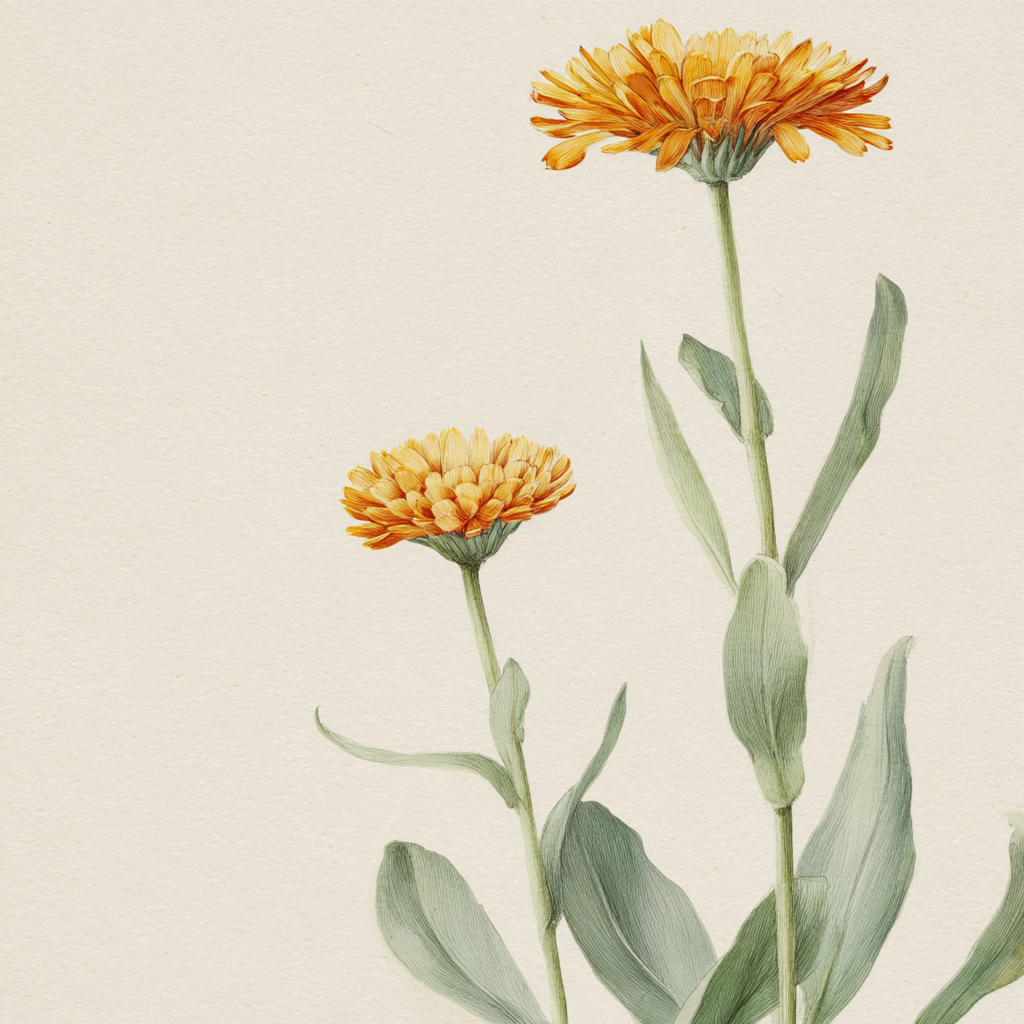
Branching green stems that may feel slightly sticky or resinous, especially near flower buds.
Leaves
Oblong to spatula-shaped leaves with soft texture, pale green color, and a slightly sticky feel.
Flowers
Daisy-like yellow to orange flower heads with many ray florets and a central disk; blooms close in poor light.
Fruit
Curved, rough achenes of different sizes, often shaped like little hooks or crescents.
Natural History
Natural History
Calendula (Calendula officinalis) is native to southern Europe and the Mediterranean, with some evidence suggesting southwestern Europe or the Canary Islands as its origin center. It is one of the few plants that has been in continuous cultivation in European gardens since at least Roman times, appearing in both kitchen gardens and apothecary stores. The name "calendula" derives from the Latin calendae - the first day of the month - supposedly because it blooms through so many months of the year. "Pot marigold," its common name, refers not to garden pots but to cooking pots, reflecting its historical use as a low-cost saffron substitute to color butter, cheese, soups, and custards. The species name officinalis signals its long-standing place in apothecary stores. The sticky, resinous quality of calendula stems and bracts is produced by a mixture of terpenoids and flavonoids associated with its skin-healing reputation in herbalism; these same compounds also trap aphids and small insects physically, which is the basis of its companion planting value.
Traditional Use
Traditional Use
Calendula's traditional significance runs in two distinct directions: as a skin-healing and wound herb, and as a kitchen plant used for color, flavor, and edible flowers. Both strands are continuous from antiquity through the present, giving calendula one of the most uninterrupted records of practical use of any European garden plant.
Parts Noted Historically
European Wound and Skin-Healing Traditions - Flower heads
Calendula has one of the most consistent records as a wound herb in European herbalism, documented from the 12th-century writings of Hildegard of Bingen through Renaissance herbals and into the 19th century. It was used in infused oils and poultices applied to cuts, bruises, burns, and inflamed skin. During World War I it was used in field hospital wound preparations when antiseptics were in short supply. The flavonoids and terpenoids in the flower heads give some chemical basis to these traditional uses.
Kitchen and Dye Traditions - Petals
Calendula petals were one of the most widely used saffron substitutes in European cooking from the medieval period onward, used to color butter, cheese, broths, custards, and rice dishes. The name "pot marigold" reflects the cooking pot rather than the garden pot. Dried petals were also used as a textile dye for wool and linen, producing warm golden tones. As an edible flower, calendula petals were added to salads and garnishes for both color and mild peppery flavor.
Medieval and Renaissance Herbal Traditions - Flower heads and leaves
Herbalists including Hildegard of Bingen, John Gerard, and Nicholas Culpeper all recorded calendula in their works. Gerard's Herball (1597) describes it as "comfortable to the hart and spirits." Culpeper associated it with the sun and recommended it widely. These classical herbal references gave calendula a cultural authority that sustained its continuous cultivation through changing fashions in herb gardening.
Calendula flowers and petals are generally well tolerated as food and as topical preparations. People with known allergies to other daisy family plants - chrysanthemums, daisies, ragweed - may react to calendula. Internal medicinal preparations are outside the scope of this profile.
This information is provided for historical and educational purposes only and is not medical advice. Always consult a qualified healthcare professional before making decisions related to your health.
Loading photo submission…