Chamomile
FlowerMatricaria chamomilla
Have seeds for this? Add to inventory →German chamomile is known as the "physician of the garden" for its ability to improve the health and vigour of nearby plants. It accumulates calcium and potassium in its tissues, attracts hoverflies and beneficial wasps, and makes a soothing herbal tea.
Growing Conditions
Growing Conditions
Sunlight
Full Sun
Water Needs
Low
Soil
Well-draining, lean loam; pH 5.6 - 7.5
Spacing
6 - 9 inches
Days to Maturity
60 - 65 days from sowing to flower
Growing Zones
Growing Zones
Thrives in USDA Zones 3 - 10
When to Plant
When to Plant
Direct Sow
Autumn or early spring; surface sow as seeds need light to germinate
Harvest
Harvest flowers when fully open for tea; dry in a warm, airy space
Phenology (Natural Timing Cues)
Direct Sow
Surface sow chamomile during cool windows - the seed must not be covered as it needs light to germinate. Both early spring and autumn sowings work; autumn sowings often establish plants that flower freely from late spring onward.
- Early dandelions are beginning to bloom (spring sowing).
- Soil is workable and surface moisture holds between rains.
- Summer heat has eased and nights are reliably cooler (autumn sowing).
Start Dates (Your Location)
Average dates use your saved zone; readiness also checks your forecast when available.
Average Last Frost
Set your growing zone to see personalized calendar dates.
Use the average timing, but check your local forecast before planting.
Direct Sow Window
Early spring or autumn
This uses autumn or first-frost timing, so keep the planting note as written. Surface sow. Seeds need light to germinate.
Organic Growing Tips
Organic Growing Tips
Allow chamomile to self-seed throughout vegetable beds - it will establish as a beneficial ground layer.
Steep chamomile flowers in water and spray around seedlings to prevent damping-off fungal disease.
Traditionally believed to improve the essential oil production and flavour of herbs grown nearby.
Let chamomile decompose in place where it grows - its fine root system improves soil aeration, and its decomposing biomass cycles calcium and potassium back into the soil, feeding the soil biology that benefits every surrounding plant.
Care Guidance
Optional seasonal guidance for what you can do, even when nothing is urgent.
Care Guidance
Watering
Extra watering is often only useful during extended dry periods. If the top 2 to 3 inches are still holding moisture, additional water may not help.
Feeding
Extra feeding is rarely required if soil is healthy. If growth looks pale or slow, a light compost top-dressing is often enough before adding anything stronger.
Seasonal care
During the main season, harvesting when the crop is ready and removing damaged growth can help keep the planting productive if it starts to look crowded or tired.
Known Varieties
Common cultivars worth knowing
Known Varieties
German Chamomile
Annual Matricaria chamomilla grown for abundant small flower heads.
Best for
tea gardens
Roman Chamomile
Low perennial Chamaemelum nobile with apple-scented foliage.
Best for
perennial herb lawns
Bodegold
German chamomile selection bred for uniform flower production.
Best for
larger harvests
Zloty Lan
Commercial German chamomile strain with consistent flower yield.
Best for
drying
Companion Planting
Companion Planting
Good companions
Support & insectary plants
Nearby plants that attract pollinators, beneficial insects, or improve soil health.
Avoid planting near
No known conflicts
Common Pests
Common Pests
All pest management in Garden uses safe, organic, non-toxic methods only. No synthetic pesticides, ever.
Simple Ways to Use
Simple Ways to Use
Start here if you're not sure how to use this crop in the kitchen.
Quick recipes you can make right away
Chamomile Tea
Pour 1 cup of hot water over about 1 tablespoon of fresh chamomile flowers or 2 teaspoons of dried flowers, then steep 5 to 10 minutes until the tea turns golden and smells sweet. Strain before drinking so the flowers do not keep steeping and turn the cup bitter.
Iced Chamomile Tea
Brew chamomile a little stronger than usual, let it cool, then pour it over ice with a squeeze of lemon if you like. Chill it fully before serving, because warm chamomile tastes flatter and less refreshing.
How to Preserve
How to Preserve
Use this section to store or process extra harvest before it spoils.
Practical methods for extra harvest
Air dry chamomile flowers
Pick flower heads when they are fully open and dry from the morning dew, then spread them in a single layer on a screen or towel in a warm airy spot out of direct sun. Dry them for about 5 to 7 days, until the yellow centers feel crisp and the petals are papery with no cool dampness left inside.
Make chamomile vinegar
Pack a jar loosely with fully dried chamomile flowers, cover them completely with vinegar, and let it steep for 1 to 2 weeks out of direct sun. Strain when the vinegar smells floral and clean, then use it in light dressings or quick drinks.
New to preserving food?
New to dehydrating? Read the dehydrating guide.How to Store
How to Store
Simple storage tips
Use fresh chamomile flowers the same day when possible, or refrigerate them in a breathable container and use them within about 1 to 2 days.
Harvest flowers only when they are dry, because damp flower heads brown and mold quickly after picking.
Store dried chamomile in an airtight jar in a dark cool place, and expect the best fragrance within about 6 to 12 months.
Check stored dried flowers now and then, and discard them if they feel soft again or smell musty instead of sweet and grassy.
Dry fresh harvests promptly, because chamomile loses quality quickly if flower heads sit in a thick pile.
How to Save Seed
How to Save Seed
Step-by-step seed saving
- 1
Leave some flower heads on the plants until the centers turn brown and dry and the petals begin to shrivel back.
- 2
Rub or shake the dry heads into a paper bag, because chamomile seed is tiny and falls out easily once the heads are fully dry.
- 3
Let the collected seed air dry a few more days before sealing it up, especially if the heads were picked in humid weather.
- 4
Store the seed in a cool dry place, or scatter some where you want it next year because chamomile self-seeds readily.
Native Range
Native Range
- Origin
- German chamomile is native to Europe and western Asia.
- Native Habitat
- Open fields, disturbed soils, roadsides, cereal-field margins, and seasonally cool ground.
- Current Distribution
- Naturalized across many temperate regions, especially in disturbed habitats.
Taxonomy
Taxonomy
- Kingdom
- Plantae
- Family
- Daisy family (Asteraceae)
- Genus
- Matricaria
- Species
- Matricaria chamomilla
Morphology
Morphology
Root System
Fine, shallow annual roots suited to loose, lightly disturbed soil.
Stem
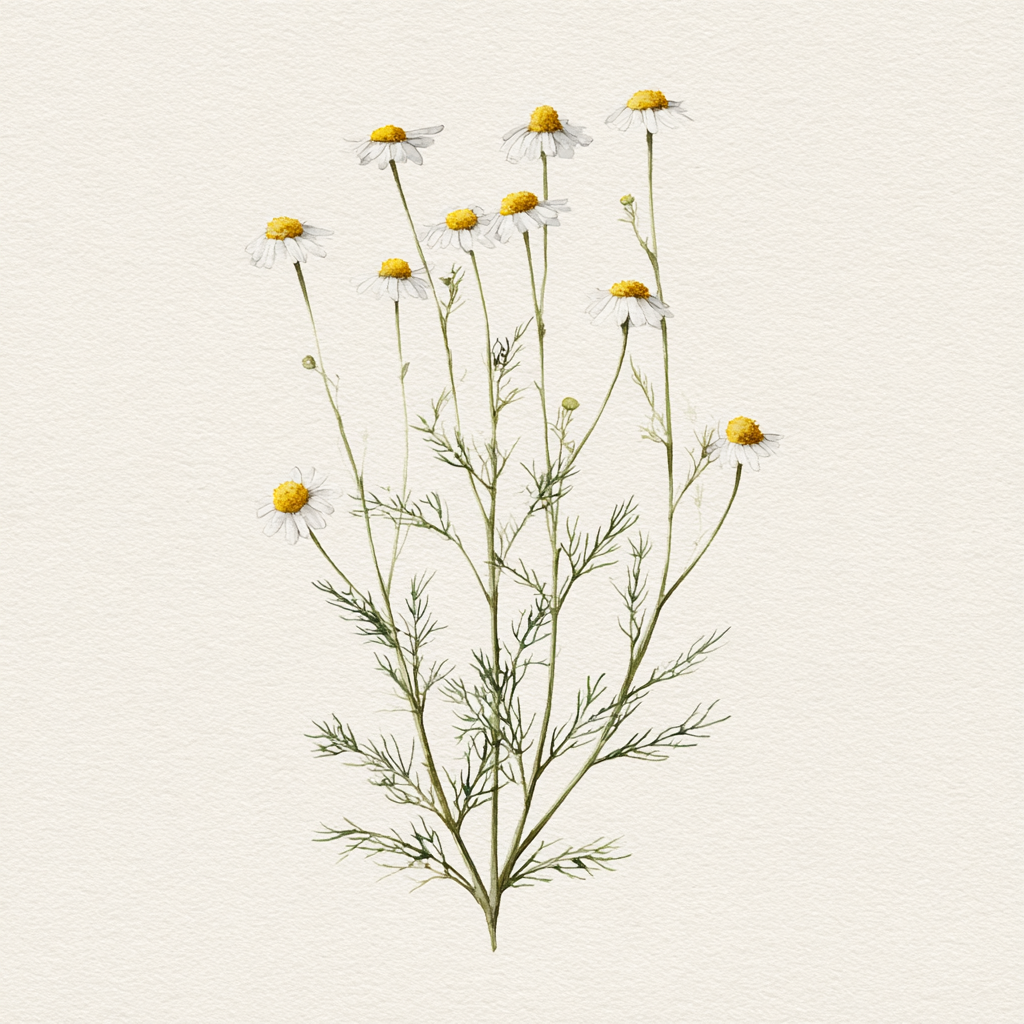
Slender branching stems that stay delicate and become airy as flowers form.
Leaves
Finely divided, feathery leaves with a soft green color and aromatic scent.
Flowers
Small daisy-like heads with white rays around a yellow cone; German chamomile has a hollow raised receptacle when split.
Fruit
Tiny dry achenes that shake free from mature flower heads and self-sow readily.
Natural History
Natural History
Matricaria chamomilla originated in southern and central Europe and parts of western Asia, growing as an annual weed of disturbed ground, roadsides, and fallow fields. Its name derives from the Greek chamaimelon - ground apple - a reference to the apple-like scent of the fresh foliage, which was already well known in classical antiquity. The plant spread across northern Europe during the medieval period alongside agriculture and became one of the most universally kept cottage herbs. Its essential oil contains the compound chamazulene, which forms only during steam distillation and gives quality chamomile extracts their characteristic deep blue color. The plant flowers best and self-sows most reliably on lightly disturbed, low-fertility soils where competition from larger plants is reduced - an ecology that tracks the disturbed edges of settled land across its entire native range.
Traditional Use
Traditional Use
Chamomile has one of the longest documentary records of any European household herb, appearing in Egyptian medical papyri, classical Greek and Roman texts, and the herbals of Gerard and Culpeper. Its reputation was built primarily on the dried flower heads and the aromatic tea prepared from them.
Parts Noted Historically
Ancient and Classical Use - Flower heads
Chamomile appears in Egyptian medical papyri and was described by Dioscorides in the first century CE as a remedy for fevers and urinary complaints. Its Greek name - ground apple - points to the esteem in which its fragrance was held in the ancient Mediterranean world, where it was also used as a strewing herb and cosmetic plant.
Medieval Monastic Herbalism - Flower heads
Chamomile was among the nine sacred herbs listed in Anglo-Saxon texts, and it appeared consistently in German, Dutch, and English herbals from the 13th through 16th centuries. John Gerard's 1597 Herball described it as comforting to the brain, while Culpeper associated it with the sun and called it one of the most comfortable plants in the garden.
Household Tea Culture - Flower heads
By the 18th and 19th centuries, dried chamomile flowers had become one of the most commonly kept household teas in England, Germany, and the Netherlands. The cultural familiarity of chamomile tea is captured precisely in Beatrix Potter's 1902 Peter Rabbit, where Mrs. Rabbit sends her injured son to bed with chamomile tea - a reference her readers would have immediately recognized as ordinary domestic medicine.
German Commercial and Pharmacopeial Tradition - Flower heads
Germany became the center of commercial chamomile cultivation and phytochemical research. The term German chamomile distinguishes Matricaria chamomilla from Roman chamomile (Chamaemelum nobile), favored in England and France. German pharmacopeias have listed chamomile flower preparations continuously from the early modern period, and Germany remains the largest producer and consumer of pharmaceutical-grade chamomile.
Chamomile belongs to the Asteraceae family; people with documented ragweed or chrysanthemum allergies may experience cross-reactions.
This information is provided for historical and educational purposes only and is not medical advice. Always consult a qualified healthcare professional before making decisions related to your health.
Loading photo submission…