Apple
FruitMalus domestica
Have seeds for this? Add to inventory →Apple trees are the cornerstone of temperate fruit gardens, offering hundreds of varieties with different flavours, textures, and seasons. Most require cross-pollination with a compatible variety and take 3 - 5 years to begin bearing significantly.
Growing Conditions
Growing Conditions
Sunlight
Full Sun
Water Needs
Moderate
Soil
Deep, well-draining, fertile loam; pH 6.0 - 7.0
Spacing
10 - 20 feet (standard); 8 - 12 feet (semi-dwarf)
Days to Maturity
3 - 5 years for first significant harvest depending on rootstock and variety
Growing Zones
Growing Zones
Thrives in USDA Zones 3 - 9
When to Plant
When to Plant
Transplant
Bare-root trees in late autumn to early spring while dormant
Harvest
Fruit lifts with a gentle twist when ripe; season varies by variety
Phenology (Natural Timing Cues)
Transplant
Plant grafted apple trees while fully dormant - either in early spring before bud break or in autumn after leaf drop. Both windows allow roots to settle before the tree has to support active top growth.
- Forsythia is beginning to bloom (spring planting).
- Deciduous trees are showing bud swell but have not leafed out (spring planting).
- Soil is workable and draining well between rains.
- Deciduous trees are at peak colour or beginning to drop leaves (autumn planting).
- Ground is not yet frozen and several frost-free weeks remain (autumn planting).
Start Dates (Your Location)
Average dates use your saved zone; readiness also checks your forecast when available.
Best Planting Window
Spring window
Late winter to early spring
Plant while dormant, before buds break and before active top growth begins.
Autumn window
Late autumn after leaf drop
Plant while dormant, after leaves have dropped and before the ground freezes.
Planting Method
Plant a grafted bare-root nursery tree. Seed-grown fruit trees are not true-to-type, so nursery stock is the reliable path to known fruit quality.
Critical Timing Note
Plant while dormant and before bud break so roots establish before leaves demand water.
Use the average timing, but check your local forecast before planting.
Typical Harvest Window
September to October
Organic Growing Tips
Organic Growing Tips
Hang pheromone traps to monitor and disrupt codling moth mating, reducing fruit damage significantly.
Plant a guild of comfrey, chives, and yarrow beneath each tree to build soil health and attract beneficials.
Apply kaolin clay spray in spring to form a physical barrier against apple sawfly and codling moth.
Prune for an open, goblet shape to maximise airflow and sunlight penetration to reduce disease.
Care Guidance
Optional seasonal guidance for what you can do, even when nothing is urgent.
Care Guidance
Watering
If the top 2 inches of soil feel dry, a deep watering at the base may help more than frequent light watering. In healthy soil, rain may cover much of what it needs.
Feeding
Extra feeding is rarely required if soil is healthy. If growth looks pale or slow, a light compost top-dressing is often enough before adding anything stronger.
Pruning
If pruning is needed, dormancy or the period just after harvest is often the simplest window. Dead, damaged, or crossing growth is usually the first place to start.
Seasonal care
In late fall, a light cleanup and fresh mulch can help if winter protection is useful in your climate. Leaving a little space around crowns and trunks often helps air move and keeps excess moisture from sitting there.
Pollination & Fruit Production
Pollination & Fruit Production
The pollination helper includes compatibility guidance for apple.
Need a compatible partner? Open the Fruit Tree Planner.Known Varieties
Common cultivars worth knowing
Known Varieties
- Honeycrisp
Modern crisp apple with explosive texture and balanced sweetness.
Best for
fresh eating
- Granny Smith
Tart green apple with firm flesh and strong storage quality.
Best for
baking, storage
- Gala
Sweet early apple with broad availability and reliable production.
Best for
fresh eating
- Cox's Orange Pippin
Classic English dessert apple with complex aromatic flavor.
Best for
heritage flavor
- Liberty
Disease-resistant apple with good flavor and scab resistance.
Best for
organic orchards
- Arkansas Black
Very firm dark red heirloom that improves in storage.
Best for
long storage
Companion Planting
Companion Planting
Good companions
Support & insectary plants
Nearby plants that attract pollinators, beneficial insects, or improve soil health.
- Comfrey
Attracts beneficial insects and produces nutrient-rich mulch
- Marigold
Suppresses soil nematodes; trap crop for aphids and whiteflies
- Nasturtium
Trap crop for aphids; attracts beneficial insects
- Lavender
Attracts pollinators and beneficial insects
- Chamomile
Attracts beneficial insects and produces nutrient-rich mulch
- Borage
Attracts beneficial insects and produces nutrient-rich mulch
- Yarrow
Attracts beneficial insects and produces nutrient-rich mulch
- Calendula
Trap crop for aphids; attracts predatory insects
Avoid planting near
No known conflicts
Common Pests
Common Pests
- Codling Moth
- Apple Scab
- Aphids
- Woolly Aphid
- Fire Blight
- Sawfly
All pest management in Garden uses safe, organic, non-toxic methods only. No synthetic pesticides, ever.
Simple Ways to Use
Simple Ways to Use
Start here if you're not sure how to use this crop in the kitchen.
Quick recipes you can make right away
Skillet Apples
Slice apples 1/4 inch thick and cook them in butter with cinnamon and a spoonful of sugar for 8 to 10 minutes, stirring once or twice, until the slices are soft at the edges but still hold their shape. Serve them while warm over oatmeal, pancakes, or yogurt.
Small-Batch Applesauce
Chop apples into a pot with 1/2 cup water for every 2 pounds of fruit, cover, and simmer 20 to 30 minutes until the pieces crush easily with the back of a spoon. Mash for chunky sauce or blend for smooth sauce, then add cinnamon or lemon only after you taste it.
Baked Apple Halves
Halve and core firm apples, place them cut side up in a baking dish with a little butter and cinnamon, and bake at 375°F for 25 to 35 minutes until a knife slides in easily. Spoon the juices from the pan over the apples before serving.
How to Preserve
How to Preserve
Use this section to store or process extra harvest before it spoils.
Practical methods for extra harvest
Freeze apple slices
Peel and slice apples, dip them for 2 minutes in water with lemon juice to slow browning, then freeze them in a single layer on a tray until hard. Bag them once frozen solid and use them straight from the freezer for pie, crisp, or sauce.
Can applesauce
Cook apples down into hot sauce, fill clean hot jars leaving the headspace called for in a tested recipe, and water-bath can them for the full tested time for your jar size and altitude. Use a tested applesauce recipe and never guess on timing because acid, jar size, and altitude all affect safety.
Dry apple rings
Slice apples evenly, dry them at 135°F until the rings are leathery and no beads of moisture appear when you tear one open, then cool them fully before jarring. Shake the jar once a day for 1 week, and if you see condensation, dry the apples longer before storing them again.
How to Store
How to Store
Simple storage tips
Store sound, unbruised apples in the refrigerator or another cold spot just above freezing for the longest life.
Keep them in a perforated bag or drawer so they stay humid but do not trap puddled moisture.
Use bruised, cut, or wormy apples first because damaged fruit spoils much faster than clean fruit.
Do not store apples beside greens, cucumbers, or broccoli for long because apples release ethylene that speeds yellowing and softening.
Check stored apples every few days and remove any that are soft, leaking, or smell fermented.
How to Save Seed
How to Save Seed
Step-by-step seed saving
- 1
Saved apple seed will not grow into the same named apple you picked, so this is for experimentation, not for keeping Honeycrisp or another cultivar true.
- 2
Rinse mature brown seeds from a ripe apple and let them dry on a plate for 1 day so surface moisture is gone but the seed is not baked hard.
- 3
Mix the seeds into barely damp sand or a damp paper towel, refrigerate them for 6 to 10 weeks, and check that they stay moist but never slimy.
- 4
Plant them when a few seeds crack or sprout, and label the seedlings clearly because each one will be a new, different apple.
Native Range
Native Range
- Origin
- Domestic apple is a cultivated complex strongly associated with Central Asian Malus sieversii ancestry.
- Native Habitat
- Wild apple relatives grow in montane forests, woodland edges, and foothill habitats of Central Asia.
- Current Distribution
- Cultivated globally; does not occur as a native plant in this form.
Taxonomy
Taxonomy
- Kingdom
- Plantae
- Family
- Rose family (Rosaceae)
- Genus
- Malus
- Species
- Malus domestica
Morphology
Morphology
Root System
Woody root system usually controlled by grafted rootstock, which determines tree size, anchorage, and soil tolerance.
Stem
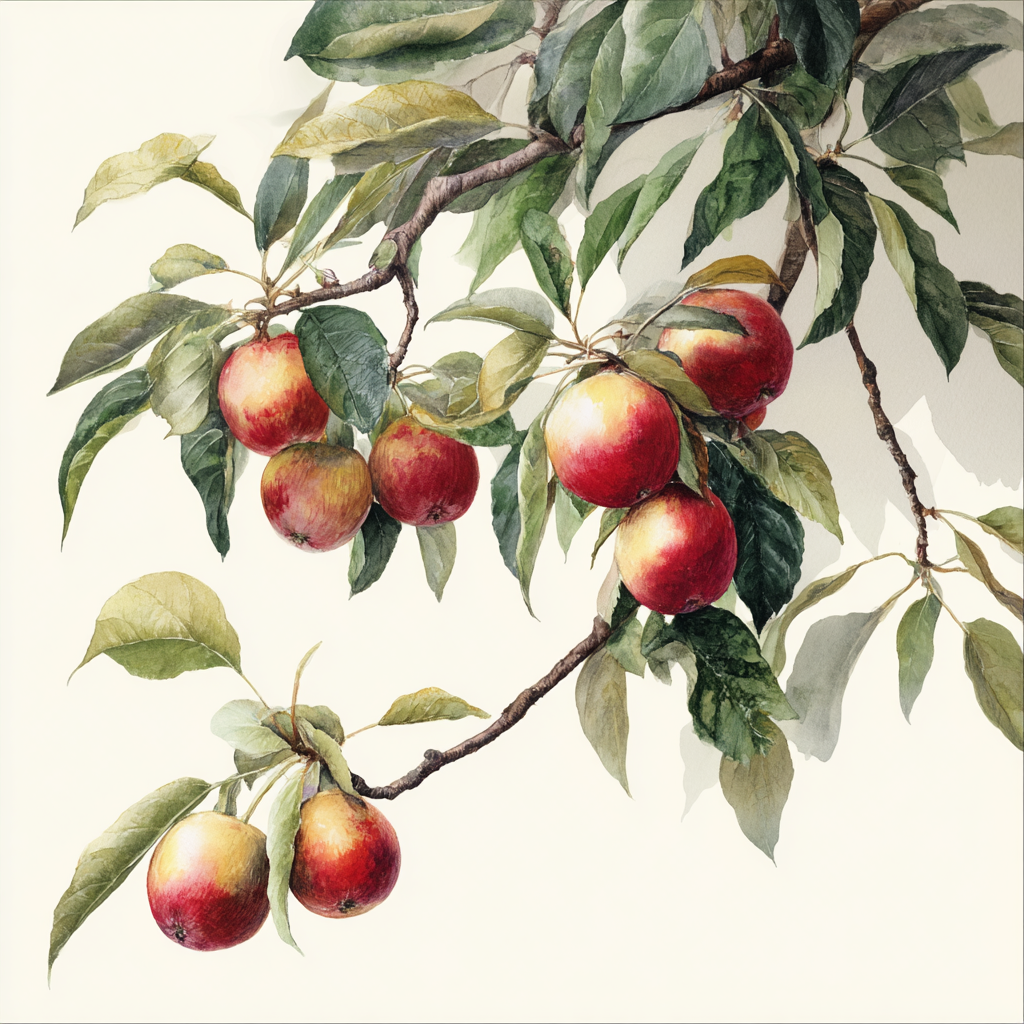
Deciduous tree with a graft union near the base and scaffold branches trained for light and airflow. Fruiting often occurs on spurs and short shoots.
Leaves
Oval toothed leaves with a slightly fuzzy underside on many varieties. Leaves emerge after flower buds swell in spring.
Flowers
Pink buds open to white or pale pink five-petaled blossoms in clusters. Cross-pollination is needed for many varieties.
Fruit
Pome fruit with a papery core and seeds, ripening from midsummer to late fall depending on cultivar. Skin color, russeting, size, and flavor vary widely.
Natural History
Natural History
The domestic apple descends primarily from Malus sieversii, a wild species still found in the ancient fruit forests of the Tian Shan mountains in Kazakhstan. As it traveled westward along Silk Road trade routes, it crossed with European crabapples and was gradually refined by Greek, Roman, and medieval orchardists into the cultivated forms we know today. By the 18th and 19th centuries, British and French pomologists had named thousands of distinct varieties - a diversity built on the apple's extraordinary genetic variability. That same variability is why seed-grown apples almost never reproduce the parent faithfully, making grafting the foundation of orchard culture for over two millennia. Today more than 7,500 named cultivars exist, with ongoing heritage apple revivals recovering varieties that came close to extinction in the 20th century.
Traditional Use
Traditional Use
Apple's traditional story is primarily one of food, drink, and orchard culture rather than medicine. Its most historically significant use outside fresh eating was fermentation: cider was the common drink across much of rural Britain and northern France for centuries before reliable water supplies made other options viable. Alongside this runs a rich tradition of storage, preserving, and ritual that traces back through medieval Europe to the apple's origins in Central Asia.
Parts Noted Historically
Central Asian Origin Traditions - Fruit
In Kazakhstan and Kyrgyzstan, where wild Malus sieversii forests still grow, the apple has deep cultural significance. Almaty - the region's largest city - takes its name from the Kazakh word for apple (alma). Wild apple gathering and local cultivation predate written record in the region.
British and Norman Cider Traditions - Fermented fruit
Across Somerset, Herefordshire, and Normandy, cider was the staple drink of rural life from the medieval period through the 19th century. Hundreds of cider-specific varieties were developed - many bittersweet or bittersharp - entirely unsuited for fresh eating but essential for producing complex, long-keeping cider. Calvados (French apple brandy) and English farmhouse cider represent the peak of this tradition.
European Orchard and Storage Traditions - Fruit and peel
Before refrigeration, keeping varieties such as Bramley, Roxbury Russet, and Newtown Pippin were grown specifically for long cellar storage. Apples were dried, pressed to vinegar, made into preserves and butters, and stored in straw in root cellars through winter. Apple cider vinegar was a common household remedy across European and American folk traditions.
Orchard Wassailing - Fruit and tree
In southern England, wassailing ceremonies on Twelfth Night involved singing to apple trees, pouring cider on the roots, and placing toast in branches to encourage a good harvest. The practice is documented from at least the 16th century and continues in revival form today in traditional cider-producing regions.
Apple fruit and peel are food-history contexts with no safety concern. Apple seeds contain amygdalin, a compound that can release small amounts of hydrogen cyanide when metabolised; they should not be eaten in quantity or used as any form of food or remedy.
This information is provided for historical and educational purposes only and is not medical advice. Always consult a qualified healthcare professional before making decisions related to your health.
Related Articles
Related Articles
Fertility Strategy by Plant Type
Soil & Compost • 9 min read
Grafting Fruit Trees: Techniques, Biology, and Practical Method
Fruit Trees • 16 min read
Fruit Tree Pollination: The Science and How to Plan for Better Yields
Fruit Trees • 17 min read
Pruning Fruit Trees: Techniques, Timing, and the Biology Behind the Cut
Fruit Trees • 18 min read
Fruit Tree Husbandry: A Complete Care Guide
Fruit Trees • 14 min read
Dehydrating Food: How to Dry Fruits, Vegetables, and Herbs
Harvesting & Storage • 6 min read
Loading photo submission…