Chives
HerbAllium schoenoprasum
Have seeds for this? Add to inventory →Chives are one of the most versatile companion herbs, deterring aphids, carrot fly, and Japanese beetle while attracting pollinators with their pretty purple flowers. They are among the first herbs to emerge in spring and are extremely easy to grow.
Growing Conditions
Growing Conditions
Sunlight
Full Sun
Water Needs
Moderate
Soil
Well-draining loam; pH 6.0 - 7.0
Spacing
6 - 12 inches
Days to Maturity
First harvest from year 1; established clumps can be harvested repeatedly
Growing Zones
Growing Zones
Thrives in USDA Zones 3 - 10
When to Plant
When to Plant
Transplant
Spring or autumn from divisions
Direct Sow
2 - 4 weeks before last frost
Harvest
Cut leaves 2 inches from base; plant regrows within 2 - 3 weeks
Phenology (Natural Timing Cues)
Direct Sow
Sow chives early in spring - they tolerate cool soil and grow slowly at first, so an early start pays off.
- Soil is workable in very early spring.
- Forsythia is beginning to bloom.
- Early bulbs like crocuses and snowdrops are flowering.
Transplant
Plant chive divisions in early spring as soon as soil is workable, or in autumn before the ground cools too deeply. Divisions establish quickly in either window.
- Early dandelions are beginning to bloom (spring planting).
- Soil is workable and draining well.
- Summer heat has eased and nights are reliably cooler (autumn planting).
- Several weeks of settling weather remain before first hard frost (autumn planting).
Start Dates (Your Location)
Average dates use your saved zone; readiness also checks your forecast when available.
Best Planting Window
Spring window
Spring
Plant early enough for roots to settle before summer heat.
Autumn window
Early autumn
Plant early enough for roots to grow before winter; avoid late planting into cold, wet soil.
Planting Method
Plant divisions from a healthy parent plant. Divisions preserve the established plant’s traits better than seed.
Critical Timing Note
Keep divisions watered through establishment and protect them from harsh sun until new growth resumes.
Use the average timing, but check your local forecast before planting.
Typical Harvest Window
April to September
Organic Growing Tips
Organic Growing Tips
Plant chives under apple trees to deter aphids from colonising new growth in spring.
Allow flowers to open - they are highly attractive to bees and edible as a garnish.
Divide clumps every 3 years to reinvigorate plants; replant divisions in compost-enriched soil.
A ring of chives planted around carrot beds creates an aromatic barrier against carrot fly.
Care Guidance
Optional seasonal guidance for what you can do, even when nothing is urgent.
Care Guidance
Watering
If the top 2 inches of soil feel dry, a deep watering at the base may help more than frequent light watering. In healthy soil, rain may cover much of what it needs.
Feeding
Extra feeding is rarely required if soil is healthy. If growth looks pale or slow, a light compost top-dressing is often enough before adding anything stronger.
Seasonal care
In late fall, a light cleanup and fresh mulch can help if winter protection is useful in your climate. Leaving a little space around crowns and trunks often helps air move and keeps excess moisture from sitting there.
Harvest timing
Harvests often cluster around April to September. If fruit, leaves, or roots start looking ready, color, size, firmness, and scent usually tell you more than the calendar alone.
Known Varieties
Common cultivars worth knowing
Known Varieties
Common Chives
Standard onion-flavored chives with purple flowers.
Best for
general garden use
Garlic Chives
Related Allium with flat leaves, white flowers, and garlic flavor.
Best for
stir-fries, late flowers
Fine Leaf
Selection with slender tender leaves.
Best for
fresh garnish
Staro
Thick-leaved chive variety with vigorous clumps.
Best for
heavy harvests
Nelly
Uniform chive selection with upright growth.
Best for
containers, bunching
Companion Planting
Companion Planting
Avoid planting near
Common Pests
Common Pests
All pest management in Garden uses safe, organic, non-toxic methods only. No synthetic pesticides, ever.
Simple Ways to Use
Simple Ways to Use
Start here if you're not sure how to use this crop in the kitchen.
Quick recipes you can make right away
Fresh Chive Garnish
Snip chives into short pieces with scissors and scatter them over eggs, potatoes, soup, or soft cheese just before serving. Add them at the end so the flavor stays fresh and oniony instead of fading in the heat.
Chive Butter
Stir 1 to 2 tablespoons of snipped chives into 4 tablespoons of soft butter with a small pinch of salt, then chill it 10 to 15 minutes until firm enough to spread. Use it on toast, potatoes, or steamed vegetables.
Simple Chive Yogurt Sauce
Mix snipped chives into plain yogurt or sour cream with a pinch of salt and a squeeze of lemon, then let it sit 10 minutes before serving. Spoon it over baked potatoes, cucumbers, or roasted carrots.
How to Preserve
How to Preserve
Use this section to store or process extra harvest before it spoils.
Practical methods for extra harvest
Air dry chives
Spread snipped chives in a thin layer on a screen or towel in a warm airy place out of direct sun, then dry them for about 3 to 7 days. They are fully dry when the pieces feel crisp and crumbly with no cool damp spots left in the pile.
Freeze snipped chives
Snip clean dry chives into short pieces and freeze them flat in a small bag or container so you can shake out only what you need. Use them straight from frozen in eggs, potatoes, or soups, because thawed chives turn limp quickly.
Make chive vinegar
Pack a jar loosely with fully dried chopped chives or dried blossoms, cover them completely with vinegar, and steep for 1 to 2 weeks out of direct sun. Strain when the vinegar smells mildly oniony and fresh, then use it in salad dressing or potato salad.
New to preserving food?
New to freezing? Read the freezing guide.New to dehydrating? Read the dehydrating guide.How to Store
How to Store
Simple storage tips
Wrap fresh chives loosely in a barely damp towel or paper towel and keep them in the refrigerator in a bag or covered container.
Use fresh chives within about 5 to 7 days, before the blades yellow, flatten, or develop slimy spots.
Do not wash chives before storage unless needed, because trapped moisture shortens their fresh life.
Store dried chives in an airtight jar away from heat and light, and expect the best flavor within about 6 months.
Freeze extra chives promptly if you will not use them soon, because they lose flavor faster than woody herbs.
How to Save Seed
How to Save Seed
Step-by-step seed saving
- 1
Let some flower heads stay on the clump until they turn dry and papery on the plant.
- 2
Cut the dry heads into a paper bag and crumble or shake them gently to release the small black seeds.
- 3
Store the seeds only when fully dry in a cool dry place, and label them because chive seed is small and easy to confuse with other alliums.
- 4
If you want more of the same chives quickly, divide a crowded clump and replant it, because chives are also easy to keep by division.
Native Range
Native Range
- Origin
- Circumboreal distribution across the cool Northern Hemisphere, including Eurasia and northern or montane regions of North America
- Native Habitat
- Cool moist meadows, river and lake margins, damp ledges, floodplains, and open rocky ground in temperate and subarctic regions
- Current Distribution
- Naturally occurring across cool Northern Hemisphere regions and widely cultivated as a culinary herb worldwide, with some naturalized populations in suitable climates.
Taxonomy
Taxonomy
- Kingdom
- Plantae
- Family
- Onion family (Amaryllidaceae)
- Genus
- Allium
- Species
- Allium schoenoprasum
Morphology
Morphology
Root System
Dense clumps of small bulbs with fibrous roots. Clumps expand gradually and benefit from division every few years.
Stem
Leaves arise from bulb bases; flowering stems are round, hollow, and slightly tougher than leaf blades.
Leaves
Thin hollow cylindrical leaves with mild onion scent. Leaves regrow from the base after cutting.
Flowers
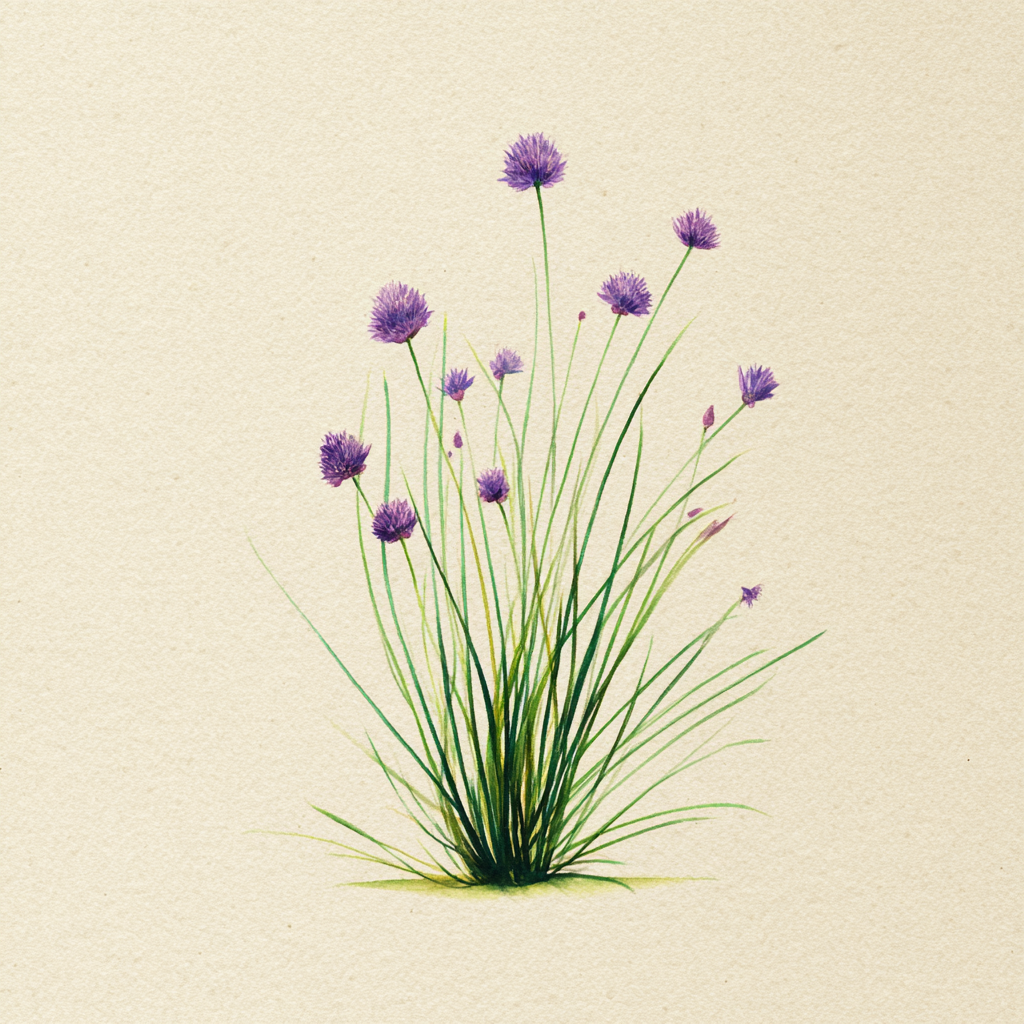
Round purple-pink flower heads made of many small starry allium flowers. Blooms are edible and very attractive to bees.
Fruit
Produces small black allium seeds in capsules after flowering, though clump division is the easiest propagation method.
Natural History
Natural History
Allium schoenoprasum grows wild across a remarkably wide range - from Scandinavia and the British Isles across Europe and temperate Asia to Siberia, and natively in parts of North America - making it one of the few alliums with both an Old World and New World native distribution. The species name comes from Greek, meaning rush-leek, describing the hollow grass-like leaves that distinguish chives from other alliums. Chives entered European cultivation so early that they are difficult to trace as a crop introduction; they were listed in the Capitulare de Villis of 812 CE, Charlemagne's edict specifying the plants required in royal estates, alongside around 70 other herbs and vegetables. They are among the hardiest cultivated alliums, reliably dying back and re-emerging after hard winters, and their lavender-pink flower heads have made them valued in both kitchen and ornamental gardens since at least the Renaissance.
Traditional Use
Traditional Use
Chives have occupied a quiet but continuous place in European culinary tradition since at least the Carolingian period - not the dramatic medicinal garlic, not the prestigious onion of trade, but the daily herb of cottage plots, monastery gardens, and kitchen beds, grown for continuous leaf harvest across the growing season.
Parts Noted Historically
Charlemagne's Royal Gardens - Leaves
Chives appear in the Capitulare de Villis - Charlemagne's edict of 812 CE listing plants required in the royal estates of the Frankish Empire. This document is one of the earliest systematic records of European garden management, and chives' presence confirms they were already considered an essential kitchen herb at the highest level of medieval society.
Medieval Cottage and Monastery Cultivation - Leaves
In medieval England, France, and the Low Countries, chives were grown in both monastery physic gardens and household plots as a mild culinary allium. They required less maintenance than onions, could be cut repeatedly without lifting, and their early spring emergence made them useful when little else was available. John Parkinson's 1629 Paradisi in Sole Paradisus Terrestris described their English garden cultivation with clear familiarity.
French Fines Herbes Tradition - Leaves
Chives became essential in the classical French kitchen as one of the fines herbes - alongside tarragon, chervil, and parsley - forming the foundation of French cold sauces, omelettes, and herb butters by the 17th century. Their role was the allium of refinement: present where raw garlic or onion would be too assertive, valued for the clean sharp note they added to delicate dishes.
Kitchen Garden Flower Use - Flowers
The perennial chive clump became a fixture of European and North American kitchen gardens by the 18th and 19th centuries. The round lavender flower heads were noted as strong bee attractors useful near fruit trees, and their use as edible garnishes was well established in European household cooking. The flowers were commonly added to butter, vinegar, and salads wherever fresh onion flavor was wanted without the bulk of a cut bulb.
This information is provided for historical and educational purposes only and is not medical advice. Always consult a qualified healthcare professional before making decisions related to your health.
Loading photo submission…