Parsley
HerbPetroselinum crispum
Have seeds for this? Add to inventory →Parsley is a slow-to-germinate biennial herb that flowers in its second year, producing nectar-rich umbels that attract parasitic wasps, hoverflies, and other beneficial predatory insects. It is a valuable companion for tomatoes and asparagus.
Growing Conditions
Growing Conditions
Sunlight
Partial Shade
Water Needs
Moderate
Soil
Rich, moist, well-draining loam; pH 6.0 - 7.0
Spacing
8 - 12 inches
Days to Maturity
70 - 90 days from sowing to first harvest
Growing Zones
Growing Zones
Thrives in USDA Zones 3 - 10
When to Plant
When to Plant
Start Indoors
10 - 12 weeks before last frost
Direct Sow
4 - 6 weeks before last frost; soak seeds overnight to speed germination
Harvest
Harvest outer stems from the base; plants continue producing all season
Phenology (Natural Timing Cues)
Start Indoors
Parsley is one of the slowest-germinating common herbs - seed can take 3 to 6 weeks to sprout even in good conditions, and seedlings grow slowly afterward. Starting 10 - 12 weeks before last frost accounts for both the long germination period and the measured early growth, so plants are a useful size by transplanting time. Soaking seed overnight before sowing reliably speeds germination. Do not give up on a tray that has not sprouted after two weeks - parsley is often still coming.
- Trees are still bare with no visible bud movement.
- Forsythia has not started blooming.
- Early dandelions are not yet in bloom.
- The last expected frost date is 10 - 12 weeks away.
Direct Sow
Direct sow parsley into cool, consistently moist soil. The key challenge is keeping the seed row from drying out during the 3 to 6 week germination period - far longer than most vegetables. Soak seed overnight before sowing to soften the seed coat. Mark the row clearly and do not disturb it; parsley is often assumed to have failed before it has actually germinated. A light topdressing of fine compost helps retain the surface moisture that germination requires.
- Forsythia is beginning to bloom.
- Soil is workable, cool, and holds moisture between waterings.
- A mild, damp stretch of weather is in the forecast - not dry or windy conditions.
- No hard frosts remain in the forecast.
Start Dates (Your Location)
Average dates use your saved zone; readiness also checks your forecast when available.
Average Last Frost
Set your growing zone to see personalized calendar dates.
Use the average timing, but check your local forecast before planting.
Organic Growing Tips
Organic Growing Tips
Soak seeds in warm water for 24 hours before sowing to soften the hard seed coat and speed germination.
Leave second-year plants to flower - they become powerful beneficial insect attractors.
Grow in rich, compost-amended soil and mulch around plants to retain moisture — parsley is slow to establish and rewards good soil preparation with strong, productive growth throughout a long season.
Black swallowtail caterpillars eat parsley; leave a few plants for them as a contribution to butterfly populations.
Care Guidance
Optional seasonal guidance for what you can do, even when nothing is urgent.
Care Guidance
Watering
If the top 2 inches of soil feel dry, a deep watering at the base may help more than frequent light watering. In healthy soil, rain may cover much of what it needs.
Feeding
Extra feeding is rarely required if soil is healthy. If growth looks pale or slow, a light compost top-dressing is often enough before adding anything stronger.
Seasonal care
During the main season, harvesting when the crop is ready and removing damaged growth can help keep the planting productive if it starts to look crowded or tired.
Known Varieties
Common cultivars worth knowing
Known Varieties
Giant of Italy
Large flat-leaf parsley with strong flavor and vigorous growth.
Best for
cooking, fresh harvests
Italian Flat Leaf
Classic flat parsley with clean flavor and easy chopping.
Best for
kitchen use
Moss Curled
Dense curly parsley with decorative texture.
Best for
garnishes, edging
Hamburg Rooted
Parsley grown for a pale edible root as well as leaves.
Best for
roots, soups
Forest Green
Curly type with dark leaves and upright growth.
Best for
containers, garnish
Companion Planting
Companion Planting
Common Pests
Common Pests
All pest management in Garden uses safe, organic, non-toxic methods only. No synthetic pesticides, ever.
Simple Ways to Use
Simple Ways to Use
Start here if you're not sure how to use this crop in the kitchen.
Quick recipes you can make right away
Fresh Parsley Garnish
Rinse and dry the leaves well, chop them just before serving, and scatter them over eggs, potatoes, soup, or beans while the food is still hot. Use the parsley right away so the cut edges stay bright instead of bruised and damp.
Parsley Herb Butter
Mash 2 tablespoons of finely chopped parsley into 4 tablespoons of soft butter with a pinch of salt, then chill it 10 to 15 minutes until it is firm enough to spread. Use it on toast, cooked vegetables, or baked potatoes while the butter still smells fresh and green.
Simple Parsley Sauce
Finely chop about 1 cup of parsley and stir it with 2 tablespoons of olive oil, 1 tablespoon of lemon juice or vinegar, a small grated garlic clove, and a pinch of salt. Let it sit 5 minutes so the leaves soften slightly, then spoon it over beans, fish, or roasted vegetables.
How to Preserve
How to Preserve
Use this section to store or process extra harvest before it spoils.
Practical methods for extra harvest
Air dry parsley
Tie small bunches or spread clean dry leaves in a single layer in a warm airy spot out of direct sun, then let them dry for about 5 to 7 days. The parsley is fully dry when the leaves crumble easily and the thinnest stems snap instead of bend.
Freeze chopped parsley
Wash and dry the parsley thoroughly, chop the leaves and tender stems, then freeze them flat in a small bag or in ice-cube trays with a spoonful of water. Use the frozen parsley straight from the freezer in soups, sauces, or eggs, because it will be too soft for a fresh garnish after thawing.
New to preserving food?
New to freezing? Read the freezing guide.New to dehydrating? Read the dehydrating guide.How to Store
How to Store
Simple storage tips
Stand fresh parsley stems in a jar with about 1 inch of water, loosely cover the leaves, and keep the jar in the refrigerator.
Change the water every 1 to 2 days, and trim the stem ends if they start to look dark or slimy.
Use fresh parsley within about 5 to 7 days, before the leaves yellow, droop, or smell stale.
Store dried parsley in an airtight jar in a dark cool cupboard, and expect the best flavor within about 6 months.
Wash parsley only before using if it is already clean, because extra moisture shortens fresh storage life.
How to Save Seed
How to Save Seed
Step-by-step seed saving
- 1
Parsley usually makes seed in its second year, so leave a healthy plant to overwinter or replant a strong root in spring if winters are too hard.
- 2
Let the flower heads dry on the plant until they turn tan to brown and the seeds rub loose easily between your fingers.
- 3
Cut the dry heads into a paper bag and let them finish drying under cover for about 1 week if the weather is still damp.
- 4
Store the cleaned seeds only when they feel hard and fully dry, then keep them in a cool dry place.
Native Range
Native Range
- Origin
- Parsley is native to the Mediterranean region, especially rocky and coastal habitats of southern Europe and nearby western Asia.
- Native Habitat
- Rocky slopes, walls, coastal ground, disturbed soils, and seasonally moist Mediterranean sites.
- Current Distribution
- Widely cultivated in suitable growing regions worldwide; not native outside its region of origin.
Taxonomy
Taxonomy
- Kingdom
- Plantae
- Family
- Carrot family (Apiaceae)
- Genus
- Petroselinum
- Species
- Petroselinum crispum
Morphology
Morphology
Root System
Long pale taproot with fine feeder roots. Root parsley types form larger edible roots, while leaf parsley still dislikes rough transplanting.
Stem
Low crown in the first year, then tall ribbed flowering stems in the second year. Harvest outer stems from the base to keep plants productive.
Leaves
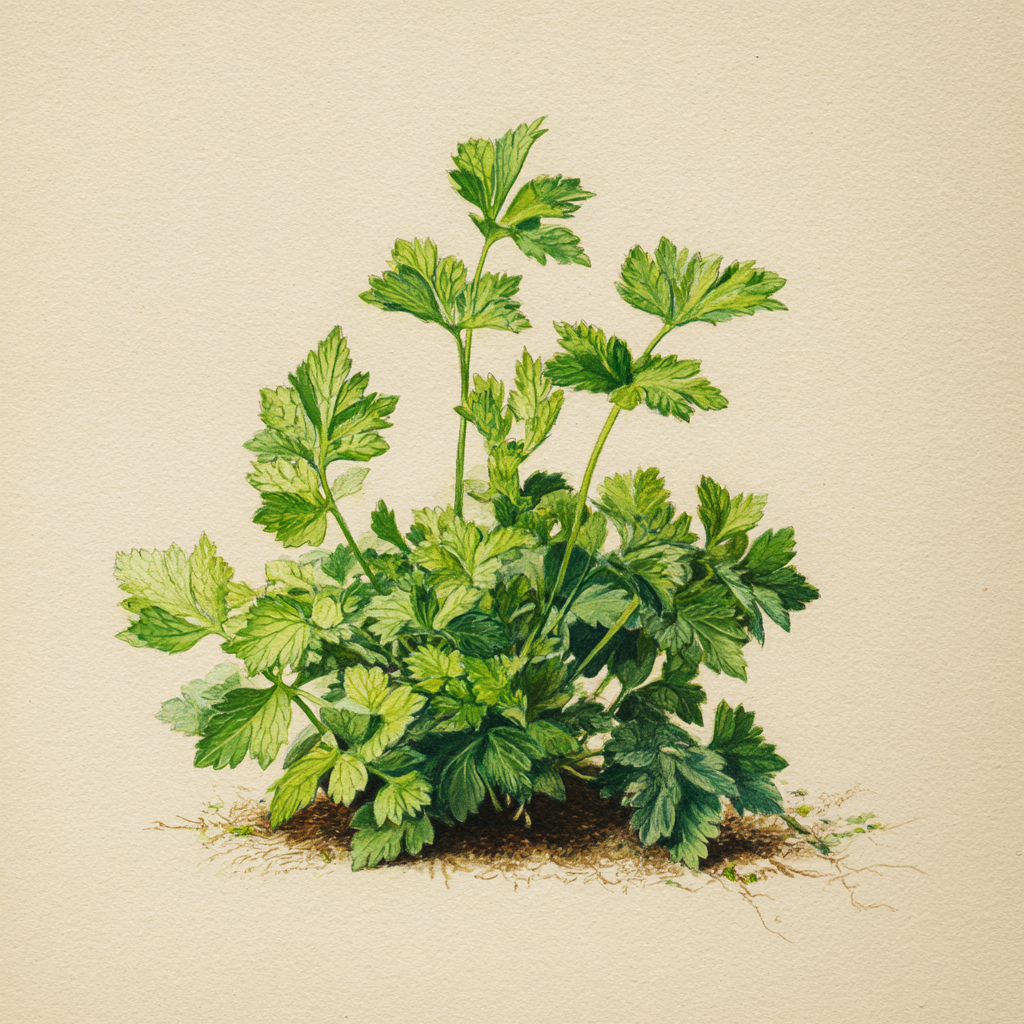
Bright green divided leaves, either curly or flat, with a fresh grassy aroma. Flat-leaf types are easier to clean and often stronger flavored.
Flowers
Second-year plants produce greenish-yellow umbels that attract small wasps, hoverflies, and other beneficial insects.
Fruit
Small ribbed seeds mature in umbels after flowering. The usual harvested crop is the leaf stem and leaflet cluster.
Natural History
Natural History
The scientific name Petroselinum crispum derives from the Greek petra (rock) and selinon (celery) - rock celery - reflecting the plant's preference for stony, well-drained sites in its Mediterranean homeland. The Greeks called it selinon petroselinum to distinguish it from celery, which was simply selinon. Among the Greeks, parsley carried a strong association with death and the underworld: it was used to make garlands for the dead and to decorate tombs, and the Greek idiom "to be in need of parsley" (deithai selinon) meant to be at death's door. Parsley was also associated with the hero Archemorus, whose name means "forerunner of death." The Romans took a more practical view, adopting parsley enthusiastically as a culinary herb and cultivating it widely, and Pliny the Elder wrote admiringly of its flavour in the 1st century CE. The reversal from funeral herb to kitchen staple was complete by the early medieval period, when parsley appears in Charlemagne's Capitulare de Villis of around 812 CE as a plant required on all imperial estates. The curly-leaf form now dominant in British and American kitchens was developed over centuries of selection from naturally flat-leaved wild types; flat-leaf parsley (sometimes called Italian parsley) retains stronger flavour and easier cleaning. Hamburg rooted parsley, which produces a substantial pale root used like parsnip or celeriac, was developed in 18th-century Germany and remains important in German, Polish, and Eastern European cooking.
Traditional Use
Traditional Use
Parsley moved from funeral herb to kitchen essential across two thousand years of cultivation, and its history reflects both the richness of Mediterranean plant culture and the sometimes dramatic reversals in how plants are understood across time.
Parts Noted Historically
Ancient Greek Death Associations - Leaves
For the ancient Greeks, parsley was inseparable from death and mourning. Wreaths of parsley adorned the dead at funerals, and the phrase "to need parsley" was a common idiom for someone near death. The Nemean Games, one of the four great Panhellenic festivals, used parsley rather than olive or laurel to crown its victors - a connection rooted in the mythological death of the infant Archemorus, whose name the Greeks interpreted as "forerunner of death." Pliny later noted this Greek funerary tradition with some bemusement, contrasting it with the Roman preference for using parsley as a table herb and garnish.
Roman Culinary Adoption - Leaves
The Romans effectively rehabilitated parsley from its Greek funerary associations and made it a standard kitchen herb. Pliny the Elder praised it in his Naturalis Historia (77 CE), and it appears in Roman recipes for sauces and seasoned dishes. The Romans also spread parsley cultivation north into Britain and across Gaul, where it became embedded in medieval kitchen garden practice. By the 1st century CE, Roman cooks used parsley with fish, in vinegar sauces, and as a table garnish in ways that would be familiar in a modern kitchen.
Medieval Kitchen Garden Tradition - Leaves and roots
Charlemagne's Capitulare de Villis, issued around 812 CE, listed petrosilinum (parsley) among the herbs required on all imperial estates - evidence of how thoroughly it had been absorbed into European kitchen practice. John Gerard, writing in his 1597 Herball, described parsley as "common in every garden" and discussed its uses in detail, including both leaf and root. By the medieval period parsley was grown in monastery physic gardens across northern Europe, its earlier Greek associations with death entirely forgotten in favour of its value as a flavouring and digestive herb.
French Fines Herbes and Persillade Tradition - Leaves
French cuisine elevated parsley to a foundational role it retains today. It is one of the four classic fines herbes alongside chervil, chives, and tarragon; it anchors the bouquet garni in almost every version; and persillade - a combination of chopped parsley and garlic - is a finishing sauce used across French regional cooking from Provence to Normandy. The preference in professional French kitchens for flat-leaf over curly parsley is long-established, on the grounds that flat-leaf has cleaner flavour and better texture. French horticultural literature of the 17th and 18th centuries documents careful selection of named parsley varieties for leaf type, root size, and germination reliability.
Parsley leaves are a safe culinary herb with a continuous use history stretching back over two thousand years. Parsley seeds and concentrated extracts are a different matter and have been used in high doses to provoke uterine contractions - seed preparations are not culinary material. Wild carrot-family plants can resemble parsley closely enough that correct identification of any foraged plant matters.
This information is provided for historical and educational purposes only and is not medical advice. Always consult a qualified healthcare professional before making decisions related to your health.
Loading photo submission…