Basil
HerbOcimum basilicum
Have seeds for this? Add to inventory →Basil is one of the most valuable companion plants in the vegetable garden, repelling aphids, whiteflies, and thrips with its volatile aromatic oils. It thrives in warm, sunny conditions and grows symbiotically alongside tomatoes.
Growing Conditions
Growing Conditions
Sunlight
Full Sun
Water Needs
Moderate
Soil
Rich, well-draining loam; pH 6.0 - 7.0
Spacing
12 - 18 inches
Days to Maturity
25 - 30 days to first harvest; pinch from 60 days for bushiness
Growing Zones
Growing Zones
Thrives in USDA Zones 4 - 11
When to Plant
When to Plant
Start Indoors
4 - 6 weeks before last frost
Transplant
After last frost, soil 60°F+
Direct Sow
After last frost
Harvest
Begin harvesting when plant has 6+ pairs of leaves; always pinch above a leaf node
Phenology (Natural Timing Cues)
Start Indoors
Start basil indoors 4-6 weeks before the last frost date - early enough to have stocky transplants ready when outdoor conditions are right, but not so early that plants outgrow their cells before they can go out.
- Early dandelions are blooming.
- Nights still drop well below 50°F outdoors.
- Warm-season weeds are not yet actively growing.
Direct Sow
Direct sow basil only when soil is reliably warm - cold soil stalls germination and weak seedlings never fully recover.
- Lilacs have bloomed and faded.
- Soil feels warm several inches down, not just at the surface.
- Tender annual weeds are germinating and growing quickly.
- Night temperatures reliably stay above 55°F.
Transplant
Transplant basil only after cold nights and wind have truly settled - basil is more cold-sensitive than most warm-season crops and a single night below 50°F can set plants back by weeks.
- Lilacs have bloomed and faded.
- Night temperatures stay above 50°F consistently.
- Soil is warm to the touch several inches down.
- Cold wind episodes have passed and days are reliably warm.
Start Dates (Your Location)
Average dates use your saved zone; readiness also checks your forecast when available.
Average Last Frost
Set your growing zone to see personalized calendar dates.
Use the average timing, but check your local forecast before planting.
Organic Growing Tips
Organic Growing Tips
Pinch out flower heads as soon as they form to maintain leaf production and flavour intensity.
Never plant near sage - their aromatic compounds compete and can reduce essential oil production in both.
Grow in soil enriched with compost and dress with worm castings mid-season — basil grown in biologically active soil produces more essential oils, richer flavour, and is naturally more resilient to downy mildew.
Water at the base only; wet foliage in the evening invites downy mildew, especially in humid climates.
Care Guidance
Optional seasonal guidance for what you can do, even when nothing is urgent.
Care Guidance
Watering
If the top 2 inches of soil feel dry, a deep watering at the base may help more than frequent light watering. In healthy soil, rain may cover much of what it needs.
Feeding
Extra feeding is rarely required if soil is healthy. If growth looks pale or slow, a light compost top-dressing is often enough before adding anything stronger.
Seasonal care
During the main season, harvesting when the crop is ready and removing damaged growth can help keep the planting productive if it starts to look crowded or tired.
Known Varieties
Common cultivars worth knowing
Known Varieties
Genovese
Classic Italian sweet basil with large leaves and strong aroma.
Best for
pesto, tomato dishes
Thai Basil
Purple-stemmed basil with anise-clove aroma and better heat tolerance.
Best for
Thai and Vietnamese cooking
Lemon Basil
Bright citrus-scented basil with smaller leaves.
Best for
fish, salads, tea blends
Purple Ruffles
Deep purple frilled leaves with ornamental value and mild flavor.
Best for
edible landscaping
Holy Basil
A related Ocimum type with clove-like aroma and distinct cultural uses.
Best for
specialty herb gardens
Companion Planting
Companion Planting
Good companions
Support & insectary plants
Nearby plants that attract pollinators, beneficial insects, or improve soil health.
Common Pests
Common Pests
All pest management in Garden uses safe, organic, non-toxic methods only. No synthetic pesticides, ever.
Simple Ways to Use
Simple Ways to Use
Start here if you're not sure how to use this crop in the kitchen.
Quick recipes you can make right away
Basic Basil Pesto
Blend basil leaves with olive oil, garlic, nuts or seeds, cheese, and salt until the mixture is smooth enough to spoon but still thick enough to mound on a spoon. Toss it with hot pasta right away or spread it on toast before the leaves darken.
Basil Eggs
Add chopped basil to beaten eggs, then cook the eggs over medium-low heat until the curds are set but still soft and glossy. Stir in a little cheese at the end if you want the basil flavor to stay bright.
Tomato and Basil Salad
Slice tomatoes, tear basil over them, and dress them with olive oil, salt, and a small splash of vinegar, then let the plate sit 5 minutes so the juices collect. Serve as soon as the basil softens slightly but before it turns dark.
How to Preserve
How to Preserve
Use this section to store or process extra harvest before it spoils.
Practical methods for extra harvest
Freeze basil paste
Blend basil leaves with just enough oil to make a thick paste, pack it into small containers or ice-cube trays, and press plastic or a lid directly against the surface so air cannot darken it. Freeze until solid and move the cubes to a bag for easy single-meal portions.
Freeze pesto
Make pesto, spoon it into small jars or silicone trays, and leave a little headspace so it can expand without cracking the container. Freeze it promptly and thaw only what you need because repeated thawing dulls the flavor and darkens the color.
Dry basil leaves
Dry clean basil leaves at 95°F to 105°F or in a warm airy spot until the leaves crumble easily between your fingers and the stems snap instead of bend. Cool them fully before jarring, and keep the jar out of light because dried basil loses flavor faster than frozen basil.
New to preserving food?
New to freezing? Read the freezing guide.New to dehydrating? Read the dehydrating guide.How to Store
How to Store
Simple storage tips
Treat fresh basil like a bouquet by standing the stems in a jar with a little water at cool room temperature.
Keep the jar out of hot sun and change the water when it looks cloudy so the stems stay fresh.
Avoid the refrigerator when possible because cold air blackens basil leaves quickly.
Use cut basil within 2 to 4 days, before the leaves droop, darken, or lose their scent.
Turn bruised or wilted leaves into pesto the same day because they lose quality fast once picked.
How to Save Seed
How to Save Seed
Step-by-step seed saving
- 1
Let a few flower spikes stay on the plant until the seed heads turn brown and feel papery, which tells you the seed inside is mature.
- 2
Cut the dry spikes and crumble them over a tray, then separate the tiny dark seeds from the larger dry plant pieces.
- 3
Let the cleaned seed sit out a few more days if it still feels cool or slightly soft, because stored basil seed must be fully dry.
- 4
Store the seed in a labeled packet, and remember that nearby basil varieties can cross if you are trying to keep one variety true.
Native Range
Native Range
- Origin
- Sweet basil is an Old World herb with native and early cultivated associations in tropical Asia and Africa, followed by long movement through Mediterranean and global cuisines.
- Native Habitat
- Warm open ground, seasonal margins, and disturbed tropical to subtropical habitats where frost is absent.
- Current Distribution
- Widely cultivated in suitable growing regions worldwide; not native outside its region of origin.
Taxonomy
Taxonomy
- Kingdom
- Plantae
- Family
- Mint family (Lamiaceae)
- Genus
- Ocimum
- Species
- Ocimum basilicum
Morphology
Morphology
Root System
Shallow fibrous roots that grow quickly in warm soil and need even moisture. Roots stall readily in cold, wet conditions.
Stem
Soft square stems typical of the mint family, branching strongly when pinched above leaf nodes. Stems become tougher and less tender as plants flower.
Leaves
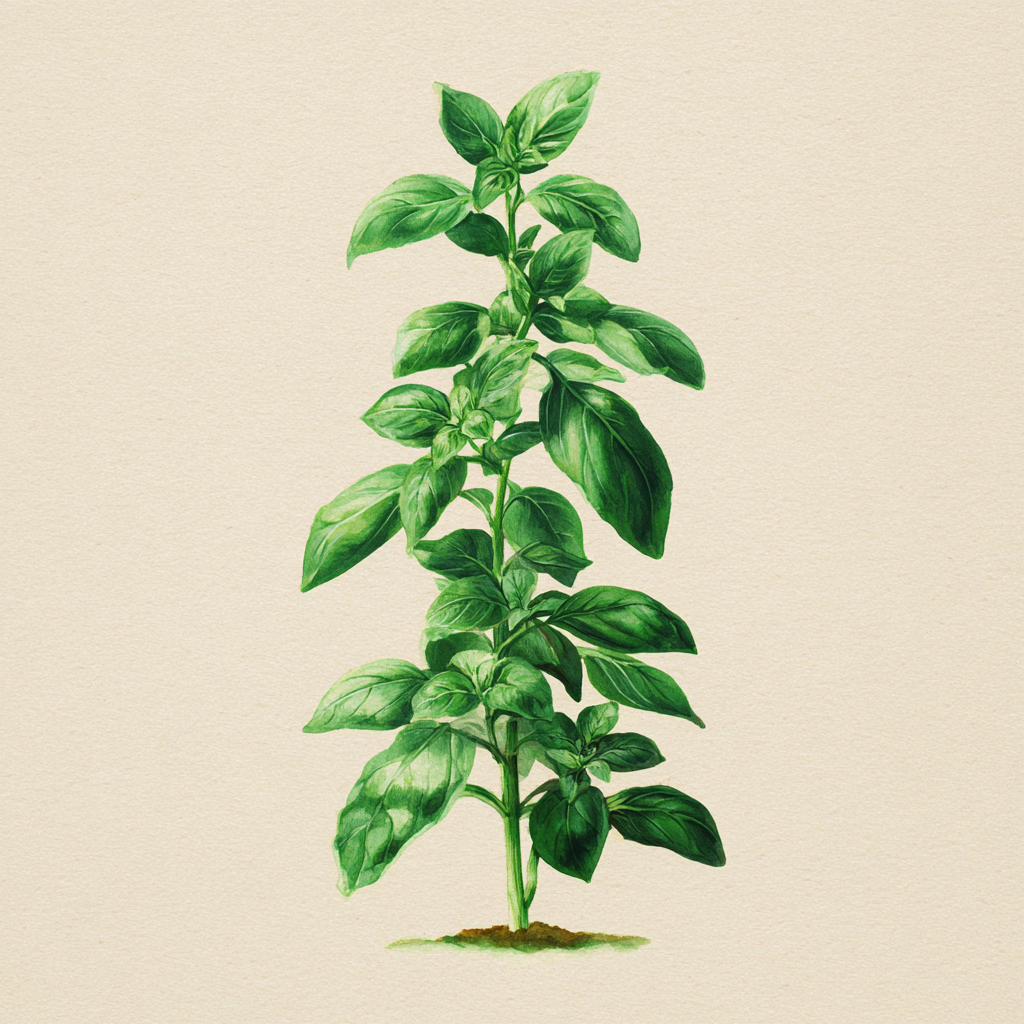
Opposite, oval, glossy to slightly puckered leaves with a strong sweet-spicy aroma when bruised. Leaf size, color, and scent vary widely by type.
Flowers
Small white to purple flowers form on upright spikes. Flowering reduces leaf tenderness and shifts flavor unless blooms are pinched.
Fruit
Produces tiny dark seeds in dry flower calyces. The harvested crop is the aromatic leaf and tender stem tips.
Natural History
Natural History
Basil belongs to a diverse genus of over 60 species originating primarily in tropical Africa and South Asia, with Ocimum basilicum thought to have been first cultivated in India, where wild ancestors still grow. The word basil derives from the Greek basilikón phuton - royal plant - suggesting it arrived in the Mediterranean already carrying high cultural status, likely via Silk Road and Arab trade routes before 300 BCE. Dried basil has been found in Egyptian tombs, and the genus was documented by Greek and Roman writers, though with a notably mixed reputation: Pliny the Elder associated it with mental illness, and Roman tradition held that basil seed should be sown with cursing and stamping to grow well - a superstition that spread into European folk belief and persisted into the Renaissance. This stands in sharp contrast to the reverence the same genus received simultaneously in Hindu culture, where tulsi (Ocimum tenuiflorum, Holy Basil) was and remains sacred - grown in household courtyards, used in daily devotional practice, and associated with Vishnu and Lakshmi. The diversity of the genus reflects these separate cultivation histories: Thai, lemon, purple, and holy basil all belong to related species or varieties with dramatically different flavor profiles shaped by different dominant volatile compounds.
Traditional Use
Traditional Use
Basil has been cultivated across a remarkable range of cultures simultaneously, with each tradition valuing something quite different: food flavor in the Mediterranean, sacred household significance in South Asia, and specific aromatic properties in Southeast Asian cooking. The diversity of the Ocimum genus - over 60 species, hundreds of cultivated varieties - reflects how independently different cultures have developed the plant along their own lines.
Parts Noted Historically
Ligurian and Italian Culinary Traditions - Leaves
Basil became the defining herb of Ligurian cuisine, where pesto Genovese - basil, Ligurian olive oil, pine nuts, garlic, and aged cheese - developed as a protected regional preparation. The Genovese variety, with its large, slightly cupped, intensely sweet leaves, is considered sufficiently distinct that authentic pesto Genovese carries DOP (Protected Designation of Origin) status in Italy. Basil's role in Italian cooking, now taken for granted, developed primarily through the modern period and is more regionally specific than its global reputation suggests.
Hindu Sacred Traditions - Leaves and plant
Tulsi (Ocimum tenuiflorum, Holy Basil) occupies an entirely different cultural position from culinary basil. In Hindu tradition it is sacred to Vishnu and Lakshmi, grown in dedicated pots in the courtyards of nearly every Hindu home, and used in daily puja (devotional worship). Tulsi beads are worn as devotional jewelry. Its properties in Ayurvedic tradition are extensive and entirely distinct from those attributed to sweet basil.
Southeast Asian Culinary Traditions - Leaves
Thai basil is central to Southeast Asian cooking, appearing in dishes such as pad kra pao and in the fresh herb plates served alongside Vietnamese pho. Its anise-clove aroma is produced by methyl chavicol (estragole) as its dominant volatile compound - a completely different chemical profile from Genovese basil, which is linalool-dominant, and the reason the two taste nothing alike despite belonging to closely related varieties.
Ancient Greek and Roman Traditions - Leaves
Greek and Roman writers were ambivalent to negative about basil, in striking contrast to the reverence it received elsewhere. Pliny the Elder described it as causing mental illness, and Roman folk tradition held that it should be sown while cursing and stamping to ensure germination. The superstition traveled into European folk belief and persisted in fragmented form into the Renaissance before giving way to the herb's current universal approval in Western cooking.
Basil leaves are food-safe in any quantity used in cooking. Concentrated basil oils and extracts contain higher levels of estragole (methyl chavicol), which has raised questions at very high doses in isolated studies; this is not relevant to normal leaf use in food.
This information is provided for historical and educational purposes only and is not medical advice. Always consult a qualified healthcare professional before making decisions related to your health.
Loading photo submission…