Borage
FlowerBorago officinalis
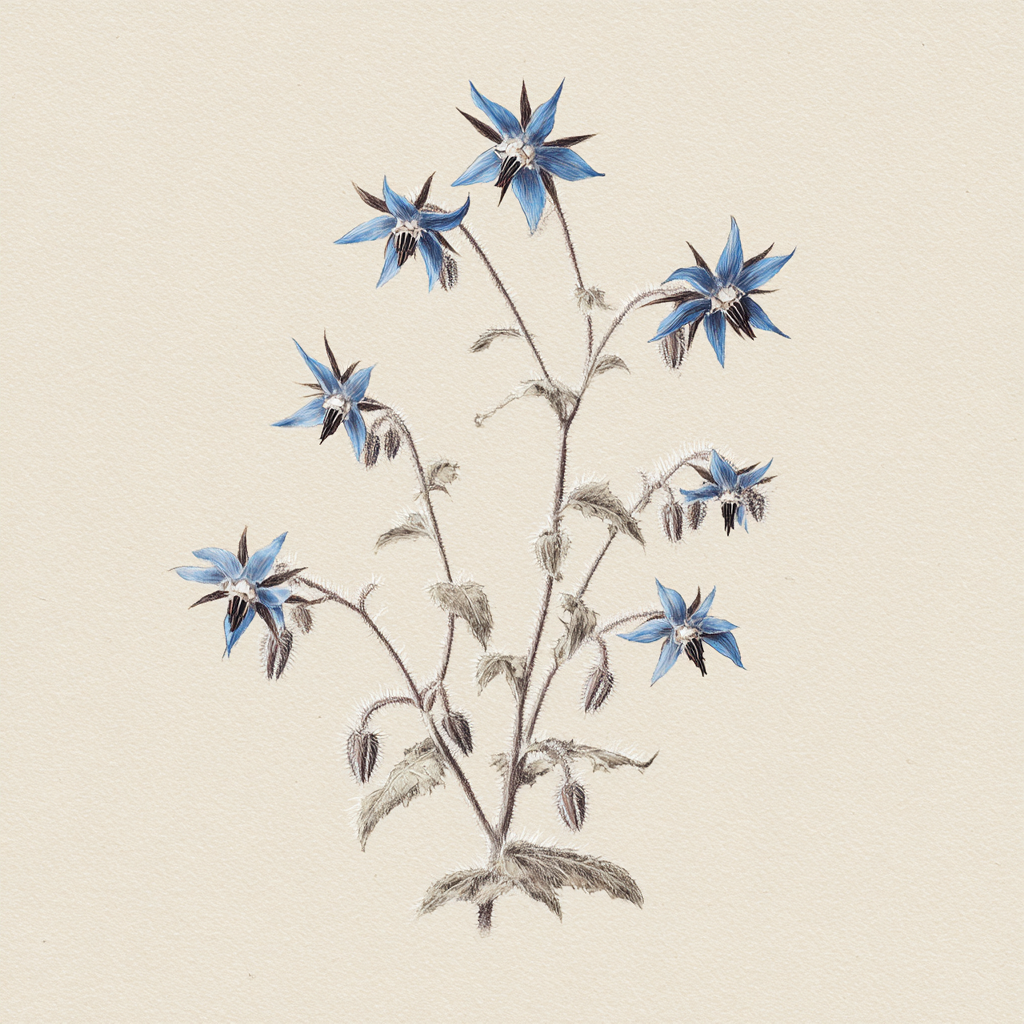
Have seeds for this? Add to inventory →Borage is a permaculture powerhouse and one of the most generous companion plants: a deep-rooted plant that produces nutrient-rich biomass as mulch, a powerful pollinator magnet, a repellent of tomato hornworm and cabbage worms, and an edible herb with star-shaped blue flowers beloved by bees.
Growing Conditions
Growing Conditions
Sunlight
Full Sun
Water Needs
Low
Soil
Well-draining loam; pH 6.0 - 7.0; thrives in poor to average soil
Spacing
12 - 18 inches
Days to Maturity
50 - 60 days from direct sow to flower
Growing Zones
Growing Zones
Thrives in USDA Zones 3 - 11
When to Plant
When to Plant
Direct Sow
After last frost; self-seeds prolifically once established
Harvest
Harvest edible flowers as they open; leaves are also edible when young
Phenology (Natural Timing Cues)
Direct Sow
Direct sow borage where it will grow - its taproot makes transplanting unreliable once the root begins to elongate. Sow as soon as soil is workable and nights are reliably above 45°F. Once established it self-seeds freely and rarely needs resowing.
- Dandelions are blooming.
- Soil is workable and holds moisture between rains.
- Night temperatures are staying above 45°F.
- Tender annual weeds are beginning to germinate.
Start Dates (Your Location)
Average dates use your saved zone; readiness also checks your forecast when available.
Average Last Frost
Set your growing zone to see personalized calendar dates.
Use the average timing, but check your local forecast before planting.
Organic Growing Tips
Organic Growing Tips
Borage accumulates silicon and potassium and returns these minerals to soil as it decomposes - chop and drop around fruiting crops.
Allow it to self-seed freely throughout the garden - it will naturalise as a self-maintaining companion.
Blue borage flowers are one of the most attractive sources of nectar for bumblebees in the garden.
Borage planted near tomatoes is reported to repel tomato hornworm and improve tomato health and yield.
Care Guidance
Optional seasonal guidance for what you can do, even when nothing is urgent.
Care Guidance
Watering
Extra watering is often only useful during extended dry periods. If the top 2 to 3 inches are still holding moisture, additional water may not help.
Feeding
Extra feeding is rarely required if soil is healthy. If growth looks pale or slow, a light compost top-dressing is often enough before adding anything stronger.
Seasonal care
During the main season, harvesting when the crop is ready and removing damaged growth can help keep the planting productive if it starts to look crowded or tired.
Known Varieties
Common cultivars worth knowing
Known Varieties
Common Borage
Standard blue-flowered Borago officinalis with strong self-seeding habit.
Best for
pollinator plantings
Alba
White-flowered borage with the same coarse foliage and bee appeal.
Best for
white flower schemes
Variegata
Variegated foliage form grown mainly for ornamental interest.
Best for
decorative herb beds
Blue Borage
Selected blue-flowered strains sold for edible flowers and companion planting.
Best for
kitchen gardens
Companion Planting
Companion Planting
Good companions
Avoid planting near
No known conflicts
Common Pests
Common Pests
All pest management in Garden uses safe, organic, non-toxic methods only. No synthetic pesticides, ever.
Native Range
Native Range
- Origin
- Borage is native to the Mediterranean region.
- Native Habitat
- Open disturbed ground, field margins, rocky slopes, roadsides, and dry Mediterranean soils.
- Current Distribution
- Naturalized across many temperate regions, especially in disturbed habitats.
Taxonomy
Taxonomy
- Kingdom
- Plantae
- Family
- Borage family (Boraginaceae)
- Genus
- Borago
- Species
- Borago officinalis
Morphology
Morphology
Root System
Taproot with branching side roots; young plants resent transplanting once the root begins to elongate.
Stem
Thick, hollow, branching stems covered in coarse bristly hairs.
Leaves
Large oval gray-green leaves with rough bristles and a cucumber-like scent when young.
Flowers
Nodding star-shaped flowers, usually vivid blue with dark anthers, held in loose curling clusters.
Fruit
Small dark nutlets that drop easily and self-sow around the parent plant.
Natural History
Natural History
Borage (Borago officinalis) is native to the eastern Mediterranean and North Africa, likely originating in the Syria/Aleppo region, and has naturalized across much of temperate Europe on disturbed ground, roadsides, and waste places since at least Roman times. The species name officinalis signals its historical place in apothecary stores - a marker it shares with asparagus, basil, and several other economically significant plants. The etymology of "borage" is debated: one derivation traces it to the Arabic abu rash (father of sweat), reflecting its traditional reputation as a warming herb; another connects it to the Latin borra (coarse hair), referencing the plant's bristly texture. The blue star-shaped flowers have a structural feature that makes them particularly attractive to bumblebees: the five dark stamens converge into a pointed cone that releases pollen when vibrated by a bee's thorax - the same buzz pollination mechanism used by tomatoes and aubergines. Borage's fast taproot development explains both its preference for direct sowing and its ability to reach deep soil moisture and minerals quickly, making it a useful source of nutrient-rich mulch biomass when chopped and dropped in the garden. It behaves as a self-maintaining annual, dropping seed continuously as flowers fade and regenerating freely around the parent plant.
Traditional Use
Traditional Use
Borage has one of the most persistent associations with a single quality of any herb in Western tradition: courage. The Latin motto ego borago gaudia semper ago (I, borage, always bring courage) circulated widely in medieval and Renaissance herb literature, and the flowers were given to knights before tournaments and embroidered on tapestries as symbols of good cheer. Its culinary history is equally specific - the cucumber-fresh flavor of flowers and young leaves made it a natural ingredient in summer drinks and cooling preparations across centuries of European food culture.
Parts Noted Historically
Medieval and Renaissance Courage Tradition - Flowers and leaves
The association of borage with courage and good cheer runs through European herb literature from classical sources through the Renaissance. Pliny mentioned its mood-elevating properties; John Gerard's Herball (1597) described it as "comfortable to the heart"; Francis Bacon listed it among five plants that "do exhilarate." The flowers were given to crusaders and embroidered on the scarves of jousting knights. The motto ego borago gaudia semper ago was among the most repeated botanical maxims of the period.
British Summer Drinks Tradition - Flowers and young leaves
Borage flowers and young leaves have been used in British cooling summer drinks for centuries, contributing a mild cucumber freshness. The tradition runs from Renaissance claret cups and wine cups through to the modern Pimm's Cup, for which borage is the traditional garnish - often considered superior to cucumber. Freezing individual borage flowers in ice cubes for summer drinks is a continuation of this cooling drinks tradition.
Ligurian and Italian Culinary Traditions - Leaves
In Liguria, borage leaves are a traditional filling ingredient in pansoti - a stuffed pasta made with a mixture of wild greens, borage, and cheese, dressed with walnut sauce. This is one of the most specific and well-documented regional culinary uses of borage, giving it a distinct identity beyond general herb-garden flavoring.
Borage leaves and seeds contain naturally occurring pyrrolizidine alkaloids (PAs). For occasional culinary use of flowers as garnish and young leaves in moderate quantities, the risk from food use is considered low. Borage seed oil is PA-free and commercially available. Borage leaves are not appropriate for concentrated medicinal preparations or sustained large-quantity use. Pregnant women are conventionally advised to avoid borage leaf preparations.
This information is provided for historical and educational purposes only and is not medical advice. Always consult a qualified healthcare professional before making decisions related to your health.
Loading photo submission…