Grape
FruitVitis vinifera
Have seeds for this? Add to inventory →Grapevines are long-lived, vigorous climbers that produce fruit for decades when properly trained and pruned. They thrive in well-drained soils with lean fertility and full sun, and are extraordinary companions with Mediterranean herbs.
Growing Conditions
Growing Conditions
Sunlight
Full Sun
Water Needs
Low
Soil
Well-draining, lean, slightly alkaline loam; pH 5.5 - 7.0
Spacing
6 - 8 feet
Days to Maturity
3 years to first significant harvest; full production in 5 - 7 years
Growing Zones
Growing Zones
Thrives in USDA Zones 6 - 11
When to Plant
When to Plant
Transplant
Bare-root canes in late winter to early spring while dormant
Harvest
Taste test - vines do not ripen further after picking; harvest when fully sweet
Phenology (Natural Timing Cues)
Transplant
Plant bare-root grapevines while they are still fully dormant or only just beginning to break dormancy. The window is early - when forsythia blooms and soil is becoming workable - because vines planted with dormant roots anchor faster and waste less energy than vines that leaf out before roots are established. Install the full trellis structure before planting, not after: training the first season's growth correctly determines the permanent vine framework for the next 30 or more years.
- Forsythia is blooming or in early bloom.
- Grape buds are still tight or only just beginning to swell - no visible green tips yet.
- Soil is workable and drains cleanly after rain without remaining sticky.
- Trellis posts and wires are in position before planting begins.
Start Dates (Your Location)
Average dates use your saved zone; readiness also checks your forecast when available.
Best Planting Window
Spring window
Late winter to early spring
Plant while dormant, before buds break and before active top growth begins.
Autumn window
Usually skip autumn planting
Use spring unless you have locally grown nursery stock and enough mild weather for roots to establish.
Planting Method
Plant dormant bare-root canes. Named varieties are propagated vegetatively so the fruiting plant stays true to type.
Critical Timing Note
Plant while dormant and before bud break so roots establish before leaves demand water.
Use the average timing, but check your local forecast before planting.
Typical Harvest Window
September to October
Organic Growing Tips
Organic Growing Tips
Plant rosemary, lavender, and thyme beneath vines to deter pests and attract beneficial insects.
Prune vines hard in late winter - grapes fruit on the current year's growth from last year's wood.
Spray kaolin clay on clusters to deter grape berry moth and create a physical pest barrier.
Allow grass or clover to grow between rows and apply compost mulch under the canopy - living ground cover feeds soil biology, prevents erosion, and clover fixes nitrogen that supports vine health without the disease pressure that comes from high-nitrogen synthetic fertilisers.
Care Guidance
Optional seasonal guidance for what you can do, even when nothing is urgent.
Care Guidance
Watering
Extra watering is often only useful during extended dry periods. If the top 2 to 3 inches are still holding moisture, additional water may not help.
Feeding
Extra feeding is rarely required if soil is healthy. If growth looks pale or slow, a light compost top-dressing is often enough before adding anything stronger.
Pruning
If pruning is needed, dormancy or the period just after harvest is often the simplest window. Dead, damaged, or crossing growth is usually the first place to start.
Seasonal care
In late fall, a light cleanup and fresh mulch can help if winter protection is useful in your climate. Leaving a little space around crowns and trunks often helps air move and keeps excess moisture from sitting there.
Pollination & Fruit Production
Pollination & Fruit Production
The pollination helper includes compatibility guidance for grape.
Need a compatible partner? Open the Fruit Tree Planner.Known Varieties
Common cultivars worth knowing
Known Varieties
- Concord
American blue grape with strong flavor for juice and jelly.
Best for
juice, jelly, cold climates
Thompson Seedless
Green seedless grape widely used fresh and for raisins.
Best for
table grapes, raisins
Flame Seedless
Red seedless table grape with crisp sweet berries.
Best for
fresh eating
Cabernet Sauvignon
Classic wine grape known for small dark berries and structured wines.
Best for
wine grapes
- Himrod
Cold-hardy green seedless grape with sweet flavor.
Best for
home gardens
Companion Planting
Companion Planting
Support & insectary plants
Nearby plants that attract pollinators, beneficial insects, or improve soil health.
- Lavender
Attracts pollinators and beneficial insects
- Borage
Attracts beneficial insects and produces nutrient-rich mulch
- Comfrey
Attracts beneficial insects and produces nutrient-rich mulch
- Marigold
Suppresses soil nematodes; trap crop for aphids and whiteflies
- Yarrow
Attracts beneficial insects and produces nutrient-rich mulch
Avoid planting near
- Fennel
Allelopathic - secretes volatile compounds that inhibit the growth of most vegetables and herbs
Common Pests
Common Pests
All pest management in Garden uses safe, organic, non-toxic methods only. No synthetic pesticides, ever.
Simple Ways to Use
Simple Ways to Use
Start here if you're not sure how to use this crop in the kitchen.
Quick recipes you can make right away
Chilled Grape Bowl
Rinse the grapes, pull them from the stems, and chill them for 30 minutes until they are cold and firm. Serve them once the skins feel taut and the fruit tastes crisp rather than warm and soft.
Roasted Grapes
Toss stemmed grapes lightly with oil and roast at 425°F for 12 to 18 minutes until some skins split and the juices begin to thicken on the pan. Let them cool 5 minutes before serving so the hot juice does not burn your mouth.
Quick Grape Sauce
Simmer stemmed grapes with a little water for 10 to 15 minutes until the fruit breaks down and releases plenty of juice, then mash and strain if you want a smoother sauce. Cook a few minutes longer if the sauce still looks thin instead of lightly syrupy.
How to Preserve
How to Preserve
Use this section to store or process extra harvest before it spoils.
Practical methods for extra harvest
Freeze whole grapes
Rinse and dry the grapes well, spread them on a tray, and freeze until hard before bagging so they stay separate. Eat them frozen as a snack or thaw them for sauce, because thawed grapes soften too much for a crisp fruit bowl.
Make grape juice or jelly
Simmer stemmed grapes with a little water until the skins split and the juice runs freely, then strain the liquid for juice or use it in a tested jelly recipe. Water-bath can juice or jelly only with a tested recipe and the full processing time for your jars and altitude.
Dry grapes into raisins
Dry seedless or small grapes at 135°F until they are leathery and wrinkled with no wet juice inside when squeezed open. Cool them fully before storing, and condition the dried fruit in a jar for a few days, returning it to the dehydrator if condensation appears.
How to Store
How to Store
Simple storage tips
Keep grapes cold in the refrigerator and use them within about 1 to 2 weeks, depending on how fresh they were when picked or bought.
Store them unwashed in a ventilated bag or their original breathable container so excess moisture can escape.
Wash only the amount you plan to eat, because wet grapes mold faster in storage.
Remove any burst or moldy grapes as soon as you notice them so spoilage does not spread through the bunch.
Freeze very ripe grapes promptly if the skins are starting to loosen but the fruit still tastes good.
How to Save Seed
How to Save Seed
Step-by-step seed saving
- 1
Grape seed is not the practical way to keep the same named variety, because grapes are normally propagated from cuttings, not from seed.
- 2
If you want more of the same grape, root a hardwood cutting or buy a plant of that cultivar instead of saving seed.
- 3
Seeds can be saved only for breeding or experimentation, not for keeping a named grape true to type.
Native Range
Native Range
- Origin
- Vitis vinifera is native from the Mediterranean region through western Asia and the Caucasus.
- Native Habitat
- Riparian woodland, forest edges, rocky slopes, scrub, and climbing woodland margins.
- Current Distribution
- Naturalized across many mild and temperate regions, especially in disturbed habitats.
Taxonomy
Taxonomy
- Kingdom
- Plantae
- Family
- Grape family (Vitaceae)
- Genus
- Vitis
- Species
- Vitis vinifera
Morphology
Morphology
Root System
Deep woody root system once established, often grafted onto resistant rootstocks. Roots prefer drainage and moderate fertility.
Stem
Woody trunk and cordons support annual green shoots. Tendrils help shoots cling to trellises and nearby supports.
Leaves
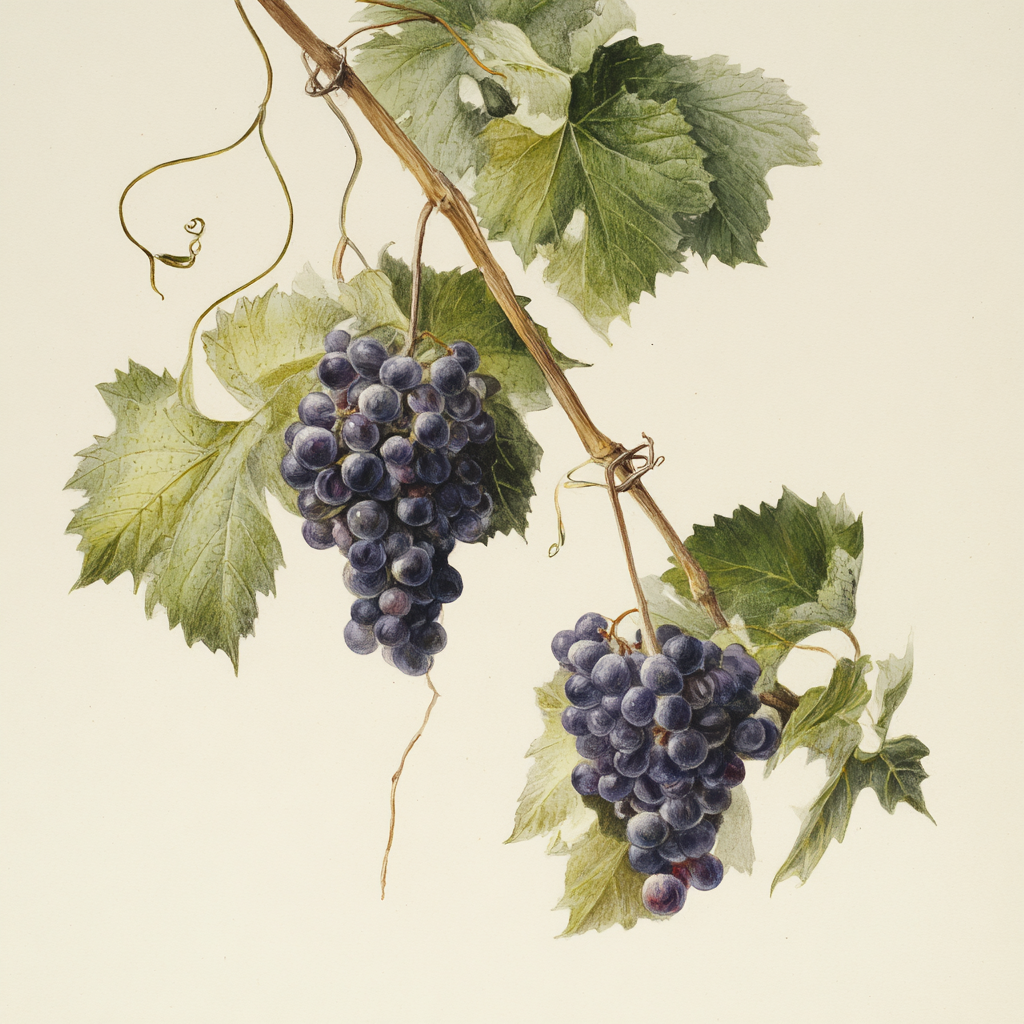
Broad lobed leaves with toothed edges and palmate veins. Leaf shape and underside texture vary by variety and species background.
Flowers
Small greenish flowers form in clusters that later become bunches. Many are self-fertile but weather during bloom affects fruit set.
Fruit
Berries form in clusters and may be seeded or seedless, with skin colors from green to red, blue, or black. Grapes do not ripen further after picking.
Natural History
Natural History
Vitis vinifera was domesticated from the wild grape Vitis vinifera ssp. sylvestris in the South Caucasus region - modern Georgia, Armenia, and northern Iran - with genetic evidence placing initial domestication around 6,000-8,000 years ago. The world's oldest known winery, found at the Areni-1 cave complex in Armenia, dates to approximately 6,100 years ago and contained grape seeds, pressed grape skins, fermentation vats, and wine storage vessels. The Phoenicians spread viticulture westward across the Mediterranean, and Greek colonists introduced Vitis vinifera to the Rhône valley when they founded Massalia (modern Marseille) around 600 BCE. Roman viticulture transformed the vine from a Mediterranean luxury into a continent-spanning agricultural system; by the 1st century CE, Roman vintners had identified the major wine-producing regions of modern France, Spain, and Germany and documented dozens of named varieties. The phylloxera outbreak of the 1860s-1880s, caused by an aphid-like insect inadvertently brought from North America, destroyed most of Europe's vineyards and demonstrated the biological relationship between Vitis vinifera and its American relatives. The only solution was grafting European scions onto resistant American rootstocks - a practice still universal in European viticulture today.
Traditional Use
Traditional Use
The history of the grape is inseparable from the history of wine, which shaped politics, religion, economy, and medicine across more than 8,000 years of documented civilization. No other cultivated plant has a deeper entanglement with recorded human culture.
Parts Noted Historically
Caucasian Origins and Ancient Near East - Fruit
The Areni-1 winery in Armenia, dated to approximately 4100 BCE, contained complete wine-production equipment including a pressing floor, fermentation vats, and storage jars. Egyptian hieroglyphs from the 3rd millennium BCE show wine production in detail, and wine was placed in royal tombs including Tutankhamun's. Grape cultivation spread from the South Caucasus southward into the ancient Near East by the 4th millennium BCE, making wine one of the earliest processed food products in human history.
Greek and Roman Viticulture - Fruit
Ancient Greece codified wine production into a civilization-defining industry. Greek colonists brought Vitis vinifera to France around 600 BCE, establishing what would become the Rhône and Languedoc wine regions. Roman viticulture was documented in unprecedented detail - Columella's De Re Rustica (1st century CE) devotes two full books to the subject, describing training systems, pruning schedules, variety characteristics, and regional wine styles in terms still recognizable to modern winemakers.
Medieval Monastic Viticulture - Fruit
After the collapse of Roman viticulture in the 5th century, European monasteries became the primary preservers of grapevine varieties and winemaking knowledge. Cistercian and Benedictine monks in Burgundy, the Rhine, and Champagne selected, named, and maintained the vine varieties that form the genetic foundation of modern European wine. The Clos de Vougeot in Burgundy - still a functioning vineyard - was established by Cistercian monks in the 12th century.
Ottoman and Eastern Mediterranean Leaf Cooking - Leaves
Young grapevine leaves have been used in cooking across the eastern Mediterranean, Levant, and Caucasus for millennia. Dolma - stuffed grape leaves - appears in Ottoman culinary records from the 15th century onward and is claimed as a traditional preparation by Turkish, Greek, Armenian, Lebanese, and Iranian cuisines. The use of vine leaves as edible wrappers is documented in Mediterranean food writing since antiquity and represents a parallel agricultural use entirely distinct from wine production.
Grapes and raisins are toxic to dogs and cats and must be kept away from pets. Grape fruit is safe for people.
This information is provided for historical and educational purposes only and is not medical advice. Always consult a qualified healthcare professional before making decisions related to your health.
Loading photo submission…