Cherry
FruitPrunus avium
Have seeds for this? Add to inventory →Sweet cherry trees are magnificent ornamental trees that produce abundant crops of sweet, rich fruit in early summer. Most sweet cherries require cross-pollination with a compatible variety, though self-fertile cultivars like Stella are widely available.
Growing Conditions
Growing Conditions
Sunlight
Full Sun
Water Needs
Moderate
Soil
Deep, well-draining, fertile loam; pH 6.0 - 6.8
Spacing
20 - 30 feet (standard); 8 - 12 feet (dwarf)
Days to Maturity
3 - 5 years to first significant harvest
Growing Zones
Growing Zones
Thrives in USDA Zones 4 - 8
When to Plant
When to Plant
Transplant
Bare-root trees in late autumn to early spring while dormant
Harvest
Early summer; harvest with stalks attached to extend shelf life
Phenology (Natural Timing Cues)
Transplant
Plant grafted cherry trees while fully dormant - either in early spring before bud break or in autumn after leaf drop. Both windows allow roots to settle before the tree has to support active top growth.
- Forsythia is beginning to bloom (spring planting).
- Deciduous trees are showing bud swell but have not leafed out (spring planting).
- Soil is workable and drains cleanly.
- Deciduous trees are at peak colour or beginning to drop leaves (autumn planting).
- Several frost-free weeks remain and the ground is not yet frozen (autumn planting).
Start Dates (Your Location)
Average dates use your saved zone; readiness also checks your forecast when available.
Best Planting Window
Spring window
Late winter to early spring
Plant while dormant, before buds break and before active top growth begins.
Autumn window
Late autumn after leaf drop
Plant while dormant, after leaves have dropped and before the ground freezes.
Planting Method
Plant a grafted bare-root nursery tree. Seed-grown fruit trees are not true-to-type, so nursery stock is the reliable path to known fruit quality.
Critical Timing Note
Plant while dormant and before bud break so roots establish before leaves demand water.
Use the average timing, but check your local forecast before planting.
Typical Harvest Window
June to July
Organic Growing Tips
Organic Growing Tips
Net trees as fruit begins to colour - birds can strip an entire crop in hours.
Plant sweet alyssum and borage below to attract hoverflies and parasitic wasps.
Paint pruning wounds with pruning sealant to prevent bacterial canker entering fresh cuts.
Mulch out to the drip line with compost annually; cherries are heavy feeders.
Care Guidance
Optional seasonal guidance for what you can do, even when nothing is urgent.
Care Guidance
Watering
If the top 2 inches of soil feel dry, a deep watering at the base may help more than frequent light watering. In healthy soil, rain may cover much of what it needs.
Feeding
If growth is strong, compost-rich soil often carries most of the load. If the plant starts looking pale or stalls, a light compost top-dressing or gentle organic feed may help.
Pruning
If pruning is needed, dormancy or the period just after harvest is often the simplest window. Dead, damaged, or crossing growth is usually the first place to start.
Seasonal care
In late fall, a light cleanup and fresh mulch can help if winter protection is useful in your climate. Leaving a little space around crowns and trunks often helps air move and keeps excess moisture from sitting there.
Pollination & Fruit Production
Pollination & Fruit Production
The pollination helper includes compatibility guidance for cherry.
Need a compatible partner? Open the Fruit Tree Planner.Known Varieties
Common cultivars worth knowing
Known Varieties
- Bing
Classic dark sweet cherry with firm flesh and rich flavor.
Best for
fresh eating
- Stella
Self-fertile sweet cherry useful for smaller home orchards.
Best for
single-tree plantings
- Rainier
Yellow-red sweet cherry with delicate flavor and premium quality.
Best for
fresh eating
- Lapins
Self-fertile dark cherry with large fruit and good crack resistance.
Best for
home gardens
- Montmorency
Classic tart cherry, a different cherry type grown for pies and preserves.
Best for
baking, preserves
Companion Planting
Companion Planting
Good companions
Support & insectary plants
Nearby plants that attract pollinators, beneficial insects, or improve soil health.
- Comfrey
Attracts beneficial insects and produces nutrient-rich mulch
- Marigold
Suppresses soil nematodes; trap crop for aphids and whiteflies
- Yarrow
Attracts beneficial insects and produces nutrient-rich mulch
- Lavender
Attracts pollinators and beneficial insects
- Borage
Attracts beneficial insects and produces nutrient-rich mulch
- Sweet Alyssum
Attracts pollinators and beneficial insects
- Calendula
Trap crop for aphids; attracts predatory insects
Avoid planting near
No known conflicts
Common Pests
Common Pests
All pest management in Garden uses safe, organic, non-toxic methods only. No synthetic pesticides, ever.
Simple Ways to Use
Simple Ways to Use
Start here if you're not sure how to use this crop in the kitchen.
Quick recipes you can make right away
Fresh Cherry Bowl
Rinse the cherries, remove any cracked or soft fruit, and chill them for 20 to 30 minutes if you want them firmer and colder. Eat them once the flesh feels taut and juicy, not warm and soft from sitting out.
Quick Cherry Compote
Pit the cherries and simmer them with a little sugar for 8 to 12 minutes until the fruit softens and the juice thickens enough to coat a spoon lightly. Stop while some pieces still hold their shape if you want spoonable fruit instead of jam.
Simple Cherry Pie Filling
Pit the cherries, stir them with sugar and a little starch, and cook 5 to 8 minutes until the juices bubble and begin to look glossy instead of watery. Cool the filling slightly before using it so it thickens enough to stay in the crust.
How to Preserve
How to Preserve
Use this section to store or process extra harvest before it spoils.
Practical methods for extra harvest
Freeze pitted cherries
Pit the fruit, spread it in a single layer on a tray, and freeze until hard before bagging so the cherries stay separate instead of clumping. Use them frozen for baking, smoothies, or sauce, because thawed cherries soften a lot.
Make cherry jam or preserves
Cook pitted cherries with sugar until the fruit breaks down and the mixture thickens enough to mound lightly on a spoon, or follow a tested jam recipe if you want shelf-stable jars. Water-bath can it only with a tested recipe and the full processing time for your jars and altitude.
Dry cherries
Pit the cherries and dry them at 135°F until they feel leathery and no wet juice appears when squeezed at the cut face. Cool them fully before storing, and refrigerate them if they still feel sticky or damp after cooling.
How to Store
How to Store
Simple storage tips
Keep cherries cold in the refrigerator and use them within about 5 to 7 days, because they lose firmness quickly once picked.
Store them unwashed in a shallow bowl or breathable bag so the fruit on the bottom does not get crushed.
Wash cherries only before using them, because surface moisture speeds mold and splitting in storage.
Use cracked, bruised, or leaking cherries first for sauce, baking, or preserves.
Freeze fully ripe cherries the same day if you will not use them soon, because very ripe fruit softens fast even in the refrigerator.
How to Save Seed
How to Save Seed
Step-by-step seed saving
- 1
Cherry pits do not grow true to the named variety, so saving pits is not the practical way to keep a cherry like Montmorency or Bing the same.
- 2
If you want more of the same cherry, use grafting or buy a grafted tree rather than saving pits for planting.
- 3
Pits can be planted only for breeding or experimentation, not for keeping a named cherry true to type.
Native Range
Native Range
- Origin
- Sweet cherry is native to Europe and western Asia.
- Native Habitat
- Open woodlands, forest edges, hedgerows, slopes, and well-drained temperate soils.
- Current Distribution
- Naturalized across parts of temperate Europe and western Asia; also cultivated beyond its native range.
Taxonomy
Taxonomy
- Kingdom
- Plantae
- Family
- Rose family (Rosaceae)
- Genus
- Prunus
- Species
- Prunus avium
Morphology
Morphology
Root System
Woody root system usually grafted onto rootstock that influences tree size and soil tolerance. Cherries resent wet, compacted soil.
Stem
Deciduous tree with smooth reddish-brown young bark and horizontal lenticels. Fruiting often occurs on spurs and short shoots.
Leaves
Oval toothed leaves with pointed tips and often small glands near the leaf base on the petiole.
Flowers
White five-petaled blossoms appear in clusters before or with young leaves and are highly attractive to bees.
Fruit
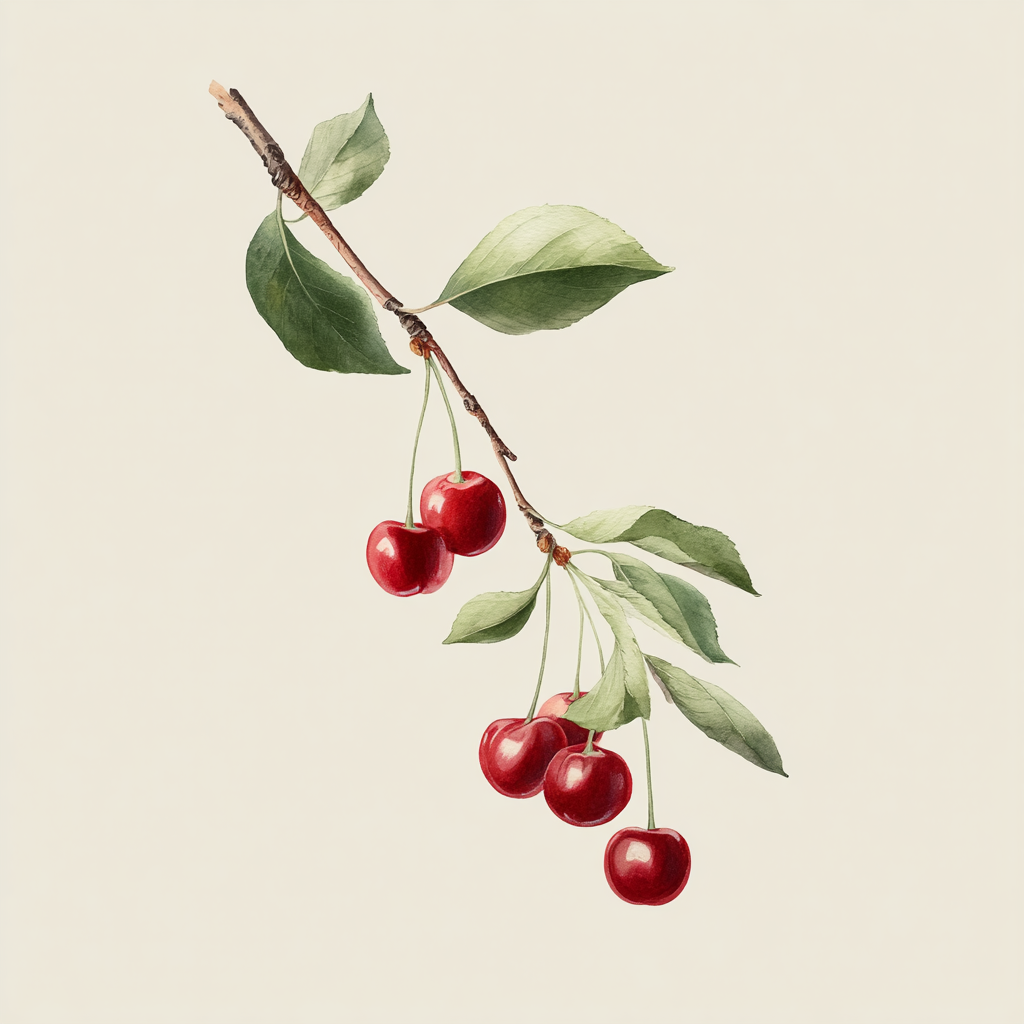
Small round stone fruit ripens red, dark red, yellow, or nearly black. Sweet cherries are usually harvested with stems attached for best keeping.
Natural History
Natural History
Sweet cherry (Prunus avium) is native to a broad arc from western Europe through the Caucasus and into northern Iran, growing wild as a forest-edge and woodland species. Its specific name avium means "of the birds," acknowledging the role of bird dispersal in spreading cherry seeds across European woodlands. Roman writers including Pliny credited the general Lucullus with bringing superior cherry varieties from Giresun on the Black Sea coast to Rome around 74 BCE - a story that may be embellished but reflects documented Roman interest in improving cultivated cherry. By the 16th century, the county of Kent in England had become the center of British cherry growing, with orchards established under Henry VIII whose varieties persisted for centuries. Modern sweet cherries are largely self-infertile and require compatible pollen donors planted nearby; this biological constraint shaped orchard design for most of their cultivated history and drove the development of self-fertile cultivars, including Stella, introduced by Canada's Summerland Research Station in 1968.
Traditional Use
Traditional Use
Cherry has been prized as a luxury fruit and table delicacy across Europe and western Asia since classical antiquity. Its brief season concentrated cultural importance into an annual event associated with summer abundance and festive eating.
Parts Noted Historically
Roman and Early European Cultivation - Fruit
Roman authors wrote extensively about cherry cultivation and the range of varieties available at market. By medieval times, cherry orchards were documented on monastic and aristocratic estates across France, England, and the German-speaking lands. The concentrated ripening season made cherries perishable luxuries - eaten fresh, made into conserves, and incorporated into seasonal summer dishes.
Central European Preserving Culture - Fruit
In the Black Forest, Rhine Valley, and Austrian regions, sour and sweet cherry varieties were central to a preserving culture that included cherry brandy (Kirschwasser), cherry jam, and dried fruit. Kirschwasser distillation is documented in the Black Forest region from at least the 17th century and the regional association between cherries, cream, and cherry spirit eventually gave rise to what became Black Forest cake.
Japanese and East Asian Blossom Traditions - Flowers
The Japanese tradition of hanami - flower viewing - centered on ornamental cherry species (Prunus serrulata and related forms) and reflects a wider East Asian appreciation of Prunus blossoms that is among the world's most enduring cultural associations with a fruit tree. Imperial hanami gatherings are recorded from the Heian period around 812 CE under Emperor Saga.
Kentish Orchard Tradition - Fruit
Traditional Kentish cherry orchards used tall standard trees worked from ladders and were a defining feature of the southeastern English rural landscape from Tudor times. Named varieties - Frogmore Early, Napoleon, Turk - were associated with specific village orchards whose microclimate peculiarities were carefully matched to variety. The cherry harvest was a significant seasonal rural employment event, drawing workers from across the region.
Cherry fruit is safe to eat. Pits, leaves, and bark contain cyanogenic glycosides and are not edible.
This information is provided for historical and educational purposes only and is not medical advice. Always consult a qualified healthcare professional before making decisions related to your health.
Related Articles
Related Articles
Grafting Fruit Trees: Techniques, Biology, and Practical Method
Fruit Trees • 16 min read
Fruit Tree Pollination: The Science and How to Plan for Better Yields
Fruit Trees • 17 min read
Pruning Fruit Trees: Techniques, Timing, and the Biology Behind the Cut
Fruit Trees • 18 min read
Fruit Tree Husbandry: A Complete Care Guide
Fruit Trees • 14 min read
Loading photo submission…