
Blueberry
FruitVaccinium corymbosum
Have seeds for this? Add to inventory →Blueberries are long-lived, productive shrubs that require very acidic soil and at least two compatible varieties for cross-pollination. Their stunning autumn colour makes them as ornamental as they are productive.
Growing Conditions
Growing Conditions
Sunlight
Full Sun
Water Needs
Moderate
Soil
Strongly acidic, well-draining soil rich in organic matter; pH 4.5 - 5.5
Spacing
4 - 6 feet
Days to Maturity
2 - 3 years to first significant harvest; full production in 5 - 6 years
Growing Zones
Growing Zones
Thrives in USDA Zones 4 - 10
When to Plant
When to Plant
Transplant
Early spring or autumn; plant at least 2 compatible varieties
Harvest
Harvest when berries are fully blue and detach easily - about 1 week after turning blue
Phenology (Natural Timing Cues)
Transplant
Plant blueberries while shrubs are still near dormancy and acidic soil preparation is complete.
- Forsythia is beginning to bloom.
- Blueberry buds are swelling but not fully leafed out.
- Soil is workable, moist, and prepared for acid-loving roots.
- Summer heat is easing and leaf drop is beginning for fall planting.
Start Dates (Your Location)
Average dates use your saved zone; readiness also checks your forecast when available.
Best Planting Window
Spring window
Early spring
Plant as soon as the soil is workable so roots establish before heat arrives.
Autumn window
Early autumn
Plant early enough for roots to grow before winter; avoid late planting into cold, wet soil.
Planting Method
Plant nursery-grown blueberry shrubs. Seed-grown blueberries are slow and variable, and named cultivars are propagated from selected stock.
Critical Timing Note
Plant early enough for shallow roots to establish before heat, and keep the root zone consistently moist.
Use the average timing, but check your local forecast before planting.
Typical Harvest Window
June to August
Organic Growing Tips
Organic Growing Tips
Blueberries require strongly acidic soil, generally pH 4.5 - 5.5; pine needles and bark mulch help hold moisture and support soil biology, but they do not reliably lower pH on their own.
Net plants with fine mesh as berries begin to ripen to protect from birds.
Plant comfrey nearby as a chop-and-drop mulch plant; cut and drop its leaves around blueberries to cycle nutrients back into the soil surface.
In neutral or alkaline soils, elemental sulphur is usually the most effective long-term way to adjust pH; test regularly and make changes gradually over time.
Care Guidance
Optional seasonal guidance for what you can do, even when nothing is urgent.
Care Guidance
Watering
If the top 2 inches of soil feel dry, a deep watering at the base may help more than frequent light watering. In healthy soil, rain may cover much of what it needs.
Feeding
Extra feeding is rarely required if soil is healthy. If growth looks pale or slow, a light compost top-dressing is often enough before adding anything stronger.
Pruning
If pruning is needed, dormancy or the period just after harvest is often the simplest window. Dead, damaged, or crossing growth is usually the first place to start.
Seasonal care
In late fall, a light cleanup and fresh mulch can help if winter protection is useful in your climate. Leaving a little space around crowns and trunks often helps air move and keeps excess moisture from sitting there.
Pollination & Fruit Production
Pollination & Fruit Production
The pollination helper includes compatibility guidance for blueberry.
Need a compatible partner? Open the Fruit Tree Planner.Known Varieties
Common cultivars worth knowing
Known Varieties
- Bluecrop
Widely planted highbush variety with reliable yields and midseason berries.
Best for
general garden use
- Duke
Early highbush blueberry with firm fruit and consistent production.
Best for
early harvests
- Elliott
Late-season variety that extends the blueberry harvest window.
Best for
late harvests
- Patriot
Cold-hardy variety with good performance in heavier soils if drainage is adequate.
Best for
northern gardens
- Pink Lemonade
Pink-fruited rabbiteye/highbush hybrid with ornamental appeal.
Best for
novelty fruit, edible landscaping
Companion Planting
Companion Planting
Good companions
Support & insectary plants
Nearby plants that attract pollinators, beneficial insects, or improve soil health.
- Comfrey
Attracts beneficial insects and produces nutrient-rich mulch
- Borage
Attracts beneficial insects and produces nutrient-rich mulch
- Marigold
Suppresses soil nematodes; trap crop for aphids and whiteflies
- Yarrow
Attracts beneficial insects and produces nutrient-rich mulch
- Calendula
Trap crop for aphids; attracts predatory insects
Avoid planting near
- Fennel
Allelopathic - secretes volatile compounds that inhibit the growth of most vegetables and herbs
Common Pests
Common Pests
- Birds
- Aphids
- Blueberry Maggot
- Mummyberry Fungus
- Spotted Wing Drosophila
All pest management in Garden uses safe, organic, non-toxic methods only. No synthetic pesticides, ever.
Simple Ways to Use
Simple Ways to Use
Start here if you're not sure how to use this crop in the kitchen.
Quick recipes you can make right away
Warm Blueberry Sauce
Cook blueberries with a spoonful of sugar and a splash of water for 5 to 8 minutes until some berries burst and the juice lightly thickens. Take it off the heat while a few berries still hold shape so it does not turn into jam.
Blueberry Oat Bowl
Stir fresh blueberries into hot oatmeal at the end and let the bowl sit 1 minute until a few berries begin to soften and streak the oats purple. Add nuts or yogurt after the berries warm through.
Sheet-Pan Blueberries
Spread blueberries on a parchment-lined tray and roast at 375°F for 12 to 18 minutes until some split and the juices turn syrupy. Cool them slightly before spooning them over toast, yogurt, or pancakes.
How to Preserve
How to Preserve
Use this section to store or process extra harvest before it spoils.
Practical methods for extra harvest
Freeze dry berries
Spread clean, fully dry blueberries on a tray and freeze them until hard before bagging them, so they stay loose instead of freezing into one block. Use them frozen for smoothies, baking, or sauce, because thawed berries soften quickly.
Make blueberry jam
Cook blueberries with sugar and the acid or pectin called for in a tested jam recipe until the mixture sheets off a spoon or reaches the recipe temperature. Water-bath can it only with a tested recipe and full processing time for your jar size and altitude.
Dry blueberries
Dry blueberries at 135°F until the skins are leathery and the centers no longer feel wet when squeezed or torn open. Cool them fully before jarring, and refrigerate them if they still feel tacky after cooling.
How to Store
How to Store
Simple storage tips
Refrigerate blueberries as soon as possible and use them within about 5 to 7 days for best quality.
Do not wash them before storage because extra moisture speeds mold on the skins.
Spread them in a shallow container or keep them in their vented box so crushed berries do not leak over the whole batch.
Pick out any soft or moldy berries right away because one bad berry can spoil the rest fast.
Freeze very ripe berries the same day if you will not use them soon, because fully ripe blueberries soften quickly.
How to Save Seed
How to Save Seed
Step-by-step seed saving
- 1
Blueberry seed does not grow true to the named variety, so seed saving is for experimentation rather than keeping a plant like Bluecrop or Duke the same.
- 2
If you still want to try it, crush ripe berries in water and keep the heavier seeds that sink while pouring off the floating skins and pulp.
- 3
Dry the cleaned seeds on a plate for several days until they no longer feel damp, then store them cool and dry until sowing.
- 4
Label them clearly, because seedlings will vary and may not match the parent in flavor, size, or ripening time.
Native Range
Native Range
- Origin
- Eastern North America, from southeastern Canada to the Gulf states
- Native Habitat
- Acidic wetlands, bog margins, pond and stream edges, pine barrens, moist open woods, and low-pH soils with steady moisture
- Current Distribution
- Native across eastern North America and widely cultivated in suitable acidic-soil fruit-growing regions.
Taxonomy
Taxonomy
- Kingdom
- Plantae
- Family
- Heath family (Ericaceae)
- Genus
- Vaccinium
- Species
- Vaccinium corymbosum
Morphology
Morphology
Root System
Very shallow, fine, fibrous roots without root hairs. Roots depend on acidic organic soil and suffer quickly in drought or alkalinity.
Stem
Multi-stemmed woody shrub with new canes emerging from the crown. Older stems become gray and less productive over time.
Leaves
Oval, smooth-edged leaves that are green in summer and often red, orange, or burgundy in autumn. Leaf yellowing can indicate high soil pH.
Flowers
Small white to pink urn-shaped flowers hang in clusters and are pollinated by bees, especially bumblebees.
Fruit
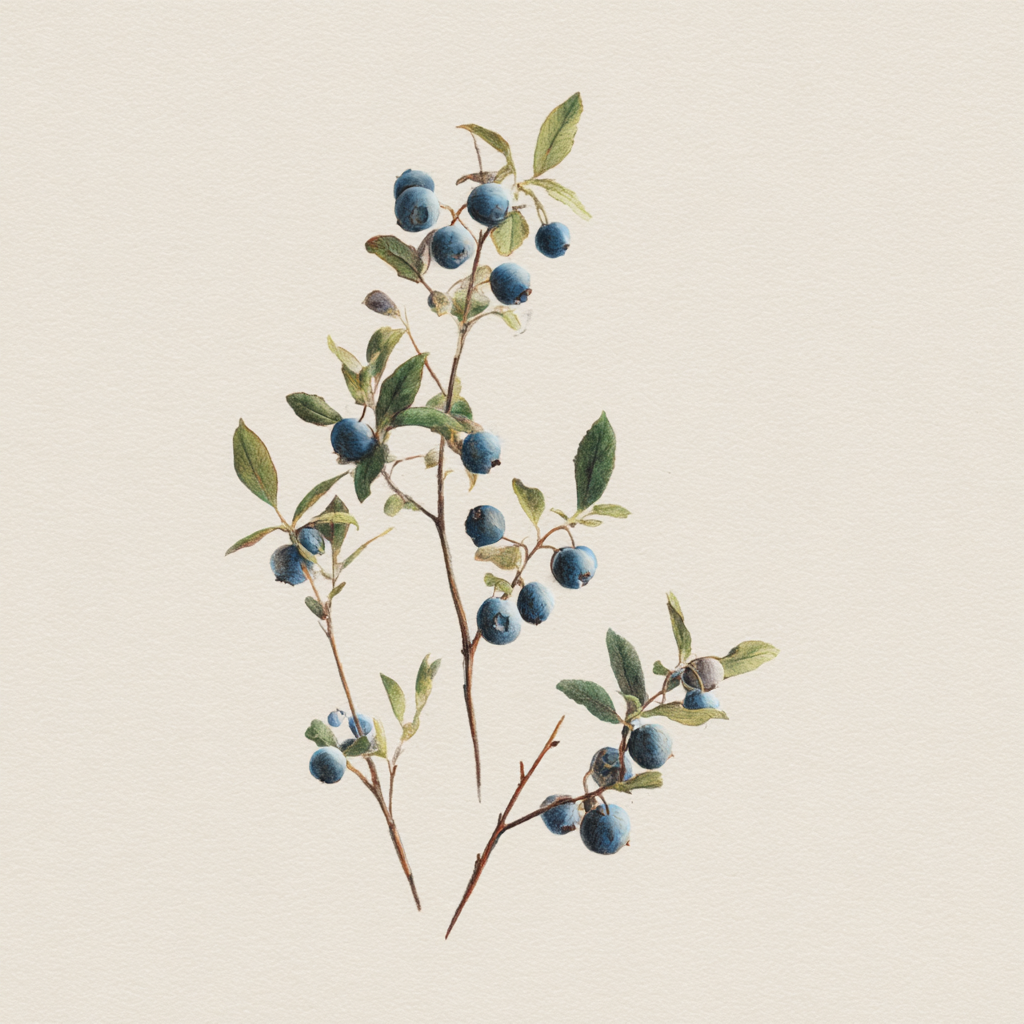
Round blue berries with a waxy bloom ripen in clusters. Fully ripe berries detach easily and are sweeter several days after first turning blue.
Natural History
Natural History
Highbush blueberry (Vaccinium corymbosum) is native to the eastern seaboard of North America, with its greatest wild diversity in the acidic sandy soils of the Pine Barrens of New Jersey - precisely the landscape from which the cultivated fruit was first developed. The genus Vaccinium is remarkably diverse, encompassing cranberries, huckleberries, lingonberries, and the European bilberry (V. myrtillus), a smaller wild relative of heathlands, upland bogs, and moorland from Britain to Scandinavia. The domestication of highbush blueberry is one of the most recent in fruit history: the entire cultivated industry traces to a collaboration beginning around 1908 between Elizabeth Coleman White, a New Jersey cranberry farmer's daughter, and Frederick Coville, a USDA botanist, who selected superior wild plants from the Pine Barrens and produced the first named varieties by the 1910s. Before this work, blueberries had no cultivation history anywhere in the world. The shallow fibrous roots that make blueberries so demanding in the garden reflect their adaptation to thin, waterlogged, highly acidic soils where nutrient uptake depends on ericoid mycorrhizal fungi rather than conventional root mechanisms. The lowbush blueberry (Vaccinium angustifolium), a separate species of northeastern North America, supports a distinct wild blueberry industry in Maine and Atlantic Canada, where blueberry barrens have been managed by controlled burning for centuries.
Traditional Use
Traditional Use
Wild blueberries and their close relatives across the Vaccinium genus have been gathered across North America and northern Europe for thousands of years. The cultivated highbush blueberry is a 20th-century creation, but the cultural and food history behind it is ancient - sustained by Indigenous North American harvest traditions and, in Europe, by the parallel tradition of gathering wild bilberries from heathland and moorland.
Parts Noted Historically
Indigenous North American Wild Blueberry Traditions - Berries
Wild blueberries were a critical food source for Indigenous nations across eastern and northern North America. The Ojibwe, Potawatomi, Algonquin, and other Great Lakes and northeastern nations gathered and dried them in quantity. Dried blueberries were incorporated into pemmican - a concentrated, long-keeping mixture of dried meat, fat, and berries that was a staple of winter food stores and travel provisions. Blueberries also held ceremonial significance in some traditions, with gathering marking an important seasonal event.
Maine and Atlantic Canada Wild Blueberry Barrens Traditions - Berries
The lowbush blueberry (Vaccinium angustifolium) supports a distinct tradition of managed wild harvest in the barrens of Maine and Atlantic Canada. Indigenous peoples managed these landscapes with controlled burning to maintain open, productive blueberry ground - a practice adopted by early European settlers and continued in the commercial wild blueberry industry today. Maine's wild blueberry sector, now a significant agricultural industry, traces directly to this managed landscape tradition.
British and European Bilberry Traditions - Berries
The European bilberry (Vaccinium myrtillus) - called whimberry or whinberry in Wales, blaeberry in Scotland and Ireland, and bilberry across England - has been gathered from heathland, moorland, and upland bogs for centuries. A tradition of gathering on Whinberry Sunday (the last Sunday of July, associated with the Lughnasadh harvest period) was documented into the 20th century in parts of Wales. Bilberry jam, tarts, and preserves remain regionally significant in upland Britain and across Scandinavia.
The Domestication of Highbush Blueberry - Berries
The entire cultivated blueberry industry traces to a collaboration beginning around 1908 between Elizabeth Coleman White, a cranberry farmer's daughter from Whitesbog, New Jersey, and Frederick Coville, a USDA botanist. White recruited local Pine Barrens foragers to find outstanding wild plants; Coville supplied the botanical knowledge to propagate and select them. The first named cultivated varieties appeared by the 1910s. Before this work, the highbush blueberry had no cultivation history anywhere in the world.
Blueberry fruit is safe in any quantity. Leaves appear in older herbal references in the context of the broader Vaccinium genus; these are historical botanical notes rather than preparation guidance.
This information is provided for historical and educational purposes only and is not medical advice. Always consult a qualified healthcare professional before making decisions related to your health.
Related Articles
Related Articles
Loading photo submission…