
Corn
VegetableZea mays
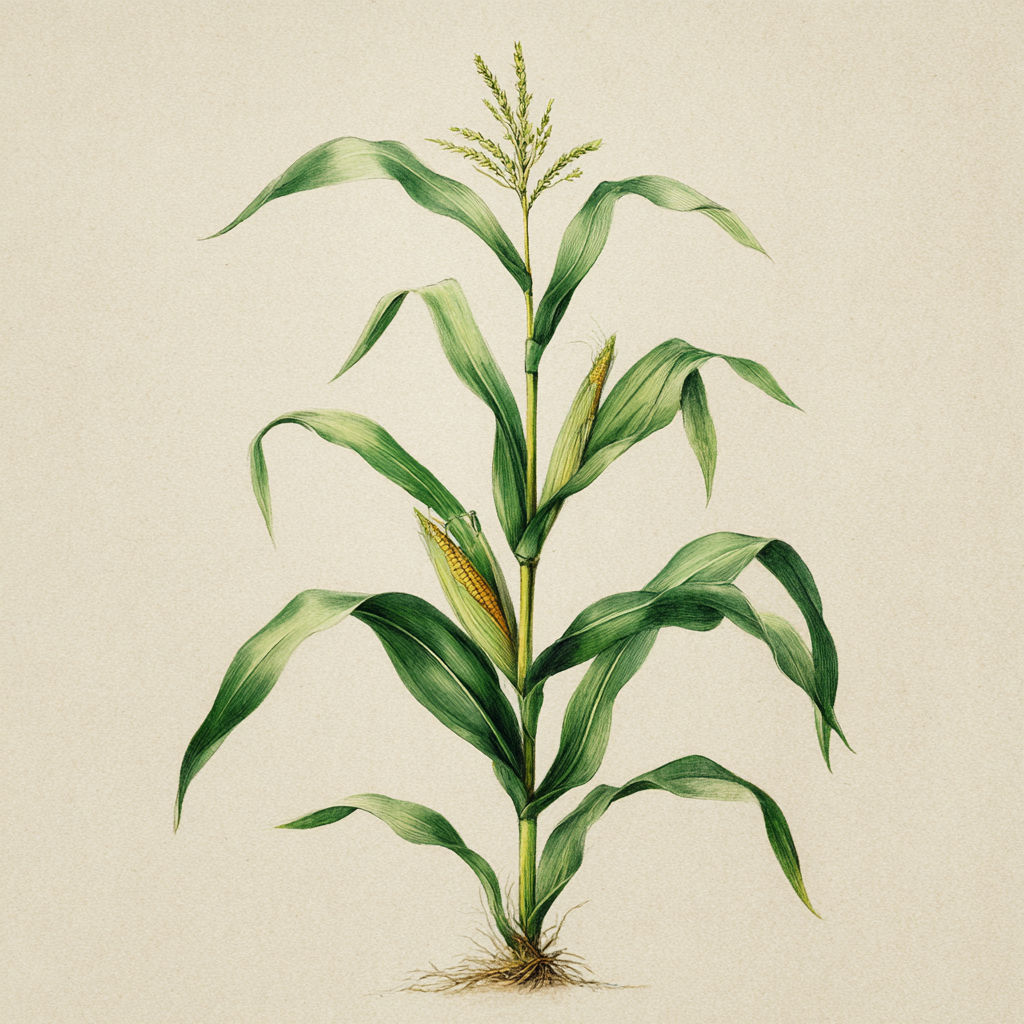
Have seeds for this? Add to inventory →Corn is a tall wind-pollinated grain grown as a warm-season vegetable. It forms the vertical component of the Three Sisters guild, providing a living trellis for beans and shade for squash. Plant in blocks rather than rows for good pollination.
Growing Conditions
Growing Conditions
Sunlight
Full Sun
Water Needs
Moderate
Soil
Rich, well-draining loam; pH 5.8 - 6.8
Spacing
12 inches in blocks of at least 4 rows
Days to Maturity
60 - 100 days from direct sow
Growing Zones
Growing Zones
Thrives in USDA Zones 3 - 11
When to Plant
When to Plant
Direct Sow
1 - 2 weeks after last frost, soil 60°F+
Harvest
60 - 100 days; harvest when silks turn brown and kernels are plump
Phenology (Natural Timing Cues)
Direct Sow
Direct sow corn only when soil has reached at least 60°F - cold soil delays germination unevenly across a block, and patchy emergence means poor wind pollination and poorly filled ears.
- Lilacs are blooming or just past bloom.
- Oak leaves are the size of a squirrel's ear.
- Soil feels warm several inches down, not just at the surface.
- Night temperatures stay above 50°F.
Start Dates (Your Location)
Average dates use your saved zone; readiness also checks your forecast when available.
Average Last Frost
Set your growing zone to see personalized calendar dates.
Use the average timing, but check your local forecast before planting.
Organic Growing Tips
Organic Growing Tips
Plant in a minimum 4×4 block for good wind pollination - rows produce poorly pollinated cobs.
Apply a drop of mineral oil to fresh silks at the tip of each ear to suffocate corn earworm larvae.
Interplant with Three Sisters companions - beans fix nitrogen that feeds the heavy corn plants.
Choose a location with no night shade; corn needs maximum daylight hours for high yields.
Care Guidance
Optional seasonal guidance for what you can do, even when nothing is urgent.
Care Guidance
Watering
If the top 2 inches of soil feel dry, a deep watering at the base may help more than frequent light watering. In healthy soil, rain may cover much of what it needs.
Feeding
Extra feeding is rarely required if soil is healthy. If growth looks pale or slow, a light compost top-dressing is often enough before adding anything stronger.
Seasonal care
During the main season, harvesting when the crop is ready and removing damaged growth can help keep the planting productive if it starts to look crowded or tired.
Known Varieties
Common cultivars worth knowing
Known Varieties
Silver Queen
Classic white sweet corn with tall plants and late-season harvest.
Best for
traditional sweet corn
Golden Bantam
Old open-pollinated yellow sweet corn with rich flavor.
Best for
heirloom gardens
Honey Select
TripleSweet hybrid with tender kernels and extended sweetness.
Best for
fresh eating
Peaches and Cream
Bicolor sweet corn with reliable flavor and broad availability.
Best for
family gardens
Glass Gem
Ornamental flint corn with multicolored translucent kernels.
Best for
decorative ears, seed saving
Companion Planting
Companion Planting
Common Pests
Common Pests
All pest management in Garden uses safe, organic, non-toxic methods only. No synthetic pesticides, ever.
Simple Ways to Use
Simple Ways to Use
Start here if you're not sure how to use this crop in the kitchen.
Quick recipes you can make right away
Boiled Sweet Corn
Shuck the ears, bring a large pot of water to a boil, then cook the corn 3 to 5 minutes until the kernels turn bright yellow and release milky juice when pressed. Serve it right away with butter and salt before the kernels toughen.
Roasted Corn Kernels
Cut fresh kernels from the cob, spread them on a hot skillet or sheet pan with a little oil, and cook 8 to 12 minutes until some kernels brown at the edges and smell sweet. Stir once or twice so they color without burning.
Corn and Bean Bowl
Cook fresh kernels in a skillet for 4 to 6 minutes until just tender, then stir them into warm beans with lime juice and salt. Stop cooking while the kernels still pop slightly between your teeth instead of turning chewy.
How to Preserve
How to Preserve
Use this section to store or process extra harvest before it spoils.
Practical methods for extra harvest
Freeze blanched kernels
Boil whole ears 4 minutes, chill them fully in ice water, then cut off the kernels and dry them well before bagging. Freeze the kernels flat so you can break off what you need later without thawing the whole bag.
Freeze ears whole
Blanch shucked ears 7 to 9 minutes depending on size, chill them in ice water until cold all the way through, then drain and freeze them in bags. Do not skip blanching, because raw frozen corn loses sweetness and texture faster in storage.
Dry mature kernels
Leave field or flour corn on the stalk until the husks are brown and the kernels are hard enough that a fingernail cannot dent them, then finish drying the ears indoors with airflow if needed. Shell and store only when the kernels feel fully hard and dry, because partly dry corn molds quickly.
New to preserving food?
New to freezing? Read the freezing guide.New to dehydrating? Read the dehydrating guide.How to Store
How to Store
Simple storage tips
Keep sweet corn cold as soon as possible after picking, because the kernels lose sweetness quickly at room temperature.
Use fresh ears within 1 to 3 days for the best flavor, even if they still look fine longer than that.
Store unshucked ears in the refrigerator in a bag or crisper so they do not dry out.
Shuck only right before cooking, because the husk helps protect the kernels from drying.
If the kernels look dull or feel starchy instead of juicy, cook or preserve the corn right away instead of waiting.
How to Save Seed
How to Save Seed
Step-by-step seed saving
- 1
If the packet or plant tag says F1 hybrid, saved seeds may grow into uneven corn next year. Open-pollinated corn is the better choice if you want seed to stay true.
- 2
Corn crosses very easily with other corn varieties, so save seed only if it is isolated from other corn that sheds pollen at the same time.
- 3
Leave ears on the stalk until the husks dry brown and the kernels are hard enough that a thumbnail cannot dent them.
- 4
Bring the ears under cover to finish drying if needed, then shell and store the kernels only when they feel fully hard and no longer cool or rubbery.
Native Range
Native Range
- Origin
- Maize is a Mesoamerican domesticate derived from teosinte lineages native to Mexico.
- Native Habitat
- Wild teosinte relatives occupy warm open slopes, field margins, grasslands, and seasonally disturbed habitats.
- Current Distribution
- Widely cultivated in suitable growing regions worldwide; not native outside its region of origin.
Taxonomy
Taxonomy
- Kingdom
- Plantae
- Family
- Grass family (Poaceae)
- Genus
- Zea
- Species
- Zea mays
Morphology
Morphology
Root System
Fibrous grass root system with brace roots near the soil surface that help anchor tall stalks. Roots need steady moisture during tasseling and ear fill.
Stem
Tall jointed stalk with nodes and internodes, usually unbranched in sweet corn. Each node can support a leaf, and ears form from side shoots.
Leaves
Long strap-like leaves with parallel veins, clasping the stalk at nodes. Leaf rolling is an early sign of drought stress.
Flowers
Separate male tassels at the top shed pollen onto female silks emerging from ears. Each silk connects to one potential kernel, so poor pollination causes missing kernels.
Fruit
Ears contain rows of kernels enclosed in husks. Sweet corn is harvested immature when kernels are plump and milky.
Natural History
Natural History
Maize (Zea mays) was domesticated from wild teosinte (Balsas teosinte, Zea mays ssp. parviglumis) in the Balsas River valley of what is now southwestern Mexico, with genetic and archaeological evidence placing initial domestication around 9,000 years ago. The transformation from teosinte - a branching grass with small, hard, open-husked kernels - to maize's enclosed cob was one of the most dramatic genetic reorganizations in the history of crop domestication, requiring selection across multiple genes governing kernel size, kernel number, and husk enclosure. By around 5,000 years ago, maize was spreading northward through Mesoamerica, and by approximately 2,000 years ago it had reached the eastern woodlands of North America where it became foundational to Three Sisters agriculture alongside beans and squash. Columbus encountered it in the Caribbean in 1492 - calling it mahiz, the Taino word - beginning its global spread: Europe by 1520, Africa by 1550, China by the late 16th century. A critical technology traveled less successfully: the Mesoamerican process of nixtamalization - soaking maize in alkaline solution to release bound niacin - was not adopted by European or African populations, leading to widespread pellagra in regions where maize became a dietary staple without this processing step.
Traditional Use
Traditional Use
Maize sits at the intersection of agriculture, ceremony, and cultural identity across the Americas more deeply than almost any other crop plant. Its history is primarily one of agricultural sophistication - the maintenance of hundreds of distinct landrace varieties by indigenous communities across the Americas for thousands of years - rather than medicinal use.
Parts Noted Historically
Mesoamerican Nixtamal Tradition - Kernels
The Aztec and pre-Aztec Mesoamerican discovery of nixtamalization - soaking dried corn in calcium hydroxide or wood ash lye before grinding - transformed maize from a starchy grain into a nutritionally complete food by releasing bound niacin and increasing available calcium. This process, documented archaeologically by around 1500-1200 BCE, made maize capable of sustaining populations as a dietary staple. Spanish colonists adopted the food but ignored the process, with severe nutritional consequences for European and African populations that adopted corn without the nixtamal step.
Three Sisters Agriculture - Kernels
Indigenous peoples of the eastern woodlands and northeast - including the Haudenosaunee (Iroquois) and many other nations - developed the Three Sisters intercrop of corn, beans, and squash as a mutually supporting system. Corn provided vertical structure for bean vines; beans fixed nitrogen; squash shaded the ground to retain moisture and suppress weeds. This system is one of the most thoroughly documented pre-Columbian agricultural innovations and was described in detail by European colonists from the 17th century onward.
Corn Silk in Folk and Botanical Medicine - Silks
Corn silk - the long stigmas of the female flower - was used in folk traditions across North America and later incorporated into 19th-century botanical pharmacy. Multiple nations including the Cherokee and Choctaw had documented corn silk applications. American eclectic physicians listed it in 19th-century texts and it appeared in the US Pharmacopoeia from 1894 through the early 20th century.
Andean Maize and Chicha - Kernels
In the Andean civilizations of Peru and Bolivia, maize was central to both food and ritual. Chicha - a fermented maize beverage - was produced in dedicated facilities associated with the Inca administrative system and consumed in ceremonial contexts connecting ancestors, agricultural cycles, and political authority. Archaeological evidence of industrial-scale chicha brewing has been found at major Inca administrative centers, indicating state-level organization of maize fermentation.
Sweet corn is one of the most widely consumed and well-tolerated vegetables. The primary historical safety consideration is dietary: maize consumed as a staple without nixtamalization has caused pellagra (niacin deficiency) throughout history in populations that adopted corn without the processing step.
This information is provided for historical and educational purposes only and is not medical advice. Always consult a qualified healthcare professional before making decisions related to your health.
Related Articles
Related Articles
Composting: From Kitchen Scraps to Garden Gold
Soil & Compost • 5 min read
Companion Planting: What Actually Works
Companion Planting • 7 min read
The Three Sisters: Growing Corn, Beans & Squash Together
Companion Planting • 5 min read
How and When to Harvest Vegetables for Best Flavour
Harvesting & Storage • 5 min read
Freezing Food: The Simplest Way to Preserve Your Harvest
Harvesting & Storage • 6 min read
Canning Food Safely: Water Bath vs Pressure Canning Explained
Harvesting & Storage • 7 min read
Choosing the Right Food Preservation Method
Harvesting & Storage • 6 min read
Loading photo submission…