
Zucchini
VegetableCucurbita pepo
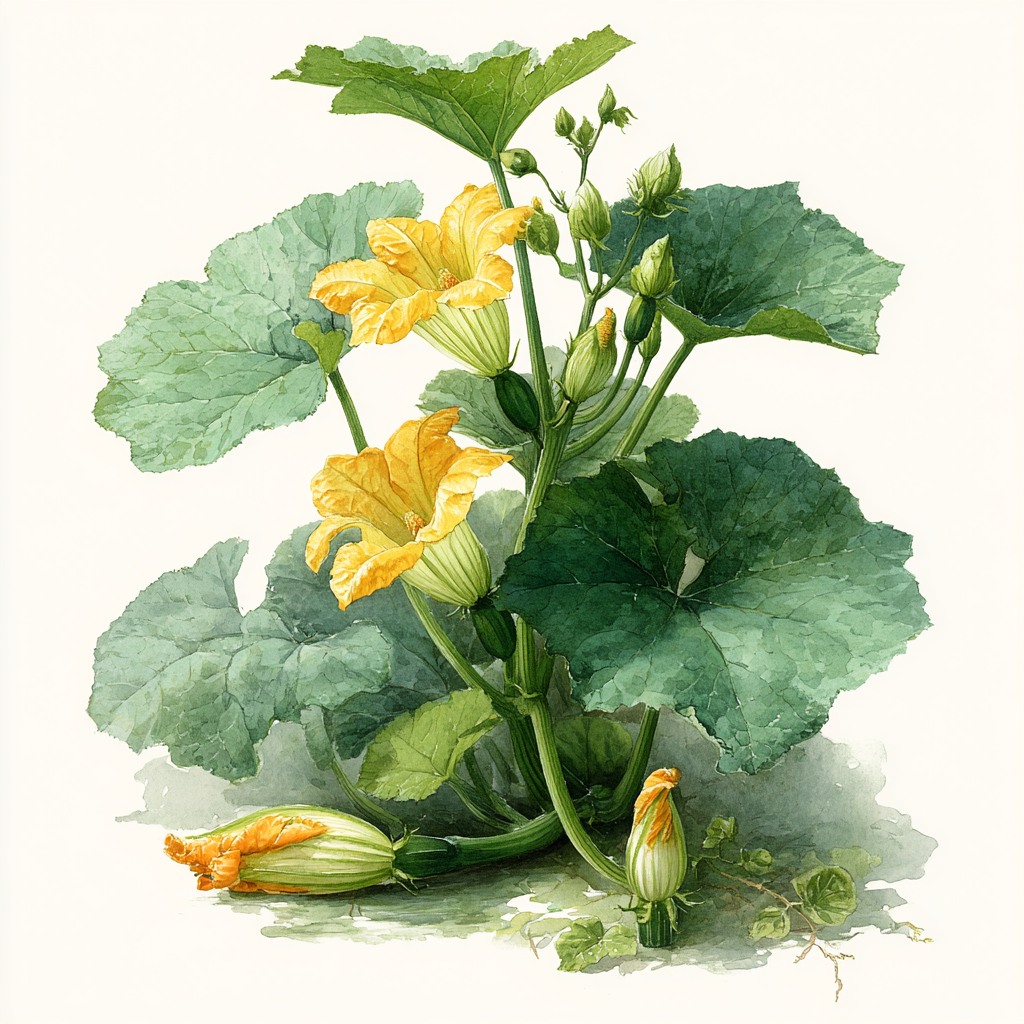
Have seeds for this? Add to inventory →Zucchini is one of the most productive summer vegetables, capable of overwhelming gardeners with its output. Part of the classic Three Sisters guild alongside corn and beans, it shades the ground to suppress weeds.
Growing Conditions
Growing Conditions
Sunlight
Full Sun
Water Needs
Moderate
Soil
Rich, well-draining loam; pH 6.0 - 7.5
Spacing
24 - 36 inches
Days to Maturity
45 - 65 days from direct sow
Growing Zones
Growing Zones
Thrives in USDA Zones 3 - 11
When to Plant
When to Plant
Start Indoors
3 - 4 weeks before last frost
Direct Sow
1 week after last frost, soil 60°F+
Harvest
45 - 65 days from sowing
Phenology (Natural Timing Cues)
Start Indoors
Indoor starts for zucchini should be brief - 3 to 4 weeks maximum - because zucchini grows explosively and root-bound plants stall badly at transplant. The only purpose of starting indoors is to gain a week or two in short-season zones where soil is not yet warm enough for direct sowing. Starting too early produces a pot-bound, overgrown plant that loses its momentum advantage immediately after transplant.
- Dandelions are blooming and lilac buds are swelling or beginning to open.
- Outdoor soil is warming but still below 60°F in a sunny bed.
- The last expected frost is still 3 - 4 weeks away.
Direct Sow
Direct sowing is the preferred method for zucchini because seedlings sown into genuinely warm soil usually catch up to transplants within 1 - 2 weeks. The key is patience - sowing into cold or marginal soil leads to slow germination, damping-off risk, and seedlings that stall before establishing. The reliable signal is that lilacs have bloomed and faded: in most zones this coincides with soil temperatures that have reached at least 60°F in sunny beds, which is the threshold for reliable zucchini germination.
- Lilacs have bloomed and are fading or fully past.
- Soil feels warm in the top few inches even in the morning.
- Tender annual weeds are germinating and growing quickly.
- Last frost has passed by at least a week.
Transplant
Transplanting should happen only when warm-season conditions are genuinely stable. Zucchini set back by cold, wet weather after planting can be slower to recover than plants that were never moved, so timing the transition from indoors to garden correctly matters. Do not hold zucchini plants in pots once they are 3 - 4 weeks old waiting for ideal conditions - they become root-bound quickly and lose the advantage the indoor start was meant to provide.
- Lilacs have finished blooming.
- Oak leaves are near full size.
- Nights are reliably warm above 50°F.
- New transplant growth stays firm after several days of hardening off.
Start Dates (Your Location)
Average dates use your saved zone; readiness also checks your forecast when available.
Average Last Frost
Set your growing zone to see personalized calendar dates.
Use the average timing, but check your local forecast before planting.
Organic Growing Tips
Organic Growing Tips
Plant borage nearby to repel squash bugs and attract pollinators for better fruit set.
Inspect the base of stems weekly for squash vine borer eggs and remove by hand.
Work compost or worm castings into planting hills before sowing — zucchini are heavy feeders and biologically rich soil grows plants that resist disease and produce prolifically without needing supplemental synthetic inputs.
Apply kaolin clay to stems as a physical barrier against squash vine borers.
Care Guidance
Optional seasonal guidance for what you can do, even when nothing is urgent.
Care Guidance
Watering
If the top 2 inches of soil feel dry, a deep watering at the base may help more than frequent light watering. In healthy soil, rain may cover much of what it needs.
Feeding
If growth is strong, compost-rich soil often carries most of the load. If the plant starts looking pale or stalls, a light compost top-dressing or gentle organic feed may help.
Seasonal care
During the main season, harvesting when the crop is ready and removing damaged growth can help keep the planting productive if it starts to look crowded or tired.
Known Varieties
Common cultivars worth knowing
Known Varieties
Black Beauty
Classic dark green heirloom with reliable production and straight fruit.
Best for
general garden use
Costata Romanesco
Ribbed Italian heirloom with excellent flavor and prominent blossoms.
Best for
flavor, squash blossoms
Raven
Compact hybrid with dark fruit and strong productivity in small spaces.
Best for
containers, small gardens
Cocozelle
Striped Italian type with tender texture when picked young.
Best for
sauteing, fresh harvests
Eight Ball
Round zucchini harvested small for stuffing or grilling.
Best for
stuffing, novelty harvests
Companion Planting
Companion Planting
Good companions
Support & insectary plants
Nearby plants that attract pollinators, beneficial insects, or improve soil health.
- Nasturtium
Trap crop for aphids; attracts beneficial insects
- Borage
Attracts beneficial insects and produces nutrient-rich mulch
- Marigold
Suppresses soil nematodes; trap crop for aphids and whiteflies
Avoid planting near
- Fennel
Allelopathic - secretes volatile compounds that inhibit the growth of most vegetables and herbs
Common Pests
Common Pests
All pest management in Garden uses safe, organic, non-toxic methods only. No synthetic pesticides, ever.
Simple Ways to Use
Simple Ways to Use
Start here if you're not sure how to use this crop in the kitchen.
Quick recipes you can make right away
Garlic Saute Zucchini
Slice zucchini into 1/4 inch half-moons and cook it in a hot skillet with oil, garlic, and salt for 4 to 6 minutes until the pieces are just tender and lightly browned on the edges. Add lemon juice at the end and serve right away before it turns watery.
Roasted Zucchini Planks
Cut zucchini lengthwise into planks, brush lightly with oil, and roast at 425°F for 15 to 20 minutes until the edges brown and the centers are soft when pierced with a fork. Sprinkle with herbs or cheese while the planks are still hot.
Zucchini Fritters
Grate zucchini, toss it with salt, and let it sit 10 minutes, then squeeze out as much water as you can with your hands or a towel until it stops dripping. Mix it with egg and flour, pan-fry spoonfuls 2 to 3 minutes per side until both sides are deep golden, and serve while crisp.
How to Preserve
How to Preserve
Use this section to store or process extra harvest before it spoils.
Practical methods for extra harvest
Freeze shredded zucchini
Grate zucchini, squeeze out excess water until the shreds clump instead of dripping, then pack it into measured freezer bags and flatten the bags for quick freezing. Freeze until solid and use it later in breads, soups, or fritters where a softer texture is fine.
Pickle zucchini rounds
Slice zucchini into rounds, pour a hot vinegar brine over the slices, and refrigerate them for quick pickles or water-bath can them using a tested recipe. Keep the full vinegar amount the recipe calls for because lowering the acid makes pickles unsafe for shelf storage.
Dry zucchini chips
Slice zucchini very thin, dry it at 125°F to 135°F until the slices are crisp and snap cleanly instead of bending, then cool them fully before sealing. If the chips soften in the jar the next day, dry them longer before storing them again.
How to Store
How to Store
Simple storage tips
Use zucchini while the skin is glossy and the fruit still feels firm, because it turns seedy and watery as it ages.
Store it dry and unwashed in the refrigerator crisper, ideally in a loose bag that lets extra moisture escape.
Use it within about 4 to 7 days for the best texture, especially if the fruit was picked small.
Cook or grate oversized zucchini first because large fruit softens faster once picked.
Check every day or two and remove any fruit with soft spots, wet patches, or mold so it does not spoil the rest.
How to Save Seed
How to Save Seed
Step-by-step seed saving
- 1
If the packet or tag says F1 hybrid, saved seed may give you a mix of squash types next year. Open-pollinated zucchini is the better choice if you want seed to stay true.
- 2
Leave one healthy zucchini on the plant until it becomes oversized, dull-colored, and hard enough that you cannot dent the skin with a fingernail.
- 3
Cut it open, scoop out the mature seeds, and rinse away the strings until the seeds feel clean and no slippery pulp remains.
- 4
Dry the seeds in a single layer for 1 to 2 weeks until they feel hard and snap instead of bending, then store them dry because zucchini crosses easily with other summer squash nearby.
Native Range
Native Range
- Origin
- Cucurbita pepo includes wild and domesticated North American squash lineages, but zucchini is a cultivated garden form rather than a local wild ecotype.
- Native Habitat
- Wild forms occupy river bottoms, open thickets, disturbed alluvial soils, and warm-season margins with room for sprawling vines.
- Current Distribution
- Widely cultivated in warm garden regions; not native outside its region of origin.
Taxonomy
Taxonomy
- Kingdom
- Plantae
- Family
- Gourd family (Cucurbitaceae)
- Genus
- Cucurbita
- Species
- Cucurbita pepo
Morphology
Morphology
Root System
Shallow, wide-spreading fibrous roots that feed heavily near the soil surface. Roots resent disturbance and perform best in loose, compost-rich soil with steady moisture.
Stem
Thick, hollow, prickly stems radiate from a central crown in bush types. Plants look compact at first but quickly form a broad mound with short running stems.
Leaves
Large, rough, lobed leaves with stiff hairs and often silver mottling along the veins. Healthy mottling can be mistaken for disease; powdery mildew appears as a dustier white coating on leaf surfaces.
Flowers
Large yellow-orange blossoms with separate male and female flowers on the same plant. Female flowers are easy to spot by the small zucchini-shaped ovary behind the petals.
Fruit
Immature cylindrical squash harvested while skin is glossy and seeds are soft. Fruit can enlarge very quickly and becomes seedy, watery, and tougher if left too long.
Natural History
Natural History
Cucurbita pepo was domesticated in Mesoamerica at least 8,000-10,000 years ago - making it one of the oldest cultivated crop plants in the Americas and possibly the world. Archaeological squash remains dated to around 8,000 BCE have been found at Guila Naquitz Cave in Oaxaca, Mexico. The word "squash" comes from the Narragansett word askutasquash, meaning something eaten raw or uncooked, recorded by English colonists in the 17th century. Zucchini itself is an Italian invention: the word is Italian for "little squashes" (zucchino, diminutive of zucca, meaning gourd), and the specific form - a dark green cylindrical summer squash harvested immature - was developed by Italian growers in the 19th century from marrow-type squashes that Europeans had been cultivating since the 16th-17th centuries after seeds arrived from the Americas. Zucchini arrived in the United States primarily through Italian immigration in the early 20th century, becoming common in California's Italian-American communities before spreading nationally. The squash blossom tradition - harvesting male flowers for cooking - predates the development of the zucchini form and has roots both in Italian practice and in Mesoamerican cuisine, where squash flowers were eaten long before the Italian variety was created. The Three Sisters agricultural system of the Haudenosaunee (Iroquois) and other northeastern Nations used Cucurbita pepo as the third sister alongside corn and beans, where the large leaves shaded the ground, retained moisture, and suppressed weeds in a relationship that has been confirmed by modern agronomic research.
Traditional Use
Traditional Use
Cucurbita pepo's eight-thousand-year history moves through Mesoamerican seed crops, European marrow cultivation, Italian summer squash development, and the Three Sisters agricultural guild - a longer and more complex trajectory than its modern garden reputation suggests.
Parts Noted Historically
Mesoamerican Domestication - Seeds and flesh
The Guila Naquitz Cave site in Oaxaca, Mexico has yielded squash remains dated to approximately 8,000 BCE - some of the oldest evidence of plant domestication in the Americas. Early domestication focused on seeds (eaten as a high-protein, high-fat food) before selection for larger, sweeter flesh became important. By the time of the Aztec empire, Cucurbita pepo was thoroughly integrated into Mesoamerican agriculture and cooking. The Florentine Codex records squash being sold in Aztec markets, and multiple forms - including both summer and storage types - were cultivated across different ecological zones.
Three Sisters Agriculture - Fruit and leaves
The Three Sisters - corn, beans, and squash - were grown together in the same mound by the Haudenosaunee (Iroquois Confederacy) and many other North American nations in a companion planting system of extraordinary ecological sophistication. Corn provided vertical structure for the beans to climb; beans fixed nitrogen and fed the heavy-feeding corn and squash; squash spread its large leaves as living mulch, suppressing weeds and retaining soil moisture. Modern agronomic research has confirmed the productivity benefits of this combination. The Three Sisters were not merely crops but held ceremonial and spiritual significance as gifts from the Creator, featuring in harvest ceremonies and oral traditions across the Northeast.
European Marrow and Summer Squash Development - Fruit
Cucurbita pepo seeds reached Europe via Spain in the 16th century, and European gardeners began selecting forms suited to European tastes and conditions. The marrow - a large mature squash harvested when the rind has hardened - became a British kitchen garden staple from the 17th century onward. Italian growers made the key innovation: selecting for harvest before maturity, when the squash is small, glossy, and tender. This practice, producing what we now call summer squash, developed into the specific cylindrical zucchino form in 19th-century Italy. John Gerard's 1597 Herball described several gourd types including early C. pepo forms under different names.
Italian Squash Blossom Tradition - Flowers
The use of squash flowers as food has roots in both Mesoamerican and Italian practice. In Italy, fiori di zucca - squash blossoms, typically the male flowers - are a significant seasonal ingredient in Roman and central Italian cooking: stuffed with ricotta and anchovies then deep-fried in a light batter, or sliced raw into pasta. The tradition is well documented in Roman-dialect cookbooks from the 19th century onward and reflects a broader Italian practice of eating the whole plant through the season. The same instinct appears in Mexican cuisine, where flor de calabaza is used in quesadillas, soups, and sautéed dishes, connecting back to the pre-Columbian use of the same plant.
This information is provided for historical and educational purposes only and is not medical advice. Always consult a qualified healthcare professional before making decisions related to your health.
Related Articles
Related Articles
Establishing a Garden Bed
Getting Started • 6 min read
Composting: From Kitchen Scraps to Garden Gold
Soil & Compost • 5 min read
Using Animal Manure in the Garden: Chickens, Rabbits, and Compost Safety
Soil & Compost • 12 min read
The Three Sisters: Growing Corn, Beans & Squash Together
Companion Planting • 5 min read
Identifying and Treating Common Fungal Diseases
Pest & Disease • 7 min read
How and When to Harvest Vegetables for Best Flavour
Harvesting & Storage • 5 min read
Loading photo submission…