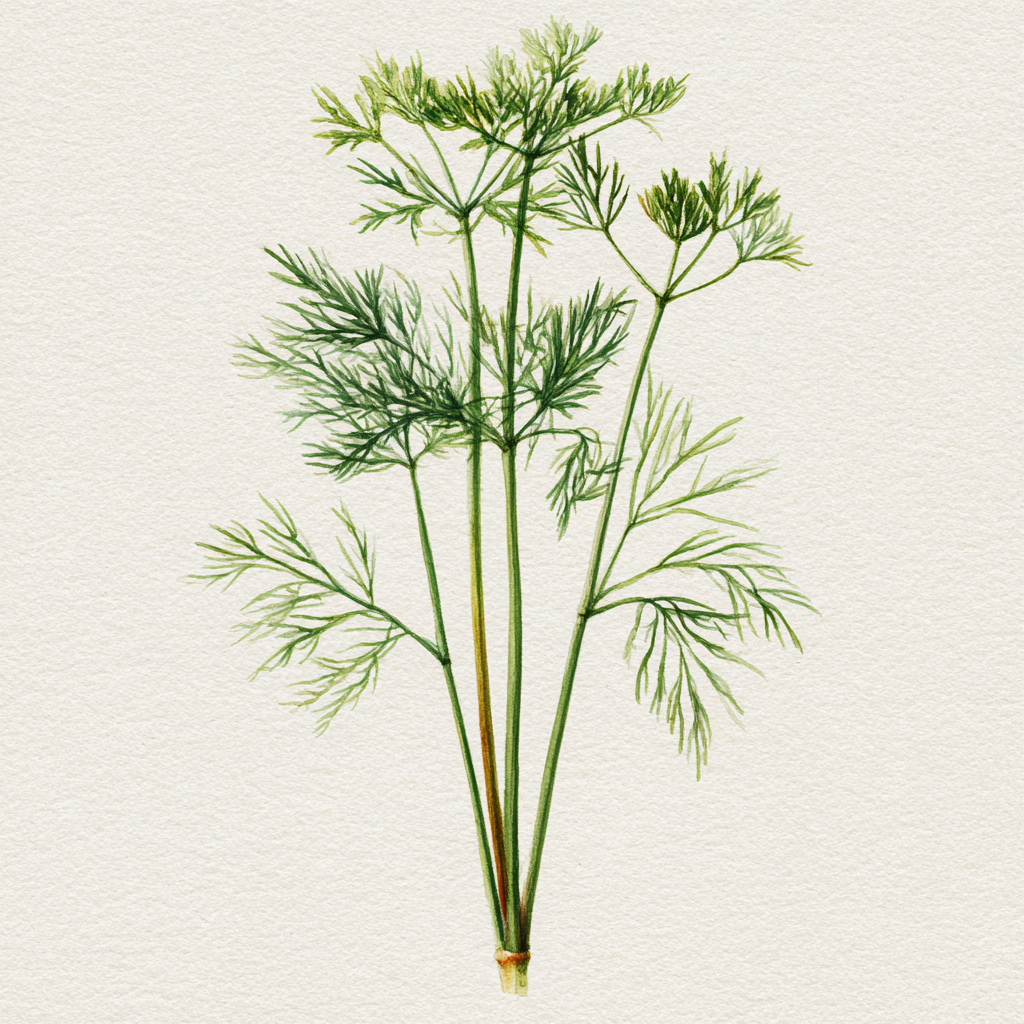
Dill
HerbAnethum graveolens
Have seeds for this? Add to inventory →Dill is an airy, feathery annual herb that produces both edible foliage and seeds. Its yellow umbel flowers attract an enormous range of beneficial insects including parasitic wasps, hoverflies, and lacewings that control pest populations.
Growing Conditions
Growing Conditions
Sunlight
Full Sun
Water Needs
Low
Soil
Well-draining loam; pH 5.5 - 6.5
Spacing
12 inches
Days to Maturity
40 - 60 days to first leaf harvest; 90 - 110 days to seed
Growing Zones
Growing Zones
Thrives in USDA Zones 3 - 11
When to Plant
When to Plant
Direct Sow
After last frost; succession sow every 3 - 4 weeks
Harvest
Harvest leaves young; harvest seeds when they begin to brown
Phenology (Natural Timing Cues)
Direct Sow
Dill has two good sowing windows - early spring while weather is still cool and mild, and late summer as heat eases into autumn. Once peak summer heat arrives, dill bolts to flower quickly and leaf production drops sharply. Always sow where plants will grow rather than transplanting, because the taproot dislikes disturbance. Succession sow in small batches every 3 - 4 weeks during cool windows for steady leaf harvest rather than one tall flush of bolting plants.
- Dandelions are fully in bloom (spring sowing).
- Soil is workable and drains freely after rain.
- Cool to mild days are forecast for the next week or more.
- Summer heat is easing and first cool nights are returning (late-season sowing).
Start Dates (Your Location)
Average dates use your saved zone; readiness also checks your forecast when available.
Average Last Frost
Set your growing zone to see personalized calendar dates.
Use the average timing, but check your local forecast before planting.
Organic Growing Tips
Organic Growing Tips
Plant young dill near brassicas to attract beneficial insects, but keep mature dill away from carrots and tomatoes.
Allow dill to flower and self-seed freely - it will naturalise in the garden and provide continuous beneficial insect habitat.
Do not grow near fennel - they cross-pollinate readily and produce a bland hybrid flavour.
Sow into compost-enriched, moisture-retentive soil and allow dill to decompose in place when spent — as it breaks down it returns nutrients to the soil and feeds the biology that underpins the whole garden ecosystem.
Care Guidance
Optional seasonal guidance for what you can do, even when nothing is urgent.
Care Guidance
Watering
Extra watering is often only useful during extended dry periods. If the top 2 to 3 inches are still holding moisture, additional water may not help.
Feeding
Extra feeding is rarely required if soil is healthy. If growth looks pale or slow, a light compost top-dressing is often enough before adding anything stronger.
Seasonal care
During the main season, harvesting when the crop is ready and removing damaged growth can help keep the planting productive if it starts to look crowded or tired.
Known Varieties
Common cultivars worth knowing
Known Varieties
Bouquet
Classic dill grown for both leaves and abundant seed heads.
Best for
pickling, seed harvest
Fernleaf
Compact dwarf dill with dense foliage.
Best for
containers, leaf harvest
Mammoth
Tall vigorous dill with large seed heads.
Best for
pollinators, pickling
Dukat
Leafy variety with strong aroma and slower seed formation.
Best for
fresh leaves
Tetra
Productive leaf dill with sturdy growth.
Best for
bunching, repeated harvest
Companion Planting
Companion Planting
Good companions
Support & insectary plants
Nearby plants that attract pollinators, beneficial insects, or improve soil health.
- Borage
Attracts beneficial insects and produces nutrient-rich mulch
- Nasturtium
Trap crop for aphids; attracts beneficial insects
Common Pests
Common Pests
All pest management in Garden uses safe, organic, non-toxic methods only. No synthetic pesticides, ever.
Simple Ways to Use
Simple Ways to Use
Start here if you're not sure how to use this crop in the kitchen.
Quick recipes you can make right away
Fresh Dill Yogurt Dip
Stir 1 to 2 tablespoons of chopped dill into plain yogurt with a pinch of salt and a squeeze of lemon, then chill it 10 minutes before serving. Use it with cucumbers, potatoes, or roasted vegetables while the dill still tastes bright.
Quick Dill Cucumbers
Slice cucumbers, toss them with chopped dill, vinegar, salt, and a little sugar if you like, then let them stand 10 minutes so the cucumbers release a little juice. Serve while they are still crisp and cold.
Dill Potatoes
Toss hot boiled or roasted potatoes with butter or oil and a spoonful of chopped dill just before serving. Add the dill at the end so it stays fragrant instead of cooking away.
How to Preserve
How to Preserve
Use this section to store or process extra harvest before it spoils.
Practical methods for extra harvest
Air dry dill
Tie small dill bundles or spread sprigs on a screen in a warm airy place out of direct sun for about 4 to 7 days. The dill is fully dry when the fine leaves crumble easily and the stems snap with no damp bend left.
Freeze chopped dill
Rinse and dry the dill well, chop the fronds, and freeze them flat in a small bag or in ice-cube trays with a spoonful of water. Use the dill straight from frozen in soups, eggs, or potatoes, because thawed fronds are too soft for a fresh garnish.
Make dill vinegar
Pack a jar loosely with fully dried dill sprigs or seed heads, cover them completely with vinegar, and steep for 1 to 2 weeks out of direct sun. Strain when the vinegar smells strongly of dill, then use it for potato salad, cucumber salad, or quick pickles.
New to preserving food?
New to freezing? Read the freezing guide.New to dehydrating? Read the dehydrating guide.How to Store
How to Store
Simple storage tips
Wrap fresh dill loosely in a barely damp towel or paper towel and keep it in the refrigerator in a bag or covered container.
Use fresh dill within about 3 to 5 days, before the fronds yellow, collapse, or turn slimy.
If the stems are long, you can also stand them in a jar with a little water in the refrigerator and cover them loosely.
Store dried dill in an airtight jar in a dark cool cupboard, and expect the best flavor within about 6 months.
Freeze extra dill quickly, because it loses fresh quality faster than sturdier herbs like rosemary or sage.
How to Save Seed
How to Save Seed
Step-by-step seed saving
- 1
Let the flower heads dry on the plant until they turn brown and the seeds feel hard and dry.
- 2
Cut the dry heads into a paper bag and hang or set them in a dry place for several more days if needed.
- 3
Rub or shake the heads to release the seeds, then remove the larger dry pieces before storing them.
- 4
Store the fully dry seed in a cool dry place, and save extra for sowing because dill is one of the easiest herbs to reseed from the garden.
Native Range
Native Range
- Origin
- Dill is native to the Mediterranean region and western to central Asia.
- Native Habitat
- Sunny disturbed soils, field margins, dry open ground, and seasonally cool grasslands.
- Current Distribution
- Naturalized across many temperate regions, especially in disturbed habitats.
Taxonomy
Taxonomy
- Kingdom
- Plantae
- Family
- Carrot family (Apiaceae)
- Genus
- Anethum
- Species
- Anethum graveolens
Morphology
Morphology
Root System
Slender taproot with fine side roots, sensitive to transplant disturbance. Direct sowing keeps plants sturdier.
Stem
Upright hollow stems with a blue-green cast, branching as plants mature. Tall plants may lean in wind or rich soil.
Leaves
Very fine, feathery, blue-green leaves with a fresh dill aroma. Leaves are most tender before flowering.
Flowers
Flat yellow umbels held above the foliage. Flowers are excellent landing platforms for small beneficial insects.
Fruit
Flattened oval seeds mature from green to tan-brown and carry the classic dill seed aroma used in pickling.
Natural History
Natural History
Anethum graveolens is the only species in its genus and is native to the eastern Mediterranean and western Asia, growing wild from the Balkans and Asia Minor through Iran and into India. Its species name graveolens means "strongly scented," reflecting the penetrating volatile oil profile - primarily carvone and limonene - that gives dill its distinctive flavor. Archaeological evidence places dill among the oldest documented cultivated herbs; seeds have been recovered from Egyptian tombs, from Bronze Age Swiss lake settlements, and from ancient Mesopotamian sites. The Ebers Papyrus of around 1550 BCE mentions dill, and it appears in ancient Assyrian medical tablets. In the New Testament, dill (anethon) is mentioned as a tithed garden crop - evidence it was commercially significant enough to be formally counted in first-century CE Jerusalem. The plant's hollow stem and deep taproot - typical of the Apiaceae - explain its strong preference for direct sowing and resistance to transplanting.
Traditional Use
Traditional Use
Dill has one of the longest written records of any culinary herb - cited in Egyptian papyri, mentioned in the New Testament, and described by Dioscorides. Its dual identity as both leaf herb and seed spice gave it a continuous presence in European, Middle Eastern, and South Asian food cultures from antiquity onward.
Parts Noted Historically
Ancient Mediterranean and Egyptian Use - Seeds
Dill seeds appear in Egyptian records including the Ebers Papyrus of around 1550 BCE and in ancient Assyrian medical tablets. Dioscorides described the plant in the first century CE in De Materia Medica. The New Testament reference to dill as a tithed garden crop (Matthew 23:23) confirms it was grown commercially in the ancient Near East, not merely foraged.
Northern and Eastern European Pickling Traditions - Flowers and seeds
Dill's most enduring European food role is in pickle production across Scandinavia, Germany, Poland, Russia, and the Baltic states. Dill-brined cucumbers, herring, and root vegetables define a distinct preserved-food culture traceable to at least the medieval period. The flowering head of dill - most aromatic when flowers are open and seeds just forming - became the critical flavoring in fermented and vinegar-brined foods across this entire region.
Scandinavian Midsummer Tradition - Leaves
In the Nordic countries, fresh dill became synonymous with summer cooking in a way few other herbs have achieved in any food culture. Dill-cured salmon (gravlax), new potatoes with dill, and dill-finished fish soups represent a cultural attachment tied specifically to the brief midsummer harvest. The word dill itself derives from the Old Norse dilla - to lull or soothe - a reference to folk beliefs about the plant's gentle properties that also gave its name to "dill water," a traditional preparation given to infants in European households.
South Asian and Persian Seed Spice Use - Seeds
In Indian and Persian cuisines, dill seed (known as sowa or suwa in India) has been used as a distinct spice rather than as a substitute for fennel or caraway. It appears in classical Ayurvedic texts among digestive herbs and is used in lentil dishes, rice preparations, and flatbreads. Indian cultivation centers on seed-crop varieties distinct from the European leaf-dill types developed for fresh herb use.
Dill is a widely eaten culinary herb with an excellent safety record. It belongs to the Apiaceae family; rare sensitization can occur in people with documented carrot-family allergies.
This information is provided for historical and educational purposes only and is not medical advice. Always consult a qualified healthcare professional before making decisions related to your health.
Related Articles
Related Articles
Loading photo submission…