Broccoli
VegetableBrassica oleracea var. italica
Have seeds for this? Add to inventory →Broccoli is a cool-season brassica that forms dense green heads and benefits from a long growing season with consistent cool temperatures. It is a heavy feeder that performs best in rich, well-amended soil.
Growing Conditions
Growing Conditions
Sunlight
Full Sun
Water Needs
Moderate
Soil
Rich, well-draining loam; slightly alkaline pH 6.0 - 7.0
Spacing
18 - 24 inches
Days to Maturity
80 - 100 days from transplant
Growing Zones
Growing Zones
Thrives in USDA Zones 3 - 10
When to Plant
When to Plant
Start Indoors
6 - 8 weeks before last frost
Transplant
2 - 3 weeks before last frost
Direct Sow
85 - 100 days before first autumn frost
Harvest
Cut main head before flowers open; side shoots continue for weeks
Phenology (Natural Timing Cues)
Start Indoors
Start broccoli indoors 6-8 weeks before the last frost date - while outdoor conditions are still firmly winter, well before spring growth advances.
- Deciduous trees are still bare.
- Forsythia has not reached full bloom.
- Dandelions have not reached heavy bloom.
Direct Sow
Direct sow broccoli for an autumn harvest when summer heat has genuinely broken. Count back 85-100 days from your expected first frost to set the target sowing date - sow too late and plants will not size before cold shuts them down.
- Daytime temperatures are consistently below 80°F.
- First cool nights are returning and nights feel distinctly different from midsummer.
- Cool-season weeds and volunteer greens are growing again.
- At least 10-12 weeks remain before expected first frost.
Transplant
Transplant spring broccoli while soil is still cool and early bloom signals are just beginning - plants need cool temperatures to form quality heads.
- Forsythia is blooming.
- Early dandelions are beginning to bloom.
- Soil is workable and not waterlogged.
Start Dates (Your Location)
Average dates use your saved zone; readiness also checks your forecast when available.
Average Last Frost
Set your growing zone to see personalized calendar dates.
Use the average timing, but check your local forecast before planting.
Direct Sow
Autumn
This uses autumn or first-frost timing, so keep the planting note as written.
Organic Growing Tips
Organic Growing Tips
Use floating row covers from transplant to prevent cabbage white butterfly egg-laying.
Apply Bacillus thuringiensis (Bt) spray when caterpillars are spotted - it is lethal to larvae but safe for beneficials.
Plant sweet alyssum nearby to attract hoverflies, whose larvae feed voraciously on aphids.
Side-dress with compost or worm castings monthly — broccoli is a heavy feeder and building soil biology rather than applying synthetic fertiliser produces plants with stronger cell walls that naturally resist pest and disease pressure.
Care Guidance
Optional seasonal guidance for what you can do, even when nothing is urgent.
Care Guidance
Watering
If the top 2 inches of soil feel dry, a deep watering at the base may help more than frequent light watering. In healthy soil, rain may cover much of what it needs.
Feeding
If growth is strong, compost-rich soil often carries most of the load. If the plant starts looking pale or stalls, a light compost top-dressing or gentle organic feed may help.
Seasonal care
During the main season, harvesting when the crop is ready and removing damaged growth can help keep the planting productive if it starts to look crowded or tired.
Known Varieties
Common cultivars worth knowing
Known Varieties
Green Magic
Reliable hybrid with smooth domed heads and good heat tolerance for broccoli.
Best for
main-season harvests
Calabrese
Traditional Italian type with central heads and many side shoots.
Best for
home gardens, side shoots
Waltham 29
Open-pollinated variety known for cold tolerance and extended side-shoot production.
Best for
fall crops
Belstar
Adaptable hybrid for spring and fall plantings with uniform heads.
Best for
reliable harvests
Purple Sprouting
Overwintering sprouting broccoli with many purple side shoots in early spring.
Best for
overwintering, early shoots
Companion Planting
Companion Planting
Support & insectary plants
Nearby plants that attract pollinators, beneficial insects, or improve soil health.
- Nasturtium
Trap crop for aphids; attracts beneficial insects
- Chamomile
Attracts beneficial insects and produces nutrient-rich mulch
- Marigold
Suppresses soil nematodes; trap crop for aphids and whiteflies
- Sweet Alyssum
Attracts pollinators and beneficial insects
- Calendula
Trap crop for aphids; attracts predatory insects
- Lavender
Attracts pollinators and beneficial insects
Avoid planting near
- Fennel
Allelopathic - secretes volatile compounds that inhibit the growth of most vegetables and herbs
- Tomato
- Strawberry
Common Pests
Common Pests
- Cabbage White Caterpillar
- Cabbage Looper
- Aphids
- Clubroot
- Flea Beetle
All pest management in Garden uses safe, organic, non-toxic methods only. No synthetic pesticides, ever.
Simple Ways to Use
Simple Ways to Use
Start here if you're not sure how to use this crop in the kitchen.
Quick recipes you can make right away
Steamed Broccoli
Cut broccoli into even florets and steam them 4 to 6 minutes until the stems can be pierced with a fork but the tops stay bright green. Serve right away before the florets fade to olive green and turn mushy.
Roasted Broccoli
Toss florets with oil and salt, then roast at 425°F for 15 to 22 minutes until the edges brown and the stems are tender when pierced. Stir once halfway through so one side does not scorch.
Broccoli Skillet Bowl
Slice the stems thinly, cook them in a skillet for 2 minutes first, then add the florets and a splash of water and cover for 3 to 4 minutes until both parts turn tender-crisp. Remove the lid at the end so any extra water cooks away.
How to Preserve
How to Preserve
Use this section to store or process extra harvest before it spoils.
Practical methods for extra harvest
Freeze blanched florets
Cut broccoli into florets, boil them 3 minutes, then chill them in ice water until fully cold so they stop cooking and hold better color. Dry them well before freezing on a tray, then bag them once solid so they stay separate.
Freeze blanched stems
Peel tough outer stem skin if needed, slice the stems, and blanch them 3 minutes before cooling them in ice water. Freeze them flat in bags for later soup, stir-fry, or roasted vegetable mixes.
Make broccoli soup base
Steam or simmer broccoli until very soft, blend it with broth, then cool the puree completely before freezing it in meal-size containers. Freeze it as a cooked base only, because raw broccoli puree turns harsh and watery.
New to preserving food?
New to freezing? Read the freezing guide.How to Store
How to Store
Simple storage tips
Keep broccoli cold in the refrigerator and use it within about 3 to 5 days, before the florets loosen or start yellowing.
Store it dry in a bag or container with a little airflow so moisture does not collect around the head.
Use it as soon as the buds start looking puffy or the color lightens, because that means flowering is close.
Do not wash it before storage unless you can dry it well, because trapped moisture encourages rot between the florets.
If the florets smell strong, feel slimy, or show yellow flowers, cook them immediately or discard them if quality is too far gone.
How to Save Seed
How to Save Seed
Step-by-step seed saving
- 1
If the packet or plant tag says F1 hybrid, saved seeds may grow into broccoli that heads differently. Open-pollinated broccoli is the better choice if you want seed to stay true.
- 2
Saving broccoli seed is advanced because the plant must flower and dry down instead of being harvested at the eating stage.
- 3
Leave a few strong plants to bloom, then wait until the seed pods turn tan and brittle before cutting the stalks.
- 4
Broccoli crosses with nearby flowering brassicas, so isolate seed plants if you want clean seed, and thresh only when the pods snap easily instead of bending.
Native Range
Native Range
- Origin
- Broccoli is a cultivated form of Brassica oleracea, a species with wild coastal ancestry in western and Mediterranean Europe.
- Native Habitat
- Wild Brassica oleracea grows on maritime cliffs, coastal limestone, rocky slopes, and open salt-exposed habitats.
- Current Distribution
- Cultivated globally; does not occur as a native plant in this form.
Taxonomy
Taxonomy
- Kingdom
- Plantae
- Family
- Mustard family (Brassicaceae)
- Genus
- Brassica
- Species
- Brassica oleracea var. italica
Morphology
Morphology
Root System
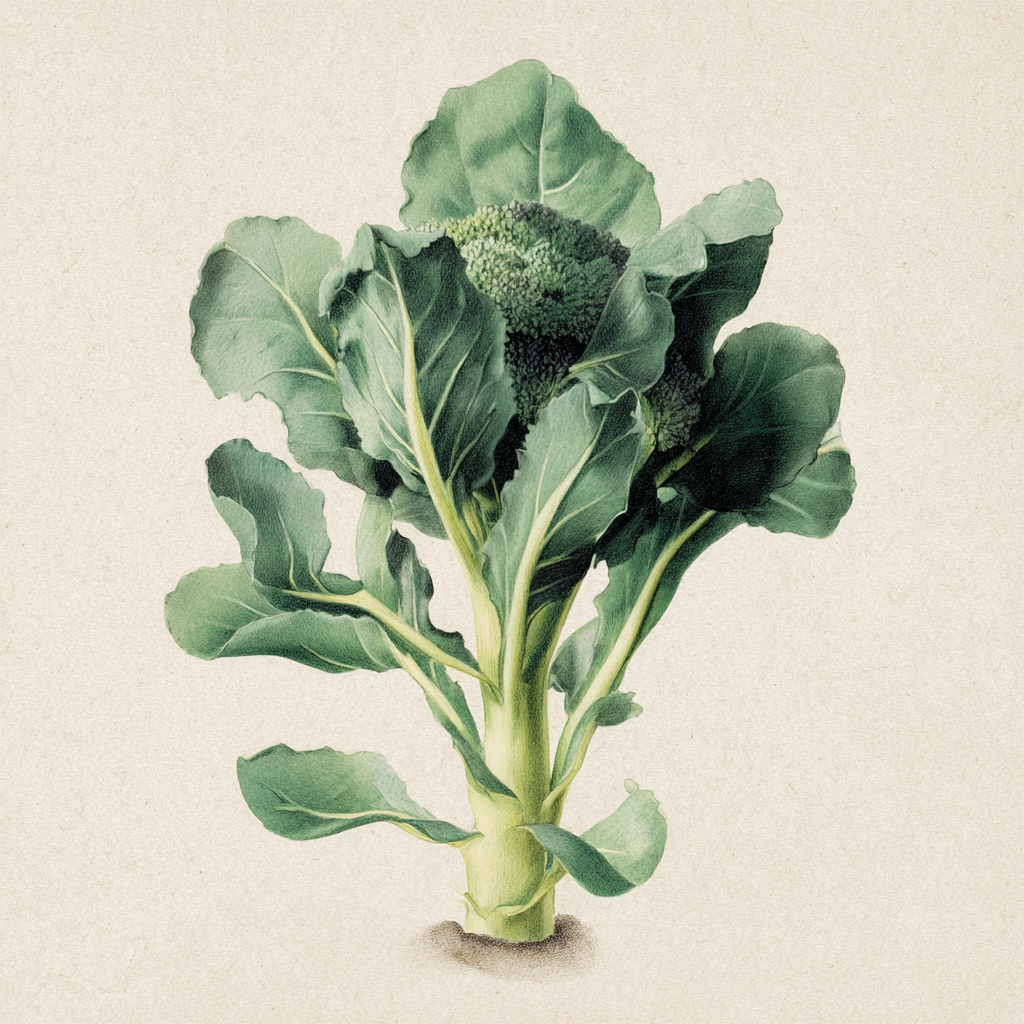
Strong branching roots with a central taproot and many feeder roots. Plants need fertile soil because head formation draws heavily on nutrients and moisture.
Stem
Thick upright stem that supports large leaves and a central bud cluster. Side shoots form from leaf axils after the main head is cut.
Leaves
Large blue-green waxy leaves with wavy margins. Leaves clasp the stem and often show pest damage before heads are affected.
Flowers
Dense green clusters of unopened flower buds form the main edible head. If left too long, buds loosen and open into small yellow four-petaled flowers.
Fruit
After flowering, broccoli produces slender seed pods called siliques. The harvested crop is the unopened flower head and tender side shoots.
Natural History
Natural History
Broccoli is a variety of Brassica oleracea selected for enlarged unopened flower buds - making it botanically unusual among vegetables in that the edible harvest is a pre-bloom flower structure. The same species, under different selective pressures, gave rise to kale, cabbage, cauliflower, kohlrabi, Brussels sprouts, and collards. The word "broccoli" is the Italian plural of broccolo, meaning "the flowering crest of a cabbage" or "arm branch," from the Latin brachium. Its origin is most strongly associated with Calabria, the region at the tip of southern Italy, with Pliny the Elder describing a plant in his Naturalis Historia that closely matches sprouting broccoli. For centuries it remained primarily an Italian regional crop. It arrived in North America largely through Italian immigration; the D'Arrigo brothers are credited with establishing commercial production in California around 1922, advertising it as "Italian asparagus" to consumers who had never encountered it. Broccoli remained largely unknown outside Italian-American communities in the United States until the 1930s and only became a mainstream vegetable after World War II.
Traditional Use
Traditional Use
Broccoli is deeply embedded in Italian cooking but was largely unknown to northern European and American cooks until the 20th century. Its culinary history is primarily Italian and specifically southern Italian, with the Roman record providing an earlier reference point.
Parts Noted Historically
Roman and Early Italian Traditions - Flower buds and stems
Pliny the Elder describes in his Naturalis Historia a plant that appears to match sprouting broccoli, noting it as a prized food. Roman agricultural writers including Columella also mention brassica forms that likely include early broccoli types. The Italian regional tradition that developed from these origins is most strongly associated with Calabria and the broader Italian cultivation of cool-season sprouting vegetables.
Southern Italian and Calabrian Traditions - Flower buds and stems
Calabrese broccoli, named for Calabria at the tip of southern Italy, represents the classic Italian sprouting type with a loose central head and abundant side shoots. In southern Italian cooking, broccoli was a kitchen staple prepared with olive oil, garlic, anchovies, and pasta - particularly in the tradition of orecchiette with broccoli rabe, a closely related Calabrian preparation that remains a regional signature dish.
Italian-American Introduction to North America - Flower buds
Broccoli arrived in North America through Italian immigration in the early 20th century. The D'Arrigo brothers, Sicilian-American farmers in California, began commercial production around 1922, initially marketing it as "Italian asparagus." It remained unfamiliar to mainstream American consumers until the 1930s, when growing Italian-American influence and commercial promotion gradually introduced it to a wider audience.
Broccoli is food-safe in any quantity. Raw broccoli contains goitrogens which in very large, sustained quantities may affect thyroid function, but cooking neutralizes most of these and normal dietary amounts are not a concern.
This information is provided for historical and educational purposes only and is not medical advice. Always consult a qualified healthcare professional before making decisions related to your health.
Related Articles
Related Articles
Loading photo submission…