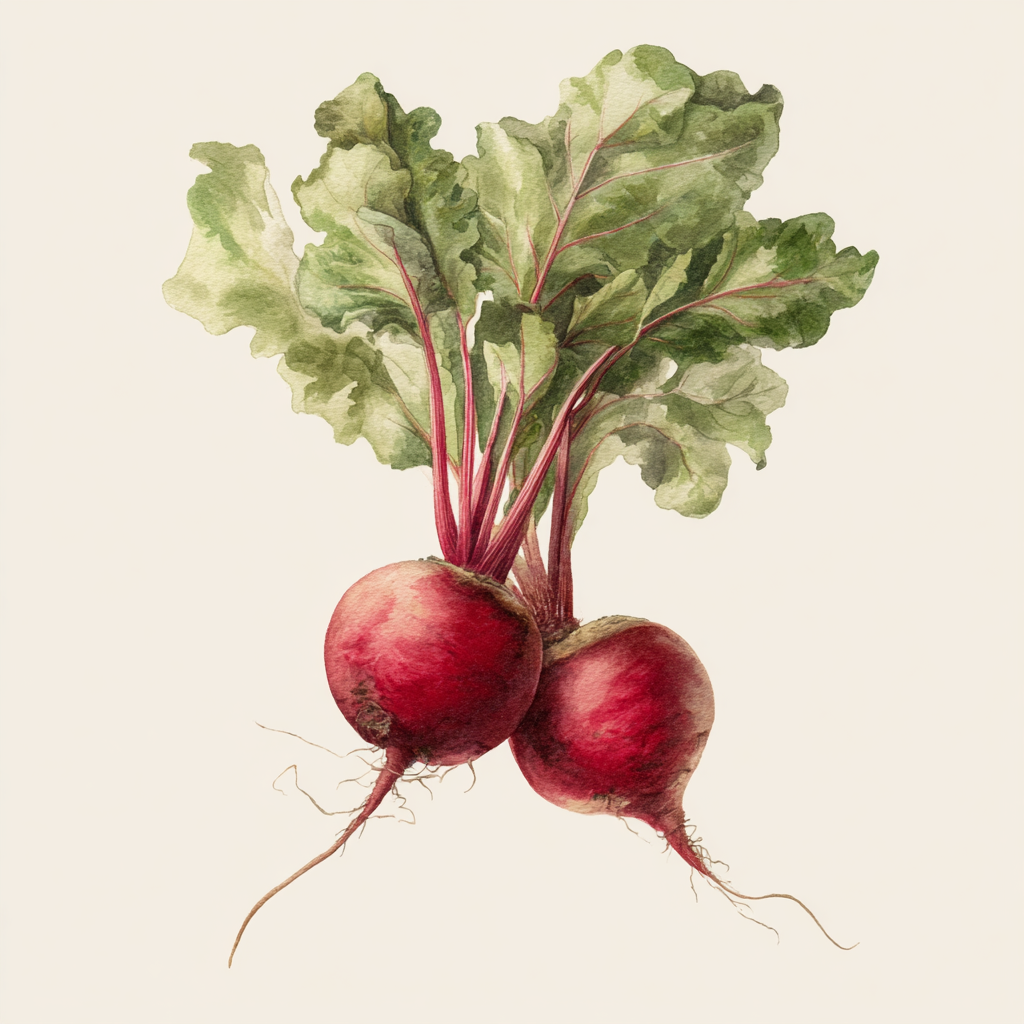
Beet
VegetableBeta vulgaris
Have seeds for this? Add to inventory →Beets are dual-purpose root vegetables offering both sweet, earthy roots and nutritious greens. They are cool-season crops that tolerate light frost and grow well as both spring and autumn plantings.
Growing Conditions
Growing Conditions
Sunlight
Full Sun
Water Needs
Moderate
Soil
Loose, well-draining loam; pH 6.0 - 7.0
Spacing
3 - 4 inches after thinning
Days to Maturity
55 - 70 days from sowing
Growing Zones
Growing Zones
Thrives in USDA Zones 2 - 10
When to Plant
When to Plant
Direct Sow
3 - 4 weeks before last frost; again in late summer
Harvest
55 - 70 days; harvest at golf-ball size for best flavour
Phenology (Natural Timing Cues)
Direct Sow
Sow beets in cool weather at both ends of the season. Spring beets go in as soon as soil is loose and workable; autumn beets need sowing 8-10 weeks before first frost so roots have time to size up before cold arrives.
- Early dandelions are blooming (spring sowing).
- Soil is loose and holds moisture at the surface - not waterlogged or forming a crust.
- Cool-season weeds are growing steadily.
- Summer heat has eased and nights are cooling (autumn sowing).
- Around 8-10 weeks before your expected first frost (autumn sowing).
Start Dates (Your Location)
Average dates use your saved zone; readiness also checks your forecast when available.
Average Last Frost
Set your growing zone to see personalized calendar dates.
Use the average timing, but check your local forecast before planting.
Organic Growing Tips
Organic Growing Tips
Each beet "seed" is actually a cluster - thin to one seedling per cluster for best root development.
Use the thinnings as nutritious microgreens in salads rather than discarding them.
Mulch to retain consistent moisture; uneven watering causes zoning (rings) in roots.
Interplant with garlic and onions to repel aphids and leaf miners from the beet patch.
Care Guidance
Optional seasonal guidance for what you can do, even when nothing is urgent.
Care Guidance
Watering
If the top 2 inches of soil feel dry, a deep watering at the base may help more than frequent light watering. In healthy soil, rain may cover much of what it needs.
Feeding
Extra feeding is rarely required if soil is healthy. If growth looks pale or slow, a light compost top-dressing is often enough before adding anything stronger.
Seasonal care
During the main season, harvesting when the crop is ready and removing damaged growth can help keep the planting productive if it starts to look crowded or tired.
Known Varieties
Common cultivars worth knowing
Known Varieties
Detroit Dark Red
Classic round red beet with dependable roots and good greens.
Best for
general garden use
Chioggia
Italian heirloom with red-and-white rings when sliced.
Best for
fresh eating, visual interest
Golden
Yellow-orange beet with mild flavor and less staining.
Best for
roasting, salads
Cylindra
Long cylindrical beet that slices evenly.
Best for
pickling, uniform slices
Bull's Blood
Deep red leaves and roots, often grown for striking baby greens.
Best for
greens, color
Companion Planting
Companion Planting
Support & insectary plants
Nearby plants that attract pollinators, beneficial insects, or improve soil health.
Avoid planting near
- Fennel
Allelopathic - secretes volatile compounds that inhibit the growth of most vegetables and herbs
Common Pests
Common Pests
All pest management in Garden uses safe, organic, non-toxic methods only. No synthetic pesticides, ever.
Simple Ways to Use
Simple Ways to Use
Start here if you're not sure how to use this crop in the kitchen.
Quick recipes you can make right away
Roasted Beet Wedges
Trim the beet tops to 1 inch, wrap whole or halved beets loosely in foil, and roast at 400°F for 45 to 70 minutes until a knife slides into the center easily. Rub off the skins while the beets are still warm enough to handle, then slice and dress them with oil and vinegar.
Boiled Beets for Salad
Place whole beets in a pot, cover them with water, and simmer 30 to 50 minutes until the largest beet can be pierced easily with a fork. Cool them just enough to handle, slip off the skins, and cut them while they are still moist so the pieces do not dry out.
Sauteed Beet Greens
Wash the greens well, chop the stems separately from the leaves, then cook the stems in oil for 2 to 3 minutes before adding the leaves and a pinch of salt. Stir 2 to 4 minutes more until the leaves are fully wilted and the stems are tender instead of stringy.
How to Preserve
How to Preserve
Use this section to store or process extra harvest before it spoils.
Practical methods for extra harvest
Pickled beet slices
Boil or roast the beets until tender, peel and slice them, then simmer the slices briefly in a vinegar brine before packing into jars. Refrigerate for quick pickles or water-bath can them only with a tested pickled-beet recipe, because the vinegar level is what makes shelf storage safe.
Freeze cooked beets
Cook beets until just tender, cool them, peel them, and cut them into slices or cubes before packing them into freezer bags or containers. Freeze them only after cooking, because raw beets lose texture and flavor quality more quickly in the freezer.
Freeze beet greens
Blanch washed beet greens in boiling water for 2 minutes, then chill them in ice water until fully cold so they stop cooking and keep better color. Squeeze out excess water, pack them into small portions, and freeze for soups or sautés.
New to preserving food?
New to canning? Read the safe canning guide.New to freezing? Read the freezing guide.How to Store
How to Store
Simple storage tips
Cut beet greens off when you bring beets inside, leaving about 1 inch of stem, because attached greens pull moisture out of the roots.
Store the roots unwashed in the refrigerator crisper or another cold, humid place, where they often keep for 2 to 4 weeks.
Keep beet greens in a separate bag in the refrigerator and use them within 2 to 4 days, because they wilt much faster than the roots.
Do not wash whole beets before long storage, because extra surface moisture encourages rot.
Use roots right away if they become rubbery, develop wet spots, or smell earthy in a sour way instead of fresh.
How to Save Seed
How to Save Seed
Step-by-step seed saving
- 1
If the packet or plant tag says F1 hybrid, saved seeds may grow into roots that size up or color differently. Open-pollinated beets are the better choice if you want seed to stay true.
- 2
Beets usually make seed in their second year, so leave selected roots in the ground only where winters are mild, or store good roots and replant them in spring.
- 3
Let the seed stalks dry on the plant until the clusters turn brown and feel hard instead of green or rubbery, then cut the stalks before heavy rain if possible.
- 4
Dry the stalks under cover if needed, then rub the seed clusters loose and store them only when fully dry. Beets can cross with swiss chard and some other beets nearby, so isolate seed plants if you want cleaner seed.
Native Range
Native Range
- Origin
- Beet and chard descend from Beta vulgaris, whose wild sea beet relatives are native around Mediterranean, Atlantic European, and western Asian coasts.
- Native Habitat
- Wild beet grows on coastal shingle, salt-influenced margins, cliffs, and disturbed maritime soils.
- Current Distribution
- Cultivated globally; does not occur as a native plant in this form.
Taxonomy
Taxonomy
- Kingdom
- Plantae
- Family
- Amaranth family (Amaranthaceae)
- Genus
- Beta
- Species
- Beta vulgaris
Morphology
Morphology
Root System
Swollen taproot with a narrow tail and smaller feeder roots. Even spacing and moisture help roots round out without becoming woody.
Stem
Short crown at soil level during the first season. In the second year, plants send up tall branched seed stalks.
Leaves
Glossy oval leaves with red, green, or purple veins depending on variety. Leaves grow from the crown and can be harvested lightly as greens.
Flowers
Small greenish flowers appear in clusters on second-year stalks. Beet seed sold to gardeners is usually a cluster of several fruits.
Fruit
The edible root is a swollen storage taproot, often round, cylindrical, or flattened. Seed clusters can produce multiple seedlings and require thinning.
Natural History
Natural History
The beet descends from sea beet (Beta vulgaris subsp. maritima), a low-growing coastal plant still found along the Atlantic shores of Europe and the Mediterranean, growing in shingle, cliff edges, and salt-influenced soils. This coastal origin explains the beet's tolerance for boron deficiency and mildly alkaline conditions that challenge other crops. The species name vulgaris - Latin for "common" - understates a crop with a remarkable domestication history: ancient Greeks and Romans knew leaf beet well but ate little root; the swollen storage root we now regard as the beet's defining feature was not developed until around the 1st century CE, and the deep red beetroot familiar today was not documented until 16th-century Germany. The same species, through selective breeding alone, also gave us Swiss chard (selected for large leaves and colored stems) and sugar beet - a variety bred to extraordinary sucrose concentrations in the 18th century, when Napoleon's blockade of cane sugar imports drove French and German chemists to develop a land-based sugar industry. Today sugar beet accounts for roughly 20% of world sugar production. The red pigments in beet roots are betalains - a chemically distinct class from the anthocyanins that color most other red vegetables, which explains why beet's color bleeds into cooking water so readily and why golden and Chioggia varieties behave differently under heat.
Traditional Use
Traditional Use
Beet's traditional history runs in two quite separate directions: the leaf beet forms eaten across the ancient Mediterranean, and the storage root that became a winter staple of eastern European cooking. A third strand - the industrial sugar beet - transformed the same species into one of the world's most economically significant crops within two centuries of its development.
Parts Noted Historically
Ancient Greek and Roman Leaf Beet Traditions - Leaves
The Greeks and Romans ate leaf beet - closer in character to chard than to modern root beet - as a common cooked green, often served with lentils or fish sauce. Aristotle mentions it, and Apicius gives recipes. The swollen root form was largely unknown to classical cooks; their beet was primarily a leaf vegetable grown for its greens.
Eastern European Borscht Traditions - Root
Red beet became a central ingredient in the cooking of Ukraine, Russia, Poland, and neighboring countries, most significantly as the base for borscht - a hearty sour beet soup with regional variations numbering in the hundreds. Ukrainian borscht, reflecting the depth and complexity of that tradition, was added to UNESCO's list of intangible cultural heritage in 2022. The deep color, earthy sweetness, and acidity of beet make it irreplaceable in this tradition.
British and Scandinavian Pickling Traditions - Root
Pickled beetroot, typically in malt or wine vinegar with spices, became a fixture of British and Scandinavian cold-food traditions from the 18th century onward. In Britain it appears as a standard accompaniment to salads, cold meats, and cheese. Pickling preserves the root through winter and softens the earthiness that some find overpowering in raw or roasted beet.
European Folk Medicine Traditions - Root and juice
Beet juice was used as a blood tonic in 19th-century European folk medicine, based on its deep red color and the doctrine of signatures - the idea that red foods strengthened the blood. While this specific logic has no medical foundation, beet does contain unusually high nitrate levels that have attracted genuine modern research interest in cardiovascular contexts - an ironic partial alignment with its older reputation.
Beet is food-safe in any culinary quantity. Some people experience beeturia - pink or red urine after eating beets - which is entirely harmless but can be alarming if unexpected. The response is more common in people with low stomach acid and is not an indicator of any health problem.
This information is provided for historical and educational purposes only and is not medical advice. Always consult a qualified healthcare professional before making decisions related to your health.
Related Articles
Related Articles
Loading photo submission…