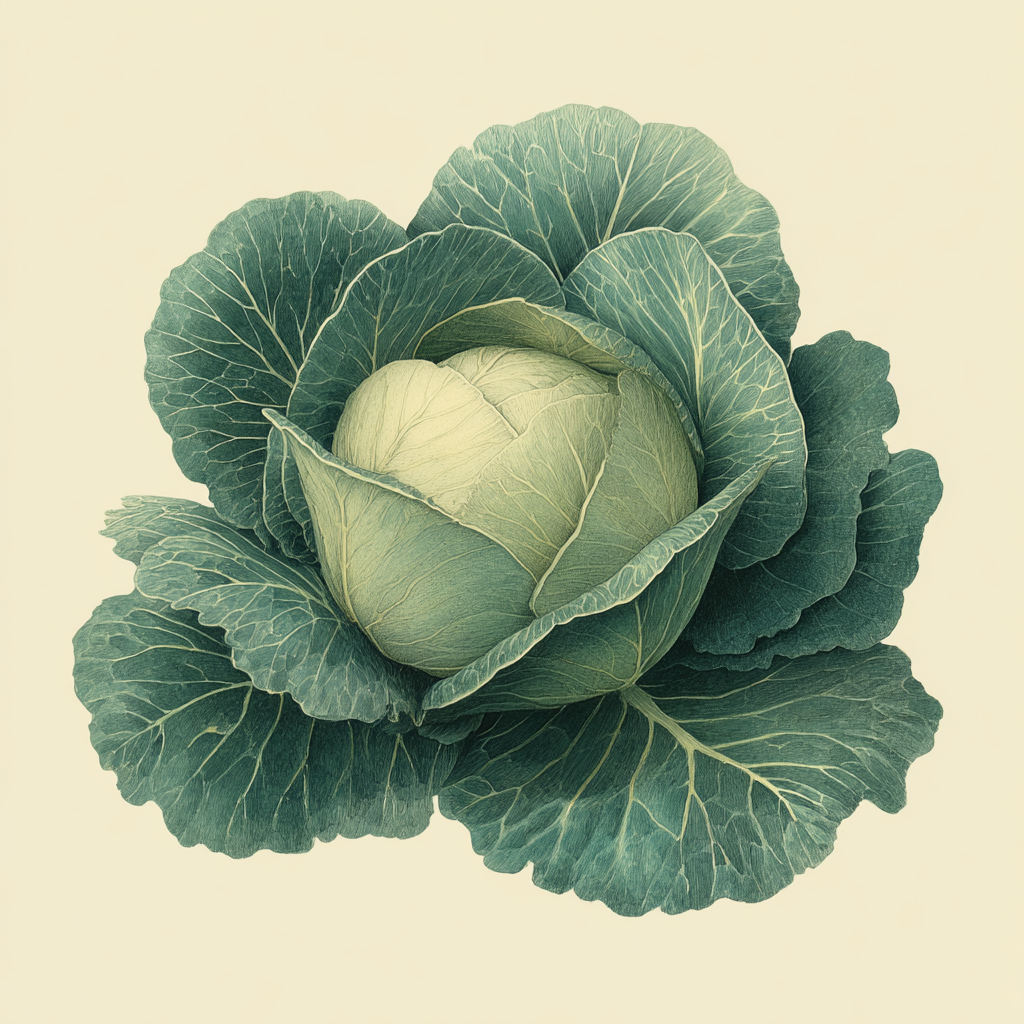
Cabbage
VegetableBrassica oleracea var. capitata
Have seeds for this? Add to inventory →Cabbage is a hardy cool-season brassica producing dense heads of crisp leaves used fresh or fermented into sauerkraut. It benefits enormously from aromatic companion herbs that confuse and deter its many pest species.
Growing Conditions
Growing Conditions
Sunlight
Full Sun
Water Needs
Moderate
Soil
Rich, firm, well-draining loam; pH 6.0 - 7.5
Spacing
18 - 24 inches
Days to Maturity
70 - 100 days from transplant
Growing Zones
Growing Zones
Thrives in USDA Zones 3 - 10
When to Plant
When to Plant
Start Indoors
6 - 8 weeks before last frost
Transplant
2 - 4 weeks before last frost
Harvest
70 - 100 days; harvest when heads are firm and dense
Phenology (Natural Timing Cues)
Start Indoors
Start cabbage indoors 6-8 weeks before the last frost date - while outdoor conditions are still firmly winter, well before spring growth advances.
- Deciduous trees are still bare or showing only early bud swell.
- Forsythia has not reached full bloom.
- Dandelions have not reached heavy bloom.
Transplant
Transplant spring cabbage while soil is still cool and early bloom signals have just arrived. For autumn cabbage, allow 70-100 days of cool growing weather before the first frost.
- Forsythia is blooming (spring transplant).
- Early dandelions are blooming (spring transplant).
- Soil is workable and consistently cool (spring transplant).
- Summer heat has broken and first cool nights have returned (autumn transplant).
- At least 70-100 days remain before expected first frost (autumn transplant).
Start Dates (Your Location)
Average dates use your saved zone; readiness also checks your forecast when available.
Average Last Frost
Set your growing zone to see personalized calendar dates.
Use the average timing, but check your local forecast before planting.
Organic Growing Tips
Organic Growing Tips
Interplant with a diverse mix of aromatic herbs to disguise the scent signals that attract butterflies.
Use row covers from transplant to exclude egg-laying by cabbage white and cabbage moth.
Apply diatomaceous earth as a targeted barrier only around individual plant bases — it harms all insects including beneficial ones, so use it sparingly and precisely rather than scattering across the bed.
Side-dress with compost or worm castings mid-season and rotate brassicas to new ground every 4 years — feeding the soil keeps plants robust and rotation prevents the clubroot spore buildup that persists for over a decade.
Care Guidance
Optional seasonal guidance for what you can do, even when nothing is urgent.
Care Guidance
Watering
If the top 2 inches of soil feel dry, a deep watering at the base may help more than frequent light watering. In healthy soil, rain may cover much of what it needs.
Feeding
If growth is strong, compost-rich soil often carries most of the load. If the plant starts looking pale or stalls, a light compost top-dressing or gentle organic feed may help.
Seasonal care
During the main season, harvesting when the crop is ready and removing damaged growth can help keep the planting productive if it starts to look crowded or tired.
Known Varieties
Common cultivars worth knowing
Known Varieties
Copenhagen Market
Classic round green cabbage with uniform medium heads.
Best for
fresh eating, general use
Early Jersey Wakefield
Pointed early cabbage with tender heads.
Best for
early harvests
Red Acre
Compact red cabbage with dense heads and good color.
Best for
slaws, small gardens
January King
Hardy semi-savoy cabbage with purple-green winter heads.
Best for
winter harvests
Brunswick
Large flat storage cabbage suited to kraut and long keeping.
Best for
sauerkraut, storage
Companion Planting
Companion Planting
Support & insectary plants
Nearby plants that attract pollinators, beneficial insects, or improve soil health.
- Chamomile
Attracts beneficial insects and produces nutrient-rich mulch
- Marigold
Suppresses soil nematodes; trap crop for aphids and whiteflies
- Nasturtium
Trap crop for aphids; attracts beneficial insects
- Calendula
Trap crop for aphids; attracts predatory insects
Avoid planting near
- Fennel
Allelopathic - secretes volatile compounds that inhibit the growth of most vegetables and herbs
- Tomato
- Strawberry
Common Pests
Common Pests
- Cabbage White Caterpillar
- Cabbage Looper
- Aphids
- Harlequin Bug
- Clubroot
All pest management in Garden uses safe, organic, non-toxic methods only. No synthetic pesticides, ever.
Simple Ways to Use
Simple Ways to Use
Start here if you're not sure how to use this crop in the kitchen.
Quick recipes you can make right away
Quick Cabbage Slaw
Shred cabbage finely, toss it with vinegar, salt, and a little oil or mayo, then let it sit 15 to 20 minutes until the leaves soften slightly but still stay crisp. Stir again before serving so the dressing reaches the bottom of the bowl.
Sauteed Cabbage
Slice cabbage into thin ribbons and cook it in a large skillet with oil and salt for 8 to 12 minutes until the edges brown in spots and the thicker pieces turn tender. Add a splash of water only if the pan dries out before the cabbage softens.
Braised Cabbage Wedges
Cut cabbage into wedges, place them in a covered pan with a little broth or water, and cook 15 to 20 minutes until the core can be pierced easily with a knife. Remove the lid for the last few minutes if you want the liquid to cook down.
How to Preserve
How to Preserve
Use this section to store or process extra harvest before it spoils.
Practical methods for extra harvest
Make sauerkraut
Shred cabbage, mix it with salt until it releases enough juice to look wet and glossy, then pack it tightly under its own brine in a jar or crock. Ferment at room temperature until it smells pleasantly sour and bubbles slow down, keeping the cabbage fully submerged the whole time so mold does not form on exposed pieces.
Freeze blanched cabbage
Cut cabbage into wedges or shreds, boil it 1 1/2 to 3 minutes depending on thickness, then chill it in ice water until fully cold so it keeps better texture. Dry it well before freezing, and use it later in soups or cooked dishes because thawed cabbage is too soft for slaw.
Make freezer slaw mix
Shred cabbage and other firm vegetables, mix them with a cooked vinegar dressing if your recipe calls for it, then cool the mixture completely before freezing in meal-size portions. Freeze only recipes written for freezer slaw, because raw dressed cabbage often turns watery after thawing.
New to preserving food?
New to fermentation? Read the fermentation guide.New to freezing? Read the freezing guide.How to Store
How to Store
Simple storage tips
Store whole cabbage cold in the refrigerator and use it within about 1 to 3 weeks, depending on how tight and fresh the head is.
Leave the outer wrapper leaves on until you use it, because they protect the inner leaves from drying out.
Once cut, wrap the exposed side and use it within a few days before the cut edge dries or browns.
Use any leaves with black spots, slime, or sour smell first or discard them, because spoilage spreads faster once a head is damaged.
Keep cabbage away from strong-smelling foods if possible, because cut cabbage easily picks up refrigerator odors.
How to Save Seed
How to Save Seed
Step-by-step seed saving
- 1
If the packet or plant tag says F1 hybrid, saved seeds may grow into heads that size up or mature differently. Open-pollinated cabbage is the better choice if you want seed to stay true.
- 2
Saving cabbage seed is advanced because cabbage usually flowers in its second year after winter, not in the same season you harvest the head.
- 3
Overwinter a few healthy plants if your climate allows, then let them flower and dry down until the seed pods turn tan and brittle.
- 4
Cut the dry stalks into a bag and thresh them only when the pods snap easily, and remember that cabbage crosses with nearby flowering cabbage relatives unless isolated.
Native Range
Native Range
- Origin
- Cabbage is a cultivated head-form of Brassica oleracea, whose wild ancestors are native to coastal western and Mediterranean Europe.
- Native Habitat
- Wild Brassica oleracea favors open maritime cliffs, rocky coastal soils, and calcareous seaside grasslands.
- Current Distribution
- Cultivated globally; does not occur as a native plant in this form.
Taxonomy
Taxonomy
- Kingdom
- Plantae
- Family
- Mustard family (Brassicaceae)
- Genus
- Brassica
- Species
- Brassica oleracea var. capitata
Morphology
Morphology
Root System
Branching brassica roots with a central taproot and many feeder roots. Firm soil helps plants anchor and form dense heads.
Stem
Short thick stem supports tightly overlapping leaves. If left too long or stressed, heads may split as the stem keeps growing.
Leaves
Broad waxy leaves wrap inward to form round, flat, pointed, or savoyed heads. Outer wrapper leaves are tougher and protect the head.
Flowers
Yellow four-petaled flowers appear on tall stalks in the second year or after bolting. Flowering follows head formation if plants overwinter.
Fruit
Produces slender seed pods after flowering. The harvested crop is the compact head of layered leaves.
Natural History
Natural History
Cabbage is a head-forming selection of Brassica oleracea - the same species that, under different selective pressures, gave rise to kale, broccoli, cauliflower, kohlrabi, Brussels sprouts, and collards. Its wild ancestor still grows on chalk and limestone sea cliffs along the Atlantic coast of western Europe, from southern England and Wales through northern France to the Iberian Peninsula, where the loose leafy non-heading form survives in exposed coastal conditions. The Greeks and Romans both cultivated brassicas extensively: Cato the Elder, writing in the 2nd century BCE, was a famous advocate who claimed cabbage could cure a remarkable range of ailments, and Pliny the Elder called it one of the most important vegetables of the Roman diet. The dense heading characteristic - overlapping leaves forming around a compressed growing point - was developed over centuries of selection and gave cabbage its defining practical advantage: a hard head that stores well, travels well, and ferments readily. This made it one of the most important winter food crops of northern and central Europe for centuries. The discovery that fermented cabbage could prevent scurvy - by preserving enough vitamin C through fermentation - had significant practical consequences: Captain Cook carried over two tonnes of sauerkraut on his Pacific voyages in the 1770s and reported virtually no scurvy cases.
Traditional Use
Traditional Use
Cabbage has been one of the most economically important vegetables in human food history - not primarily for its fresh flavor but for its storability, productivity, and fermentation potential. It fed northern and central European populations through winters for centuries, and fermented cabbage traditions arose independently across Europe and East Asia, producing some of the most culturally significant foods in their respective cuisines.
Parts Noted Historically
Ancient Greek and Roman Traditions - Leaves and heads
Brassica cultivation was central to ancient Greek and Roman agriculture. Cato the Elder devoted significant space to cabbage in De Agri Cultura (2nd century BCE), recommending it for a wide range of household purposes. Pliny the Elder called it one of the most important vegetables of the Roman diet. These classical references helped embed cabbage deeply in European food culture through the medieval period and beyond.
European Sauerkraut and Fermented Cabbage Traditions - Heads
The tradition of fermenting shredded cabbage with salt into sauerkraut is documented across Germany, Austria, Poland, and the Czech Republic from at least the medieval period. In central Europe, sauerkraut became a winter staple of profound importance - a means of preserving a dense calorie and nutrient source through months when fresh food was unavailable. Captain Cook's Pacific voyages (1768-1779) demonstrated its effectiveness against scurvy; he carried over two tonnes of it and reported virtually no scurvy cases among his crew.
Korean Kimchi Traditions - Leaves and heads
Though kimchi predates the introduction of chilli pepper to Korea, napa cabbage kimchi became the defining form after the Columbian Exchange introduced chilli to Korea in the late 16th or early 17th century. Kimchi is now a national cultural institution: UNESCO added kimjang - the communal tradition of making and sharing kimchi - to its Intangible Cultural Heritage list in 2013. Koreans consume an estimated 1.85 million tonnes of kimchi annually.
Eastern European Bigos and Stuffed Cabbage Traditions - Heads and leaves
In Poland, bigos - a hearty stew made with sauerkraut, fresh cabbage, various meats, and mushrooms - is among the closest things to a national dish. Stuffed cabbage leaves (gołąbki in Polish, holubtsi in Ukrainian, sarma across the Balkans) appear across central and eastern Europe under various names, filled with rice, meat, or grain mixtures. These traditions reflect centuries of cabbage as a foundation ingredient across the region.
Cabbage is food-safe in any quantity in normal cooking. Raw cabbage contains goitrogens which in very large quantities may affect thyroid function; cooking neutralizes most of these. People on blood-thinning medications are advised to keep their intake of high-vitamin-K leafy greens including cabbage consistent rather than dramatically variable.
This information is provided for historical and educational purposes only and is not medical advice. Always consult a qualified healthcare professional before making decisions related to your health.
Related Articles
Related Articles
Loading photo submission…