Brussels Sprouts
VegetableBrassica oleracea var. gemmifera
Have seeds for this? Add to inventory →Brussels sprouts are slow-growing cool-season brassicas that reward patience with dense, flavourful sprouts along their tall stems. A light frost before harvest dramatically improves their flavour by converting starches to sugars.
Growing Conditions
Growing Conditions
Sunlight
Full Sun
Water Needs
Moderate
Soil
Rich, firm, well-draining loam; pH 6.0 - 7.5
Spacing
18 - 24 inches
Days to Maturity
90 - 120 days from transplant
Growing Zones
Growing Zones
Thrives in USDA Zones 3 - 10
When to Plant
When to Plant
Start Indoors
12 - 14 weeks before first autumn frost
Transplant
6 - 8 weeks before first autumn frost
Harvest
Harvest sprouts from bottom up; sweetest after frost
Phenology (Natural Timing Cues)
Start Indoors
Start Brussels sprouts 12-14 weeks before the expected first autumn frost - earlier than any other common brassica. The very long season means the start date matters more than for any other vegetable in this family.
- Deciduous trees are still bare or showing only early bud swell (spring starts for mild-winter areas).
- Summer heat is easing and nights are beginning to feel cooler (main autumn-crop timing).
- At least 12-14 weeks remain before the expected first hard frost.
Transplant
Transplant Brussels sprouts into cool, steady growing conditions with enough season ahead for the crop to develop fully before hard autumn frosts arrive.
- Early dandelions are blooming (spring transplants in mild-winter areas).
- Soil is workable and consistently cool.
- Summer heat has eased and first cool nights have returned (main autumn-crop timing).
- At least 90-100 frost-free days remain before expected first hard frost.
Start Dates (Your Location)
Average dates use your saved zone; readiness also checks your forecast when available.
Average Last Frost
Set your growing zone to see personalized calendar dates.
Use the average timing, but check your local forecast before planting.
Start Indoors
Autumn
This uses autumn or first-frost timing, so keep the planting note as written.
Transplant Outdoors
Autumn
This uses autumn or first-frost timing, so keep the planting note as written.
Organic Growing Tips
Organic Growing Tips
Remove lower yellowing leaves as the season progresses to improve airflow and reduce disease.
Plant mint as a border to confuse and repel cabbage white butterflies seeking host plants.
Apply neem oil spray at dusk at the first sign of aphid colonies to prevent exponential spread — applying at dusk protects foraging bees and beneficial insects active during the day.
Mulch with compost around the base at planting and firm the soil well — loose soil leads to poorly formed sprouts, while compost mulch feeds soil biology and improves moisture retention through the long growing season.
Care Guidance
Optional seasonal guidance for what you can do, even when nothing is urgent.
Care Guidance
Watering
If the top 2 inches of soil feel dry, a deep watering at the base may help more than frequent light watering. In healthy soil, rain may cover much of what it needs.
Feeding
Extra feeding is rarely required if soil is healthy. If growth looks pale or slow, a light compost top-dressing is often enough before adding anything stronger.
Seasonal care
During the main season, harvesting when the crop is ready and removing damaged growth can help keep the planting productive if it starts to look crowded or tired.
Known Varieties
Common cultivars worth knowing
Known Varieties
Long Island Improved
Classic open-pollinated variety with sturdy stalks and medium sprouts.
Best for
home gardens
Diablo
Hybrid with uniform sprouts and good cold performance.
Best for
fall harvests
Jade Cross
Compact hybrid with reliable sprout set and shorter stalks.
Best for
smaller gardens
Red Bull
Purple-red Brussels sprout variety with striking color and mild flavor.
Best for
visual interest
Churchill
Productive hybrid with early, uniform sprouts.
Best for
shorter seasons
Companion Planting
Companion Planting
Support & insectary plants
Nearby plants that attract pollinators, beneficial insects, or improve soil health.
- Chamomile
Attracts beneficial insects and produces nutrient-rich mulch
- Nasturtium
Trap crop for aphids; attracts beneficial insects
- Marigold
Suppresses soil nematodes; trap crop for aphids and whiteflies
- Sweet Alyssum
Attracts pollinators and beneficial insects
- Lavender
Attracts pollinators and beneficial insects
Avoid planting near
- Fennel
Allelopathic - secretes volatile compounds that inhibit the growth of most vegetables and herbs
- Tomato
- Strawberry
Common Pests
Common Pests
- Cabbage White Caterpillar
- Aphids
- Cabbage Looper
- Whitefly
- Clubroot
All pest management in Garden uses safe, organic, non-toxic methods only. No synthetic pesticides, ever.
Simple Ways to Use
Simple Ways to Use
Start here if you're not sure how to use this crop in the kitchen.
Quick recipes you can make right away
Roasted Brussels Sprouts
Trim the stem ends, halve large sprouts, and roast them at 425°F with oil and salt for 20 to 30 minutes until the cut faces brown and the centers are tender when pierced. Stir once halfway through so the outer leaves crisp without scorching.
Skillet Brussels Sprouts
Slice the sprouts in half and cook them cut side down in a hot skillet with oil for 4 to 5 minutes, then add a splash of water, cover, and cook 3 to 4 minutes more until tender. Remove the lid at the end so any extra water cooks away before serving.
Shredded Sprout Saute
Shred the sprouts thinly and cook them in a skillet with oil for 4 to 6 minutes until the shreds soften and a few edges brown. Stop while the strands are still green and tender instead of dull and mushy.
How to Preserve
How to Preserve
Use this section to store or process extra harvest before it spoils.
Practical methods for extra harvest
Freeze blanched sprouts
Trim the sprouts, blanch small ones for 3 minutes and larger ones for 4 to 5 minutes, then chill them fully in ice water. Dry them well before freezing on a tray, then bag them once solid so they stay separate.
Freeze shredded sprouts
Shred the sprouts, blanch the shreds for 1 1/2 minutes, then chill and dry them thoroughly before freezing in flat bags. Use them later in sautés or casseroles, because thawed shreds are too soft for raw slaw.
Roast and freeze
Roast halved sprouts until just tender, cool them completely, and freeze them in small portions for quick reheating. Reheat until hot through and lightly crisp again, because thawed roasted sprouts soften if warmed too gently.
New to preserving food?
New to freezing? Read the freezing guide.How to Store
How to Store
Simple storage tips
Keep brussels sprouts cold in the refrigerator and use them within about 5 to 10 days for the best texture.
Store them unwashed in a breathable bag or container so extra moisture does not collect around the leaves.
If the sprouts are still attached to the stalk, leave them on until use, because they keep better that way.
Use any loose or yellowing outer leaves first, because once the leaves start opening the sprouts lose quality quickly.
If the sprouts smell strong, feel slimy, or show black wet rot at the base, discard them instead of trying to trim around it.
How to Save Seed
How to Save Seed
Step-by-step seed saving
- 1
If the packet or plant tag says F1 hybrid, saved seeds may grow into plants that make looser or later sprouts. Open-pollinated brussels sprouts are the better choice if you want seed to stay true.
- 2
Brussels sprouts usually flower in their second year, so saving seed is more advanced than saving seed from annual garden crops.
- 3
Overwinter selected plants if your climate allows, then let them flower and dry down until the seed pods turn tan and brittle.
- 4
Brussels sprouts cross readily with other flowering brassicas nearby, so isolate seed plants if you want cleaner seed, and thresh only when the pods snap easily instead of bending.
Native Range
Native Range
- Origin
- Brussels sprouts are a cultivated form of Brassica oleracea, a species native in wild coastal forms to western and Mediterranean Europe.
- Native Habitat
- Wild Brassica oleracea occupies maritime cliffs, coastal grassland, rocky calcareous slopes, and salt-exposed open ground.
- Current Distribution
- Cultivated globally; does not occur as a native plant in this form.
Taxonomy
Taxonomy
- Kingdom
- Plantae
- Family
- Mustard family (Brassicaceae)
- Genus
- Brassica
- Species
- Brassica oleracea var. gemmifera
Morphology
Morphology
Root System
Strong fibrous root system with a central taproot. Firm planting and steady moisture help the tall stalk stay anchored and form tight sprouts.
Stem
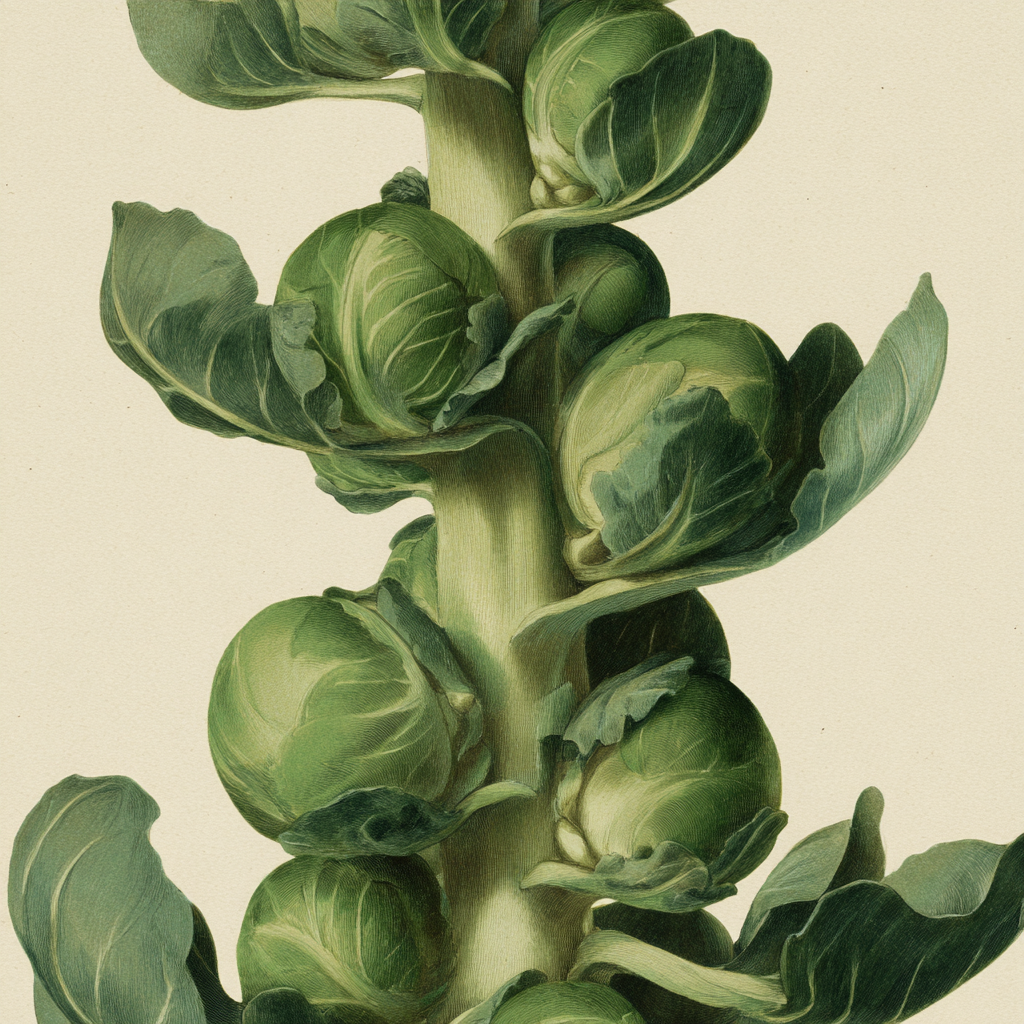
Tall upright stem that can reach 2 - 3 feet or more. Sprouts form as enlarged buds in the leaf axils along the stem.
Leaves
Large blue-green leaves on long stalks, often removed from the lower stem as sprouts size up. Yellowing lower leaves are common late in the season.
Flowers
If overwintered or left unharvested, plants bolt into yellow four-petaled brassica flowers from the top and side buds.
Fruit
Produces slender seed pods after flowering. The harvested crop is the tight round axillary bud, picked from the bottom upward.
Natural History
Natural History
Brussels sprouts are a northern European selection of Brassica oleracea in which lateral buds along a tall central stem enlarge into compact, cabbage-like heads rather than remaining dormant. The association with Belgium is long-standing: they appear in Flemish agricultural records from the 16th century and are thought to have been cultivated in the Leuven region from at least the 13th century, though the precise origin remains debated. They reached France and England significantly later, becoming familiar in British kitchen gardens through the 19th century. The notable flavor improvement after frost is a genuine biochemical response: cold temperatures cause the plant to convert stored starches to sugars, a mechanism common in cold-climate crops that helps prevent cell damage from freezing. Brussels sprouts's variable reputation for bitterness reflects partly the glucosinolate content of older varieties - modern cultivars have been bred significantly lower - and partly a genuine genetic difference among people: those carrying a variant of the TAS2R38 gene perceive Brussels sprouts as intensely bitter, while those with a different variant find them mild. In British English, "sprouts" alone almost invariably means Brussels sprouts, reflecting their established place in the Christmas dinner tradition.
Traditional Use
Traditional Use
Brussels sprouts are one of the newer vegetables in European food culture, with no significant presence outside the Low Countries before the 18th century and only becoming widely familiar in Britain in the 19th. Their primary cultural story is northern European - particularly Belgian and British - and strongly seasonal, centered on the autumn and winter harvest window.
Parts Noted Historically
Flemish and Belgian Cultivation Traditions - Sprouts
Brussels sprouts have been cultivated in the Low Countries longer than anywhere else, with records suggesting cultivation in the Leuven area from as early as the 13th century and clear Flemish agricultural references from the 16th. Belgium remains closely identified with the vegetable and produces a significant proportion of European supply. The name "Brussels sprouts" in English reflects this origin, though the vegetable is simply called spruitjes in Dutch and choux de Bruxelles in French.
British Christmas Dinner Tradition - Sprouts
Brussels sprouts became so embedded in the British Christmas dinner tradition that "sprouts" in British English means Brussels sprouts almost without qualification. Their arrival at the table in late November and December aligns naturally with their peak season after frost. Their divisive reputation - passionately loved by some, strongly disliked by others - has made them a cultural touchstone of British seasonal eating, and the TAS2R38 genetics research has given a biological explanation to the long-running family arguments.
Northern European Winter Vegetable Traditions - Sprouts and leaves
Across the Low Countries, northern France, and Germany, Brussels sprouts were valued as a standing winter crop that could be harvested through hard frosts, providing fresh green vegetables in a season when other crops were long finished. The ability to harvest incrementally from the bottom of the stalk upward over several weeks made them particularly practical for kitchen garden use.
Brussels sprouts are food-safe in any quantity. They contain meaningful levels of vitamin K; people on blood-thinning medications such as warfarin are advised to keep their intake consistent rather than dramatically variable. Cooking reduces goitrogen content significantly.
This information is provided for historical and educational purposes only and is not medical advice. Always consult a qualified healthcare professional before making decisions related to your health.
Related Articles
Related Articles
Loading photo submission…