Blackberry
FruitRubus fruticosus
Have seeds for this? Add to inventory →Blackberries are vigorous, thorny or thornless cane fruits that produce large, richly flavoured berries in late summer. They are among the most productive and low-maintenance fruits in the organic garden.
Growing Conditions
Growing Conditions
Sunlight
Full Sun
Water Needs
Moderate
Soil
Well-draining, slightly acidic loam; pH 5.5 - 7.0
Spacing
3 - 4 feet in rows; 8 feet between rows
Days to Maturity
Year 2 from planting; full production in year 3
Growing Zones
Growing Zones
Thrives in USDA Zones 5 - 10
When to Plant
When to Plant
Transplant
Bare-root canes in late autumn to early spring while dormant
Harvest
Late summer; berries ripen over several weeks - harvest when fully black and soft
Phenology (Natural Timing Cues)
Transplant
Plant blackberry canes while they are dormant or just beginning spring growth.
- Forsythia is beginning to bloom.
- Cane buds are swelling but new shoots are not elongating fast.
- Soil is workable and drains cleanly.
- Leaf drop is beginning for fall planting.
Start Dates (Your Location)
Average dates use your saved zone; readiness also checks your forecast when available.
Best Planting Window
Spring window
Late winter to early spring
Plant while dormant, before buds break and before active top growth begins.
Autumn window
Late autumn after leaf drop
Plant while dormant, after leaves have dropped and before the ground freezes.
Planting Method
Plant dormant bare-root canes. Named varieties are propagated vegetatively so the fruiting plant stays true to type.
Critical Timing Note
Plant while dormant and before bud break so roots establish before leaves demand water.
Use the average timing, but check your local forecast before planting.
Typical Harvest Window
August to September
Organic Growing Tips
Organic Growing Tips
Choose thornless varieties like Ouachita or Triple Crown for easier harvesting and management.
Train canes onto a wire support system to improve airflow and dramatically reduce disease.
Mulch roots with compost or leaf mould annually to maintain moisture and feed the plants.
Do not plant near raspberries - they share diseases and can cross-pollinate.
Care Guidance
Optional seasonal guidance for what you can do, even when nothing is urgent.
Care Guidance
Watering
If the top 2 inches of soil feel dry, a deep watering at the base may help more than frequent light watering. In healthy soil, rain may cover much of what it needs.
Feeding
Extra feeding is rarely required if soil is healthy. If growth looks pale or slow, a light compost top-dressing is often enough before adding anything stronger.
Pruning
If pruning is needed, dormancy or the period just after harvest is often the simplest window. Dead, damaged, or crossing growth is usually the first place to start.
Seasonal care
In late fall, a light cleanup and fresh mulch can help if winter protection is useful in your climate. Leaving a little space around crowns and trunks often helps air move and keeps excess moisture from sitting there.
Known Varieties
Common cultivars worth knowing
Known Varieties
Triple Crown
Thornless semi-erect blackberry with large sweet berries.
Best for
home gardens
Ouachita
Thornless erect variety with firm berries and good disease resistance.
Best for
easy harvests
Navaho
Thornless upright blackberry with excellent flavor and manageable growth.
Best for
small plantings
Marionberry
Trailing blackberry type from Oregon with rich complex flavor.
Best for
pies, preserves
Prime-Ark Freedom
Thornless primocane-fruiting blackberry that can crop on first-year canes.
Best for
extended harvests
Companion Planting
Companion Planting
Good companions
None noted
Support & insectary plants
Nearby plants that attract pollinators, beneficial insects, or improve soil health.
Common Pests
Common Pests
All pest management in Garden uses safe, organic, non-toxic methods only. No synthetic pesticides, ever.
Simple Ways to Use
Simple Ways to Use
Start here if you're not sure how to use this crop in the kitchen.
Quick recipes you can make right away
Mashed Blackberry Bowl
Mash blackberries lightly with a fork and stir in a little sugar or honey if needed, then let the bowl sit 5 minutes until the berries release juice. Spoon it over yogurt, oatmeal, or toast while the seeds still give some texture.
Quick Blackberry Sauce
Cook blackberries with a spoonful of sugar and a splash of water for 5 to 8 minutes until the berries collapse and the juice thickens enough to coat a spoon lightly. Serve it warm or cool it until just thickened, because it sets a bit more as it cools.
Fresh Blackberry Crumble Filling
Toss blackberries with sugar and a little flour or starch, then spread them in a baking dish and bake at 375°F until the juices bubble actively around the edges, about 25 to 35 minutes. Let the dish rest 10 minutes so the juice thickens slightly before serving.
How to Preserve
How to Preserve
Use this section to store or process extra harvest before it spoils.
Practical methods for extra harvest
Freeze berries on a tray
Spread clean, dry blackberries in a single layer and freeze them until hard before bagging them, so they stay loose instead of crushing into one frozen block. Use them frozen for smoothies, baking, or sauce, because thawed berries soften quickly.
Make blackberry jam
Cook blackberries with sugar and the acid or pectin called for in a tested jam recipe until the mixture sheets from a spoon or reaches the recipe temperature. Water-bath can it only with a tested recipe and the full processing time for your jars and altitude.
Freeze blackberry puree
Mash or blend the berries, strain out some seeds if you want a smoother puree, then cool it before freezing in small containers with a little headspace. Freeze it in small portions so you can thaw only what you need for sauce, desserts, or baking.
New to preserving food?
New to canning? Read the safe canning guide.New to freezing? Read the freezing guide.How to Store
How to Store
Simple storage tips
Keep blackberries refrigerated and use them within about 1 to 3 days, because they soften and mold quickly after harvest.
Store them dry in a shallow container so the berries on the bottom do not get crushed by the weight above them.
Do not wash them before storage, because extra surface moisture speeds mold.
Remove any leaking or moldy berry as soon as you see it, because spoilage spreads very quickly through a full container.
Freeze fully ripe berries the same day if you will not use them soon, because they lose shape and juice fast at refrigerator temperatures.
How to Save Seed
How to Save Seed
Step-by-step seed saving
- 1
Blackberry seed is not the practical way to keep the same named variety, because blackberries are normally propagated by tip layers, suckers, or nursery-grown canes.
- 2
If you want more of the same blackberry, root a healthy cane tip or transplant a strong sucker instead of saving seed.
- 3
Seeds can be saved only for breeding or experimentation, not for keeping a named blackberry true to type.
Native Range
Native Range
- Origin
- Rubus fruticosus is commonly treated as a complex or aggregate of blackberry lineages native mainly to Europe, western Asia, and North Africa.
- Native Habitat
- Hedgerows, woodland edges, thickets, disturbed ground, roadsides, and sunny margins.
- Current Distribution
- Naturalized across many temperate regions, especially in disturbed habitats.
Taxonomy
Taxonomy
- Kingdom
- Plantae
- Family
- Rose family (Rosaceae)
- Genus
- Rubus
- Species
- Rubus fruticosus
Morphology
Morphology
Root System
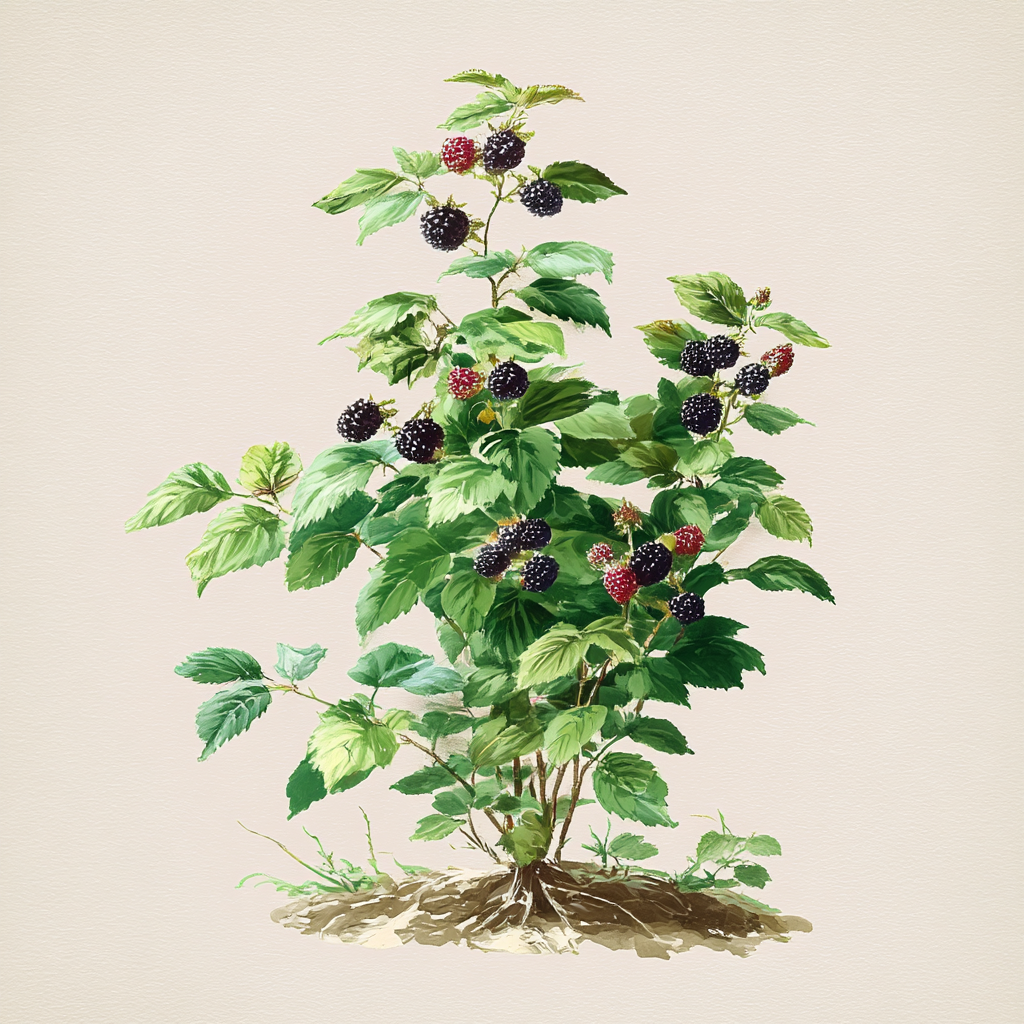
Perennial crown with spreading roots and suckers. Some types also root from cane tips, making patches expand quickly.
Stem
Long biennial canes may be erect, arching, trailing, thorny, or thornless. Fruited canes die after cropping.
Leaves
Compound leaves usually with three to five toothed leaflets. Stems and leaf ribs often carry prickles except on thornless cultivars.
Flowers
White to pale pink five-petaled flowers appear on fruiting laterals and are heavily visited by bees.
Fruit
Aggregate berries turn from green to red to glossy black. Unlike raspberries, the central core stays inside the ripe fruit when picked.
Natural History
Natural History
The blackberry listed as Rubus fruticosus is not a single species but an aggregate - a collective name for several hundred microspecies that hybridize freely, many reproducing apomictically (producing seeds without fertilization). This taxonomic complexity makes Rubus one of the most difficult genera in European botany; precise identification of wild bramble forms is largely the domain of specialists. Cultivated blackberries are selected clones from breeding programs developed primarily from North American wild species (Rubus allegheniensis, R. argutus, and others) alongside European forms, which is why modern garden varieties behave quite differently from British hedgerow brambles. The biennial cane cycle - where first-year primocanes grow vegetatively and second-year floricanes produce fruit before dying - is the organizing principle of all blackberry management. Ecologically, brambles are important pioneer species that colonize disturbed ground, produce dense protective thickets used by nesting birds and small mammals, and create sheltered conditions under which woodland seedlings can establish. The late-summer berry crop is a critical pre-migration energy source for many bird species. In British hedgerow culture the bramble is one of the defining plants of the rural landscape, and wild blackberry picking in late summer is among the most widely practiced foraging traditions in the country.
Traditional Use
Traditional Use
Blackberry's traditional history centres on wild foraging, hedgerow culture, and the making of preserves, wines, and cordials - a food tradition continuous from prehistoric times to the present. The leaves and roots have a separate but well-documented herbal history rooted in their high tannin content.
Parts Noted Historically
British and European Hedgerow Foraging Traditions - Berries
Wild blackberry picking is one of the oldest and most widely practiced foraging traditions in Britain and northern Europe. The late-summer crop - free, abundant, and accessible on roadsides and field margins to anyone - has provided an annual windfall across social classes for centuries. Blackberry jam, jelly, wine, and cordial are among the most historically common hedgerow preserves. British folklore holds that blackberries should not be eaten after Michaelmas (September 29) because the devil spits on them that night - a belief with a practical basis in the observation that late-season berries are often infected with mould or fermenting on the cane.
European and Indigenous North American Herbal Traditions - Leaves and roots
Blackberry leaves contain high levels of tannins and were used in European folk medicine as an astringent preparation for diarrhea, sore throats, and mouth ulcers - documented across Britain, Germany, and France. Several Indigenous North American nations used native Rubus species for similar purposes. The tannin content is genuine and high; blackberry leaf preparations remained in European domestic medicine well into the 20th century.
Wine, Cordial, and Vinegar Traditions - Berries and juice
Blackberry wine is one of the most traditional hedgerow wines in Britain, made from late-summer wild-gathered fruit. Blackberry vinegar - berries steeped in malt vinegar - was a common Victorian household preparation used as a throat and cold remedy. Blackberry cordial and rob (a thick syrup made by simmering juice with sugar) appear in British and American domestic recipe books from the 18th century onward.
Wild blackberries are safe to eat when ripe and gathered from clean, unsprayed sites away from busy roadsides. Late-season berries after late September are often infected with grey mould or fermenting on the cane - the Michaelmas folklore reflects a real seasonal pattern. Unripe green blackberries should not be eaten in quantity as they can cause stomach upset.
This information is provided for historical and educational purposes only and is not medical advice. Always consult a qualified healthcare professional before making decisions related to your health.
Loading photo submission…