Peas
VegetablePisum sativum
Have seeds for this? Add to inventory →Peas are cool-season nitrogen-fixing legumes that thrive in the shoulder seasons of spring and autumn. They climb readily with support and are one of the first crops to go in the ground each year.
Growing Conditions
Growing Conditions
Sunlight
Full Sun
Water Needs
Moderate
Soil
Well-draining loam; pH 6.0 - 7.5
Spacing
2 - 4 inches
Days to Maturity
55 - 70 days from direct sow
Growing Zones
Growing Zones
Thrives in USDA Zones 3 - 10
When to Plant
When to Plant
Direct Sow
4 - 6 weeks before last frost; as soon as soil is workable
Harvest
55 - 70 days; pick frequently to stimulate more pods
Phenology (Natural Timing Cues)
Direct Sow
Sow peas as early as soil is physically workable - typically when forsythia blooms - because the crop has a narrow productive window before heat shuts it down. The window opens when soil can be forked but is still cool: roughly 40 - 65°F for germination. Sowing too late is the most common mistake; many gardeners wait until conditions feel comfortable and miss the sweet spot entirely. At the other end, sowing into frozen or waterlogged soil leads to rotting seed. Once daytime temperatures exceed 80°F consistently, plants stop setting pods and the season is over regardless of how healthy the plants look. Succession sowing every two weeks through the cool window spreads harvest and reduces the all-or-nothing risk of a single early sowing.
- Forsythia is beginning to bloom or early dandelions are just opening.
- Soil can be forked cleanly and crumbles in the hand rather than smearing or clumping.
- Soil temperature is below 65°F - peas germinate readily in cool, even cold soil.
- The last frost date is still 4 - 6 weeks away.
- For autumn sowing: days are shortening and first cool nights have arrived but hard frost is still weeks off.
Start Dates (Your Location)
Average dates use your saved zone; readiness also checks your forecast when available.
Average Last Frost
Set your growing zone to see personalized calendar dates.
Use the average timing, but check your local forecast before planting.
Organic Growing Tips
Organic Growing Tips
Provide netting or twiggy sticks for support from the earliest stage to keep vines off the ground.
Sow mint as a border plant to deter aphids from establishing on pea foliage.
Do not add nitrogen-rich compost - peas fix their own and excess nitrogen reduces yield.
After harvest, cut plants at ground level rather than pulling to leave nitrogen-rich roots in the soil.
Care Guidance
Optional seasonal guidance for what you can do, even when nothing is urgent.
Care Guidance
Watering
If the top 2 inches of soil feel dry, a deep watering at the base may help more than frequent light watering. In healthy soil, rain may cover much of what it needs.
Feeding
Extra feeding is rarely required if soil is healthy. If growth looks pale or slow, a light compost top-dressing is often enough before adding anything stronger.
Seasonal care
During the main season, harvesting when the crop is ready and removing damaged growth can help keep the planting productive if it starts to look crowded or tired.
Known Varieties
Common cultivars worth knowing
Known Varieties
Sugar Snap
Classic edible-pod snap pea with sweet thick pods on tall vines.
Best for
fresh eating, trellises
Oregon Sugar Pod II
Reliable snow pea with flat tender pods and good disease resistance.
Best for
stir-fries, cool springs
Lincoln
Traditional shelling pea with sweet peas and dependable production.
Best for
shelling, freezing
Little Marvel
Compact shelling pea for smaller spaces and shorter supports.
Best for
small gardens
Tall Telephone
Old tall shelling variety with heavy yields and long harvest potential.
Best for
large trellises
Companion Planting
Companion Planting
Common Pests
Common Pests
All pest management in Garden uses safe, organic, non-toxic methods only. No synthetic pesticides, ever.
Simple Ways to Use
Simple Ways to Use
Start here if you're not sure how to use this crop in the kitchen.
Quick recipes you can make right away
Quick Buttered Peas
Boil shelled peas 2 to 4 minutes until they turn bright green and taste tender but still sweet, then drain and toss with butter and salt. Take them off the heat before they wrinkle and dull in color.
Pea Stir-In Pasta
Add shelled peas to boiling pasta water for the last 2 minutes of cooking, then drain and toss everything with oil or butter while hot. The peas are done when they are tender to bite but still pop slightly in the center.
Snow Pea Skillet
Cook trimmed snow peas in a hot skillet with a little oil for 1 to 2 minutes until they turn glossy and bright green but are still crisp. Add garlic only near the end so it softens without burning before the peas are ready.
How to Preserve
How to Preserve
Use this section to store or process extra harvest before it spoils.
Practical methods for extra harvest
Freeze blanched peas
Shell the peas, boil them 1 1/2 to 2 minutes, then chill them in ice water until cold so they keep sweetness and color better. Dry them well before freezing on a tray, then bag them once solid so they do not clump.
Freeze edible pods
Trim snow or snap peas, blanch them 1 1/2 to 2 minutes, then cool them fully in ice water and dry them before freezing. Use them later in cooked dishes, because thawed pods lose the crisp texture needed for raw eating.
Dry shell peas for storage
Leave shell peas on the plant until the pods turn tan and papery and the peas inside feel hard enough that a fingernail cannot dent them. Finish drying the pods under cover if needed, then shell and store the fully hard dry peas in airtight jars.
New to preserving food?
New to freezing? Read the freezing guide.New to dehydrating? Read the dehydrating guide.How to Store
How to Store
Simple storage tips
Refrigerate fresh peas as soon as possible and use them within about 3 to 5 days, because sweetness fades quickly after picking.
Store peas in their pods until you are ready to use them, because shelled peas dry out faster.
Keep the pods dry in a bag or crisper drawer so they do not lose moisture too fast.
If the pods turn dull, limp, or yellow, cook or freeze them right away instead of waiting.
Use sugar snap or snow peas quickly once trimmed, because cut ends dry and toughen fast.
How to Save Seed
How to Save Seed
Step-by-step seed saving
- 1
If the packet or plant tag says F1 hybrid, saved seeds may grow into peas that mature or taste differently. Open-pollinated peas are the better choice if you want seed to stay true.
- 2
Leave healthy pods on the plant until they turn fully tan, dry, and papery and the peas rattle inside when shaken.
- 3
Pull the dry pods before wet weather if possible, shell the peas out, and let them dry a few more days if they still feel cool or slightly soft.
- 4
Store the seed only when the peas are fully hard and cannot be dented with a fingernail, because half-dry peas mold in storage.
Native Range
Native Range
- Origin
- Garden pea is an Old World domesticate associated with eastern Mediterranean and western Asian wild ancestry.
- Native Habitat
- Wild relatives grow in cool-season open ground, scrub, field margins, and rocky slopes.
- Current Distribution
- Widely cultivated in cool-season growing regions worldwide; not native outside its region of origin.
Taxonomy
Taxonomy
- Kingdom
- Plantae
- Family
- Legume family (Fabaceae)
- Genus
- Pisum
- Species
- Pisum sativum
Morphology
Morphology
Root System
Fibrous roots with nitrogen-fixing nodules when soil biology is compatible. Roots are not deep, so plants need steady moisture during flowering and pod fill.
Stem
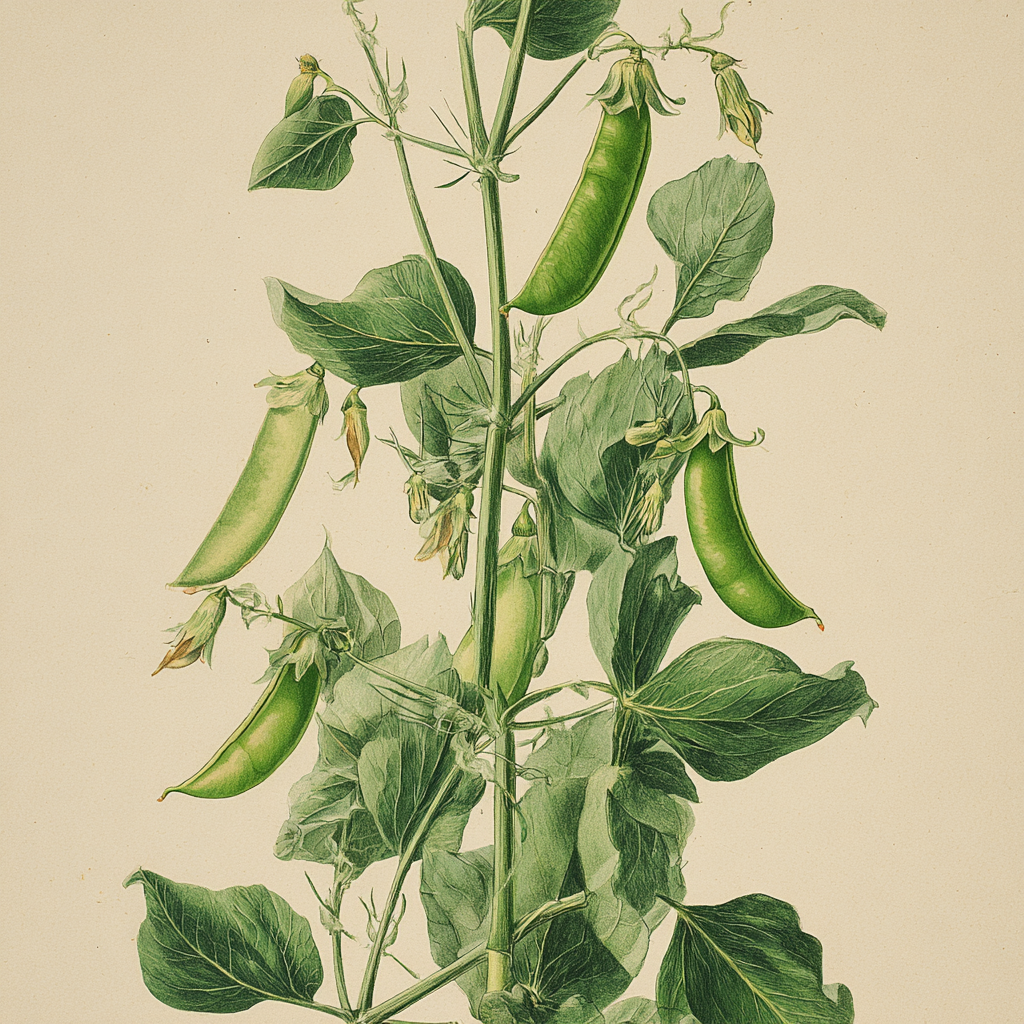
Slender hollow vines that climb with tendrils. Dwarf types stay short, while tall shelling and snap peas need netting, twigs, or trellis support.
Leaves
Compound leaves with paired leaflets and curling tendrils at the tips. Tendrils help identify peas early and distinguish them from bush beans.
Flowers
Pea-shaped flowers, usually white or purple, held at leaf nodes. Flowers are mostly self-pollinating and quickly develop pods in cool conditions.
Fruit
Pods may be flat and tender for snow peas, thick and edible for snap peas, or fibrous around sweet shelling peas. Pods become starchy as seeds mature.
Natural History
Natural History
Pisum sativum was domesticated in the Near East approximately 10,000 years ago and is one of the earliest known cultivated crops - seeds have been recovered from Neolithic sites in the Jordan Valley, Turkey, and across the Fertile Crescent. Along with wheat, barley, lentils, chickpeas, bitter vetch, and flax, peas are one of the eight Neolithic founder crops that formed the nutritional basis of early farming societies. For most of human history, peas were grown for dry seed rather than fresh eating; the fresh green pea as a luxury food was a 17th-century development associated with French court cuisine. Gregor Mendel conducted his foundational experiments on hereditary inheritance in Pisum sativum in the garden of the Augustinian monastery in Brno between 1856 and 1863 - choosing peas deliberately for their distinct, countable traits. His 1866 paper on the laws of inheritance was largely ignored until 1900 when it was independently rediscovered by three researchers, establishing the foundation of modern genetics. The snap pea - combining the sweet seed of a shelling pea with the edible pod of a snow pea - was developed by Calvin Lamborn and released in 1979.
Traditional Use
Traditional Use
The history of peas divides between the dry field pea - a Neolithic founder crop and staple protein source for 10,000 years - and the fresh green garden pea, a 17th-century French court luxury. Gregor Mendel's pea garden in Brno connects this ancient crop directly to the origins of modern genetics.
Parts Noted Historically
Neolithic Founder Crop - Dry seeds
Pisum sativum is one of the eight Neolithic founder crops of Near Eastern agriculture, domesticated approximately 10,000 years ago. Archaeological pea seeds have been recovered from the Jordan Valley, Çatalhöyük in Turkey, and across the Fertile Crescent. Their nitrogen-fixing root nodules made them invaluable in early crop rotations, though the mechanism was not formally understood until the 19th century. For millennia, peas were grown as dry protein-rich storage crops rather than fresh vegetables.
Mendel's Monastery Garden and the Birth of Genetics - Seeds and pods
Gregor Mendel conducted his foundational heredity experiments in Pisum sativum in the Augustinian monastery of St. Thomas in Brno between 1856 and 1863. He chose peas deliberately for their distinct, discrete, countable traits: smooth vs. wrinkled seed, yellow vs. green cotyledon, tall vs. dwarf plant. Tracking 29,000 plants across seven generations, he identified the laws of dominant and recessive inheritance. His 1866 paper went largely unread until 1900, when it was independently rediscovered by three researchers. The pea garden in Brno is now a UNESCO memorial site.
French Court and the Green Pea as Luxury - Green seeds
Fresh green garden peas became a fashionable luxury at the court of Louis XIV in the late 17th century. Madame de Maintenon wrote in 1696 that the court's obsession with fresh peas was so intense that ladies were eating them secretly at night. Italian gardeners introduced tender fresh peas to the French court around 1660, transforming the dry field crop into the first modern vegetable grown specifically for sweet immaturity rather than storage.
British Kitchen Garden Tradition - Green seeds and pods
From the 18th century, the kitchen garden pea became one of the defining pleasures of the English garden. Cultivar development expanded rapidly, selecting for sweetness, pod size, tenderness, and succession timing. The Sugar Snap pea, developed by Calvin Lamborn and released by Rogers Brothers Seed Company in 1979, combined the sweetness of a shelling pea with an edible pod and revived widespread garden interest in the crop.
This information is provided for historical and educational purposes only and is not medical advice. Always consult a qualified healthcare professional before making decisions related to your health.
Related Articles
Related Articles
Extending Your Growing Season
Seasonal Growing • 6 min read
How and When to Harvest Vegetables for Best Flavour
Harvesting & Storage • 5 min read
Cover Crops: The Complete Guide for Home Gardeners
Soil & Compost • 18 min read
Freezing Food: The Simplest Way to Preserve Your Harvest
Harvesting & Storage • 6 min read
Loading photo submission…