
Tomato
VegetableSolanum lycopersicum
Have seeds for this? Add to inventory →The most popular home garden vegetable, tomatoes reward attentive growers with abundant harvests of flavour-packed fruit. They are heavy feeders that thrive in warm soil enriched with compost and benefit enormously from companion planting.
Native Range
- Origin
- Tomato is derived from wild Solanum lineages native to western South America, with domestication and crop development involving Andean and Mesoamerican movement.
- Native Habitat
- Wild relatives occur in dry valleys, coastal slopes, disturbed ground, and seasonally arid habitats rather than temperate North American garden conditions.
- Current Distribution
- Widely cultivated in suitable growing regions worldwide; not native outside its region of origin.
Growing Conditions
Sunlight
Full Sun
Water Needs
Moderate
Soil
Rich, well-draining loam; pH 6.0 - 6.8
Spacing
24 - 36 inches
Days to Maturity
60 - 85 days from transplant
Growing Zones
Thrives in USDA Zones 4 - 11
Companion Planting
When to Plant
Start Indoors
6 - 8 weeks before last frost
Transplant
After last frost, soil 60°F+
Harvest
60 - 85 days from transplant
Phenology (Natural Timing Cues)
Start Indoors
Start tomatoes indoors 6 - 8 weeks before last frost, which means beginning well before outdoor spring feels relevant - typically while deciduous trees are still bare. Starting too early is a common mistake: seedlings held too long under lights before outdoor conditions are ready become root-bound, leggy, or overly large and suffer more transplant stress than younger, stockier plants. Starting too late leaves insufficient time to build good transplants. The target is seedlings that are compact, well-rooted, and showing true leaves by the time hardening off begins - timed to emerge from hardening off right as outdoor conditions are ready.
- Deciduous trees are still bare with no significant bud movement.
- Forsythia has not yet bloomed or is only just beginning.
- Dandelions have not reached heavy bloom.
- Outdoor soil is still cold and not yet workable in most zones.
Transplant
Tomatoes are cold-sensitive in a way many gardeners underestimate: exposure to temperatures below 50°F, even without frost, stresses transplants, stunts root development, and can cause lasting setbacks including blossom drop and slow recovery. Transplanting during a brief warm spell followed by a cold, damp week is worse than waiting an additional week. The reliable cues are late-blooming markers - lilacs faded, oak leaves approaching full size - which in most zones coincide with soil temperatures that are genuinely warm rather than just above freezing. Planting into 60°F+ soil produces noticeably faster root development than planting into 55°F soil, and the seedling does not stall at the margin.
- Lilacs have bloomed and are fading.
- Oak leaves are close to full size.
- Tender annual weeds are growing quickly and steadily.
- Nighttime temperatures are consistently above 50°F.
- Soil temperature in the top few inches is 60°F or warmer.
Start Dates (Your Location)
Based on your saved growing zone and this plant's timing notes.
Typical Last Frost
Set your growing zone to see personalized calendar dates.
Organic Growing Tips
Interplant with basil to repel aphids and whiteflies; basil also enhances tomato flavour.
Apply straw mulch 3 - 4 inches deep to retain moisture and prevent soil-splash fungal diseases.
Spray diluted neem oil at dusk every 7 - 10 days as a preventive against early blight and mites — applying at dusk avoids harming pollinators and beneficial insects active during the day.
Pinch off suckers and stake plants to improve airflow and reduce fungal pressure.
Common Pests
All pest management in Garden uses safe, organic, non-toxic methods only. No synthetic pesticides, ever.
Taxonomy
- Kingdom
- Plantae
- Family
- Nightshade family (Solanaceae)
- Genus
- Solanum
- Species
- Solanum lycopersicum
Natural History
The tomato (Solanum lycopersicum) is native to western South America, where wild relatives still grow in the Andes of Peru, Ecuador, and Colombia. Domestication happened in Mesoamerica - almost certainly Mexico - where the Aztecs called it tomatl, from a Nahuatl root meaning "the swelling fruit," the word that became tomate in Spanish and tomato in English. The Italian botanist Pietro Andrea Mattioli was the first European to describe it in writing, in 1544, calling it pomo d'oro, golden apple - suggesting the earliest varieties to reach Europe were yellow-fruited rather than red. For a century after its European arrival the tomato was viewed with deep suspicion across most of northern Europe. It belongs to the Solanaceae, the nightshade family, and its resemblance to deadly nightshade and mandrake convinced herbalists including Gerard that it was unwholesome or actively poisonous. A practical reinforcement of this view was real, if indirect: tomatoes are highly acidic, and affluent Europeans eating from pewter plates discovered that the acid leached lead from the metal, causing genuine illness. Poorer people eating from wooden boards had no such problem and may have adopted tomatoes sooner. Southern Italy and Spain - receiving the plant from American colonies and eating from earthenware - adopted it into cooking far earlier than northern Europe: the first tomato sauce recipe appears in Antonio Latini's Lo Scalco alla Moderna, published in Naples in 1692. The transformation of tomato into a commercial garden crop in the United States owes a large debt to Alexander W. Livingston, an Ohio plant breeder who spent decades selecting for uniformity, round form, and reliable ripening. His Paragon variety of 1870 is considered the first truly smooth, uniform commercial tomato, and he went on to select more than a dozen others. Livingston's work in the 1870s-1890s formed the practical foundation of the American tomato industry.
Traditional Use
The tomato's journey from Aztec tomatl to Italian pomodoro to global staple is one of the most dramatic food history stories of the last five hundred years, and the two centuries of European suspicion are as much a part of its cultural record as its eventual triumph.
Parts Noted Historically
Aztec and Mesoamerican Cultivation - Ripe fruit
The Aztecs were cultivating and eating tomatoes as a standard food plant when Spanish conquistadors arrived. The Florentine Codex, a 16th-century ethnographic record compiled by Friar Bernardino de Sahagún, describes tomatoes being sold in Aztec markets alongside chillies, peppers, and other foods. Aztec cooks used them in sauces - the basis of what would later become salsa - and the plant was thoroughly embedded in Mesoamerican foodways long before European contact. The tomatl of Aztec markets was already a domesticated crop plant with selected varieties, not a wild fruit gathered from hedgerows.
European Suspicion and the Nightshade Problem - Ripe fruit
Pietro Andrea Mattioli's 1544 Italian description called tomatoes pomo d'oro and placed them among the mandrakes - a classification that associated them with toxicity and erotic magic from the start. John Gerard's 1597 Herball was more emphatic: he called them "of ranke and stinking savour" and placed them firmly in the poisonous nightshade family without recommending them as food. The observation was not entirely wrong - tomato leaves and stems do contain solanine and tomatine, glycoalkaloids present in most Solanaceae - but the ripe fruit is safe and the suspicion was disproportionate. The pewter-leaching problem likely reinforced the reputation in affluent households, creating a genuine feedback loop between a reasonable worry about unfamiliar plants and a specific class-linked dietary risk.
Italian and Spanish Early Adoption - Ripe fruit
While northern Europe remained suspicious through the 17th century, southern Italy and Spain had incorporated tomatoes into cooking by the late 1600s. Antonio Latini published the first written tomato sauce recipe in Naples in 1692 - a Spanish-style sauce of tomatoes, onions, and pepper - and Francesco Gaudentio's Il Panunto Toscano (1705) included tomatoes as an accepted ingredient in Tuscan cooking. By the early 18th century, tomatoes were established in the sauces of southern Italian cuisine. The route was through the Kingdom of Naples, then under Spanish rule, which provided the cultural connection between Spanish colonial produce and Italian kitchen practice.
Alexander Livingston and American Variety Development - Ripe fruit
Alexander W. Livingston of Reynoldsburg, Ohio spent decades in the 1860s-1880s selecting tomatoes for what had previously seemed an impossible combination of traits: smooth uniform round fruit that ripened consistently across the plant. His Paragon variety, released in 1870, was the breakthrough - the first commercially reliable smooth round tomato. He followed it with Acme, Perfection, Favorite, and more than a dozen others documented in his memoir Livingston and the Tomato (1893). Livingston's systematic selection work established the principles of tomato variety improvement that underpinned the subsequent American commercial industry, and his insistence on uniformity over wildness defined the template for the processing tomato industry that grew through the 20th century.
Ripe tomato fruit is a safe food with continuous human consumption going back thousands of years. Tomato leaves, stems, and unripe green fruit contain glycoalkaloids and should not be eaten; this is the factual basis behind the historical European suspicion, though it was greatly overstated.
This information is provided for historical and educational purposes only and is not medical advice. Always consult a qualified healthcare professional before making decisions related to your health.
Morphology (Plant Structure & Identification)
Root System
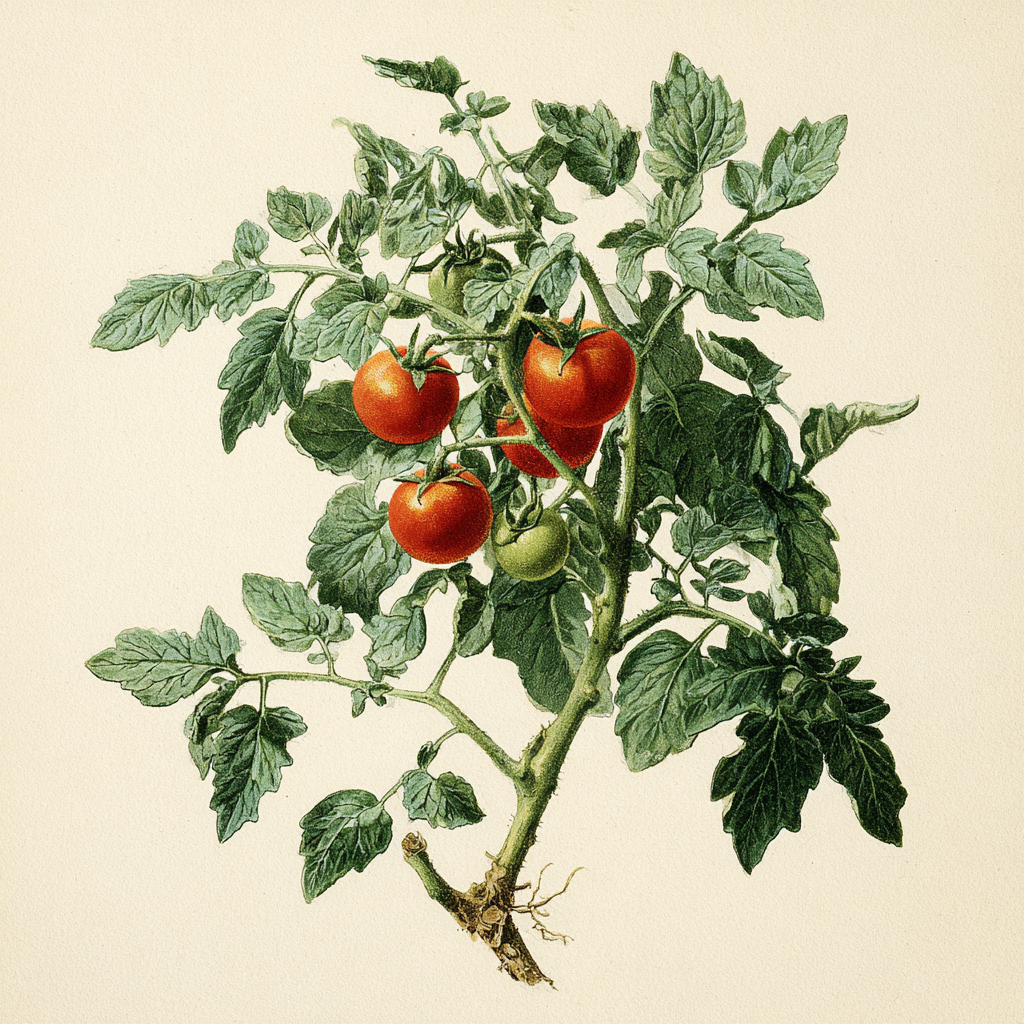
Deep taproot with extensive fibrous lateral roots capable of reaching 60cm or more in depth. Indeterminate varieties develop particularly vigorous root systems. Roots will form along buried stems, making deep planting beneficial.
Stem
Soft, hairy, branching stem that becomes woody at the base with age. Indeterminate varieties grow continuously and can reach 2 meters or more without pruning. Determinate varieties stop growing at a set height. Stem hairs (trichomes) produce aromatic oils that deter some insects.
Leaves
Pinnately compound, alternately arranged, with 5-9 leaflets. Strongly aromatic when crushed due to volatile oils. Dark green, slightly fuzzy texture. Leaves are indicator plants - yellowing patterns reveal nutrient deficiencies.
Flowers
Small, yellow, star-shaped flowers with 5 petals, borne in clusters. Self-pollinating - pollen is released when the flower vibrates, which is why wind and bees improve fruit set. Hand-pollination with an electric toothbrush or gentle shaking helps in still conditions.
Fruit
Botanically a berry - a fleshy fruit developed from a single flower with multiple seed-bearing chambers (locules). Ranges from 1cm cherry types to 500g+ beefsteaks. Red color comes from lycopene, a carotenoid antioxidant that increases with cooking.
Known Varieties
Common cultivars worth knowing
- Best for: fresh eating, slicing
Cherokee Purple
Heirloom beefsteak with dusky rose and purple skin, complex smoky-sweet flavor. One of the most beloved heirlooms.
- Best for: slicing, fresh eating
Brandywine
Classic pink heirloom beefsteak, large and meaty with exceptional flavor. Slow to mature but worth the wait.
- Best for: sauce, canning, paste
San Marzano
Italian paste tomato with thick walls, few seeds, and rich concentrated flavor. The gold standard for sauce.
- Best for: snacking, salads
Sun Gold
Orange cherry tomato with exceptionally sweet, tropical flavor. Extremely prolific and crack-resistant. A gateway tomato for new growers.
- Best for: slicing, short seasons
Early Girl
Reliable medium-sized slicer that matures earlier than most. Good choice for short seasons or impatient gardeners.
- Best for: fresh eating, slicing
Black Krim
Russian heirloom with deep mahogany-red fruit and rich, slightly salty flavor. Excellent heat tolerance.
- Best for: slicing, fresh eating
Mortgage Lifter
Large pink beefsteak developed by M.C. Byles in the 1930s by crossing four large varieties. Meaty, mild, and productive.
- Best for: sauce, canning, drying
Roma
Classic determinate paste tomato with meaty flesh and low moisture. Easy to grow and process in large quantities.
- Best for: fresh eating, visual interest
Green Zebra
Striking striped variety with tangy, citrusy flavor. Ripe when yellow-green stripes appear and fruit yields to gentle pressure.
Related Articles
Planning Your First Vegetable Garden
Getting Started • 5 min read
Understanding Your Growing Zone
Getting Started • 4 min read
Establishing a Garden Bed
Getting Started • 6 min read
Building Great Garden Soil
Soil & Compost • 6 min read
Composting: From Kitchen Scraps to Garden Gold
Soil & Compost • 5 min read
Companion Planting: What Actually Works
Companion Planting • 7 min read
Organic Pest Control: The Layered Approach
Pest & Disease • 6 min read
Identifying and Treating Common Fungal Diseases
Pest & Disease • 7 min read
How to Water Your Vegetable Garden
Watering & Feeding • 5 min read
How and When to Harvest Vegetables for Best Flavour
Harvesting & Storage • 5 min read
Loading photo submission…