Bee Balm
FlowerMonarda didyma
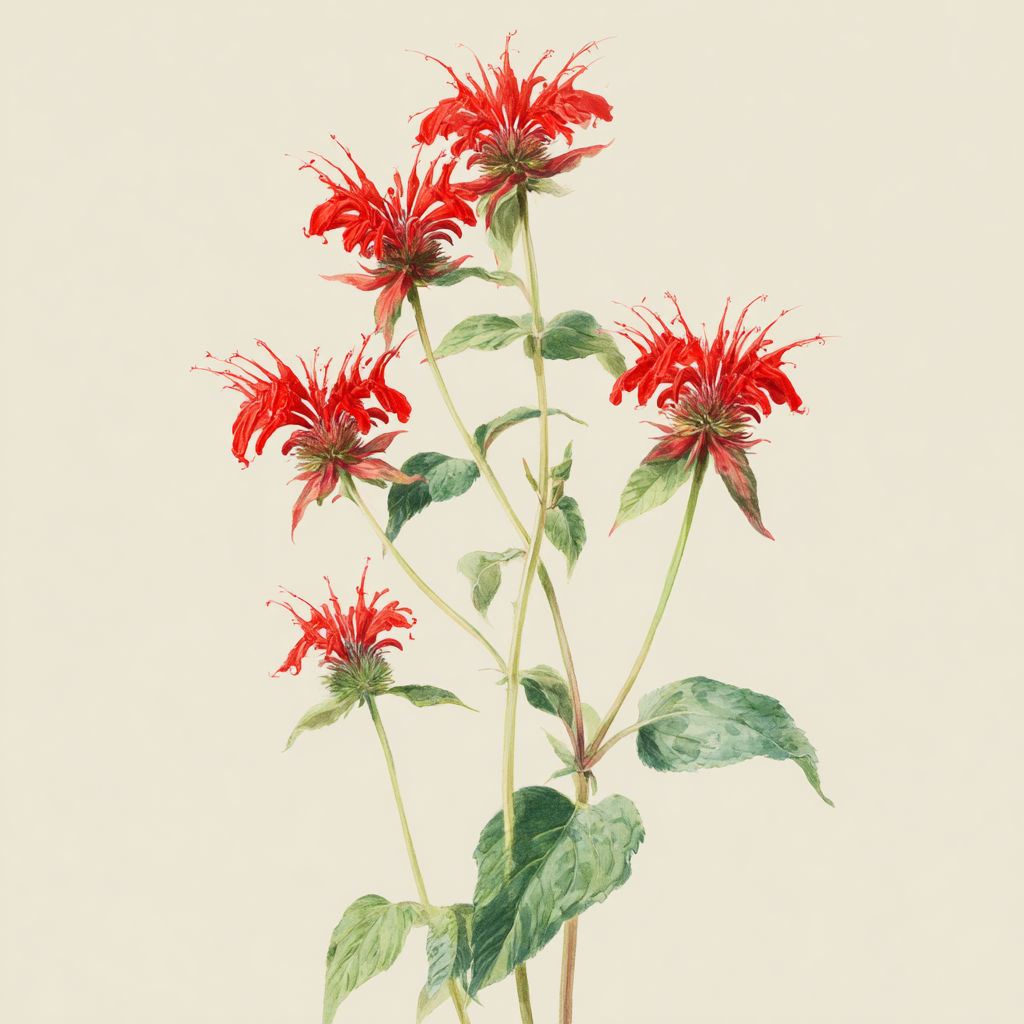
Have seeds for this? Add to inventory →Bee balm is a native North American perennial with brilliant red, pink, or purple tubular flowers that are irresistible to bees, butterflies, and hummingbirds. Its aromatic foliage deters aphids and fungal diseases on nearby plants.
Growing Conditions
Growing Conditions
Sunlight
Full Sun
Water Needs
Moderate
Soil
Rich, moist, well-draining loam; pH 6.0 - 7.0
Spacing
18 - 24 inches
Days to Maturity
Perennial; blooms year 2; most vibrant in years 3 - 4
Growing Zones
Growing Zones
Thrives in USDA Zones 4 - 9
When to Plant
When to Plant
Transplant
Spring or autumn
Harvest
Harvest flowers and leaves for herbal tea; divide every 3 years to prevent powdery mildew
Phenology (Natural Timing Cues)
Transplant
Transplant bee balm in mid-spring once perennial growth is steady, or divide and replant established clumps in early autumn before dormancy. Spring planting gives a stronger first-season result; autumn is the natural time when dividing existing beds.
- Dandelion bloom has peaked and is beginning to fade (spring planting).
- Soil is workable and holds steady moisture.
- Mint-family perennials are pushing vigorous new shoots (spring planting).
- First cool nights are arriving but hard frost is still several weeks away (autumn division).
- Existing bee balm clumps are beginning to go dormant (autumn division).
Start Dates (Your Location)
Average dates use your saved zone; readiness also checks your forecast when available.
Best Planting Window
Spring window
Spring
Plant early enough for roots to settle before summer heat.
Autumn window
Early autumn
Plant early enough for roots to grow before winter; avoid late planting into cold, wet soil.
Planting Method
Use nursery-grown planting stock rather than treating this as a standard seed-starting crop.
Critical Timing Note
Plant early enough for roots to establish before weather stress arrives.
Use the average timing, but check your local forecast before planting.
Typical Harvest Window
June to September
Organic Growing Tips
Organic Growing Tips
Divide clumps every 2 - 3 years and replant outer divisions in fresh soil enriched with compost; the centre of old clumps becomes unproductive and compost-enriched replanting soil gives divisions the best start.
Space generously and site in good airflow to prevent powdery mildew, which affects bee balm in humid conditions.
Plant near tomatoes to attract pollinators that improve fruit set throughout the season.
Both flowers and leaves are edible with an oregano-like flavour, used fresh in teas and salads.
Care Guidance
Optional seasonal guidance for what you can do, even when nothing is urgent.
Care Guidance
Watering
If the top 2 inches of soil feel dry, a deep watering at the base may help more than frequent light watering. In healthy soil, rain may cover much of what it needs.
Feeding
Extra feeding is rarely required if soil is healthy. If growth looks pale or slow, a light compost top-dressing is often enough before adding anything stronger.
Seasonal care
In late fall, a light cleanup and fresh mulch can help if winter protection is useful in your climate. Leaving a little space around crowns and trunks often helps air move and keeps excess moisture from sitting there.
Harvest timing
Harvests often cluster around June to September. If fruit, leaves, or roots start looking ready, color, size, firmness, and scent usually tell you more than the calendar alone.
Known Varieties
Common cultivars worth knowing
Known Varieties
Jacob Cline
Tall red-flowered cultivar known for strong mildew resistance.
Best for
hummingbird gardens
Raspberry Wine
Wine-red flowers on vigorous clumps.
Best for
moist perennial borders
Panorama Mix
Seed-grown mix with red, pink, salmon, and purple flowers.
Best for
mixed pollinator beds
Gardenview Scarlet
Bright scarlet cultivar with strong stems and good garden presence.
Best for
bold color
Bee's Knees
Compact red-flowered selection with shorter plants.
Best for
small gardens
Companion Planting
Companion Planting
Good companions
Support & insectary plants
Nearby plants that attract pollinators, beneficial insects, or improve soil health.
- Echinacea
Attracts pollinators and beneficial insects
- Black-Eyed Susan
Attracts pollinators and beneficial insects
- Lavender
Attracts pollinators and beneficial insects
- Yarrow
Attracts beneficial insects and produces nutrient-rich mulch
Avoid planting near
No known conflicts
Common Pests
Common Pests
All pest management in Garden uses safe, organic, non-toxic methods only. No synthetic pesticides, ever.
Native Range
Native Range
- Origin
- Bee balm is native to eastern North America, ranging from southern Ontario through the eastern United States from Maine south to Georgia and west to Michigan and Alabama.
- Native Habitat
- In its native range, bee balm grows in moist woods, along stream banks, at rich woodland edges, in wet meadows, around seepage areas, and on rocky slopes with consistent moisture and partial to full sun exposure.
- Current Distribution
- Native across eastern North America and widely cultivated beyond that range in herb gardens, ornamental borders, and pollinator plantings throughout temperate North America and Europe.
Taxonomy
Taxonomy
- Kingdom
- Plantae
- Family
- Mint family (Lamiaceae)
- Genus
- Monarda
- Species
- Monarda didyma
Morphology
Morphology
Root System
Rhizomatous perennial root system that forms expanding clumps and can thin in the center with age.
Stem
Square mint-family stems, upright and often reddish, with branching near the flower clusters.
Leaves
Opposite lance-shaped leaves with toothed margins and a strong spicy, oregano-like scent when rubbed.
Flowers
Dense whorled heads of tubular red, pink, purple, or lavender flowers with showy bracts.
Fruit
Small nutlets held in the dried mint-family calyx after flowers fade.
Natural History
Natural History
Bee balm (Monarda didyma) is native to moist, rich woodland edges, stream banks, and rocky hillsides in eastern North America, from New York state through the Appalachians and into the Great Lakes region. The genus is named after Nicolás Monardes, the Spanish physician whose 1577 work "Joyful News Out of the New Found World" was one of the first systematic European accounts of New World plants. The long red tubular flowers are a textbook example of hummingbird pollination syndrome: the color red (which bees cannot readily perceive), the tubular shape, and daytime flowering all reflect a coevolutionary relationship with hummingbirds - striking given that "bee" is embedded in the common name. The aromatic compounds in the leaves - primarily thymol and carvacrol - are the same volatile compounds found in thyme and oregano, explaining the oregano-like scent when foliage is bruised. There are around 16 species of Monarda, all native to North America; M. fistulosa (wild bergamot), the drier-ground relative, tends toward bee pollination and lavender flowers, while M. didyma with its deeper red flowers is the hummingbird specialist of moist eastern woodlands.
Traditional Use
Traditional Use
Bee balm has a well-documented history of use among several Indigenous nations of eastern North America, and a distinct second chapter as a colonial-era tea herb introduced to European botanical gardens in the 18th century. Both strands of its history are rooted in its strong aromatic oils rather than any single specific application.
Parts Noted Historically
Indigenous North American Traditions - Leaves and flowers
Several Indigenous nations of eastern North America used Monarda species in their plant traditions. The Oswego people (Haudenosaunee/Iroquois) of the Lake Ontario region, from whom the plant takes its Oswego tea name, used aromatic Monarda leaves medicinally. The Cherokee used M. fistulosa (wild bergamot) as a cold remedy and applied it to skin conditions. The Blackfoot used Monarda species as a hair treatment and aromatic. These uses reflect the plant's thymol content, which has genuine antiseptic properties.
Colonial Oswego Tea Tradition - Leaves
The American botanist John Bartram collected bee balm from the Oswego people near Lake Ontario in the 1740s and introduced it through colonial botanical networks to the English plantsman Peter Collinson, through whom it entered European gardens. The plant became widely grown in colonial herb gardens as Oswego tea. It is sometimes associated with the period following the Boston Tea Party (1773), when colonists sought native substitutes for imported tea, though historians have questioned how widespread this specifically was.
European Cottage and Physic Garden Traditions - Leaves and flowers
After Bartram's introduction, bee balm became fashionable in 18th-century European gardens, grown both as an ornamental and an aromatic herb. European herbalists noted its similarity to thyme and oregano and attributed to it similar warming properties. It settled into the cottage garden tradition as a tea herb and pollinator plant, the role it primarily occupies today.
Bee balm leaves and flowers are food-safe used as a culinary or tea herb in normal quantities. The thymol content that gives bee balm its antiseptic character is the same compound found in thyme and is well tolerated in culinary use.
This information is provided for historical and educational purposes only and is not medical advice. Always consult a qualified healthcare professional before making decisions related to your health.
Loading photo submission…