Black-Eyed Susan
FlowerRudbeckia hirta
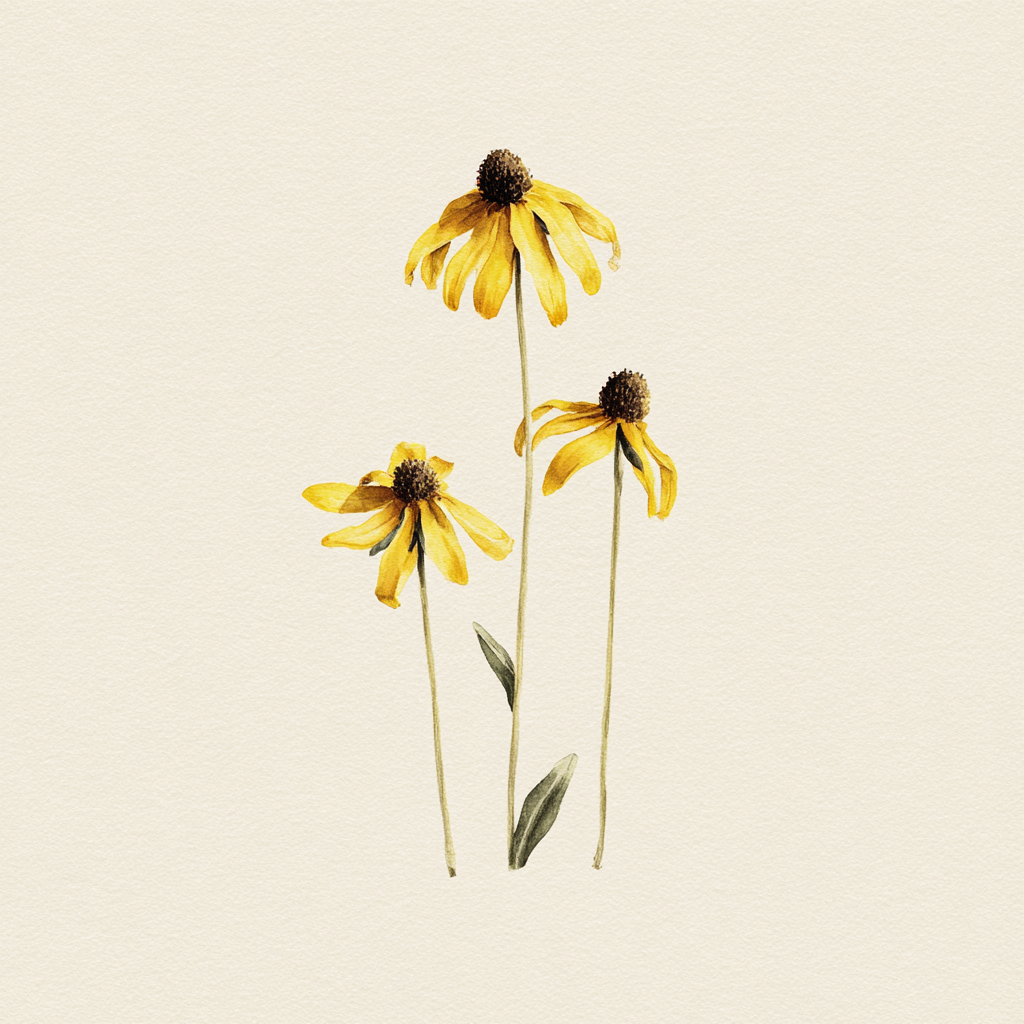
Have seeds for this? Add to inventory →Black-Eyed Susan is a cheerful native perennial wildflower bearing golden-yellow daisy-like rays surrounding a dark brown to nearly black central cone, blooming prolifically from midsummer into fall. Hardy across a wide range of climates, it thrives in well-drained, even poor soils and tolerates drought once established. An exceptional pollinator plant, it draws bees, butterflies, and goldfinches while requiring minimal care from the grower.
Growing Conditions
Growing Conditions
Sunlight
Full Sun
Water Needs
Low
Soil
Well-draining loam; pH 6.0 - 7.0; tolerates poor, dry soil
Spacing
18 - 24 inches
Days to Maturity
Perennial; blooms prolifically from year 2
Growing Zones
Growing Zones
Thrives in USDA Zones 3 - 9
When to Plant
When to Plant
Start Indoors
8–10 weeks before last frost
Transplant
Spring or autumn
Direct Sow
Surface sow in spring (needs light to germinate)
Harvest
Leave seed heads for birds through winter
Phenology (Natural Timing Cues)
Direct Sow
Direct sow onto the soil surface after the last frost when the soil has warmed to at least 50°F. Black-eyed Susan seeds require light to germinate and should not be buried; pressing them gently into moist soil is sufficient. Sowing too early into cold, wet soil leads to rot and poor germination.
- Dandelions blooming freely and lawn growth actively resuming
- Soil surface no longer cold to the touch and draining cleanly after rain
- Tender annual weeds germinating in bare garden beds
- Forsythia bloom has passed and lilac buds are swelling
Transplant
Transplant nursery starts or divisions in spring after frost risk has passed, or in early autumn at least 6 weeks before hard frost so roots establish before dormancy. Spring transplants establish faster with reliable summer moisture; autumn planting works well in warm and mild climates where the soil stays workable late.
- Overnight temperatures consistently above 40°F and no hard frost forecast
- Soil workable and draining well, not saturated from snowmelt
- Deciduous trees leafing out and active garden growth resuming
- For autumn planting: first cool nights returning and summer heat easing, but at least 6 weeks before expected hard frost
Start Dates (Your Location)
Average dates use your saved zone; readiness also checks your forecast when available.
Average Last Frost
Set your growing zone to see personalized calendar dates.
Use the average timing, but check your local forecast before planting.
Transplant Outdoors
Spring or autumn
This uses autumn or first-frost timing, so keep the planting note as written.
Direct Sow
Spring
Use the seasonal timing note for this plant. Surface sow. Seeds need light to germinate.
Typical Harvest Window
June to October
Organic Growing Tips
Organic Growing Tips
Leave seed heads standing through autumn and winter to feed finches and other seed-eating birds.
Combine with echinacea and yarrow for a long-blooming, low-maintenance beneficial insect border.
Deadhead spent flowers to extend bloom season, but leave some for seed.
Mulch lightly with leaf mould or bark and allow cut stems to decompose in place - black-eyed Susan is a native wildflower adapted to building soil organically over time, and its root channels improve drainage and earthworm habitat for the whole bed.
Care Guidance
Optional seasonal guidance for what you can do, even when nothing is urgent.
Care Guidance
Watering
Extra watering is often only useful during extended dry periods. If the top 2 to 3 inches are still holding moisture, additional water may not help.
Feeding
Extra feeding is rarely required if soil is healthy. If growth looks pale or slow, a light compost top-dressing is often enough before adding anything stronger.
Seasonal care
In late fall, a light cleanup and fresh mulch can help if winter protection is useful in your climate. Leaving a little space around crowns and trunks often helps air move and keeps excess moisture from sitting there.
Harvest timing
Harvests often cluster around June to October. If fruit, leaves, or roots start looking ready, color, size, firmness, and scent usually tell you more than the calendar alone.
Known Varieties
Common cultivars worth knowing
Known Varieties
Indian Summer
An All-America Selections winner with exceptionally large flower heads up to 6–9 inches across, longer individual bloom duration, and a reliably compact habit around 2 feet tall.
Best for
Bold garden display and large cut flowers
Cherry Brandy
Unusual bicolor cultivar with deep mahogany-red rays shading to orange-yellow at the tips and a dark central cone; adds warm autumnal color contrast in mixed borders.
Best for
Color contrast in cut-flower arrangements and mixed borders
Goldsturm (Rudbeckia fulgida var. sullivantii 'Goldsturm')
Technically R. fulgida rather than R. hirta, but so widely sold under the black-eyed Susan name that growers should know it; a longer-lived, more reliably perennial form with uniform golden flowers and stronger clump habit.
Best for
Long-lived, low-maintenance perennial beds
Prairie Sun
A distinctive cultivar with golden-yellow rays and a contrasting green rather than dark central cone; bred for heat tolerance and extended bloom in hot summer climates.
Best for
Hot, dry climates and gardeners who prefer a lighter-centered bloom
Companion Planting
Companion Planting
Support & insectary plants
Nearby plants that attract pollinators, beneficial insects, or improve soil health.
Avoid planting near
No known conflicts
Common Pests
Common Pests
All pest management in Garden uses safe, organic, non-toxic methods only. No synthetic pesticides, ever.
Native Range
Native Range
- Origin
- Rudbeckia hirta is native to a broad swath of eastern and central North America, from the Great Plains east to the Atlantic seaboard and north into the Canadian prairie provinces and Maritime regions.
- Native Habitat
- It grows naturally in open prairies, meadows, forest edges, roadsides, and disturbed ground, thriving in full sun with well-drained or even rocky, nutrient-poor soils where competing vegetation is limited.
- Current Distribution
- Widely native across most of the contiguous United States and much of southern Canada; cultivated and naturalized well beyond its native range in Europe, Australia, and elsewhere as a garden ornamental.
Taxonomy
Taxonomy
- Kingdom
- Plantae
- Family
- Daisy family (Asteraceae)
- Genus
- Rudbeckia
- Species
- Rudbeckia hirta
Morphology
Morphology
Root System
Forms a fibrous, moderately deep root crown that spreads gradually; established crowns are drought-tolerant and should be divided every 3–4 years when the center becomes woody and bloom declines.
Stem
Upright, branching stems reaching 1.5–3 feet, covered in stiff bristly hairs that are a reliable identification feature and can cause mild skin irritation during cutting or division.
Leaves
Basal and alternate stem leaves are rough, hairy, and lance- to spoon-shaped; yellowing lower leaves in midsummer are normal as the plant directs energy to flowering, but spotting or powdery coating signals septoria leaf spot or powdery mildew - mprove airflow and avoid overhead watering.
Flowers
Each stem terminates in a single composite flower head with 8–21 bright golden-yellow ray florets surrounding a domed, dark brown to black central disc; the disc florets open in rings from the outside inward over several weeks, making each head a sustained nectar source for bees and butterflies.
Fruit
After pollination, the disc develops into a tight cone of small, hard achenes that persist through winter and are avidly eaten by goldfinches and American tree sparrows; leaving cones standing is the single most wildlife-beneficial management choice.
Natural History
Natural History
Rudbeckia hirta has graced North American prairies and meadow edges since long before European settlement, taking its genus name from Olof Rudbeck the Elder and his son, Swedish botanists honored by Linnaeus in 1753. Indigenous peoples across its native range were familiar with the plant as a fixture of open, disturbed ground, and early European botanists encountered it along the eastern seaboard and interior grasslands in the 17th and 18th centuries. As a short-lived perennial that self-seeds prolifically on bare soil, black-eyed Susan is ecologically tuned to disturbance - t colonizes open gaps rapidly, which makes it both a reliable garden self-renewer and a champion of degraded or newly established meadow plantings.
Traditional Use
Traditional Use
Several Indigenous peoples of eastern and central North America recorded uses of Rudbeckia hirta in their traditional practices, documented by ethnobotanists in the 19th and 20th centuries. The Cherokee, Ojibwe, and other nations noted the plant in contexts involving the roots and leaves. Historical records are observational and ethnobotanical rather than clinical.
Parts Noted Historically
Cherokee (recorded in Mooney and Olbrechts ethnobotanical records, late 19th century) - roots
Cherokee practitioners were documented using the roots of Rudbeckia hirta in a wash applied to sores and swellings, as recorded in late 19th-century ethnobotanical surveys of Appalachian Cherokee plant knowledge.
Ojibwe (recorded by Densmore, early 20th century) - roots
Densmore's early 20th-century documentation of Ojibwe plant knowledge noted root preparations associated with treating snakebite and worms, representing one of the more specific recorded traditional contexts for this species.
Black-eyed Susan is not considered toxic to humans in ordinary garden contact, though the coarse, bristly hairs on stems and leaves may cause mild skin irritation in sensitive individuals. Members of the Asteraceae family occasionally trigger reactions in people with ragweed sensitivities.
This information is provided for historical and educational purposes only and is not medical advice. Always consult a qualified healthcare professional before making decisions related to your health.
Loading photo submission…