Strawberry
FruitFragaria × ananassa
Have seeds for this? Add to inventory →Strawberries are low-growing perennial fruits that produce abundantly from spring through summer and spread readily via runners. They thrive in well-draining, slightly acidic soil rich in organic matter and benefit greatly from companion planting.
Native Range
- Origin
- Garden strawberry is a cultivated hybrid derived principally from North American Fragaria virginiana and South American/western American Fragaria chiloensis.
- Native Habitat
- The parent species occupy meadows, dunes, open woods, coastal bluffs, and cool grasslands, but the garden hybrid itself is cultivated.
- Current Distribution
- Cultivated globally; does not occur as a native plant in this form.
Growing Conditions
Sunlight
Full Sun
Water Needs
Moderate
Soil
Rich, well-draining, slightly acidic loam; pH 5.5 - 6.5
Spacing
12 - 18 inches
Days to Maturity
Everbearing: fruits same year; June-bearing: harvest in year 2
Growing Zones
Thrives in USDA Zones 3 - 10
Companion Planting
When to Plant
Transplant
Early spring (June-bearing) or spring-autumn (everbearing)
Harvest
Pick when fully red and slightly soft; check daily at peak season
Phenology (Natural Timing Cues)
Transplant
Strawberries establish from crowns or rooted runners best in cool, moist soil that supports rapid rooting without drought or heat stress. June-bearing strawberries planted in early spring will not fruit significantly in their first year - the standard practice is to remove flowers in year one to focus energy on root and runner development, with the full harvest arriving in year two. Everbearing types may produce some fruit in their first season if well-established. Planting into cold, waterlogged soil stalls rooting and can rot the crown, while planting into dry warm summer soil means the crown desiccates before roots can spread. The autumn window in mild zones often gives the best root development of all, because cool weather persists through the whole establishment period and crowns can build a strong root system before spring flowering.
- Early dandelions are beginning to bloom and soil is cool but workable.
- Soil holds steady moisture and is not waterlogged.
- Existing strawberry crowns nearby are just pushing fresh leaves.
- For autumn planting: summer heat has eased, first cool nights have returned, and hard frost is still weeks away.
Start Dates (Your Location)
Based on your saved growing zone and this plant's timing notes.
Best Planting Window
Spring window
Early spring
Plant as soon as the soil is workable so roots establish before heat arrives.
Autumn window
Early autumn
Plant early enough for roots to grow before winter; avoid late planting into cold, wet soil.
Planting Method
Plant crowns, runners, or nursery-grown plugs. Seed-grown strawberries are slow and variable, so starts are the practical choice.
Critical Timing Note
Keep the crown level with the soil surface; buried crowns rot and exposed roots dry out.
Typical Harvest Window
May to July
Organic Growing Tips
Plant borage nearby - it deters aphids and attracts pollinators, and its flowers are edible in fruit salads.
Mulch with straw to keep berries off the soil, suppress weeds, and reduce grey mould.
Remove runners promptly if fruiting is the goal, or pot up runners for free replacement plants.
Refresh beds every 3 years with new certified plants to prevent virus buildup.
Common Pests
- Slugs
- Spider Mites
- Aphids
- Grey Mould (Botrytis)
- Vine Weevil
- Birds
All pest management in Garden uses safe, organic, non-toxic methods only. No synthetic pesticides, ever.
Taxonomy
- Kingdom
- Plantae
- Family
- Rose family (Rosaceae)
- Genus
- Fragaria
- Species
- Fragaria × ananassa
Natural History
The modern garden strawberry (Fragaria × ananassa) is a hybrid that did not exist anywhere in the world before the 1740s. It was created by accident in France from a cross between two New World species: Fragaria virginiana from eastern North America and Fragaria chiloensis from the Pacific coast of Chile. The Chilean strawberry had been cultivated by the Mapuche people for centuries before European contact. The French military engineer Amédée-François Frézier - whose surname was itself derived from fraise, the French word for strawberry, from a family legend about an ancestor who introduced the fruit to the French king - observed the large-fruited white-fleshed Mapuche strawberry in Chile in 1712 and brought five plants back to France in 1714. Frézier did not know the species was gynodioecious and required cross-pollination with a different Fragaria. When his Chilean plants were grown near Fragaria virginiana in the gardens at Brest, natural crosses produced exceptional offspring. The resulting hybrid was named Fragaria × ananassa ("pineapple strawberry") for its supposed pineapple-like aroma and was formally described by Antoine Nicolas Duchesne in his Histoire Naturelle des Fraisiers (1766) - Duchesne also discovered that strawberries propagated through runners rather than seed, a foundational observation for all later cultivation. Before the 18th-century hybrid existed, Europeans had cultivated Fragaria vesca - the woodland strawberry or fraise des bois - since at least the 13th century. It appears in illuminated manuscripts and garden records throughout the medieval period, and Cardinal Thomas Wolsey's famous strawberry garden at Ely Place in London was mentioned by Shakespeare in Richard III.
Traditional Use
The history of the strawberry is one of the most precisely documented origin stories in fruit cultivation, moving from Chilean Mapuche orchards to a French military engineer's ship to an accidental cross in the gardens at Brest that produced the fruit now grown worldwide.
Parts Noted Historically
Medieval Wood Strawberry (Fragaria vesca) - Fruit and leaves
The woodland strawberry or fraise des bois was the only strawberry known to European gardeners before the 18th century. Small, intensely flavoured, and seasonal, it appears in illuminated manuscripts and garden records throughout the medieval period. Cardinal Wolsey's strawberry garden at Ely Place in London was well known enough that Shakespeare referenced it in Richard III (1592-1593): "My Lord of Ely, when I was last in Holborn, I saw good strawberries in your garden there." John Gerard described F. vesca in his 1597 Herball, and Nicholas Culpeper's 1652 Complete Herbal noted uses for leaves and fruit. Strawberry leaves from F. vesca appear in older household texts as a mild cooling preparation, but the culinary fruit was always the primary interest.
Frézier and the Chilean Discovery - Fruit
Amédée-François Frézier was a French military engineer and spy sent to survey Spanish defences in South America in 1711-1714. His account of the voyage, published in 1716, included detailed botanical descriptions of Chilean plants including the large-fruited Mapuche strawberry, which he called "as big as a walnut." He brought five living plants back to Brest, and after distributing them to botanical gardens, some were planted near Virginia strawberries (Fragaria virginiana). The accidental hybrid that emerged combined the size of the Chilean fruit with the flavour and productivity of the Virginia species. Frézier's surname - which he was indeed conscious of, having written a punning comment about it - gave the story a remarkable symmetry: the man who enabled the modern strawberry was himself named after the fruit.
Antoine Nicolas Duchesne and the Science of Fragaria - Fruit
Antoine Nicolas Duchesne was nineteen years old in 1766 when he presented Louis XV with a pot of strawberries and published his Histoire Naturelle des Fraisiers, a comprehensive monograph on the Fragaria genus that was the first scientific treatment of strawberry species and their relationships. Duchesne described the hybrid origin of F. × ananassa, discovered the runner-propagation system, and correctly identified the different species then in cultivation. He was the first to recognize that strawberries could be propagated vegetatively through runners in a controlled way, a discovery that made systematic variety improvement possible and laid the foundation for all subsequent commercial strawberry breeding.
British and American Cultivar Development - Fruit
The first major named modern strawberry variety was Michael Keens' Seedling, selected by Keens of Isleworth around 1821 and exhibited at the Horticultural Society of London, where it won a prize. Keens' Seedling set the standard for large, high-quality dessert strawberries and dominated English cultivation for decades. In North America, the 19th century saw rapid variety development, and by the early 20th century specific varieties were being developed for different regional conditions. The everbearing types, which produce a second autumn crop, were developed primarily in the 20th century, and the modern commercial strawberry industry - now the most valuable berry crop globally by value - is built on intensive selection from the Fragaria × ananassa hybrid that Frézier's Chilean plants inadvertently created.
Strawberry fruit is safe food for most people. A small proportion of individuals have genuine strawberry allergy, typically involving an immune response to a protein in the ripe fruit.
This information is provided for historical and educational purposes only and is not medical advice. Always consult a qualified healthcare professional before making decisions related to your health.
Morphology (Plant Structure & Identification)
Root System
Shallow fibrous roots grow from a central crown and need steady moisture without waterlogging. Crowns must sit at soil level, not buried.
Stem
Short crown produces leaves, flowers, and runners. Runners root at nodes to form daughter plants and can quickly fill a bed.
Leaves
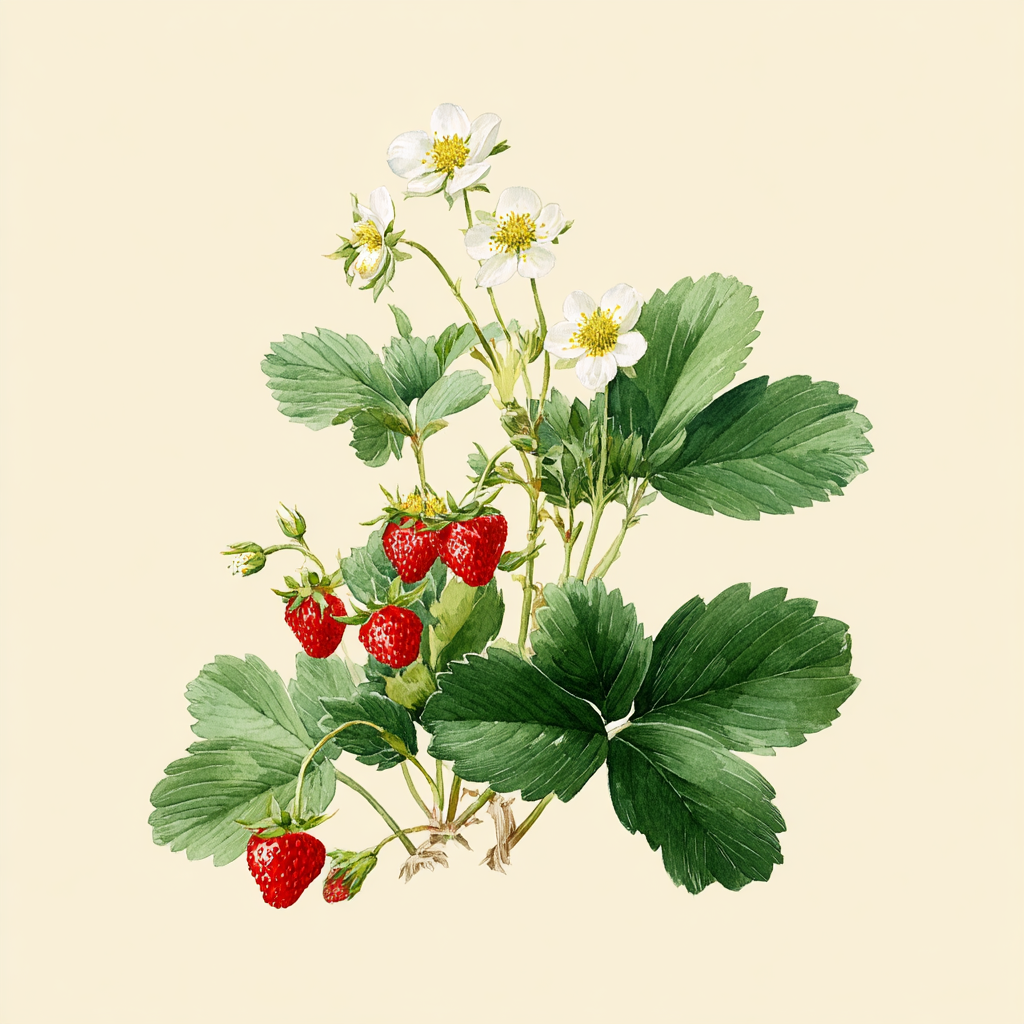
Three-part leaves with toothed edges and a slightly hairy texture. Healthy leaves form low mounds above the crown.
Flowers
White to pink five-petaled flowers with yellow centers appear on short stalks and require pollinator activity for well-shaped berries.
Fruit
The red strawberry is an enlarged receptacle with tiny seed-like achenes on the outside. Fruit ripens from white to red and does not improve much after picking.
Known Varieties
Common cultivars worth knowing
- Best for: fresh eating
Earliglow
June-bearing variety known for excellent flavor and early harvest.
- Best for: extended harvests
Seascape
Day-neutral strawberry with repeated harvests through the season.
- Best for: containers, fresh market quality
Albion
Firm day-neutral variety with large berries and good disease resistance.
- Best for: northern gardens
Honeoye
Productive June-bearing type with good cold hardiness.
- Best for: flavor, specialty gardens
Mara des Bois
Day-neutral French variety with wild-strawberry aroma.
Loading photo submission…