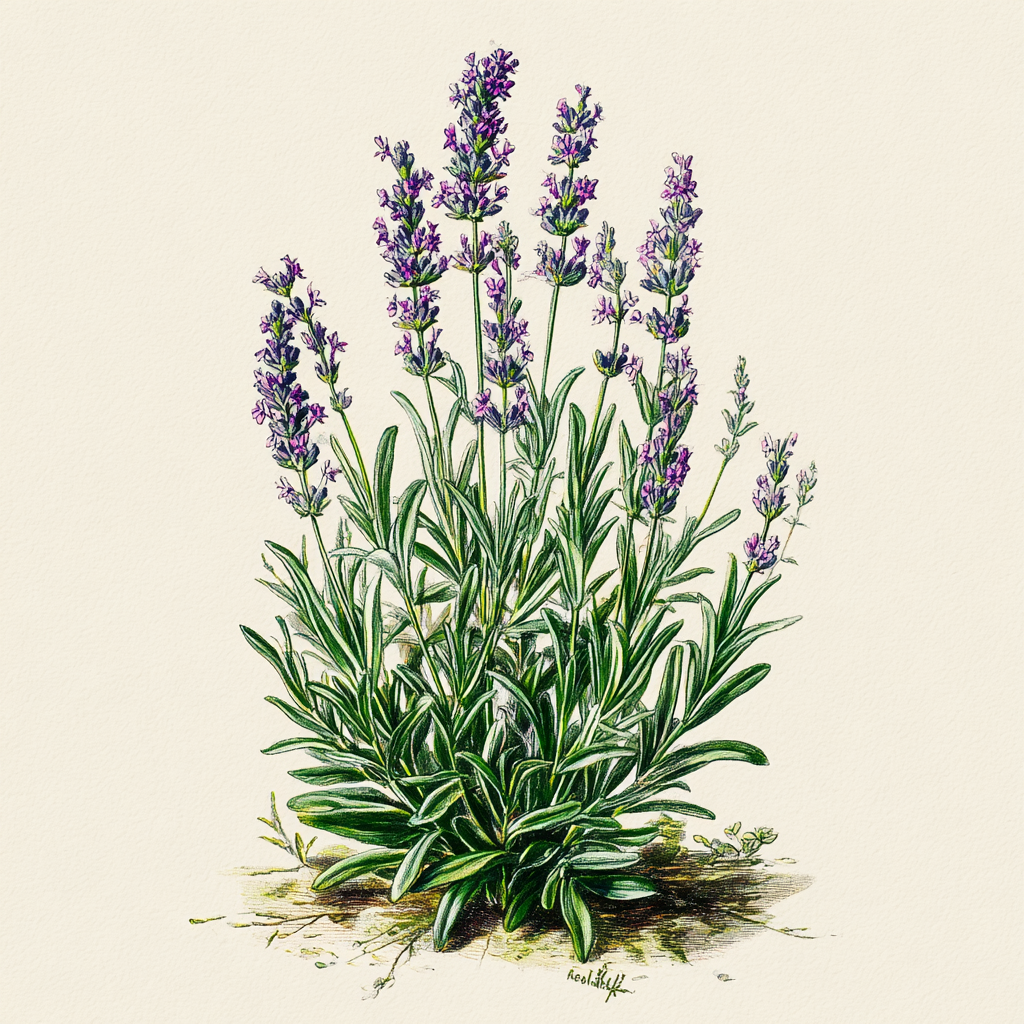
Lavender
HerbLavandula angustifolia
Have seeds for this? Add to inventory →Lavender is a drought-tolerant perennial whose fragrant flowers attract bees, butterflies, and other beneficial pollinators while repelling moths, flies, and fleas. It is a beautiful and highly functional addition to any kitchen garden border.
Native Range
- Origin
- English lavender is native to parts of the western Mediterranean and southern Europe.
- Native Habitat
- Dry rocky limestone slopes, open scrub, mountain meadows, and sunny well-drained Mediterranean habitats.
- Current Distribution
- Widely cultivated in dry, mild climates; not native outside its region of origin.
Growing Conditions
Sunlight
Full Sun
Water Needs
Low
Soil
Well-draining, lean, alkaline sandy or chalky soil; pH 6.5 - 8.0
Spacing
18 - 24 inches
Days to Maturity
Harvest flower spikes from year 2 onwards
Growing Zones
Thrives in USDA Zones 5 - 10
Companion Planting
When to Plant
Transplant
Spring or early autumn
Harvest
Cut flower spikes just as buds begin to open for best scent
Phenology (Natural Timing Cues)
Transplant
Lavender is more vulnerable to wet, cold soil than to cold air temperatures - the primary establishment risk is waterlogged roots in slow-draining spring soil, not frost. Plant once spring soil has dried down enough to drain freely within a day of rain, and choose the site for drainage above all else. Early autumn planting can also work well in most climates, giving roots time to anchor before winter without the waterlogging risk of wet springs.
- Lilacs have faded and spring rainfall is becoming less frequent.
- Soil drains visibly within a day of rain rather than staying wet for several days.
- Warm-season growth is underway throughout the garden - plants are not sitting still.
- Risk of prolonged cold, wet weather has passed.
Start Dates (Your Location)
Based on your saved growing zone and this plant's timing notes.
Best Planting Window
Spring window
Spring
Plant early enough for roots to settle before summer heat.
Autumn window
Usually skip autumn planting
Use spring unless you have locally grown nursery stock and enough mild weather for roots to establish.
Planting Method
Use nursery-grown planting stock rather than treating this as a standard seed-starting crop.
Critical Timing Note
Plant early enough for roots to establish before weather stress arrives.
Organic Growing Tips
Plant along vegetable bed borders to attract hoverflies, whose larvae consume hundreds of aphids each.
Prune back by one-third after first flowering to encourage a second flush of blooms.
Never cut back into old wood - lavender does not regenerate from bare stems.
Mulch with fine grit around the base rather than rich organic matter — lavender thrives in lean, alkaline conditions, and grit mulch improves drainage, reduces soil splash onto leaves, and mimics the Mediterranean hillside habitat where lavender evolved.
Common Pests
- Rosemary Beetle
- Leaf-Hoppers
- Root Rot
All pest management in Garden uses safe, organic, non-toxic methods only. No synthetic pesticides, ever.
Taxonomy
- Kingdom
- Plantae
- Family
- Mint family (Lamiaceae)
- Genus
- Lavandula
- Species
- Lavandula angustifolia
Natural History
Lavandula angustifolia and related Mediterranean species are native to the rocky calcareous soils of the western Mediterranean, growing naturally from the Atlantic coast of Spain through Provence, Italy, and into the Balkans. The genus name derives from the Latin lavare - to wash - reflecting the plant's deep association with bathing and laundry in Roman culture. Lavender was documented by Dioscorides in De Materia Medica in the 1st century CE and appears in the writings of the medieval abbess Hildegard von Bingen (1098-1179), who described it as a plant of particular purity in her Physica. The commercial lavender industry centered on Provence dates to at least the 17th century, supplying the perfumery centers of Grasse with raw material for distillation. Modern lavandin (Lavandula × intermedia) is a sterile hybrid between L. angustifolia and L. latifolia developed in the 20th century for essential oil production; it yields significantly more oil than true lavender and now dominates commercial cultivation. The term aromatherapy was coined by the French perfume chemist René-Maurice Gattefossé in his 1937 book of that name, following his experience with lavender oil after a laboratory burn.
Traditional Use
Lavender's association with cleanliness, fragrance, and calm runs from Roman bathing culture through medieval physic gardens to the Provençal perfume industry and modern aromatherapy - a continuous thread of 2,000 years of household and commercial use.
Parts Noted Historically
Roman Bathing Culture - Flowers and flowering tops
The Latin lavare - to wash - connects lavender directly to Roman bathing practice. Pliny the Elder described its use in bathing preparations, and Roman legions carried lavender as an antiseptic dressing material on campaign. The Romans introduced lavender cultivation to Britain and across northern European territories, establishing it as a cultivated herb associated with Roman cleanliness and household practice throughout the provinces.
Hildegard von Bingen and Medieval Physic Gardens - Flowers
The German abbess and polymath Hildegard von Bingen (1098-1179) wrote about lavender in her Physica, describing it as a plant of purity and associating its scent with clarity of mind. Medieval monastery physic gardens grew lavender for fragrance, household use, and as a strewing herb - scattered on floors to mask odors and deter insects. Lavender appears consistently in the garden lists of major medieval monasteries across England, France, and Germany.
Provençal Lavender Industry - Flowering tops
The lavender fields of Provence became a commercial industry from the 17th century onward, supplying the perfumery centers of Grasse. Steam distillation of lavender flowering tops for essential oil developed into a significant regional economy. The creation of lavandin (Lavandula × intermedia) in the 20th century - a sterile hybrid yielding three times the oil of true lavender - transformed commercial production and is now responsible for the majority of world lavender oil output.
Gattefossé and the Birth of Aromatherapy - Flowers
The French perfume chemist René-Maurice Gattefossé coined the term aromathérapie in his 1937 book of that name, following an incident in which he applied lavender essential oil to a chemical burn in his laboratory and observed rapid healing. Whether the account is accurate or embellished, Gattefossé's systematization of essential oil therapeutic use created the modern vocabulary of aromatherapy and drew explicitly on the long lavender tradition in European household and medical culture.
Lavender essential oil is highly concentrated and distinct from garden flowers - undiluted it can irritate skin. Lavender flowers used in culinary quantities are safe as food.
This information is provided for historical and educational purposes only and is not medical advice. Always consult a qualified healthcare professional before making decisions related to your health.
Morphology (Plant Structure & Identification)
Root System
Woody perennial roots that require excellent drainage and tolerate lean soil. Root rot is common in wet or rich beds.
Stem
Low woody shrub with many branching stems. Plants become woody with age and respond best to light pruning after flowering.
Leaves
Narrow gray-green aromatic leaves, often slightly fuzzy or silvery. The foliage scent is strongest in dry sunny conditions.
Flowers
Upright spikes of small purple, blue, pink, or white flowers held above the foliage. Flower spikes are a major bee resource.
Fruit
Produces small dry nutlets after flowers fade. Named lavender types are usually propagated by cuttings to preserve scent and habit.
Known Varieties
Common cultivars worth knowing
- Best for: small gardens, edging
Munstead
Compact English lavender with good cold tolerance and fragrant purple flowers.
- Best for: borders, drying
Hidcote
Compact dark-purple English lavender with dense flower spikes.
- Best for: humid regions
Phenomenal
Hybrid lavender with improved humidity tolerance and strong growth.
- Best for: bundles, pollinators
Grosso
Lavandin type with long stems and strong fragrance.
- Best for: large plantings
Provence
Tall lavandin with pale fragrant flowers and long stems.
Loading photo submission…