Sweet Alyssum
FlowerLobularia maritima
Have seeds for this? Add to inventory →Sweet alyssum is a low-growing, honey-scented annual that carpets the ground between taller plants. It is extraordinarily effective at attracting hoverflies and parasitic wasps whose larvae consume aphids, thrips, and other soft-bodied pests.
Native Range
- Origin
- Sweet alyssum is native to the Mediterranean region and Macaronesia.
- Native Habitat
- Coastal cliffs, rocky slopes, dry open ground, and well-drained maritime habitats.
- Current Distribution
- Naturalized across many mild climates, especially in disturbed habitats.
Growing Conditions
Sunlight
Full Sun
Water Needs
Low
Soil
Well-draining loam; pH 6.0 - 7.0
Spacing
6 - 8 inches
Days to Maturity
45 - 60 days from sowing to flower
Growing Zones
Thrives in USDA Zones 5 - 10
Companion Planting
Good Companions
Keep Away From
No known antagonists
When to Plant
Direct Sow
2 - 4 weeks before last frost; self-seeds freely
Harvest
Shear back by half in midsummer to trigger a fresh flush of flowers
Phenology (Natural Timing Cues)
Direct Sow
Sweet alyssum is a cool-season annual that germinates in cool soil, tolerates light frost, and self-seeds prolifically once established. Sowing in early spring takes advantage of cool temperatures and spring moisture - ideal germination conditions for this species. The tiny seeds need light to germinate and should be surface-sown or barely covered. The main failure mode is sowing into dry, warm summer soil where seeds desiccate before germinating. An autumn sowing can produce a second wave of bloom in mild climates, and in warm zones alyssum is best grown from autumn through spring rather than through peak summer heat, which stops flowering until temperatures moderate.
- Forsythia is blooming and early dandelions are just beginning.
- Soil surface is cool, workable, and holding even moisture between rain events.
- No heavy downpours expected that would wash tiny seed from the surface.
- For late-summer sowing: summer heat has eased and first cool nights have returned.
Transplant
Sweet alyssum transplants easily from small plugs or clumps, and the transplant window follows the same logic as direct sowing - cool, moist soil conditions help the shallow roots establish quickly. The plants are frost-tolerant and can be moved out earlier than most warm-season annuals. In mild climates, autumn transplanting of young plants raised from late-summer seed gives a long flowering season through winter. The crown should sit at soil level, not buried.
- Forsythia is blooming and soil is cool and evenly moist.
- Small plugs hold together and have visible fine roots.
- Cool, overcast conditions are expected for the next few days.
Start Dates (Your Location)
Based on your saved growing zone and this plant's timing notes.
Typical Last Frost
Set your growing zone to see personalized calendar dates.
Organic Growing Tips
Scatter seed liberally along the edges of vegetable beds as a living mulch that attracts hoverflies.
Shear plants back by half in midsummer when flowering slows - they will rebound with fresh growth.
Self-seeds prolifically and will naturalise as a perennial presence in mild climates.
Interplant with brassicas specifically to attract hoverflies, whose larvae are voracious aphid predators.
Common Pests
All pest management in Garden uses safe, organic, non-toxic methods only. No synthetic pesticides, ever.
Taxonomy
- Kingdom
- Plantae
- Family
- Mustard family (Brassicaceae)
- Genus
- Lobularia
- Species
- Lobularia maritima
Natural History
Sweet alyssum (Lobularia maritima) is native to the Mediterranean basin and the Canary Islands, where it grows in rocky coastal habitats - the species name maritima, "of the sea," reflects this clifftop and shoreline ecology. The genus name Lobularia comes from the Latin lobulus (small lobe), referring to the shape of the seed pods. The old genus under which it was classified for centuries, Alyssum, carries a more surprising etymology: it comes from the Greek a-lysson, "against lyssa" - lyssa meaning both rabies and madness. Ancient writers believed the plant could cure rabies and calm violent anger, giving it the English folk name "madwort." This belief was entirely unfounded, but it persisted long enough to name a genus, and the common name "alyssum" preserves it permanently, even though the plant has been moved out of Alyssum proper into Lobularia. The true Alyssum genus - now reserved for a different group of mustard-family plants - and the common name both derive from this ancient, incorrect belief about rabies. Sweet alyssum was in cultivation in British gardens by the 16th century and became a foundational Victorian bedding plant, valued for fragrance, edge planting, and ease of self-seeding. In companion planting terms, it is among the most scientifically studied beneficial-insect plants, with documented effects on hoverfly recruitment and aphid control when planted adjacent to brassica crops.
Traditional Use
Sweet alyssum's most interesting history is not medicinal at all but etymological: the plant carries a classical Greek belief about curing rabies in its very name, a belief preserved in nomenclature long after it was abandoned in practice.
Parts Noted Historically
The Madwort Tradition and Greek Etymology - Flowers and leaves
The ancient Greek belief that Alyssum species could cure lyssa - both rabies and fits of rage - gave the genus its name and the plant its English folk name "madwort." This belief appears in Dioscorides and other classical writers and was accepted in European herbal literature through the 16th century. John Gerard included madwort in his 1597 Herball, describing the traditional belief while remaining noncommittal about its validity. By the 17th century the belief had largely been abandoned, but the name it generated - Alyssum, from a-lysson - became permanent in botanical nomenclature and passed into common usage as "alyssum," outlasting the belief by centuries.
Mediterranean Coastal Botany and Classical Description - Flowers
As a native plant of Mediterranean coastal cliffs and rocky ground, sweet alyssum was known to classical botanists as part of the broader Mediterranean flora. Its low mat-forming habit and honey fragrance made it recognizable and distinguishable from other small mustard-family plants. The coastal habitat ecology - lean soil, salt tolerance, bright sun, sharp drainage - shaped the plant's characteristics and explains why it thrives in similar garden conditions: dry borders, wall tops, gravel, and the gaps between paving stones.
Victorian Ornamental Garden Tradition - Flowers
Sweet alyssum became a Victorian bedding plant staple from roughly the 1860s onward, valued for its honey fragrance, its ability to self-seed prolifically, and its low mounding habit suitable for edging formal beds. The Royal Horticultural Society and Victorian nursery catalogues listed multiple named forms, and the white-flowered Carpet of Snow type became ubiquitous in cottage gardens and formal bedding schemes alike. The tradition of scattering alyssum seed along border edges to provide fragrance and edging is documented continuously from the Victorian period to the present.
Companion Planting Research and Hoverfly Science - Flowers
Of all the plants commonly recommended as companion plants for beneficial insect recruitment, sweet alyssum has attracted some of the most rigorous field research. Studies in New Zealand, Australia, and the United States have measured hoverfly (syrphid fly) attraction to Lobularia maritima in brassica plots, finding meaningful increases in hoverfly numbers and corresponding reductions in aphid populations. The mechanism is understood: the small, accessible flowers of alyssum provide nectar and pollen to adult hoverflies, whose larvae are voracious aphid predators. Research published in Agricultural and Forest Entomology and other journals from the 2000s onward has given sweet alyssum's companion planting reputation a stronger scientific basis than most plants in the category.
Sweet alyssum is a safe ornamental plant with no significant toxicity. It is in the mustard family (Brassicaceae), so people with brassica sensitivities could theoretically be affected, though this is not commonly reported.
This information is provided for historical and educational purposes only and is not medical advice. Always consult a qualified healthcare professional before making decisions related to your health.
Morphology (Plant Structure & Identification)
Root System
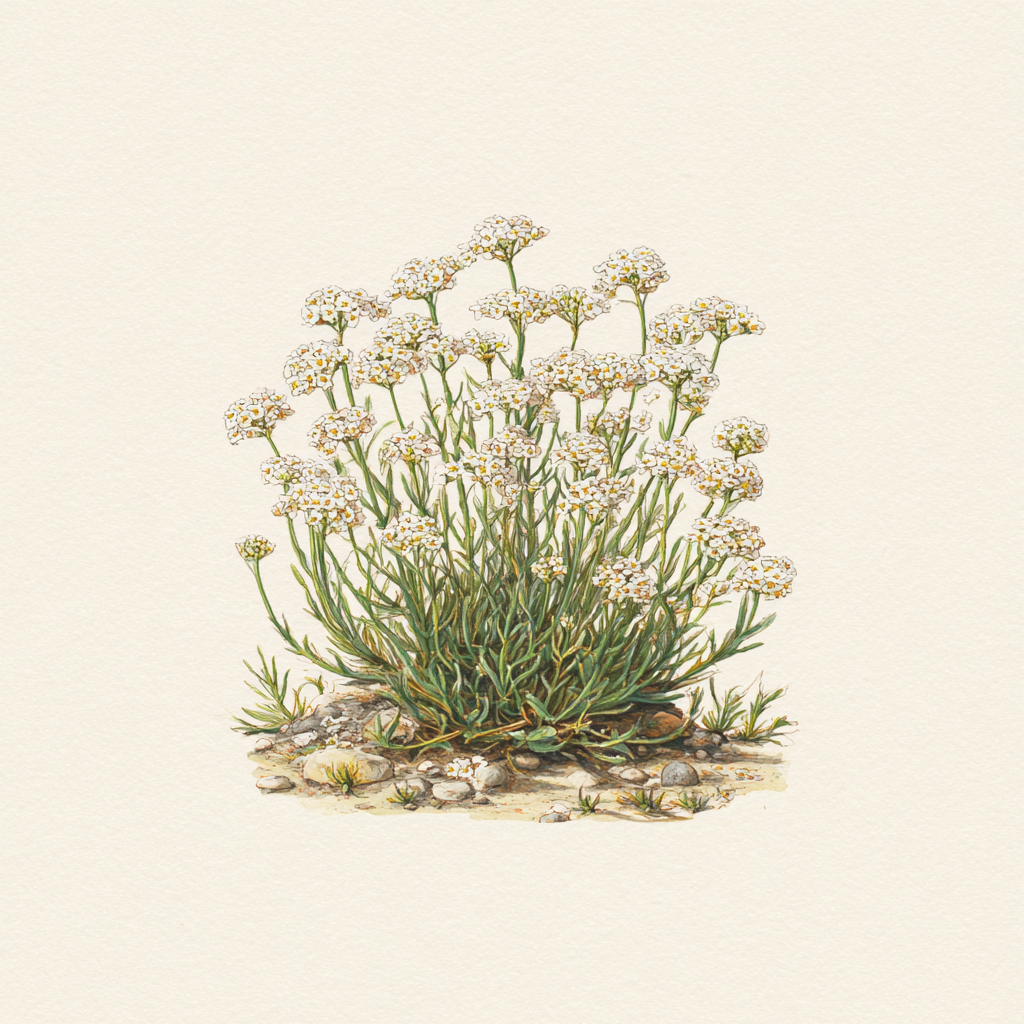
Shallow fibrous roots that suit cool, loose soil and small gaps between larger plants.
Stem
Low spreading to trailing stems that form soft mats and branch freely after shearing.
Leaves
Small narrow gray-green leaves, often slightly hairy, arranged densely along low stems.
Flowers
Clusters of tiny four-petaled white, pink, lavender, or purple flowers with a honey-like scent.
Fruit
Small flattened seed pods typical of the mustard family, forming after the tiny flowers fade.
Known Varieties
Common cultivars worth knowing
- Best for: cool-season groundcover
Carpet of Snow
Classic low white-flowered alyssum for edging and gaps.
- Best for: containers
Snow Princess
Vigorous sterile hybrid with heavy white bloom and trailing growth.
- Best for: small edging
Easter Bonnet
Compact series in white, violet, lavender, and rose shades.
- Best for: soft color accents
Rosie O'Day
Rose-pink flowers on compact plants.
- Best for: contrasting borders
Royal Carpet
Low purple-flowered strain with dense bloom.
Loading photo submission…