
Marigold
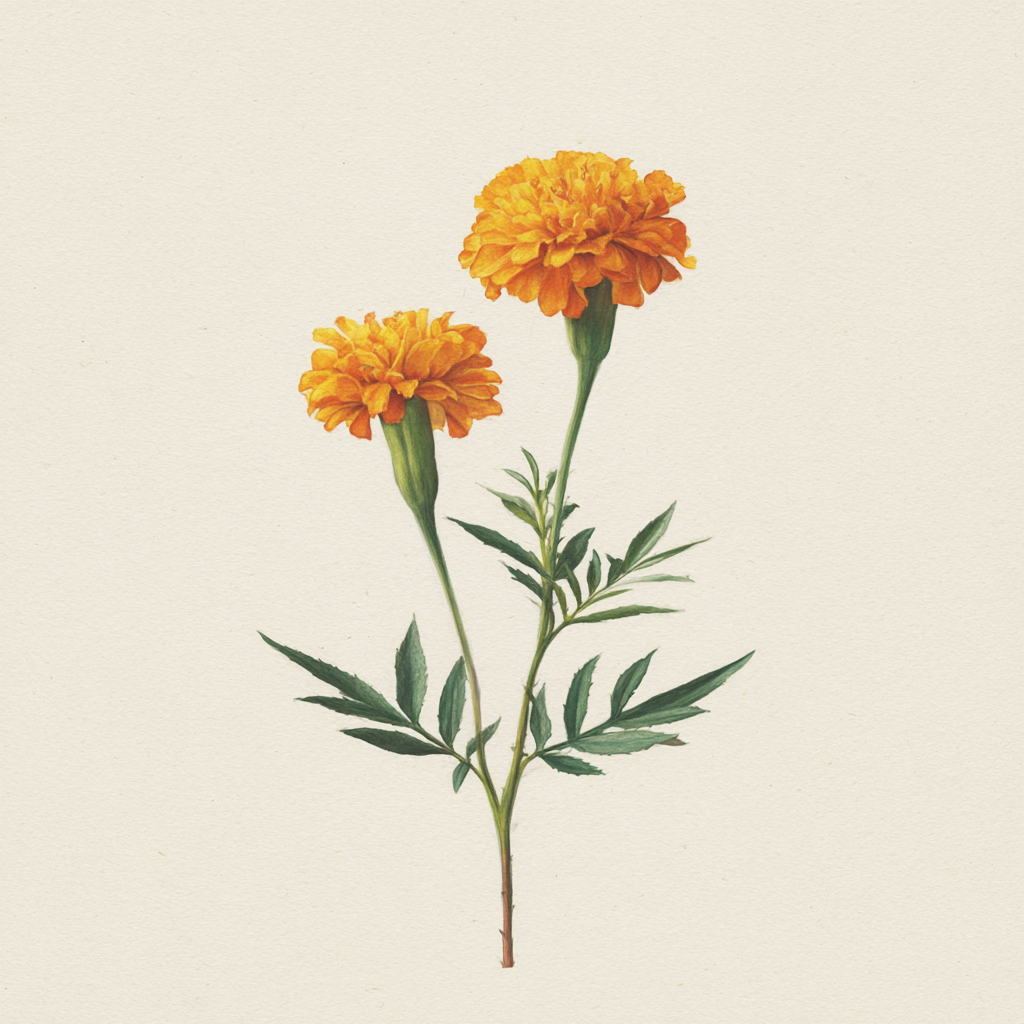
FlowerTagetes patula
Have seeds for this? Add to inventory →French marigolds are possibly the single most valuable companion plant in the entire vegetable garden. Their root secretions suppress soil nematodes, their scent deters aphids and whiteflies, and their flowers act as a trap crop drawing pest insects away from valuable crops.
Native Range
- Origin
- French marigold is native to Mexico and Central America.
- Native Habitat
- Open sunny slopes, disturbed ground, field margins, and warm seasonal habitats.
- Current Distribution
- Widely cultivated in gardens worldwide; not native outside its region of origin.
Growing Conditions
Sunlight
Full Sun
Water Needs
Low
Soil
Well-draining loam; pH 5.8 - 7.0; thrives in average soil
Spacing
8 - 12 inches
Days to Maturity
45 - 55 days from transplant to full flower
Growing Zones
Thrives in USDA Zones 3 - 11
Companion Planting
Good Companions
Keep Away From
No known antagonists
When to Plant
Start Indoors
6 - 8 weeks before last frost
Direct Sow
After last frost
Harvest
Deadhead spent flowers to maintain continuous bloom through season
Phenology (Natural Timing Cues)
Direct Sow
Direct sow marigolds after the last cold spell once soil is warming reliably. They germinate quickly in warm conditions and grow fast enough that a well-timed direct sowing will flower almost as early as an indoor-started transplant. Marigolds sown directly into the vegetable bed alongside warm-season crops also begin their nematode-suppressing root work earlier than transplants moved in weeks later - an advantage worth having.
- Lilacs have faded.
- Soil feels warm near the surface and drains freely.
- Tender annual weeds are germinating and growing steadily.
- Night temperatures consistently stay above 50°F.
Transplant
Transplant marigold starts at the same time as tomatoes, peppers, and other warm-season crops - once conditions are genuinely settled. Marigolds are most effective as companions when they are established and actively flowering alongside the crops they protect; a transplant set out too late loses weeks of peak pest-pressure coverage. Aim to have them in the ground at the same time as your main vegetable transplants, not as an afterthought.
- Lilacs have fully faded and their leaves are near full size.
- Soil is warm and settled in the planting bed.
- Hardened-off transplants hold firm new growth through a full day of outdoor conditions.
- Warm-season vegetable transplants are going in at the same time.
Start Dates (Your Location)
Based on your saved growing zone and this plant's timing notes.
Typical Last Frost
Set your growing zone to see personalized calendar dates.
Organic Growing Tips
Interplant French marigolds (Tagetes patula) throughout vegetable beds - root secretions suppress nematodes for up to 3 months.
Deadhead regularly to maintain continuous flowering and pest-deterrent effect all season.
Dense plantings around tomatoes and peppers significantly reduce whitefly populations.
Allow plants to decompose in place at season's end rather than discarding them — marigold biomass feeds soil organisms, their roots continue to suppress nematodes as they break down, and self-sown seedlings appear the following year as ready-made companions.
Common Pests
- Slugs
- Spider Mites
- Aphids
All pest management in Garden uses safe, organic, non-toxic methods only. No synthetic pesticides, ever.
Taxonomy
- Kingdom
- Plantae
- Family
- Daisy family (Asteraceae)
- Genus
- Tagetes
- Species
- Tagetes patula
Natural History
Tagetes is a genus of about 50 species native to the Americas, with diversity centered in Mexico and Central America. Tagetes erecta (African marigold) and Tagetes patula (French marigold) are both Mexican species whose common names are geographical misnomers - they were called African and French because seeds reached Africa and France before wider European circulation, and European gardeners attributed the plants to wherever they had most recently acquired them. The Aztec people cultivated cempasúchil (Tagetes erecta) extensively; it remains the primary flower of the Día de los Muertos tradition, where its brilliant color and strong scent are believed to guide spirits back to the living. Spanish colonists brought seeds to Europe in the 16th century, from where they spread via Portuguese trade routes to Africa and through other channels to France. The plants' thiophene chemistry - nematocidal compounds produced in the roots - accounts for their documented ability to suppress root-knot nematode populations in garden soil, giving the companion-planting tradition a confirmed chemical mechanism.
Traditional Use
Tagetes marigolds carry a dual identity: a sacred Aztec ceremonial flower with deep pre-Columbian roots, and a globally traveled ornamental whose common names accidentally record its 16th-century journey from Mexico to Africa to France.
Parts Noted Historically
Aztec Ceremonial Use and Cempasúchil - Flowers
Tagetes erecta, known in Nahuatl as cempasúchil (twenty-flower, or flower of many petals), was cultivated by the Aztecs as a sacred and ceremonial plant. Its brilliant orange-yellow color and strong musky fragrance were associated with the sun and with honoring the dead. The flower remained central to the Día de los Muertos tradition after the Spanish conquest - continuing an indigenous observance that merged with Catholic feast days. Marigold petals are still scattered on altars and used to mark paths believed to guide spirits home on November 1-2 each year.
Spanish Colonial Transfer and the Naming Confusion - Flowers
Spanish colonists brought Tagetes seeds from Mexico to Europe in the 16th century. Via Portuguese trade routes, seeds reached Africa; by other routes, they reached France. European gardeners named the plants for wherever they had most recently come from - giving the world African marigold and French marigold, both of which are Mexican natives with no historical roots in Africa or France beyond the 16th-century accident of seed distribution.
Indian Garland and Temple Tradition - Flowers
Tagetes erecta marigolds became deeply embedded in Indian ceremonial culture after their 16th-century introduction, to the point where they are now widely considered quintessentially Indian. Marigold garlands are used in Hindu temple offerings, wedding decorations, and festival observances across India. India is now the world's largest producer of marigold flowers for the garland and dye markets. The yellow-orange carotenoid pigment (lutein) extracted from dried petals is used commercially as a food colorant and poultry feed supplement.
Companion Planting and Nematode Research - Roots and leaves
The use of marigolds to suppress soil nematodes has been confirmed by 20th-century agricultural research. Thiophene compounds produced in Tagetes roots were identified as nematocidal in the 1940s, and subsequent research confirmed that dense Tagetes plantings reduce root-knot nematode (Meloidogyne spp.) populations. Marigolds are rare among garden companion plants in that the traditional observation has been verified by a specific, identified chemical mechanism.
Tagetes marigolds are distinct from calendula (Calendula officinalis) - the two plants share a common name but are unrelated species with different properties.
This information is provided for historical and educational purposes only and is not medical advice. Always consult a qualified healthcare professional before making decisions related to your health.
Morphology (Plant Structure & Identification)
Root System
Fibrous annual roots with fine branching roots near the soil surface.
Stem
Compact, branching, slightly ridged stems that become bushier after pinching or deadheading.
Leaves
Opposite to alternate pinnate leaves with narrow toothed leaflets and a strong aromatic scent when brushed.
Flowers
Composite flower heads in yellow, orange, red, or bicolor forms; blooms may be single, crested, or fully double.
Fruit
Slender dark achenes with pale tips, formed in dry spent flower heads.
Known Varieties
Common cultivars worth knowing
- Best for: vegetable borders
French Marigold
Compact Tagetes patula type with single or double blooms.
- Best for: bold bedding displays
African Marigold
Tall Tagetes erecta type with large pompom flowers.
- Best for: edging and containers
Signet Marigold
Fine-leaved Tagetes tenuifolia with many small edible flowers.
- Best for: compact color
Queen Sophia
French marigold with red-orange petals edged in gold.
- Best for: cut flowers and back rows
Crackerjack
Tall mixed African marigold with large yellow and orange blooms.
- Best for: pollinator edging
Lemon Gem
Small signet marigold with lemon-yellow flowers and fine foliage.
Loading photo submission…