Green Beans
VegetablePhaseolus vulgaris
Have seeds for this? Add to inventory →Green beans are nitrogen-fixing legumes that improve soil fertility for neighbouring plants. They are a key member of the Three Sisters guild alongside corn and squash, and are among the most rewarding warm-season crops.
Native Range
- Origin
- Common bean is an American domesticate with major domestication lineages in Mesoamerica and the Andes.
- Native Habitat
- Wild bean relatives are twining plants of warm thickets, woodland edges, scrub, and disturbed seasonal habitats.
- Current Distribution
- Widely cultivated in suitable growing regions worldwide; not native outside its region of origin.
Growing Conditions
Sunlight
Full Sun
Water Needs
Moderate
Soil
Well-draining loam; pH 6.0 - 7.0; avoid high nitrogen
Spacing
4 - 6 inches
Days to Maturity
50 - 70 days from direct sow
Growing Zones
Thrives in USDA Zones 3 - 11
Companion Planting
When to Plant
Direct Sow
After last frost, soil 60°F+
Harvest
50 - 70 days; harvest regularly to encourage continued production
Phenology (Natural Timing Cues)
Direct Sow
Green beans demand genuinely warm soil to germinate reliably - sown into cold or wet conditions, seed sits and rots rather than sprouting. Wait for soil at planting depth (not just the surface) to feel warm, and for late-season cold swings to be clearly over. Beans dislike root disturbance, so always direct sow into the final growing position. Succession sow every 2 - 3 weeks through summer for a continuous harvest rather than one large flush that slows when heat peaks.
- Lilacs have faded or are in their final stage of bloom.
- Soil at planting depth feels warm and crumbly, not cool and damp.
- Tender annual weeds are growing actively without cold setback.
- Night temperatures stay reliably above 50°F.
Start Dates (Your Location)
Based on your saved growing zone and this plant's timing notes.
Typical Last Frost
Set your growing zone to see personalized calendar dates.
Organic Growing Tips
Direct sow only - beans dislike root disturbance from transplanting.
Interplant with marigolds and nasturtiums to deter bean beetles and aphids.
Allow a few plants to go to seed at season's end to fix extra nitrogen in the soil.
Avoid overhead watering once flowers appear to prevent pod rot and fungal issues.
Common Pests
- Mexican Bean Beetle
- Aphids
- Spider Mites
- Bean Leaf Beetle
- Slugs
All pest management in Garden uses safe, organic, non-toxic methods only. No synthetic pesticides, ever.
Taxonomy
- Kingdom
- Plantae
- Family
- Legume family (Fabaceae)
- Genus
- Phaseolus
- Species
- Phaseolus vulgaris
Natural History
Phaseolus vulgaris was domesticated in the Americas with genetic and archaeological evidence supporting two independent domestication events: one in Mesoamerica around 8,000 years ago and one in the Andes around the same period or slightly later. These two centers produced physiologically distinct bean populations still visible in modern varieties - Andean large-seeded types and Mesoamerican smaller-seeded types. Spanish colonists brought beans to Europe on early return voyages and within decades Phaseolus vulgaris had largely displaced the native European field bean (Vicia faba) in gardens across the continent, one of the fastest adoptions of any New World crop. For most of European cultivation history the bean was grown for dry seed; the green snap bean - harvested immature as a pod vegetable - was a later selection. Calvin Keeney of Le Roy, New York, developed the first truly stringless snap bean variety in 1894 after years of deliberate selection, transforming the vegetable from one that required string removal before cooking to the convenient snap bean familiar today.
Traditional Use
Phaseolus vulgaris has the dual distinction of being a central staple food in the Americas for 8,000 years and one of the crops that most rapidly transformed European food culture after 1492. Its history divides between deep indigenous agricultural traditions and its remarkably fast adoption across the Old World.
Parts Noted Historically
Mesoamerican Three Sisters Agriculture - Seeds and pods
Phaseolus vulgaris was one of the Three Sisters alongside corn and squash in Mesoamerican and North American indigenous agriculture. Archaeological bean deposits from the Tehuacan Valley in Mexico date to around 6,000 years ago. In the Three Sisters system, beans fixed atmospheric nitrogen through rhizobial root bacteria, directly benefiting the corn planted alongside - an intuitive understanding of a biological process that Western science would not formally describe until the 19th century.
Andean Bean Cultures - Seeds
Andean civilizations developed distinct bean cultures from their independently domesticated Phaseolus vulgaris, producing the large-seeded varieties (including many heirloom types still grown today). Beans were a primary protein source in Inca food systems, stored dried at altitude and distributed along trade routes. Spanish chroniclers documented the centrality of beans to Andean diet when they arrived in the early 16th century.
Post-Columbian European Adoption - Seeds
Phaseolus vulgaris reached Europe via Spain and Portugal within decades of the Americas encounter and spread faster than tomato, potato, or corn - because it resembled familiar legumes and could be grown with existing farming practice. By the mid-16th century, beans were documented in Italian, French, and English gardens. The green snap-bean form emerged later; Calvin Keeney's 1894 stringless variety at Le Roy, New York, created the modern snap bean.
French Haricot Vert Tradition - Immature pods
France developed the haricot vert tradition - tender pencil-thin beans harvested young - through the Île-de-France market-garden culture (maraîchage) that dominated European vegetable innovation from the 17th century. The maraîchers who supplied Paris refined the succession-sowing and early-harvest techniques that created the haricot vert as a distinct culinary category, separate from the coarser English runner bean tradition that developed in parallel.
This information is provided for historical and educational purposes only and is not medical advice. Always consult a qualified healthcare professional before making decisions related to your health.
Morphology (Plant Structure & Identification)
Root System
Moderately shallow roots with nitrogen-fixing nodules when compatible rhizobia are present. Roots dislike disturbance, which is why direct sowing is preferred.
Stem
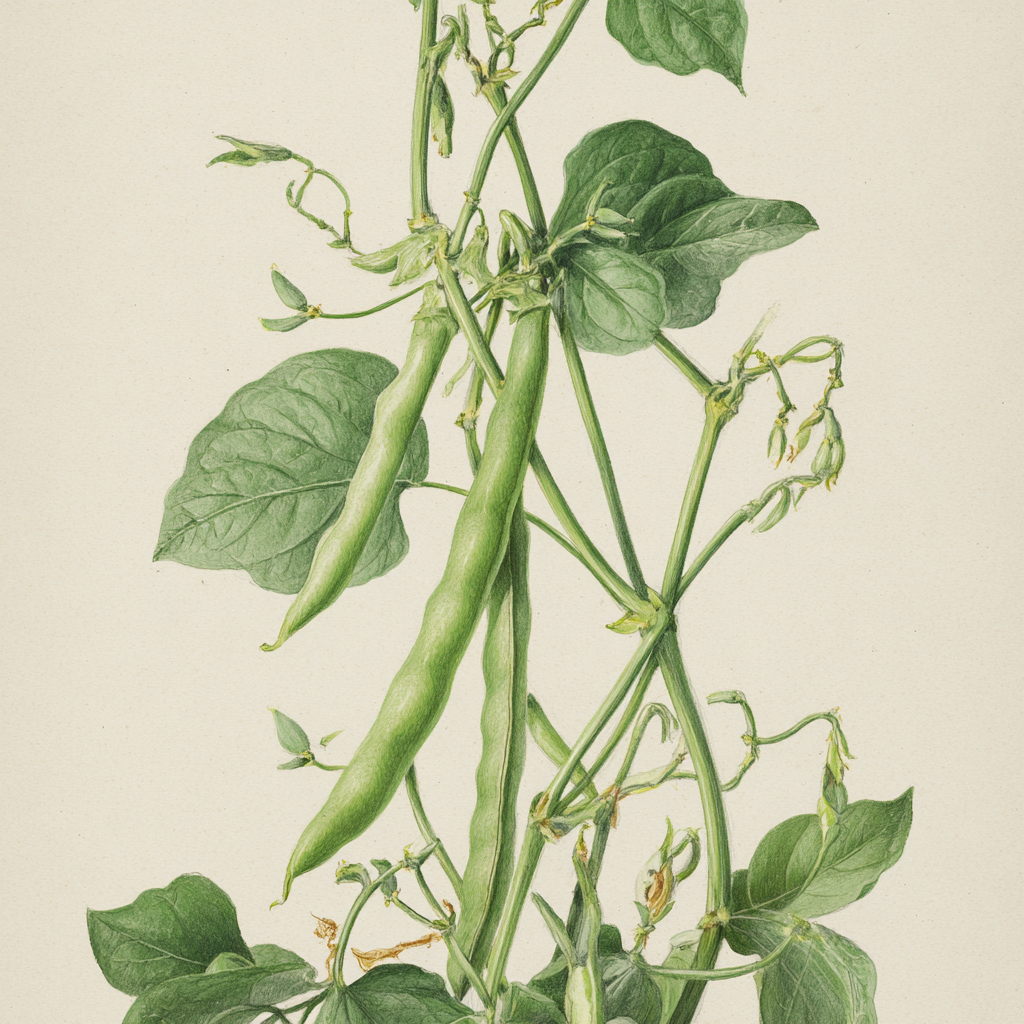
Bush beans form short, self-supporting stems; pole beans make twining vines that climb supports. Stems are angular, green, and easily broken when young.
Leaves
Compound leaves with three broad leaflets. Healthy leaves are medium to dark green; pale growth can indicate cold soil, poor nodulation, or excess moisture.
Flowers
Pea-like flowers in white, pink, lavender, or purple depending on variety. Most are self-pollinating, and pods begin forming soon after bloom.
Fruit
Long pods harvested immature for snap beans or left to dry for shelling beans. Pod shape, stringiness, color, and tenderness vary widely by variety.
Known Varieties
Common cultivars worth knowing
- Best for: early sowing, beginners
Provider
Early bush bean that germinates well in cooler soil and produces reliable green pods.
- Best for: trellises, long harvests
Kentucky Wonder
Classic pole bean with long green pods and strong productivity.
- Best for: fresh eating, freezing
Blue Lake
Widely grown snap bean with tender pods and good flavor in bush or pole forms.
- Best for: visual interest, fresh eating
Dragon Tongue
Cream pods streaked purple, tender when young and useful as a snap or shelling bean.
- Best for: high yields, fine texture
Fortex
Long French filet pole bean that stays tender at a larger size.
Related Articles
Planning Your First Vegetable Garden
Getting Started • 5 min read
Establishing a Garden Bed
Getting Started • 6 min read
Companion Planting: What Actually Works
Companion Planting • 7 min read
The Three Sisters: Growing Corn, Beans & Squash Together
Companion Planting • 5 min read
How and When to Harvest Vegetables for Best Flavour
Harvesting & Storage • 5 min read
Loading photo submission…