Rosemary
HerbSalvia rosmarinus
Have seeds for this? Add to inventory →Rosemary is a drought-tolerant Mediterranean perennial whose piney scent powerfully deters carrot fly, bean beetles, and cabbage pests. It thrives in lean, well-draining soil and can live for decades in the right conditions.
Native Range
- Origin
- Rosemary is native to the Mediterranean region, especially dry coastal and limestone habitats.
- Native Habitat
- Rocky slopes, coastal scrub, garrigue, maquis, limestone banks, and dry open Mediterranean shrublands.
- Current Distribution
- Widely cultivated in mild climates; not native outside its region of origin.
Growing Conditions
Sunlight
Full Sun
Water Needs
Low
Soil
Well-draining, lean sandy or loamy soil; pH 6.0 - 8.0
Spacing
24 - 36 inches
Days to Maturity
Harvest lightly from year 1; full harvest from year 2
Growing Zones
Thrives in USDA Zones 7 - 11
Companion Planting
Keep Away From
When to Plant
Transplant
Spring after last frost; or autumn in mild climates
Harvest
Harvest tips of young growth; never cut back into old wood
Phenology (Natural Timing Cues)
Transplant
Rosemary is killed by waterlogging far more often than by drought - its shallow woody roots cannot tolerate cold, wet, poorly draining soil, particularly in the weeks after planting when the root ball has not yet spread into surrounding ground. Planting into cold wet spring soil that has not yet warmed and dried is the most common reason nursery rosemary fails in its first season. The timing target is late spring: after sustained cold, wet conditions have clearly passed, soil is warming and drying between rain events, and nighttime temperatures are reliably above 45°F. In the mildest zones, autumn planting can succeed if drainage is truly sharp and winter rains will not pool around roots. Site choice matters as much as timing: full sun, south-facing aspects, gritty or sandy soil, and good airflow are more important for long-term rosemary health than any amendment or fertiliser.
- Lilacs have faded and settled late-spring warmth has arrived.
- Soil is drying cleanly between rain events rather than staying persistently wet.
- Tender annual weeds and basil transplants are growing steadily in the garden.
- Nighttime temperatures are reliably above 45°F.
Start Dates (Your Location)
Based on your saved growing zone and this plant's timing notes.
Best Planting Window
Spring window
After your last frost
Plant once frost risk has passed and spring conditions are settled.
Autumn window
Early autumn
Plant early enough for roots to grow before winter; avoid late planting into cold, wet soil.
Planting Method
Use nursery-grown planting stock rather than treating this as a standard seed-starting crop.
Critical Timing Note
Plant after cold risk has passed so roots can establish without chilling or stalling.
Organic Growing Tips
Plant at the edges of vegetable beds to create an aromatic boundary that confuses and repels flying pests.
Never overwater - rosemary is killed far more often by waterlogging than by drought.
Mulch lightly with grit or coarse bark rather than rich compost — rosemary thrives in lean, well-drained conditions, and a light mulch around the base reduces soil splash and improves drainage without promoting the soft growth that invites disease.
Propagate from cuttings in late summer to create free plants for hedging or companion planting.
Common Pests
- Aphids
- Rosemary Beetle
- Powdery Mildew
- Root Rot
All pest management in Garden uses safe, organic, non-toxic methods only. No synthetic pesticides, ever.
Taxonomy
- Kingdom
- Plantae
- Family
- Mint family (Lamiaceae)
- Genus
- Salvia
- Species
- Salvia rosmarinus
Natural History
Rosemary was reclassified from Rosmarinus officinalis into Salvia rosmarinus in 2017 following phylogenetic studies confirming it sits within the Salvia clade rather than forming a separate genus - a revision that resolved a long-standing botanical ambiguity but surprised many gardeners accustomed to two centuries of the old name. The common name comes from the Latin ros marinus, "dew of the sea," naming the plant's native habitat on dry, rocky, salt-tolerant coastal cliffs and scrub from the Iberian Peninsula to the eastern Mediterranean. In the wild, rosemary grows on hot, sun-baked slopes where its narrow resinous leaves and woody stems reflect a classic Mediterranean drought adaptation. The Romans carried it throughout their empire and it was established in Britain by the medieval period, though its hardiness limit (roughly zone 7) meant it needed wall protection in northern gardens. A letter of 1338 from Henry Daniel, physician to Queen Philippa of Hainault, describes rosemary being sent as a gift to the English queen - one of the earliest dated references to its presence in England. Rosemary's connection to memory and remembrance is ancient: in classical Greek and Roman practice it was placed at both funerals and weddings, and by the time Shakespeare wrote Ophelia's line "There's rosemary, that's for remembrance" in Hamlet (c.1600) the association was already several centuries old in English culture. Hungary Water - considered the first modern alcohol-based perfume and said to have been prepared for Queen Elizabeth of Hungary in the 14th century - was essentially rosemary distilled in spirits, used for its fragrance and as a topical application for gout and joint pain.
Traditional Use
Rosemary is among the most thoroughly embedded aromatic herbs in Western culture, carrying roles in cooking, perfumery, ceremony, remembrance, and household medicine that stretch from ancient Rome to the present day with remarkable continuity.
Parts Noted Historically
Classical Mediterranean - Leaves and flowering tips
Dioscorides described rosemary in De Materia Medica around 65 CE as warming and useful for digestion and liver complaints - a characteristically humoral-era classification. Roman cooks used it extensively with lamb, game, and roasted meats, and Pliny the Elder noted its fragrance and its value as a bee-pasture plant. The Romans grew it in sacred gardens and used it in religious ceremonies, giving it an early sacred-and-culinary dual status that persisted through European history.
Medieval Remembrance and Ceremony - Sprigs
The association of rosemary with memory and ceremony was fully formed in medieval Europe. Sprigs were carried at both funerals and weddings - the same plant, the same gesture, marking the two passages of life. John Bradwardine's sermon for Edward III in 1347 mentions rosemary at funerals; Chaucer mentions it in The Knight's Tale. By the time Shakespeare's Ophelia distributes symbolic flowers in Hamlet around 1600, rosemary for remembrance was one of the most familiar plant-symbol associations in English culture. The reason for the memory association is speculative - classical writers connected its smell with mental clarity, and some modern researchers have investigated 1,8-cineole in rosemary oil for cognitive effects, though without clinical certainty.
Hungary Water and Perfumery - Flowering tips
Hungary Water is traditionally described as the first alcohol-based perfume in European history, said to have been prepared for Queen Elizabeth of Hungary around 1370 for her rheumatism. The original recipe - rosemary flowers steeped in spirits of wine - was widely reproduced in European pharmacopoeias and household receipt books from the 15th century onward. Whether the attribution to the Hungarian queen is accurate or legendary, Hungary Water spread across Europe as both a perfume and a topical preparation, and versions of it appear in household books through the 18th century. It established rosemary as a foundational note in European perfumery and laid the groundwork for later lavender waters and eau de cologne.
Culinary and Household Aromatic Use - Leaves
As a culinary herb rosemary is most strongly associated with Mediterranean meat cookery - lamb especially - where its essential oils tolerate and complement long roasting. Italian and Spanish cooking both use it extensively, and it appears throughout French regional cuisine. In the British household tradition rosemary was one of the standard "strewing herbs" used to freshen floor-rushes and repel insects, and it was planted near bee skeps because its early flowers provided important spring forage. John Gerard described multiple practical uses in his 1597 Herball, including hair care, and rosemary oil remained in the British Pharmacopoeia as an ingredient in liniments well into the 20th century.
Culinary rosemary leaves used in normal cooking quantities have a safe history spanning over two thousand years. Concentrated rosemary essential oil is a different matter - applied directly to skin it can cause irritation, and internal use of concentrated oil is not culinary-level exposure.
This information is provided for historical and educational purposes only and is not medical advice. Always consult a qualified healthcare professional before making decisions related to your health.
Morphology (Plant Structure & Identification)
Root System
Woody perennial roots that prefer sharp drainage and fail in soggy soil. Established plants tolerate drought better than wet feet.
Stem
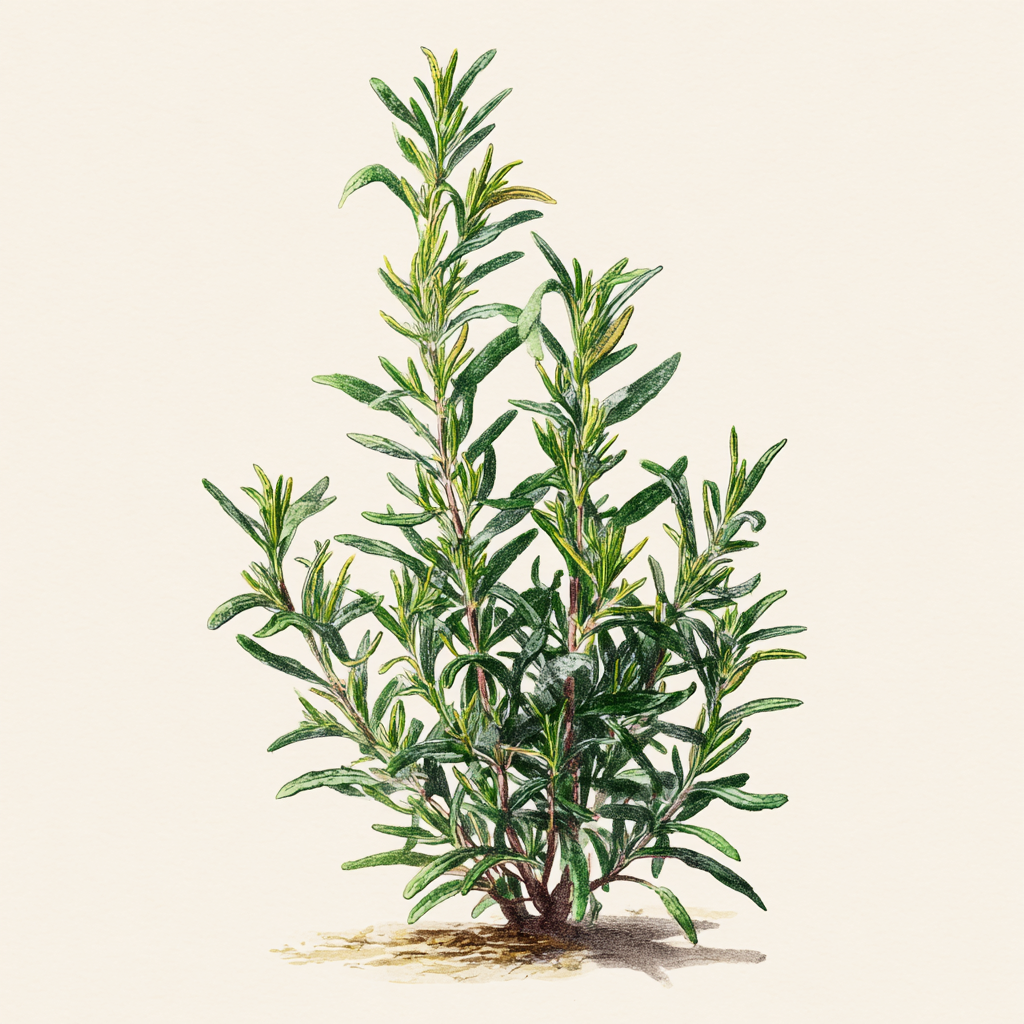
Woody branching stems with gray-brown bark on older growth. New shoots are green and flexible, but plants should not be cut hard into bare old wood.
Leaves
Narrow evergreen leaves with rolled edges, dark green tops, pale undersides, and a strong pine-resin aroma when rubbed.
Flowers
Small two-lipped flowers in blue, lavender, pink, or white appear along stems and are highly attractive to bees.
Fruit
Produces small dry nutlets after flowering, though rosemary is usually propagated from cuttings for reliable traits.
Known Varieties
Common cultivars worth knowing
- Best for: cooler regions
Arp
Cold-hardy upright rosemary selected for better winter survival.
- Best for: culinary use, hedges
Tuscan Blue
Tall upright type with broad leaves and strong flavor.
- Best for: walls, containers
Prostratus
Trailing rosemary with cascading stems and blue flowers.
- Best for: grilling
Barbecue
Upright variety with sturdy straight stems useful as skewers.
- Best for: fresh harvests
Spice Island
Vigorous culinary rosemary with strong upright growth.
Loading photo submission…