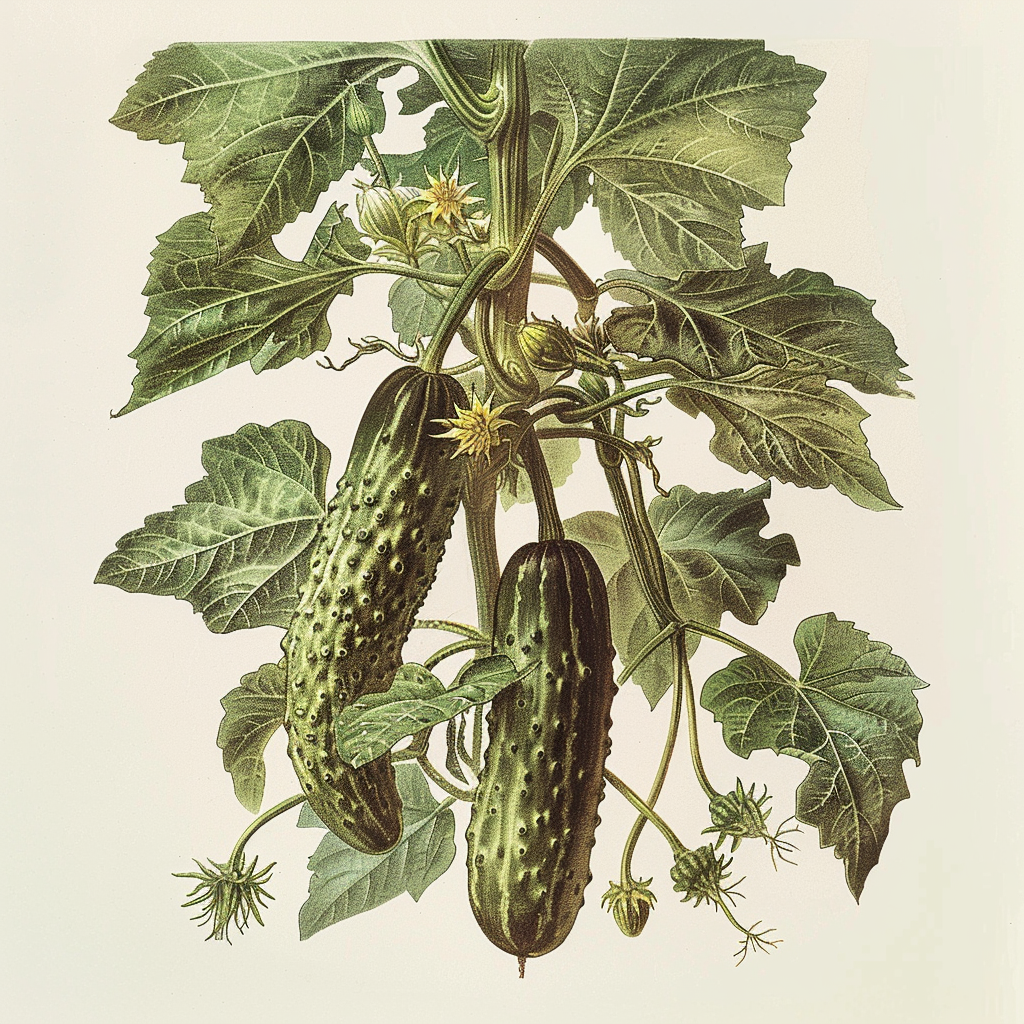
Cucumber
VegetableCucumis sativus
Have seeds for this? Add to inventory →Cucumbers are fast-growing vines that produce prolifically in warm weather. They benefit from trellising to improve airflow, reduce disease, and make harvesting easier.
Native Range
- Origin
- Cucumber is an Old World domesticate derived from Cucumis lineages native to the Indian subcontinent and Himalayan foothills.
- Native Habitat
- Wild relatives grow as warm-season vines in open scrub, forest edges, and disturbed tropical to subtropical habitats.
- Current Distribution
- Widely cultivated in suitable growing regions worldwide; not native outside its region of origin.
Growing Conditions
Sunlight
Full Sun
Water Needs
High
Soil
Rich, well-draining loam; pH 6.0 - 7.0
Spacing
12 inches in rows; 36 inches between rows
Days to Maturity
50 - 70 days from direct sow
Growing Zones
Thrives in USDA Zones 4 - 11
Companion Planting
When to Plant
Start Indoors
3 - 4 weeks before last frost
Transplant
After last frost, soil 60°F+
Direct Sow
1 - 2 weeks after last frost
Harvest
50 - 70 days from sowing
Phenology (Natural Timing Cues)
Start Indoors
Start cucumbers indoors only 3-4 weeks before the last frost date - cucumbers grow fast and become rootbound quickly. An early start buys little and risks stalled transplants.
- Dandelions are blooming.
- Lilac buds are swelling or beginning to open.
- Night temperatures are approaching 50°F outdoors.
Direct Sow
Direct sow cucumbers when soil is reliably warm and overnight temperatures will not stall vine growth.
- Lilacs have bloomed and are fading.
- Soil feels warm several inches down, not just at the surface.
- Tender annual weeds are growing quickly.
- Night temperatures stay above 55°F.
Transplant
Transplant cucumbers only after warm-season conditions are settled - cucumbers are sensitive to root disturbance and cold setbacks in equal measure.
- Lilacs have finished blooming.
- Oak leaves are near full size.
- Soil is warm several inches down.
- Night temperatures stay above 55°F.
Start Dates (Your Location)
Based on your saved growing zone and this plant's timing notes.
Typical Last Frost
Set your growing zone to see personalized calendar dates.
Organic Growing Tips
Plant nasturtiums nearby as a trap crop to lure aphids away from cucumbers.
Enrich soil with 2 - 3 inches of mature compost before planting and mulch generously after — cucumbers grown in biologically active soil are more resilient to disease and produce better through the season.
Trellis vines vertically to improve air circulation and dramatically reduce powdery mildew.
Water at the base only in the morning to keep foliage dry and prevent fungal disease.
Common Pests
- Cucumber Beetle
- Squash Vine Borer
- Aphids
- Powdery Mildew
- Downy Mildew
All pest management in Garden uses safe, organic, non-toxic methods only. No synthetic pesticides, ever.
Taxonomy
- Kingdom
- Plantae
- Family
- Gourd family (Cucurbitaceae)
- Genus
- Cucumis
- Species
- Cucumis sativus
Natural History
The cucumber originated in South Asia, with evidence of cultivation in India dating back at least 3,000 years. It spread westward through the Middle East and into ancient Greece and Rome - the Roman Emperor Tiberius was famously so fond of cucumbers that he had them grown year-round using an early form of greenhouse cultivation. Cucumber reached China by the 2nd century BCE and Europe more broadly during the Middle Ages. It was brought to the Americas by Columbus on his second voyage in 1494. The cucumber has always been valued not just as food but for its cooling properties - the phrase "cool as a cucumber" has genuine physiological basis, as the interior of a cucumber can be up to 20 degrees cooler than the surrounding air temperature. Most cucumbers grown today are gynoecious hybrids, meaning they produce predominantly female flowers and are much more productive than older open-pollinated varieties.
Traditional Use
Cucumber has been one of the most widely eaten summer vegetables across South Asia, the Middle East, and the Mediterranean since antiquity. Its cool, water-rich flesh made it valued across warm climates both as food and as a household cooling agent in household practice.
Parts Noted Historically
South Asian and Ancient Near East Origins - Fruit
Cucumber cultivation in India dates back at least 3,000 years and the plant is mentioned in the Atharva Veda. It spread westward through the Persian Empire and into ancient Greece and Rome. Pliny the Elder described the Roman Emperor Tiberius's near-obsessive appetite for cucumbers - he reportedly required them daily and had them grown year-round in portable garden beds moved to catch winter sun, a form of protected cultivation documented in the first century CE.
Islamic and Medieval European Cultivation - Fruit
Arab agronomists helped spread cucumber cultivation across the medieval Islamic world, and it was grown widely in Moorish Spain. The plant reached northern Europe during the early medieval period and was cultivated in monastery gardens. Charlemagne's Capitulare de Villis (812 CE) - the same document that listed chives and other garden herbs - included cucumbers among the vegetables required in royal estates.
Household Cooling Traditions - Fruit
The physiological basis for "cool as a cucumber" - the interior of a cucumber can run significantly cooler than air temperature due to its water content and light-reflective skin - was known empirically long before it was measured. European household herbals from the 16th century onward described cucumber flesh as cooling and refreshing applied to the skin, a folk use that persisted into commercial cosmetics. Gerard's 1597 Herball described cucumber preparations for skin in terms that reflect this domestic tradition.
Global Pickling Traditions - Fruit
Cucumber pickling developed independently across multiple cultures - in South Asia, the Middle East, and across Central and Eastern Europe. Jewish dill pickle traditions in Poland and Russia, German sour pickles, and Indian achaar represent distinct regional approaches to the same preservation problem. Columbus introduced cucumbers to the Americas on his second voyage in 1494, where they were adopted quickly by Indigenous peoples and became central to North American food culture within a century.
This information is provided for historical and educational purposes only and is not medical advice. Always consult a qualified healthcare professional before making decisions related to your health.
Morphology (Plant Structure & Identification)
Root System
Extensive shallow fibrous root system that spreads widely but does not penetrate deeply. Very sensitive to root disturbance, which is why direct sowing or careful transplanting is essential. Roots require consistently moist, well-aerated soil.
Stem
Trailing or climbing vine with tendrils that grasp supports. Main stem can reach 2 meters or more. Stems are angular, hollow, and covered with rough hairs. Vining varieties are more productive when trained vertically on a trellis.
Leaves
Large, roughly triangular, palmately lobed with 3-5 pointed lobes. Covered with stiff hairs that can irritate skin. Alternate arrangement on the vine. Leaves are sensitive to fungal disease, particularly powdery mildew, and good air circulation is essential.
Flowers
Yellow, five-petaled, and typically monoecious - bearing separate male and female flowers on the same plant. Male flowers appear first, followed by female flowers which are identifiable by the small immature cucumber at their base. Requires pollinator activity for fruit set unless growing parthenocarpic varieties.
Fruit
Botanically a pepo - a type of berry with a hard outer rind. Cylindrical, typically green, with a crisp, high-water-content flesh. Seeds develop in the center. Cucumbers are 95% water, making them one of the most hydrating foods. Bitterness in cucumbers comes from cucurbitacins, compounds concentrated in the skin and ends.
Known Varieties
Common cultivars worth knowing
- Best for: slicing, fresh eating
Marketmore 76
Classic slicing cucumber, dark green, straight, and reliable. Disease resistant and productive. The standard home garden slicer.
- Best for: slicing, fresh eating
Straight Eight
Heirloom slicer with mild flavor and crisp texture. Reliable producer, good for beginners.
- Best for: fresh eating, novelty
Lemon
Round, yellow heirloom cucumber with mild, never-bitter flavor. Excellent for children and people who find regular cucumbers bitter.
- Best for: fresh eating, snacking
Persian
Small, thin-skinned cucumbers with no seeds and mild flavor. Similar to English cucumbers but shorter. Very productive.
- Best for: containers, small spaces
Spacemaster
Compact bush variety excellent for containers and small gardens. Produces full-sized slicing cucumbers on a smaller plant.
- Best for: pickling, preserving
National Pickling
Classic pickling variety with thin skin and crisp texture. Blocky shape fits well in jars. Produces prolifically over a short period.
- Best for: fresh eating, heat tolerance
Suyo Long
Chinese heirloom that produces long, ribbed cucumbers up to 45cm. Burpless and mild, with excellent heat tolerance.
- Best for: fresh eating, hot climates
Armenian
Technically a muskmelon but used as a cucumber. Extremely long, ribbed, and mild. Heat tolerant and prolific in hot summers.
- Best for: fresh eating, greenhouse
English (Telegraph)
Long, thin-skinned, seedless cucumber. Mild flavor and no bitterness. Requires greenhouse or polytunnel in cooler climates.
- Best for: pickling, disease resistance
Calypso
Disease-resistant hybrid pickling cucumber. Very productive and uniform. Gynoecious - mostly female flowers.
Related Articles
Loading photo submission…