Passion Fruit
FruitPassiflora edulis
Have seeds for this? Add to inventory →Passion fruit is a vigorous tropical vine with extraordinary exotic flowers that is grown for its intensely flavoured, aromatic fruit. It needs a strong support structure, warm conditions, and regular feeding to produce well.
Growing Conditions
Growing Conditions
Sunlight
Full Sun
Water Needs
Moderate
Soil
Rich, well-draining loam; pH 6.0 - 6.5
Spacing
6 - 10 feet (vine length up to 30 feet)
Days to Maturity
12 - 18 months from planting to first fruit
Growing Zones
Growing Zones
Thrives in USDA Zones 9 - 11
When to Plant
When to Plant
Transplant
Spring in warm climates; provide strong trellis or fence support immediately
Harvest
When fruit falls naturally or pulls easily from vine; wrinkled skin is fully ripe
Phenology (Natural Timing Cues)
Transplant
Passion fruit is a vigorous tropical vine that needs both settled warmth and a strong permanent support structure in place before planting. The vine can grow 20 or more feet in a single season, so installing a robust fence or trellis at planting time - not after - is essential. In borderline zones, wait until all cold swings are genuinely over and plant in the warmest sheltered position available; even a brief cold spell early in establishment can check the first season of growth significantly.
- Lilacs have fully faded in temperate regions.
- Soil is warm below the surface and drains freely.
- Warm-season vines and weeds are growing vigorously.
- New passion fruit growth stays firm and upright through a full warm day outdoors.
- Permanent trellis or fence support is fully installed before planting begins.
Start Dates (Your Location)
Average dates use your saved zone; readiness also checks your forecast when available.
Best Planting Window
Spring window
Spring
Plant early enough for roots to settle before summer heat.
Autumn window
Usually skip autumn planting
Use spring unless you have locally grown nursery stock and enough mild weather for roots to establish.
Planting Method
Plant nursery-grown passion fruit stock or rooted cuttings. Seed-grown plants are slow, variable, and usually not the best way to establish a productive planting.
Critical Timing Note
Plant after cold risk has passed so roots can establish without chilling or stalling.
Use the average timing, but check your local forecast before planting.
Typical Harvest Window
July to October
Organic Growing Tips
Organic Growing Tips
Feed with potassium-rich comfrey liquid fertiliser monthly to support heavy fruiting.
Plant borage nearby to attract the bees essential for pollinating passion fruit flowers.
In cooler climates, grow in the warmest, most sheltered part of the garden against a south-facing wall.
Replace vines every 3 - 5 years as production declines with age; new plants from cuttings establish quickly.
Care Guidance
Optional seasonal guidance for what you can do, even when nothing is urgent.
Care Guidance
Watering
If the top 2 inches of soil feel dry, a deep watering at the base may help more than frequent light watering. In healthy soil, rain may cover much of what it needs.
Feeding
Extra feeding is rarely required if soil is healthy. If growth looks pale or slow, a light compost top-dressing is often enough before adding anything stronger.
Pruning
If pruning is needed, dormancy or the period just after harvest is often the simplest window. Dead, damaged, or crossing growth is usually the first place to start.
Seasonal care
In late fall, a light cleanup and fresh mulch can help if winter protection is useful in your climate. Leaving a little space around crowns and trunks often helps air move and keeps excess moisture from sitting there.
Pollination & Fruit Production
Pollination & Fruit Production
The pollination helper includes compatibility guidance for passion fruit / maypop.
Need a compatible partner? Open the Fruit Tree Planner.Known Varieties
Common cultivars worth knowing
Known Varieties
Frederick
Purple passion fruit selection with strong flavor and good productivity.
Best for
home gardens
Possum Purple
Self-fertile purple passion fruit commonly grown in warm regions.
Best for
single-vine plantings
Panama Red
Large red-purple passion fruit with tropical flavor.
Best for
warm climates
Panama Gold
Yellow passion fruit type with vigorous growth and large fruit.
Best for
tropical gardens
Sweet Granadilla
Related Passiflora with sweet mild pulp and orange shell.
Best for
specialty fruit
Companion Planting
Companion Planting
Good companions
None noted
Support & insectary plants
Nearby plants that attract pollinators, beneficial insects, or improve soil health.
- Comfrey
Attracts beneficial insects and produces nutrient-rich mulch
- Borage
Attracts beneficial insects and produces nutrient-rich mulch
- Marigold
Suppresses soil nematodes; trap crop for aphids and whiteflies
- Lavender
Attracts pollinators and beneficial insects
- Nasturtium
Trap crop for aphids; attracts beneficial insects
- Calendula
Trap crop for aphids; attracts predatory insects
Avoid planting near
No known conflicts
Common Pests
Common Pests
All pest management in Garden uses safe, organic, non-toxic methods only. No synthetic pesticides, ever.
Simple Ways to Use
Simple Ways to Use
Start here if you're not sure how to use this crop in the kitchen.
Quick recipes you can make right away
Fresh Passion Fruit Pulp
Cut ripe passion fruit in half and scoop out the pulp with a spoon once the skin is wrinkled and the fruit smells fragrant. Eat it fresh or spoon it over yogurt, because the pulp tastes best while bright and juicy.
Passion Fruit Juice
Scoop out the pulp, stir it with cold water, then strain lightly if you want fewer seeds while keeping some texture. Chill before serving, because warm passion fruit juice tastes flatter and less refreshing.
Passion Fruit Dessert Topping
Stir the fresh pulp with a little sugar or honey only if it tastes very tart, then spoon it over cake, pudding, or ice cream right before serving. Use it fresh so the aroma stays vivid instead of fading in storage.
How to Preserve
How to Preserve
Use this section to store or process extra harvest before it spoils.
Practical methods for extra harvest
Freeze passion fruit pulp
Scoop the pulp into ice-cube trays or small containers and freeze it promptly so you can thaw only a little at a time. Freeze it plain or lightly sweetened, and use it later in drinks, desserts, or sauce.
Make passion fruit syrup
Simmer the pulp with sugar and a little water for a few minutes until the sugar dissolves and the liquid thickens slightly, then strain if you want a smoother syrup. Cool it before refrigerating, and use it for drinks or desserts.
Freeze strained juice
Press or strain the pulp into juice, then freeze it in small containers with a little headspace so it can expand safely. Freeze in small portions so you can thaw only what you need for one recipe or pitcher.
New to preserving food?
New to freezing? Read the freezing guide.How to Store
How to Store
Simple storage tips
Ripen passion fruit at room temperature until the skin wrinkles and the fruit smells fragrant.
Once ripe, refrigerate the fruit and use it within about 3 to 5 days for the best flavor.
Cut fruit should be covered and refrigerated, then used within 1 to 2 days.
Freeze extra pulp quickly, because ripe passion fruit has a short fresh-storage window.
If the fruit smells fermented or leaks heavily, use it immediately in cooked preparations or discard it if the flavor has turned off.
How to Save Seed
How to Save Seed
Step-by-step seed saving
- 1
Passion fruit can be grown from seed, but named varieties are usually propagated from cuttings or grafted stock if you want the fruit quality to stay consistent.
- 2
If you do save seed, scoop it from a fully ripe fruit and rinse away the pulp until the seeds feel clean.
- 3
Dry the seeds briefly until surface moisture is gone, then store them in a cool dry place if you want to experiment.
- 4
Use cuttings or nursery plants instead of seed if your main goal is to keep the same variety.
Native Range
Native Range
- Origin
- Passion fruit is native to South America, especially tropical and subtropical regions of the continent.
- Native Habitat
- Forest edges, thickets, disturbed tropical ground, woodland margins, and climbing vegetation in warm humid climates.
- Current Distribution
- Naturalized across many tropical and subtropical regions, especially in disturbed habitats.
Taxonomy
Taxonomy
- Kingdom
- Plantae
- Family
- Passionflower family (Passifloraceae)
- Genus
- Passiflora
- Species
- Passiflora edulis
Morphology
Morphology
Root System
Fibrous perennial root system that supports rapid vine growth in warm soil. Roots need drainage but steady moisture during fruiting.
Stem
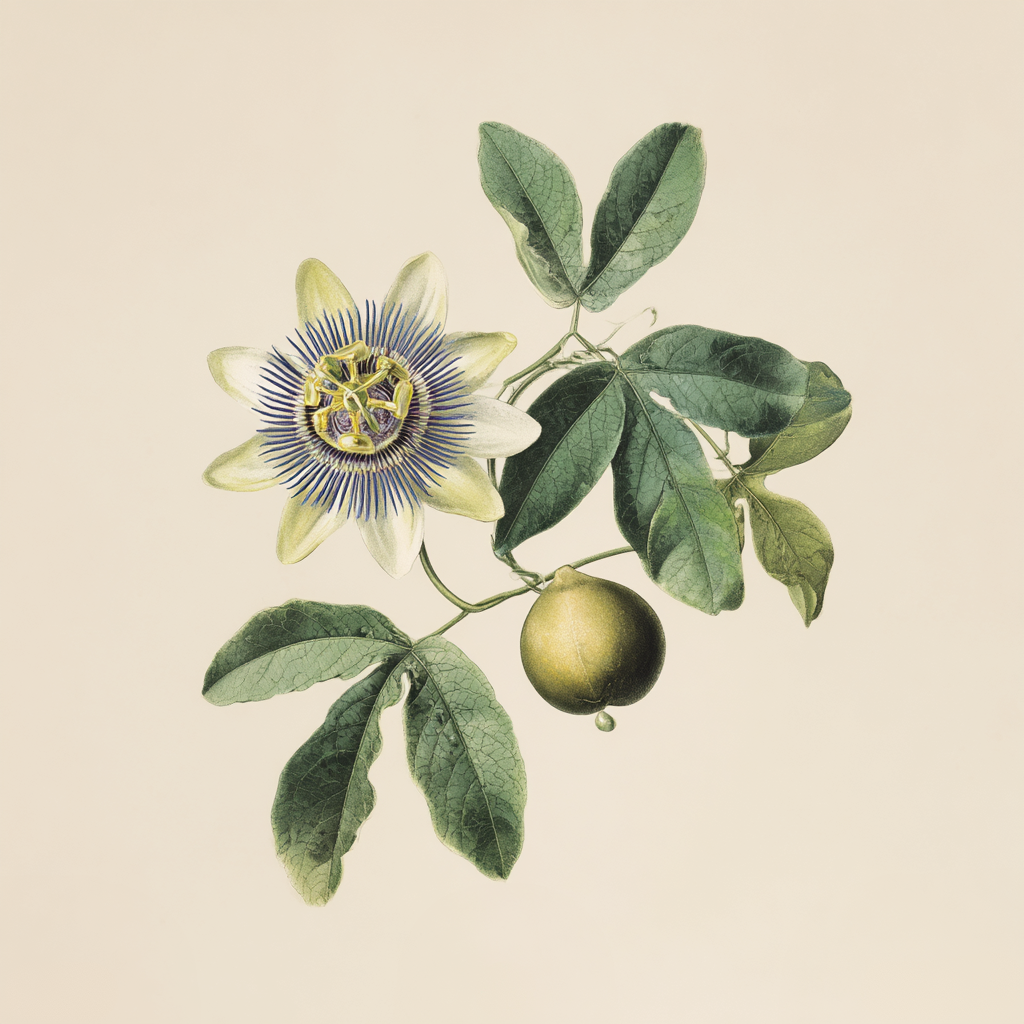
Vigorous climbing vine with tendrils that wrap around trellises, fences, and nearby plants. Stems can become woody in frost-free climates.
Leaves
Glossy green leaves, often three-lobed in Passiflora edulis, with tendrils arising at nodes.
Flowers
Large intricate flowers with white petals, purple-and-white corona filaments, and prominent reproductive structures. Pollination quality strongly affects fruit set.
Fruit
Round to oval purple or yellow fruit with tough skin and aromatic seed-filled pulp. Ripe fruit often wrinkles and may drop naturally.
Natural History
Natural History
The name passion fruit has nothing to do with romantic passion: it comes from Passio, the Latin word for Christ's suffering. Spanish Jesuit missionaries in 16th-century Brazil interpreted the flower's extraordinary structure as a botanical allegory of the Passion of Christ. The Italian botanist Giacomo Bosio formally described and illustrated the flower in 1609, laying out the symbolism that spread through Catholic missionary literature: the ten petals and sepals were read as the ten faithful apostles (excluding Judas and Peter who denied Christ), the elaborate corona filaments as the crown of thorns, the three stigmas as the three nails, the five anthers as the five wounds. Bosio's interpretation was enthusiastically received in Europe as a providential sign, and the genus name Passiflora - passion flower - preserves that reading permanently in botanical nomenclature. The Tupí-Guaraní peoples of Brazil had been eating the fruit for generations before European contact, calling it several names that the Portuguese later transliterated variously. Portuguese colonisers adopted both the fruit and its cultivation and introduced it to their colonies in Africa and Asia during the 17th century. It arrived in Australia in the late 19th century and became particularly important in Queensland and New South Wales, where the Grafton variety, selected around 1900, established the purple passion fruit as an Australian orchard crop. The related North American native species Passiflora incarnata - maypop - has its own distinct history in Indigenous medicine and in Southern folk herbalism, quite separate from the edible Passiflora edulis of commerce.
Traditional Use
Traditional Use
Passion fruit sits at a remarkable intersection of Indigenous food knowledge, Catholic missionary symbolism, and colonial botany. The edible fruit has a straightforward food history; the extraordinary flower generated a separate interpretive tradition the moment Europeans encountered it.
Parts Noted Historically
South American Indigenous Use - Fruit pulp
Tupí-Guaraní peoples of coastal and inland Brazil were eating and cultivating several Passiflora species long before European contact. The aromatic, seed-rich pulp was eaten fresh and mixed with water as a cooling drink - a preparation the Portuguese adopted immediately on contact. Spanish and Portuguese accounts from the 16th century note that Indigenous communities in Brazil, Paraguay, and Peru consumed passion fruit widely and that the vines were often found cultivated near settlements rather than purely wild. The fruit's suitability for long-distance travel - wrinkled skin indicating ripeness, high sugar content, palatable fresh - made it an easy adoption for colonists.
Jesuit Missionary Symbolism - Flowers
When Giacomo Bosio published his 1609 description of the passion flower in Rome, illustrated with careful botanical drawings, he ignited a wave of symbolic interest across Catholic Europe. The flower was widely reproduced in religious texts, embroidery, and decorative arts throughout the 17th century as a natural wonder confirming providential design. Jesuit missionaries used the flower as a teaching aid in their South American missions, presenting the floral structure to Indigenous converts as evidence that the New World itself confirmed Christian scripture. This reading made the passion flower one of the most symbolically freighted botanical objects in the history of European natural history.
British Colonial Introduction - Fruit pulp
British colonists encountered passion fruit through Portuguese trade and through their own colonial networks. It was introduced to Australia, South Africa, and parts of the Caribbean during the 19th century. In Australia, systematic cultivation began in Queensland in the 1880s, and by the early 20th century purple passion fruit had become a significant commercial crop. The Grafton selection (around 1900) and later the Nelly Kelly grafted variety (developed to bypass soil-borne disease problems in the 1980s) marked the two main leaps in Australian commercial production. Passion fruit juice and pulp became central to Australian summer food culture - in pavlova, fruit salad, and bottled juice - in ways that made the imported tropical fruit feel definitively local.
North American Maypop Distinction - Fruit and leaves
Passiflora incarnata - known as maypop, wild passion flower, or apricot vine - is native to the southeastern United States and has its own history distinct from the South American P. edulis. Cherokee, Creek, and other southeastern peoples used the fruit as food and the root in various preparations. In 19th and early 20th-century American folk herbalism, maypop leaves were widely used as a mild sedative and for nervous conditions - a use that attracted pharmaceutical attention in the 20th century and led to clinical investigation of flavonoids including chrysin and vitexin in Passiflora species. The European herbal supplement market now uses Passiflora incarnata primarily for sleep support, based partly on this North American folk tradition.
Passiflora edulis fruit pulp and juice are safe food ingredients with a centuries-long consumption history. Passiflora incarnata leaf preparations (used as a mild sedative) are a distinct product with its own dosing considerations and potential interactions with sedative medications.
This information is provided for historical and educational purposes only and is not medical advice. Always consult a qualified healthcare professional before making decisions related to your health.
Loading photo submission…