Nasturtium
FlowerTropaeolum majus
Have seeds for this? Add to inventory →Nasturtiums are edible, low-maintenance annual flowers that perform double duty as a sacrificial trap crop for aphids and cabbage caterpillars, drawing them away from vegetables. Both leaves and flowers are edible with a peppery flavour.
Native Range
- Origin
- Garden nasturtium is native to Andean South America.
- Native Habitat
- Open slopes, rocky ground, disturbed soils, and cool tropical mountain margins.
- Current Distribution
- Naturalized across some mild climates, especially in disturbed habitats.
Growing Conditions
Sunlight
Full Sun
Water Needs
Low
Soil
Well-draining, lean soil; pH 6.0 - 7.5; avoid rich soil which promotes leaves over flowers
Spacing
10 - 12 inches
Days to Maturity
35 - 52 days from direct sow to flower
Growing Zones
Thrives in USDA Zones 3 - 11
Companion Planting
Good Companions
Keep Away From
No known antagonists
When to Plant
Direct Sow
After last frost; sow directly where they will grow - dislikes transplanting
Harvest
Harvest flowers, leaves, and green seed pods throughout season; all are edible
Phenology (Natural Timing Cues)
Direct Sow
Nasturtiums are always direct sown - their fleshy roots dislike any disturbance at transplanting. Sow in cool-to-mild conditions before summer heat peaks; in heat, plants put energy into leaves at the expense of the flowers that make them most useful as edibles and companion plants. Nasturtiums flower most prolifically in lean soil, so avoid enriched beds. The large seed benefits from a few hours of soaking before sowing to soften the thick seed coat and speed germination.
- Early dandelions are blooming or just finishing.
- Soil is workable and beginning to warm.
- Cool to mild days are still the norm - peak summer heat has not arrived.
- No hard frosts remain in the forecast.
Start Dates (Your Location)
Based on your saved growing zone and this plant's timing notes.
Typical Last Frost
Set your growing zone to see personalized calendar dates.
Organic Growing Tips
Plant as a trap crop around brassicas - aphids and caterpillars prefer nasturtiums over cabbages.
Check nasturtium leaves regularly and remove heavily aphid-infested stems to reduce overall pest pressure.
Do not fertilise - rich soil produces lush leaves at the expense of flowers; lean soil maximises blooms.
Allow spent nasturtiums to decompose in place at season's end — they return minerals to the soil, and their self-sown seedlings provide next year's trap crop without any effort, building a self-sustaining companion planting system.
Common Pests
- Black Aphids (intentional trap crop)
- Cabbage White Caterpillar (trap crop)
All pest management in Garden uses safe, organic, non-toxic methods only. No synthetic pesticides, ever.
Taxonomy
- Kingdom
- Plantae
- Family
- Nasturtium family (Tropaeolaceae)
- Genus
- Tropaeolum
- Species
- Tropaeolum majus
Natural History
Tropaeolum majus is native to the Andes of South America, where wild forms still grow in Peru, Bolivia, and Colombia. The genus name Tropaeolum derives from the Greek tropaion - trophy pole - applied by Linnaeus because the helmet-shaped flowers and round shield-like leaves reminded him of Roman victory trophies. Spanish explorers encountered the plant in Peru in the 16th century and brought seeds to Europe, where it first appeared in botanical literature around 1576. It was initially grown in European physic gardens for its peppery leaves and soon became a popular kitchen-garden ornamental. The name nasturtium is a historical confusion: the word means "nose-twister" in Latin (nasi tortium) and was originally the name for watercress (Nasturtium officinale), borrowed and applied to Tropaeolum because of its similarly peppery flavor. Both the borrowed name and the flavor trace to the same chemistry: glucosinolates, which break down into isothiocyanates - the mustard-oil compounds that create peppery heat in watercress, horseradish, and the entire brassica family.
Traditional Use
Nasturtium reached European gardens within decades of the Spanish encounter with Peru and was almost immediately recognized as edible and ornamental - one of the earliest examples of an edible flower being deliberately cultivated in European kitchen gardens.
Parts Noted Historically
Andean Origin and Spanish Introduction - Leaves and flowers
Tropaeolum majus grows wild in the Andes and was part of the pre-Columbian Andean plant world. Related species - particularly Tropaeolum tuberosum (mashua) - were cultivated as food tubers. Spanish expeditions brought T. majus seeds to Europe in the 1550s-1560s; it appeared in European botanical literature by 1576 and was growing in the physic garden at Leiden by the late 16th century.
European Physic and Kitchen Garden Tradition - Leaves and flowers
John Gerard's 1597 Herball described nasturtium as "Indian cress." John Parkinson's 1629 Paradisi in Sole Paradisus Terrestris noted the peppery flavor of the leaves and the ornamental appeal of the flowers as salad material. By the 17th century it had become one of the most widely grown edible ornamentals in European kitchen gardens - valued for the flavoring its leaves and flowers added to salads and for the visual effect of its trailing stems and vivid blooms.
Caper Substitute and Hannah Glasse's Kitchen - Green seed pods
The green unripe seed pods were pickled in vinegar as a substitute for capers - documented in English household cookbooks from the 17th century onward. Hannah Glasse's 1747 The Art of Cookery Made Plain and Easy - one of the most influential English cookbooks of the 18th century - includes specific instructions for pickling nasturtium seeds as capers. The physical resemblance and similar piquancy made this a practical domestic substitution for an expensive imported ingredient.
Glucosinolate Chemistry and the Watercress Name - Leaves
The borrowed name nasturtium and the peppery flavor both trace to the same chemistry: glucosinolates, which when broken down by the enzyme myrosinase produce isothiocyanates - the compounds responsible for peppery heat in watercress, horseradish, mustard, and all brassicas. This convergent chemistry across unrelated plant families confused botanists and cooks alike and is precisely why the Tropaeolum genus ended up with a watercress name.
Nasturtium leaves, flowers, and green seed pods are all edible. The seed pods become tough and inedible when fully ripe and dry.
This information is provided for historical and educational purposes only and is not medical advice. Always consult a qualified healthcare professional before making decisions related to your health.
Morphology (Plant Structure & Identification)
Root System
Shallow fibrous roots from large seeds; roots resent transplant disturbance once established.
Stem
Soft, succulent trailing or climbing stems that sprawl over bed edges or climb with support.
Leaves
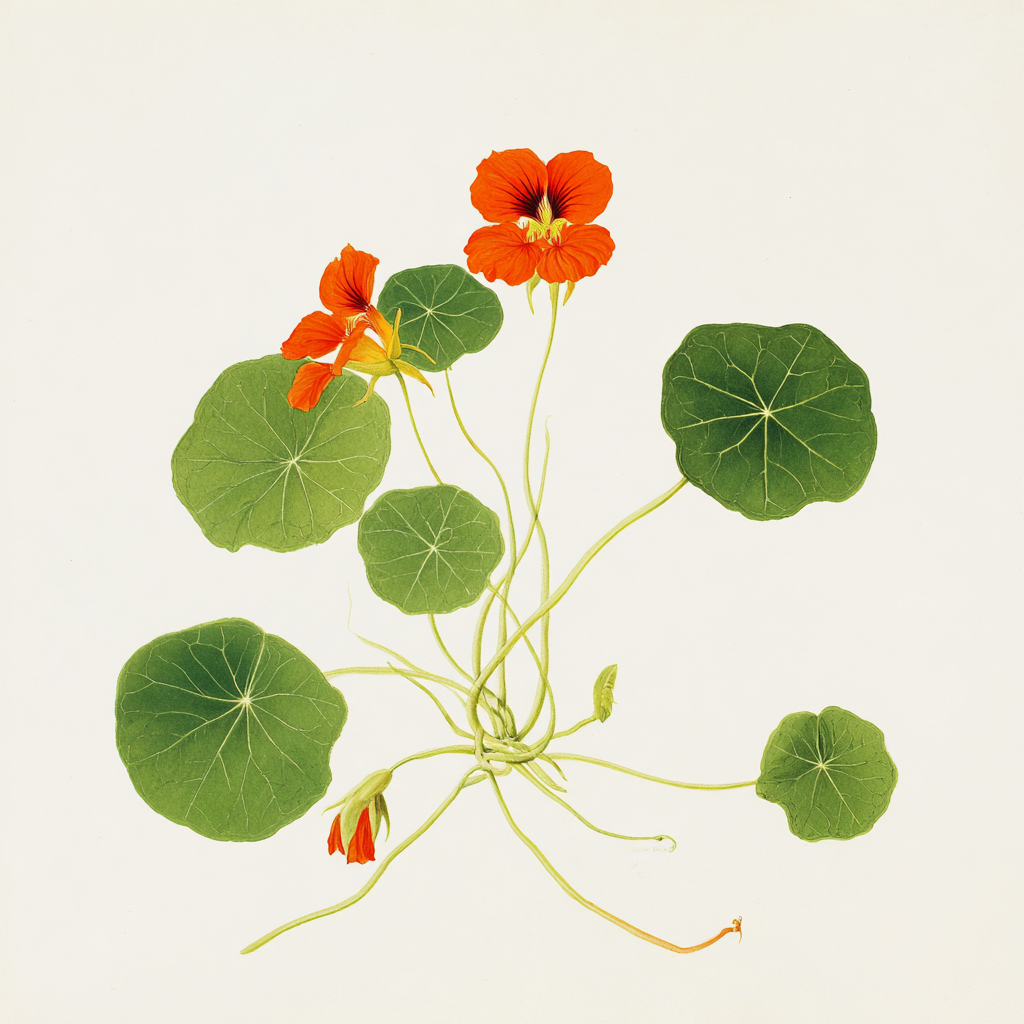
Round peltate leaves with the stalk attached near the center, giving an umbrella-like shape.
Flowers
Five-petaled flowers in yellow, orange, red, or cream, usually with a backward-pointing spur.
Fruit
Three-part green seed clusters that dry into large wrinkled seeds.
Known Varieties
Common cultivars worth knowing
- Best for: containers
Alaska
Compact plants with variegated leaves and mixed flower colors.
- Best for: edible ornamental beds
Empress of India
Dark blue-green foliage with deep red flowers.
- Best for: small gardens
Jewel Mix
Bushy dwarf mix with a wide range of warm flower colors.
- Best for: soft color schemes
Peach Melba
Creamy yellow flowers with peach-red centers.
- Best for: trellises and groundcover
Tall Trailing Mix
Long-vined forms that spill or climb readily.
Loading photo submission…