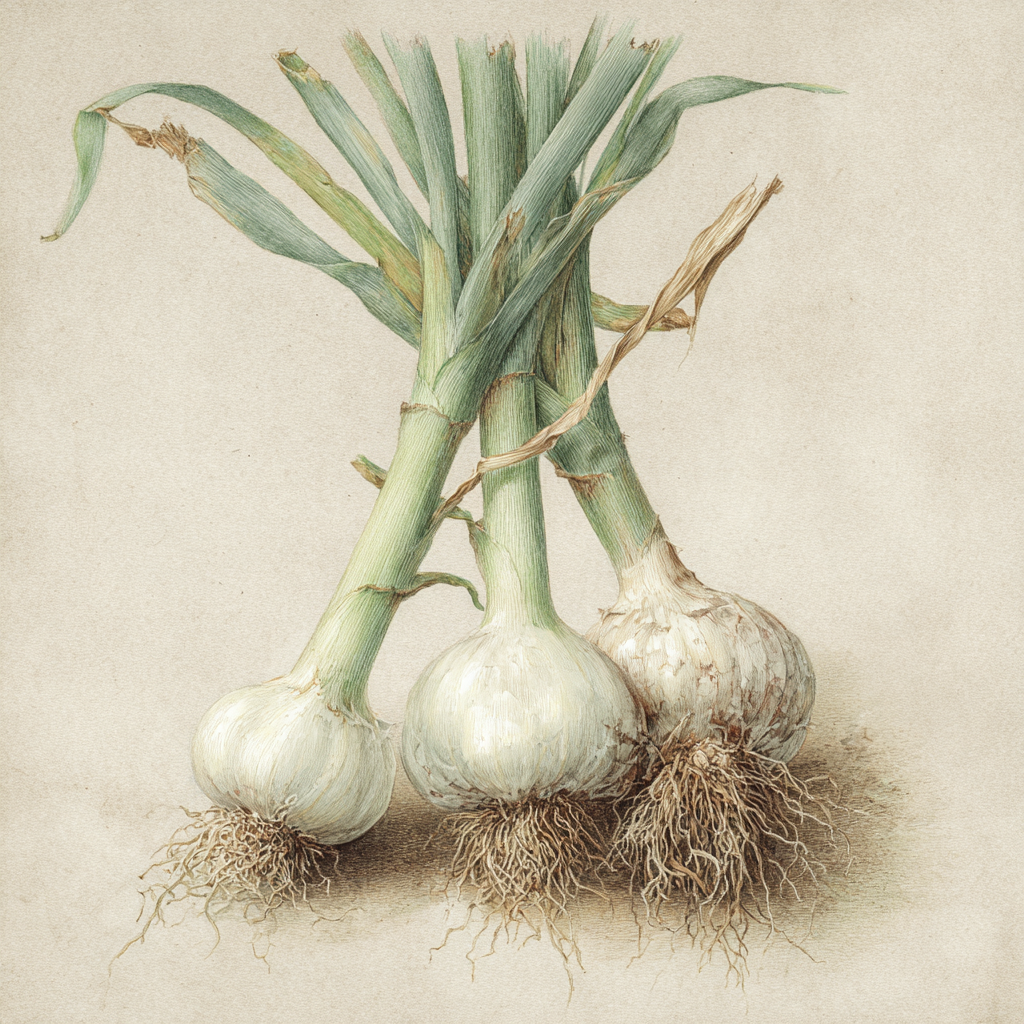
Garlic
VegetableAllium sativum
Have seeds for this? Add to inventory →Garlic is a powerful natural pest deterrent and one of the most valuable companion plants in the garden. Planted in autumn, it overwinters and is harvested the following summer when the lower leaves begin to brown.
Native Range
- Origin
- Garlic is an Old World domesticate associated with Central Asian wild Allium ancestry and ancient cultivation across western Asia and the Mediterranean.
- Native Habitat
- Wild relatives occupy dry, open, rocky slopes and steppe-like habitats with strong seasonal dormancy.
- Current Distribution
- Widely cultivated in suitable growing regions worldwide; not native outside its region of origin.
Growing Conditions
Sunlight
Full Sun
Water Needs
Low
Soil
Well-draining, fertile loam; pH 6.0 - 7.0
Spacing
6 inches
Days to Maturity
180 - 240 days (autumn-planted); 90 days (spring-planted)
Growing Zones
Thrives in USDA Zones 3 - 9
Companion Planting
When to Plant
Direct Sow
Plant individual cloves in autumn, 4 - 6 weeks before ground freezes
Harvest
Mid-summer, when lower third of leaves are brown
Phenology (Natural Timing Cues)
Direct Sow
Garlic cloves need to root firmly before the ground freezes, but should not push significant top growth before winter - the goal is an established root system going into dormancy, not a leafy shoot. Timing the window correctly varies more by climate than calendar: in cold regions, 4 - 6 weeks before the ground freezes hard; in mild-winter regions, after genuine autumn cooling has set in. Planted too early, cloves push excessive green growth that is vulnerable to frost damage and enters winter weak; planted too late, cloves barely root before freeze-up and produce small, poorly developed heads the following summer.
- Leaf drop is well underway - deciduous trees are mostly or fully bare.
- Soil is still workable and not waterlogged from autumn rain.
- Cool nights are consistent with no more warm spells driving leafy growth.
- Warm-season weeds have slowed or browned back completely.
Start Dates (Your Location)
Based on your saved growing zone and this plant's timing notes.
Typical Last Frost
Set your growing zone to see personalized calendar dates.
Direct Sow Window
Autumn
This uses autumn or first-frost timing, so keep the planting note as written.
Organic Growing Tips
Plant garlic cloves around roses and fruit trees to deter aphids and borers throughout the season.
Cure harvested bulbs in a warm, dry, well-ventilated space for 3 - 4 weeks before storing.
Amend beds with compost and well-rotted manure before planting — garlic rewards soil preparation generously, and rich soil biology produces larger, more flavourful bulbs with better disease resistance.
Rotate garlic to a new bed each year and never replant where white rot has occurred.
Common Pests
All pest management in Garden uses safe, organic, non-toxic methods only. No synthetic pesticides, ever.
Taxonomy
- Kingdom
- Plantae
- Family
- Onion family (Amaryllidaceae)
- Genus
- Allium
- Species
- Allium sativum
Natural History
Allium sativum was domesticated from wild Allium longicuspis in Central Asia, most likely in an area spanning modern Kazakhstan and northeastern Iran. All cultivated garlic is functionally sterile - modern softneck and hardneck varieties do not produce viable seed and are maintained entirely by vegetative propagation. Individual garlic strains are therefore ancient clonal lineages, some potentially thousands of years old. The Ebers Papyrus of around 1550 BCE lists garlic in 22 preparations, and cloves were found in Tutankhamun's tomb (c. 1325 BCE). Herodotus recorded that an inscription at the base of the Great Pyramid of Khufu described quantities of garlic, radishes, and onions consumed by the pyramid workers - probably the oldest documented record of industrial food consumption. Louis Pasteur documented garlic's antibacterial properties in 1858, and allicin - the principal sulfur compound responsible for garlic's distinctive smell and much of its studied biological activity - was isolated by Chester Cavallito in 1944. During World War II, both Russian and British forces used raw garlic as an antiseptic when conventional antibiotics were unavailable, earning the informal name "Russian penicillin."
Traditional Use
Garlic has the longest, widest, and most consistent documentary record of any food plant used medicinally. It appears in the earliest surviving medical texts from Egypt, Greece, China, and India, and its use has been continuous in virtually every literate food culture since antiquity.
Parts Noted Historically
Ancient Egypt and the Pyramid Workers - Cloves
Garlic is documented in the Ebers Papyrus (c. 1550 BCE) in 22 preparations. Herodotus reported that an inscription at the Great Pyramid of Khufu recorded the quantities of radishes, onions, and garlic consumed by the builders. Cloves of garlic were placed in Tutankhamun's tomb around 1325 BCE. For ancient Egyptians, garlic was simultaneously a food, a strengthening supplement for laborers, and a ritual object.
Classical Greek and Roman Medicine - Cloves
Hippocrates mentioned garlic, and Dioscorides gave it extensive description in De Materia Medica (1st century CE). Roman soldiers consumed garlic as a standard ration and the plant was closely associated with physical strength and endurance. Pliny the Elder's Naturalis Historia describes garlic preparations for a wide range of conditions. The Roman physician Galen called it "the peasant's cure-all."
Ayurvedic and Chinese Medical Traditions - Bulb
Garlic appears in the classical Ayurvedic texts Charaka Samhita and Sushruta Samhita, classified as pungent, warming, and strengthening. In Chinese medicine, da suan was documented in the Bencao Gangmu (Compendium of Materia Medica, 1596 CE) and in earlier classical texts. Both systems regarded garlic as broadly strengthening with particular affinity for respiratory and digestive health.
Modern Phytochemical Research - Cloves
Louis Pasteur documented garlic's antibacterial properties in 1858. Allicin was isolated and characterized by Chester Cavallito in 1944 at Darby Research Laboratories. During World War II, garlic was deployed by Russian and British forces as a battlefield antiseptic when conventional supplies ran short - earning the informal name "Russian penicillin." Modern pharmacological research has produced hundreds of studies on garlic chemistry, making it one of the most scientifically investigated food plants in the world.
Garlic is safe as food. Concentrated supplements may interact with blood-thinning medications. High doses can irritate the digestive tract in sensitive individuals.
This information is provided for historical and educational purposes only and is not medical advice. Always consult a qualified healthcare professional before making decisions related to your health.
Morphology (Plant Structure & Identification)
Root System
Dense fibrous roots emerge from the basal plate beneath each planted clove. Strong fall root growth is key to large bulbs the following summer.
Stem
The visible stem is a tight stack of leaf bases forming a pseudostem. Hardneck types also send up a firm central scape that curls before flowering structures mature.
Leaves
Flat, blue-green, strap-like leaves grow in alternating layers. Lower leaves browning from the tips is a harvest cue when several upper leaves remain green.
Flowers
Hardneck garlic produces a scape with bulbils and sometimes sterile flowers. Many cultivated strains rarely make viable seed and are maintained by cloves.
Fruit
The harvested bulb is made of multiple cloves attached to a basal plate and wrapped in papery skins. Clove size, wrapper color, and neck stiffness vary by type.
Known Varieties
Common cultivars worth knowing
- Best for: cold climates, roasting
Music
Hardneck porcelain type with large easy-peeling cloves and strong cold tolerance.
- Best for: northern gardens
German Extra Hardy
Reliable porcelain hardneck with large bulbs and robust flavor.
- Best for: fresh cooking
Spanish Roja
Rocambole hardneck with rich flavor and easy-peeling cloves.
- Best for: roasting
Chesnok Red
Purple stripe type known for sweet flavor when roasted.
- Best for: braiding, storage
Inchelium Red
Softneck artichoke type with good storage and mild flavor.
Related Articles
Loading photo submission…