Chamomile
FlowerMatricaria chamomilla
Have seeds for this? Add to inventory →German chamomile is known as the "physician of the garden" for its ability to improve the health and vigour of nearby plants. It accumulates calcium and potassium in its tissues, attracts hoverflies and beneficial wasps, and makes a soothing herbal tea.
Native Range
- Origin
- German chamomile is native to Europe and western Asia.
- Native Habitat
- Open fields, disturbed soils, roadsides, cereal-field margins, and seasonally cool ground.
- Current Distribution
- Naturalized across many temperate regions, especially in disturbed habitats.
Growing Conditions
Sunlight
Full Sun
Water Needs
Low
Soil
Well-draining, lean loam; pH 5.6 - 7.5
Spacing
6 - 9 inches
Days to Maturity
60 - 65 days from sowing to flower
Growing Zones
Thrives in USDA Zones 3 - 10
Companion Planting
When to Plant
Direct Sow
Autumn or early spring; surface sow as seeds need light to germinate
Harvest
Harvest flowers when fully open for tea; dry in a warm, airy space
Phenology (Natural Timing Cues)
Direct Sow
Surface sow chamomile during cool windows - the seed must not be covered as it needs light to germinate. Both early spring and autumn sowings work; autumn sowings often establish plants that flower freely from late spring onward.
- Early dandelions are beginning to bloom (spring sowing).
- Soil is workable and surface moisture holds between rains.
- Summer heat has eased and nights are reliably cooler (autumn sowing).
Start Dates (Your Location)
Based on your saved growing zone and this plant's timing notes.
Typical Last Frost
Set your growing zone to see personalized calendar dates.
Direct Sow Window
Early spring or autumn
This uses autumn or first-frost timing, so keep the planting note as written. Surface sow. Seeds need light to germinate.
Organic Growing Tips
Allow chamomile to self-seed throughout vegetable beds - it will establish as a beneficial ground layer.
Steep chamomile flowers in water and spray around seedlings to prevent damping-off fungal disease.
Traditionally believed to improve the essential oil production and flavour of herbs grown nearby.
Let chamomile decompose in place where it grows — its fine root system improves soil aeration, and as a dynamic accumulator of calcium and potassium, its decomposing biomass feeds the soil biology that benefits every surrounding plant.
Common Pests
All pest management in Garden uses safe, organic, non-toxic methods only. No synthetic pesticides, ever.
Taxonomy
- Kingdom
- Plantae
- Family
- Daisy family (Asteraceae)
- Genus
- Matricaria
- Species
- Matricaria chamomilla
Natural History
Matricaria chamomilla originated in southern and central Europe and parts of western Asia, growing as an annual weed of disturbed ground, roadsides, and fallow fields. Its name derives from the Greek chamaimelon - ground apple - a reference to the apple-like scent of the fresh foliage, which was already well known in classical antiquity. The plant spread across northern Europe during the medieval period alongside agriculture and became one of the most universally kept cottage herbs. Its essential oil contains the compound chamazulene, which forms only during steam distillation and gives quality chamomile extracts their characteristic deep blue color. The plant flowers best and self-sows most reliably on lightly disturbed, low-fertility soils where competition from larger plants is reduced - an ecology that tracks the disturbed edges of settled land across its entire native range.
Traditional Use
Chamomile has one of the longest documentary records of any European household herb, appearing in Egyptian medical papyri, classical Greek and Roman texts, and the herbals of Gerard and Culpeper. Its reputation was built primarily on the dried flower heads and the aromatic tea prepared from them.
Parts Noted Historically
Ancient and Classical Use - Flower heads
Chamomile appears in Egyptian medical papyri and was described by Dioscorides in the first century CE as a remedy for fevers and urinary complaints. Its Greek name - ground apple - points to the esteem in which its fragrance was held in the ancient Mediterranean world, where it was also used as a strewing herb and cosmetic plant.
Medieval Monastic Herbalism - Flower heads
Chamomile was among the nine sacred herbs listed in Anglo-Saxon texts, and it appeared consistently in German, Dutch, and English herbals from the 13th through 16th centuries. John Gerard's 1597 Herball described it as comforting to the brain, while Culpeper associated it with the sun and called it one of the most comfortable plants in the garden.
Household Tea Culture - Flower heads
By the 18th and 19th centuries, dried chamomile flowers had become one of the most commonly kept household teas in England, Germany, and the Netherlands. The cultural familiarity of chamomile tea is captured precisely in Beatrix Potter's 1902 Peter Rabbit, where Mrs. Rabbit sends her injured son to bed with chamomile tea - a reference her readers would have immediately recognized as ordinary domestic medicine.
German Commercial and Pharmacopeial Tradition - Flower heads
Germany became the center of commercial chamomile cultivation and phytochemical research. The term German chamomile distinguishes Matricaria chamomilla from Roman chamomile (Chamaemelum nobile), favored in England and France. German pharmacopeias have listed chamomile flower preparations continuously from the early modern period, and Germany remains the largest producer and consumer of pharmaceutical-grade chamomile.
Chamomile belongs to the Asteraceae family; people with documented ragweed or chrysanthemum allergies may experience cross-reactions.
This information is provided for historical and educational purposes only and is not medical advice. Always consult a qualified healthcare professional before making decisions related to your health.
Morphology (Plant Structure & Identification)
Root System
Fine, shallow annual roots suited to loose, lightly disturbed soil.
Stem
Slender branching stems that stay delicate and become airy as flowers form.
Leaves
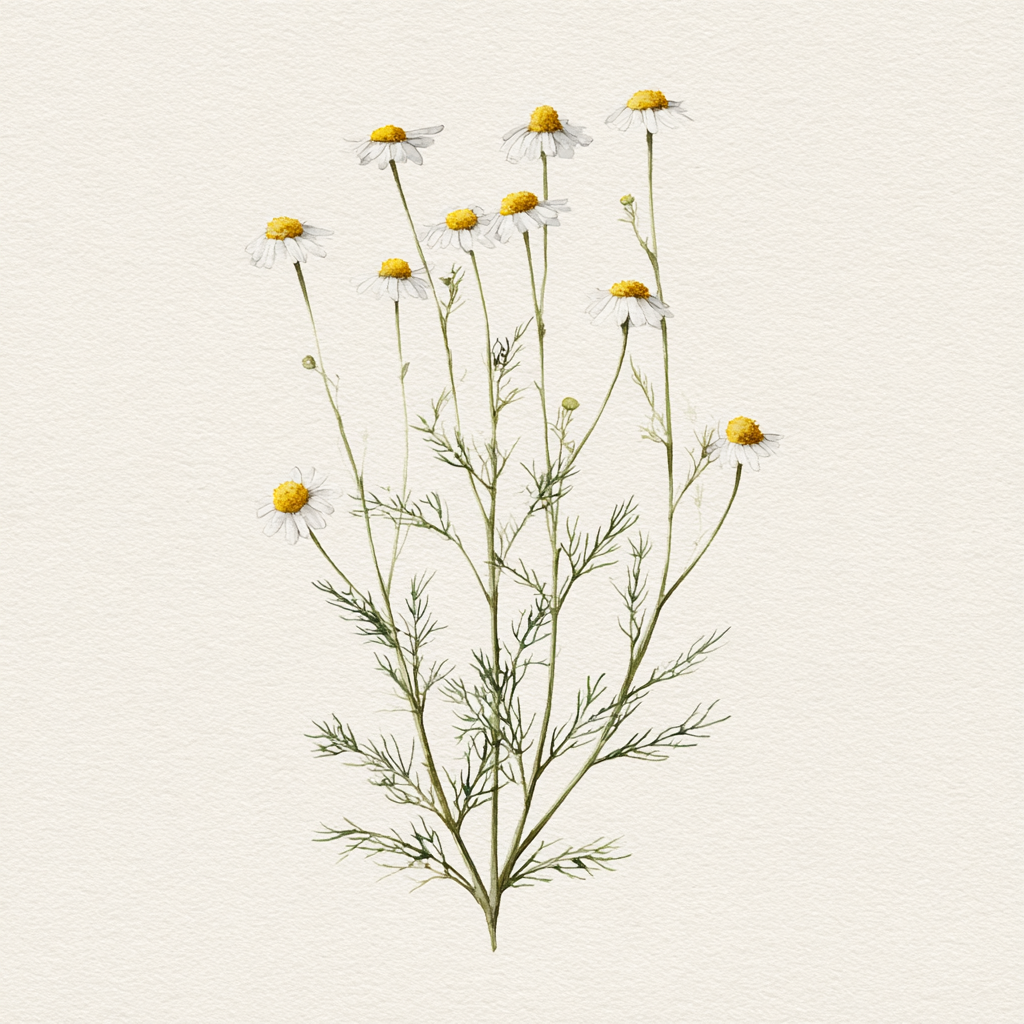
Finely divided, feathery leaves with a soft green color and aromatic scent.
Flowers
Small daisy-like heads with white rays around a yellow cone; German chamomile has a hollow raised receptacle when split.
Fruit
Tiny dry achenes that shake free from mature flower heads and self-sow readily.
Known Varieties
Common cultivars worth knowing
- Best for: tea gardens
German Chamomile
Annual Matricaria chamomilla grown for abundant small flower heads.
- Best for: perennial herb lawns
Roman Chamomile
Low perennial Chamaemelum nobile with apple-scented foliage.
- Best for: larger harvests
Bodegold
German chamomile selection bred for uniform flower production.
- Best for: drying
Zloty Lan
Commercial German chamomile strain with consistent flower yield.
Loading photo submission…