Sunflower
FlowerHelianthus annuus
Have seeds for this? Add to inventory →Sunflowers are tall, cheerful annuals that double as a living trellis for cucumbers and produce pollen-rich flowers that attract an enormous range of beneficial insects. Their allelopathic root exudates can suppress weeds but also inhibit beans and peas.
Native Range
- Origin
- Wild common sunflower originates from the southwestern United States and Mexico, where it grew as a weedy pioneer species in disturbed areas.
- Native Habitat
- Open sunny prairie, grassland edges, old fields, roadsides, rail corridors, savanna margins, and disturbed mineral soils where it colonizes bare ground after disturbance.
- Current Distribution
- Native in parts of southwestern North America and Mexico, naturalized or weedy in many temperate regions worldwide, and cultivated globally as both an ornamental and oil seed crop.
Growing Conditions
Sunlight
Full Sun
Water Needs
Low
Soil
Well-draining loam; pH 6.0 - 7.5; tolerates poor soil
Spacing
12 - 24 inches
Days to Maturity
70 - 100 days from direct sow
Growing Zones
Thrives in USDA Zones 3 - 11
Companion Planting
Keep Away From
When to Plant
Direct Sow
After last frost, soil 50°F+
Harvest
Cut flowers when outer petals are opening; harvest seeds when back of head turns yellow-brown
Phenology (Natural Timing Cues)
Direct Sow
Sunflowers are direct-sown only - the taproot is sensitive to disturbance and transplanting stunts growth noticeably. They need soil that is genuinely warm for fast taproot establishment: seeds germinating in cold soil produce seedlings that sit and stall rather than driving down. The timing is after last frost with genuine soil warmth rather than just the absence of frost. Sowing into warm soil typically means seedlings visible within 5 - 7 days; sowing into marginal soil often means 12 - 15 days of waiting with much higher damping-off risk. The "oak leaves the size of a squirrel's ear" is a traditional planting indicator from Indigenous farming practice that marks the moment soil has built enough warmth from spring sun to support fast germination.
- Lilacs are blooming or just past bloom.
- Oak leaves are the size of a squirrel's ear.
- Soil feels warm in the top few inches even on a cool morning.
- Tender annual weeds like lamb's quarters are germinating freely.
Start Dates (Your Location)
Based on your saved growing zone and this plant's timing notes.
Typical Last Frost
Set your growing zone to see personalized calendar dates.
Organic Growing Tips
Plant sunflowers as living trellises at the north end of beds so they do not shade shorter crops.
Leave seed heads standing through winter as an invaluable food source for birds and wildlife.
Keep well away from bean and pea beds - sunflower allelopathy reduces their germination and yield.
Sow into compost-enriched soil and let spent stalks decompose in place over winter — their deep root channels improve soil structure and the decomposing biomass feeds earthworms and soil biology that benefits the whole garden.
Common Pests
- Birds
- Aphids
- Sunflower Moth
- Downy Mildew
All pest management in Garden uses safe, organic, non-toxic methods only. No synthetic pesticides, ever.
Taxonomy
- Kingdom
- Plantae
- Family
- Daisy family (Asteraceae)
- Genus
- Helianthus
- Species
- Helianthus annuus
Natural History
Sunflower was domesticated in North America, almost certainly in the region east of the Rocky Mountains, by Indigenous peoples who transformed the wild multi-headed plant into the large single-headed form by approximately 3000-2300 BCE. Archaeological evidence from Missouri, Tennessee, and other eastern US sites shows cultivated sunflower seeds dramatically larger than wild forms by this date, making Helianthus annuus one of the very few major crop plants domesticated entirely within what is now the United States, independently of the Mesoamerican agricultural complex that produced maize, beans, and squash. The Spanish physician Francisco Hernández, sent by Philip II to catalog New World plants in the 1570s, described sunflowers growing in Mexico, and seeds reached European botanical gardens by 1568-1576. The Spanish physician Nicolás Monardes described them in Joyfull Newes out of the Newe Founde Worlde (1571, English translation title), treating them primarily as curiosities. The transformation of sunflower into a major oilseed crop happened not in its American homeland but in Russia, where Peter the Great reportedly saw sunflowers during his visits to the Netherlands in 1697-1698. Sunflowers were enthusiastically adopted in Russia partly because Russian Orthodox Lenten restrictions on the consumption of most oils and fats had not yet been extended to sunflower oil, making it the default cooking oil for the strictly observant. By the 19th century Russia had become the world's leading sunflower oil producer and had developed substantially improved oil-yield varieties. The Mammoth Russian variety was bred back to North America from Russian selections in the late 19th century, completing a loop that took the crop from North America to Europe to Russia and back.
Traditional Use
Sunflower is one of the very few major crops domesticated in what is now the continental United States, and its post-Columbian journey - from Indigenous North American staple to European curiosity to Russian oilseed staple - is among the more surprising crop migration stories in agricultural history.
Parts Noted Historically
Indigenous North American Domestication and Use - Seeds, oil, and dye
Archaeological evidence places sunflower cultivation in eastern North America by at least 3000 BCE, with seeds significantly larger than wild forms found at sites in Missouri and Tennessee. Indigenous peoples used sunflower seeds as food (ground into meal, roasted, or eaten raw), pressed oil for hair and skin preparations, extracted purple-black dye from the flower heads and seed hulls for body paint and textile colouring, and used the tall stalks as structural material. The Hopi used a specific black-seeded variety to produce a purple-black dye. In the southeastern US, sunflower was part of the broader Eastern Agricultural Complex alongside goosefoot, maygrass, and sumpweed before maize became dominant. The misconception that sunflower was originally a southwestern US or Mexican crop persists, but the archaeological and genetic evidence points clearly to the eastern US as the primary domestication site.
Spanish Discovery and European Botanical Curiosity - Seeds and flower heads
Francisco Hernández, Philip II's court physician sent on a seven-year natural history survey of New Spain (1571-1577), described and illustrated sunflowers growing in Mexico. His illustrated manuscripts, eventually published posthumously, became a key source for European knowledge of New World plants. Nicolás Monardes' 1571 account (translated into English as Joyfull Newes out of the Newe Founde Worlde in 1577) spread knowledge of sunflowers through England and northern Europe. Early European botanical gardens - at Leiden, Padua, and Paris - grew sunflowers as ornamental specimens, and the plant spread quickly through European elite gardens before any agricultural use developed.
Russian Oilseed Transformation - Seeds and oil
The Orthodox Lenten calendar was the unlikely catalyst for sunflower oil becoming one of the world's major edible oils. When sunflower oil was not yet listed among the fats forbidden during the forty-day fast, it became the default cooking oil for strictly observant Russian Orthodox families - a loophole that drove demand and cultivation across the Russian Empire through the 18th and 19th centuries. Russian plant breeders developed high-oil varieties with dramatically improved yields, and by the mid-19th century Ukraine and southern Russia were producing sunflower oil commercially. The Mammoth Russian variety, developed from these Russian breeding programs, was introduced to North American seed catalogues in the 1880s and became the standard garden sunflower for generations.
Return to North America and Modern Industry - Seeds and oil
North American commercial sunflower production was largely re-established in the 20th century using varieties that descended from Russian breeding programs, completing the crop's remarkable full circuit. The USDA began systematic sunflower breeding in the 1960s, and North Dakota became the centre of American commercial production. The development of high-oleic sunflower varieties with shelf-stable oil profiles, beginning in Russia with Vasilij Pustovoit's breeding work in the mid-20th century, transformed sunflower oil's commercial value and made it the preferred oil for snack food manufacturing. Current global production exceeds 50 million tonnes annually.
Sunflower seeds and oil are safe, widely consumed foods. Sunflower pollen is a significant allergen for some people sensitive to Asteraceae-family plants; this affects a minority of hay fever sufferers.
This information is provided for historical and educational purposes only and is not medical advice. Always consult a qualified healthcare professional before making decisions related to your health.
Morphology (Plant Structure & Identification)
Root System
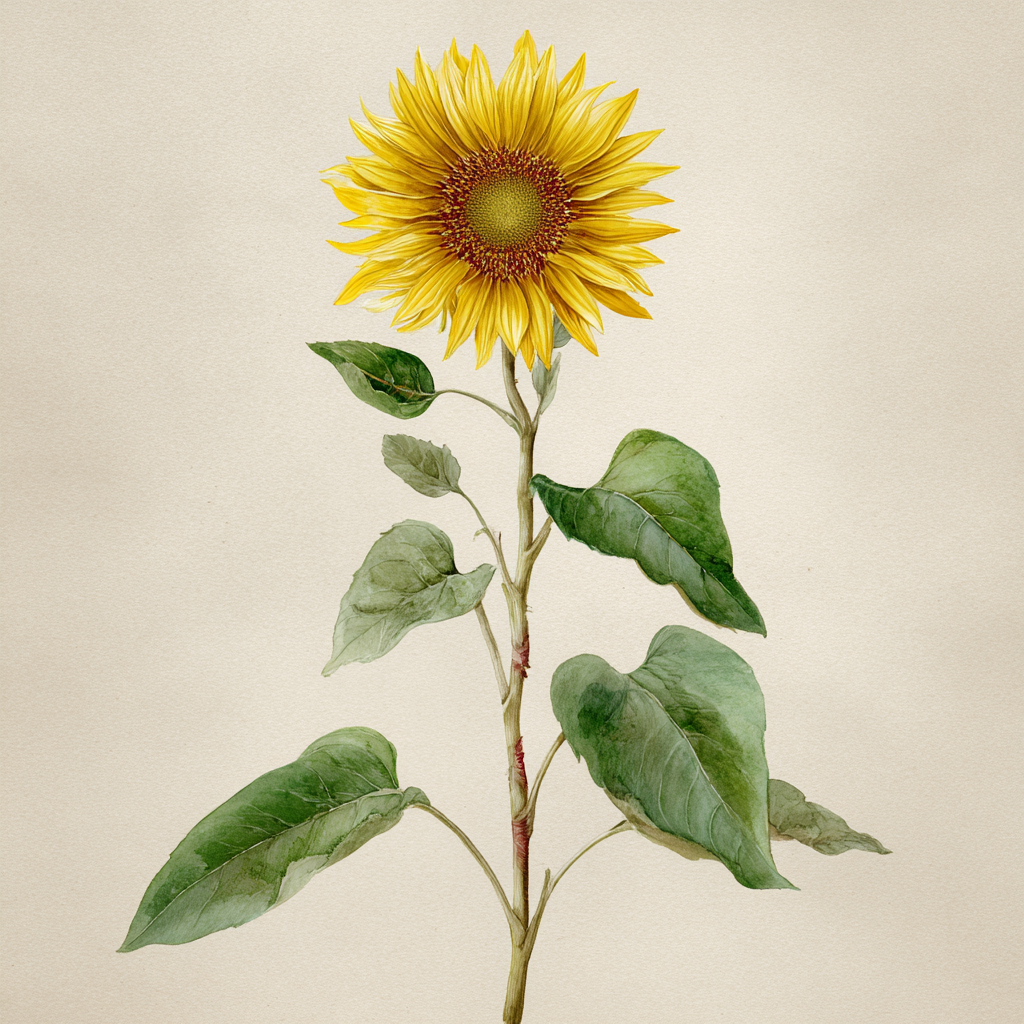
Strong taproot with branching side roots that anchor tall plants and help them reach moisture in deep soil.
Stem
Tall upright, rough, often hairy stem that can become thick and woody by seed maturity.
Leaves
Large coarse leaves, usually heart-shaped to oval, with rough surfaces and long petioles.
Flowers
Large composite heads with showy yellow ray florets around a dense disk of many small fertile flowers.
Fruit
Dry achenes held tightly in the mature flower head; the edible seed is inside the striped or dark hull.
Known Varieties
Common cultivars worth knowing
- Best for: edible seeds
Mammoth Russian
Very tall heirloom type with huge seed heads.
- Best for: wildlife gardens
Lemon Queen
Branching pale yellow sunflower popular with pollinators.
- Best for: seasonal color
Autumn Beauty
Mixed bronze, gold, and red branching blooms.
- Best for: containers and small beds
Teddy Bear
Compact double-flowered dwarf type.
- Best for: cut flowers
ProCut Orange
Pollenless single-stem cutting sunflower with uniform blooms.
- Best for: children's gardens
Sunspot
Short plant with oversized heads on sturdy stems.
Loading photo submission…