Sage
HerbSalvia officinalis
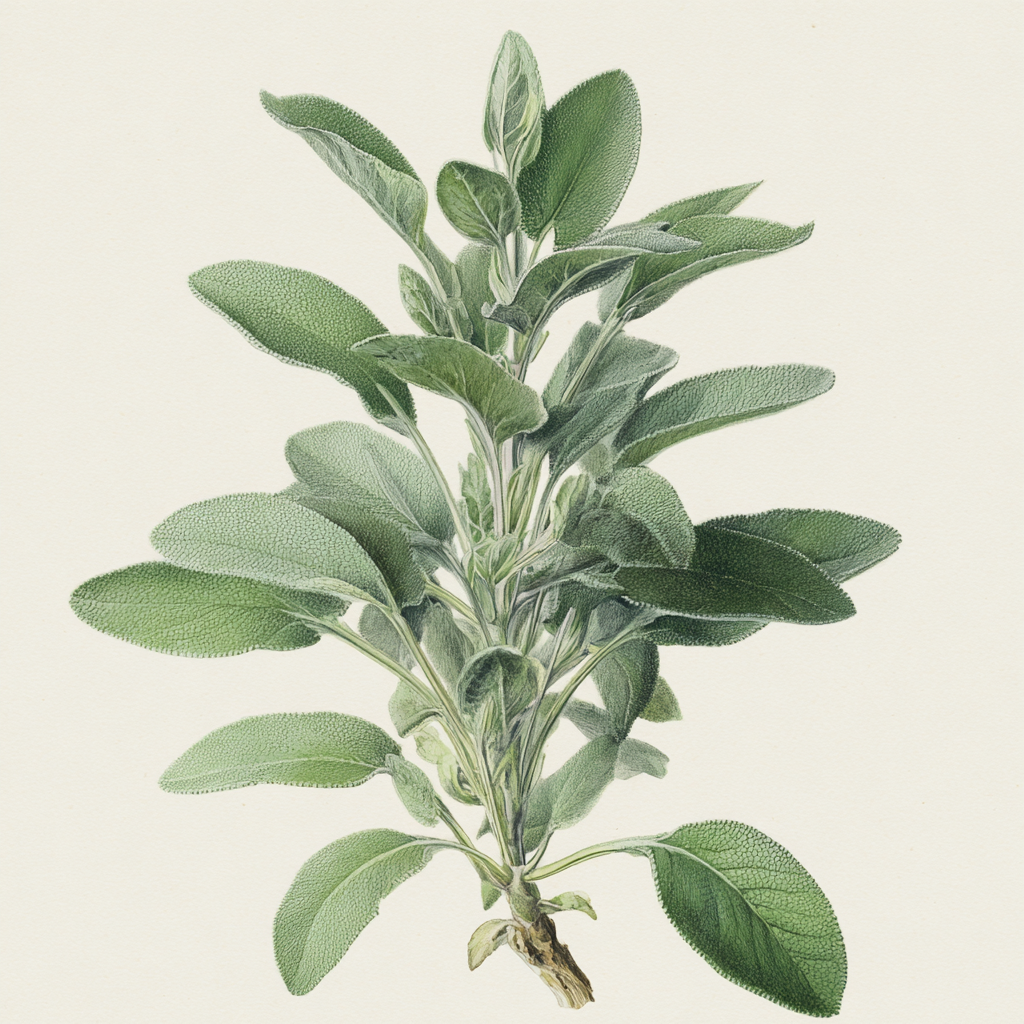
Have seeds for this? Add to inventory →Sage is a woody perennial herb whose strong camphor-like scent effectively deters cabbage moths, carrot flies, and other pests. Its purple flowers are excellent nectar sources for bees and other pollinators.
Native Range
- Origin
- Common sage is native to the central Mediterranean and Balkan region.
- Native Habitat
- Dry limestone slopes, rocky scrub, maquis, garrigue, and sunny well-drained Mediterranean habitats.
- Current Distribution
- Widely cultivated in dry, mild climates; not native outside its region of origin.
Growing Conditions
Sunlight
Full Sun
Water Needs
Low
Soil
Well-draining, lean sandy or loamy soil; pH 6.0 - 7.0
Spacing
18 - 24 inches
Days to Maturity
Harvest lightly from year 1; replace plants every 4 - 5 years as they become woody
Growing Zones
Thrives in USDA Zones 4 - 10
Companion Planting
Good Companions
When to Plant
Transplant
Spring after last frost
Harvest
Harvest before flowering for best culinary flavour; leave flowers for pollinators
Phenology (Natural Timing Cues)
Transplant
Sage thrives in lean, well-drained soil and full sun, and timing matters because it is vulnerable at both ends of the planting window. Transplanting into cold wet spring conditions often fails not from cold itself but from root rot in soggy soil - sage roots sitting in persistently wet ground before they have spread are highly susceptible. Transplanting into midsummer heat means the plant establishes more slowly and needs more frequent watering, which risks the same root rot problem. The reliable window is late spring: after the cold wet phase has clearly passed, when soil is warming and drying well, but before the hottest dry weeks of midsummer. Nighttime temperatures reliably above 45°F and forsythia and lilac both past bloom are the practical cues. In mild zones, autumn transplanting after summer heat eases is also viable.
- Forsythia bloom has fully passed and lilacs are at or past peak.
- Dandelion bloom is past peak and seed heads are beginning to form.
- Soil is warm, workable, and drying well between rain events.
- Nighttime temperatures are reliably above 45°F.
Start Dates (Your Location)
Based on your saved growing zone and this plant's timing notes.
Best Planting Window
Spring window
After your last frost
Plant once frost risk has passed and spring conditions are settled.
Autumn window
Usually skip autumn planting
Use spring unless you have locally grown nursery stock and enough mild weather for roots to establish.
Planting Method
Use nursery-grown planting stock rather than treating this as a standard seed-starting crop.
Critical Timing Note
Plant after cold risk has passed so roots can establish without chilling or stalling.
Organic Growing Tips
Plant sage at the corners of brassica beds to act as aromatic sentinels that repel cabbage butterflies.
Prune back by one-third after flowering to prevent legginess and promote new growth.
Do not plant near basil or cucumbers; sage inhibits their growth through allelopathic compounds.
Mulch lightly with fine bark or grit around the base — sage thrives in lean, well-drained soil, and a light mulch improves drainage, reduces weed competition, and feeds soil organisms as it breaks down over winter.
Common Pests
All pest management in Garden uses safe, organic, non-toxic methods only. No synthetic pesticides, ever.
Taxonomy
- Kingdom
- Plantae
- Family
- Mint family (Lamiaceae)
- Genus
- Salvia
- Species
- Salvia officinalis
Natural History
The species name officinalis derives from the Latin officina, the workshop or storeroom where medicinal and useful plants were dispensed - the same root that gives "official" and "officinal" their meanings in pharmacy. This designation, shared with many foundational medicinal plants (Valeriana officinalis, Borago officinalis, Melissa officinalis), signals how thoroughly sage was absorbed into formal European plant knowledge. The common name "sage" and the genus name Salvia both trace to the Latin salvere, meaning to be in good health or to save - making sage one of the few plants whose common name, scientific name, and historical reputation are etymologically unified. A medieval Latin proverb - Cur moriatur homo cui Salvia crescit in horto, "Why should a man die who has sage growing in his garden?" - was so well known that it appears in multiple manuscripts from the Schola Medica Salernitana, the 11th-century Italian medical school that was the first formal medical institution in Europe. Sage is native to the Dalmatian coast and Balkan peninsula - the specific region, formerly Yugoslavia, where the highest-quality commercial sage (Salvia officinalis) is still cultivated and exported today. Its gray downy leaves are a direct adaptation to intense Mediterranean sun: the fine hairs reflect light and reduce water loss. In the English garden tradition sage was one of the foundational "strewing herbs" used to freshen rushes on stone floors, and it was planted near bee skeps as a productive early forage plant.
Traditional Use
Sage is one of the few plants whose name, reputation, and documented use stretch from classical Greek medicine through the first European medical school, through Shakespeare's England, and into a modern culinary tradition where it remains one of the defining herbs of autumn and winter cooking.
Parts Noted Historically
Classical Greek and Roman Use - Leaves
Dioscorides described Salvia in De Materia Medica around 65 CE as a plant of warming, drying character suited to wounds, coughs, and urinary complaints. Pliny the Elder also discussed it, noting both culinary and household uses. The Romans used sage extensively in cooking - particularly with pork and fatty meats, where its resinous oils cut richness effectively - and as a strewing herb. Classical writers catalogued several Salvia species without always distinguishing them clearly, but Salvia officinalis was recognized as the primary culinary and medicinal form.
The Salernitan School and Medieval Medicine - Leaves
The Schola Medica Salernitana, the 11th-century medical institution in Salerno, Italy that produced the Regimen Sanitatis Salernitanum - a widely copied verse guide to health - gave sage a prominent role and generated the famous proverb about dying in a garden where sage grows. This saying spread through European medical writing for centuries and appears in household manuals, herbals, and almanacs well into the 17th century. Sage was listed in Charlemagne's Capitulare de Villis around 812 CE among plants required on imperial estates, and John Gerard gave it extensive treatment in his 1597 Herball, noting its uses for teeth, voice, nerves, and memory.
British Sage and Onion Stuffing Tradition - Leaves
In the English culinary tradition, sage is most strongly identified with the stuffing used in roast pork, goose, and the later Christmas turkey. Sage and onion stuffing appears in English household recipe books from at least the 17th century and became the defining flavour of British roast poultry. Hannah Glasse's The Art of Cookery (1747), one of the most influential English cookbooks of the 18th century, includes sage and onion stuffing in multiple forms. American Thanksgiving stuffing absorbed this tradition through the colonial period, making sage one of the few European herbs with a specific annual ceremonial role in North American food culture.
Dalmatian Sage and Modern Cultivation - Leaves and flowering tops
Commercial sage production is dominated by the Dalmatian coast of Croatia, where Salvia officinalis grows in the karst limestone landscape that exactly matches its preferred habitat. Dalmatian sage has higher essential oil content than sage grown in northern European gardens - particularly in thujone, camphor, and 1,8-cineole - giving it more intense flavour and a stronger aromatic profile. It has been exported from the region since the Venetian trade era and remains the quality benchmark for the commercial spice trade. This geographical specificity - the same plant producing markedly different qualities in different soils - is why culinary results with garden-grown sage can differ substantially from commercial dried sage.
Culinary sage leaves used in normal cooking quantities are safe and have been used as food for over two thousand years. Sage essential oil contains thujone, which is toxic in high doses; this applies to concentrated oil, not to culinary leaf use.
This information is provided for historical and educational purposes only and is not medical advice. Always consult a qualified healthcare professional before making decisions related to your health.
Morphology (Plant Structure & Identification)
Root System
Woody perennial root system that prefers lean, well-drained soil. Plants decline in heavy wet ground, especially over winter.
Stem
Square stems become woody at the base and branch into a small shrub. Regular light pruning keeps plants from becoming leggy.
Leaves
Opposite, oval, gray-green leaves with a pebbled surface, soft hairs, and a strong resinous aroma when rubbed.
Flowers
Purple, blue, pink, or white two-lipped flowers appear on upright spikes and are highly attractive to bees.
Fruit
Produces small dry nutlets after flowering. Named forms are usually propagated by cuttings or divisions to preserve leaf color and flavor.
Known Varieties
Common cultivars worth knowing
- Best for: general cooking
Common Sage
Standard culinary sage with gray-green leaves and strong flavor.
- Best for: leaf harvests
Berggarten
Broad-leaved culinary sage with compact growth and fewer flowers.
- Best for: edible borders
Purple Sage
Purple-tinged foliage with ornamental value and sage flavor.
- Best for: ornamental herb beds
Tricolor Sage
Variegated leaves with cream, green, and purple tones.
- Best for: containers, visual interest
Golden Sage
Green-and-gold variegated sage with milder growth.
Loading photo submission…