Celery
VegetableApium graveolens
Have seeds for this? Add to inventory →Celery is one of the most demanding vegetables to grow, requiring consistently moist, rich soil and a long cool growing season. Its pungent aromatic compounds make it a useful companion for repelling pests from neighbouring brassicas.
Native Range
- Origin
- Celery is derived from wild Apium graveolens, native around Europe, North Africa, and western Asia.
- Native Habitat
- Wet coastal ground, marshes, ditches, brackish margins, stream edges, and damp disturbed soils.
- Current Distribution
- Naturalized across many temperate regions, especially in damp disturbed habitats.
Growing Conditions
Sunlight
Full Sun
Water Needs
High
Soil
Rich, moisture-retaining loam; pH 6.0 - 7.0
Spacing
8 - 10 inches
Days to Maturity
100 - 120 days from transplant
Growing Zones
Thrives in USDA Zones 3 - 10
Companion Planting
When to Plant
Start Indoors
10 - 12 weeks before last frost
Transplant
2 weeks before last frost
Harvest
100 - 120 days from transplant; blanch stems by mounding soil for milder flavour
Phenology (Natural Timing Cues)
Start Indoors
Start celery indoors 10-12 weeks before the last frost date - the longest indoor lead time of any common vegetable. Celery seedlings grow very slowly and need this extended runway to reach transplant size.
- Deciduous trees are still bare.
- Forsythia has not reached full bloom.
- Dandelions are not yet in heavy bloom.
Transplant
Transplant celery into cool, consistently moist conditions. Heat above 80°F and drought can both trigger premature bolting, so cool, even moisture through the first weeks after transplant matters as much as any other factor.
- Forsythia is blooming.
- Early dandelions are beginning to bloom.
- Soil is workable, cool, and evenly moist.
- Night temperatures stay consistently above 28°F.
Start Dates (Your Location)
Based on your saved growing zone and this plant's timing notes.
Typical Last Frost
Set your growing zone to see personalized calendar dates.
Organic Growing Tips
Blanch stems by wrapping with cardboard or mounding earth around them 2 - 3 weeks before harvest.
Water consistently and deeply - irregular watering causes hollow stalks and bitter flavour.
Use compost tea as a foliar feed monthly to support celery's heavy nitrogen demands.
Grow under partial shade in hot climates to prevent bolting and maintain tender stalks.
Common Pests
- Carrot Fly
- Celery Leaf Miner
- Aphids
- Early Blight
- Slugs
All pest management in Garden uses safe, organic, non-toxic methods only. No synthetic pesticides, ever.
Taxonomy
- Kingdom
- Plantae
- Family
- Carrot family (Apiaceae)
- Genus
- Apium
- Species
- Apium graveolens
Natural History
Celery was domesticated from wild celery (Apium graveolens var. graveolens), a strongly aromatic plant of salty marshes, coastal meadows, and disturbed wet ground native to the Mediterranean and western Asia. The wild form is pungent enough that the Romans used it primarily as a flavoring and medicinal plant rather than a vegetable in the modern sense. In ancient Greek and Roman culture, celery carried a specific association with death and the underworld: wild celery garlands were placed on tombs, and winners of the Nemean and Isthmian Games were crowned with wild celery rather than the laurel used at Olympia. The thick-stalked form grown today was developed in Italian kitchen gardens around the 17th century - a relatively recent domestication compared with most common vegetables. Before that, celery was grown for its leaves (cutting celery) and seeds. The root form, celeriac (Apium graveolens var. rapaceum), was selected separately and became the preferred form in northern and central European cooking, where its winter storage quality suited local food traditions. The seeds, ground with salt, produce celery salt - one of the most distinctive spice blends in European and American cooking.
Traditional Use
Celery's traditional history runs in distinct phases: an ancient phase as a strongly aromatic flavoring, medicinal, and ritual plant; a medieval phase as a leaf herb and seed spice; and a modern phase as a mild stalk vegetable developed in 17th-century Italy. The vegetable most people recognize today represents only the final stage of a long domestication process.
Parts Noted Historically
Ancient Greek and Roman Traditions - Leaves and aerial parts
Wild celery had a funerary association in ancient Greece and Rome: garlands were placed on tombs, and athletes victorious at the Nemean and Isthmian Games received wild celery crowns. The Romans used the strongly aromatic leaves and seeds as flavoring and in preparations noted by Dioscorides and other classical medical writers. This ancient tradition is quite distinct from the mild stalk vegetable developed centuries later.
Medieval and Renaissance Leaf Celery Traditions - Leaves and seeds
Through the medieval period, celery was grown primarily as a cutting herb - the leaf form still called "cutting celery" or "smallage" - used to flavor soups, stews, and broths. The seeds were used as a spice and appeared in herbal preparations. This form of celery was much closer to the aromatic wild plant than to modern stalk celery.
Italian Stalk Celery and French Adoption - Stalks
Thick-stalked celery appears to have been developed in Italian gardens in the 17th century, representing a significant step toward the milder, fleshy form we know today. The Italian tradition of eating raw celery with salt or braised as a vegetable course developed alongside this improved form. French cuisine adopted it enthusiastically in the 18th century, and blanched celery - grown in earthed-up trenches to produce pale, mild stalks - became a refined kitchen garden crop.
Celeriac and Northern European Traditions - Root
Celeriac (Apium graveolens var. rapaceum), selected for its swollen aromatic root, became the preferred celery form in Germany, France, the Netherlands, and Scandinavia, where its winter storage quality and strong flavor suited regional cooking. French rémoulade de céleri-rave - raw celeriac dressed with mustardy mayonnaise - is one of its most enduring preparations and remains a standard French bistro dish.
Celery is one of the 14 major allergens recognized in EU food labeling law and can cause severe reactions in affected individuals. Both raw and cooked celery can trigger responses. Celery seeds contain higher concentrations of the relevant compounds than stalks and should be treated with particular caution by those with suspected sensitivity.
This information is provided for historical and educational purposes only and is not medical advice. Always consult a qualified healthcare professional before making decisions related to your health.
Morphology (Plant Structure & Identification)
Root System
Shallow fibrous roots that need constant moisture and rich soil. Plants wilt quickly when the root zone dries out.
Stem
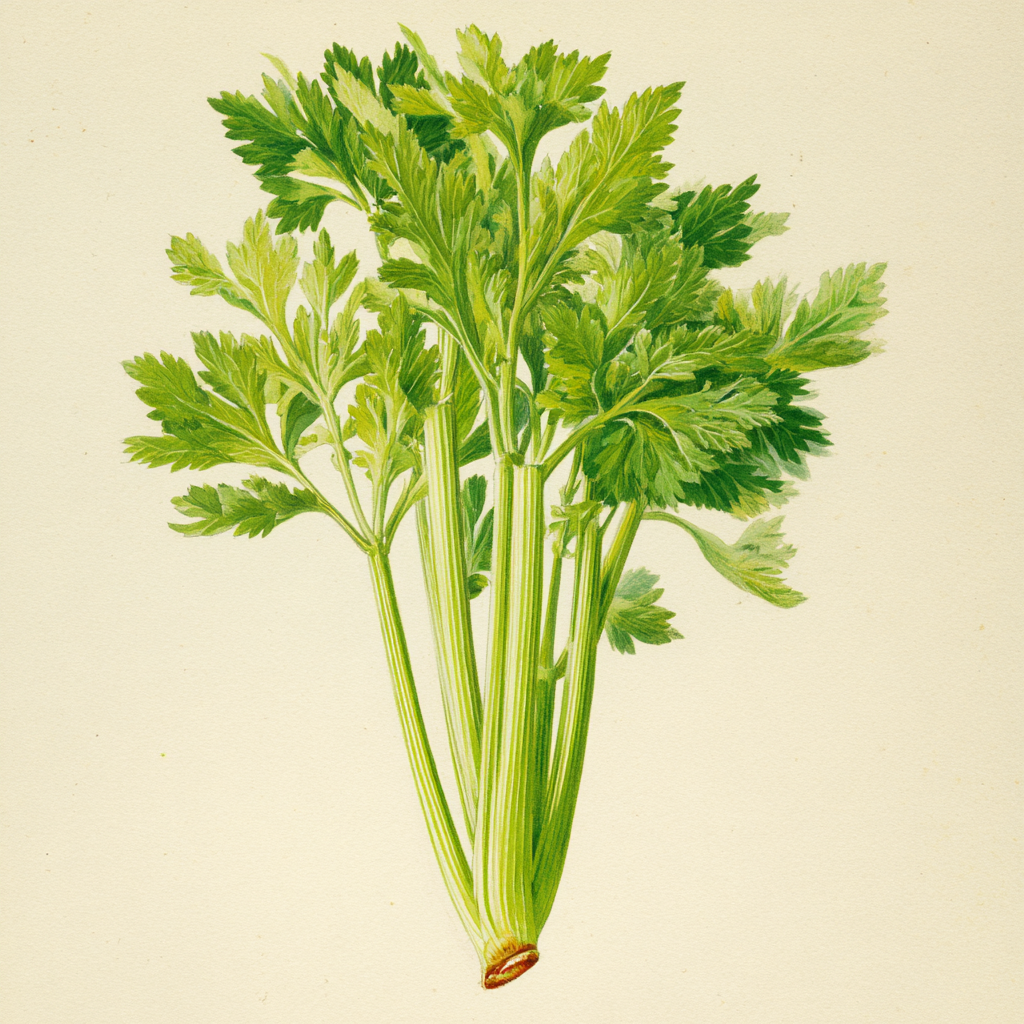
The edible stalks are thick leaf petioles clustered tightly around a central crown, not true stems. Blanching reduces color and strong flavor in some types.
Leaves
Glossy divided leaves with a strong celery scent. Leaf color and vigor show moisture stress quickly.
Flowers
Second-year plants send up branched umbels of small white flowers typical of the carrot family. Bolting makes stalks tough and bitter.
Fruit
Produces tiny aromatic seeds after flowering. The harvested crop is the crisp stalk and leafy top.
Known Varieties
Common cultivars worth knowing
- Best for: home gardens
Tango
Reliable green celery with good flavor and improved tolerance of garden stress.
- Best for: traditional stalk celery
Utah 52-70
Classic tall green celery with crisp stalks.
- Best for: shorter seasons
Conquistador
Earlier variety with better performance under less-than-perfect conditions.
- Best for: mild flavor
Golden Self-Blanching
Pale celery type selected for milder blanched stalks.
- Best for: specialty gardens
Redventure
Red-stalked celery with strong color and old-fashioned flavor.
Loading photo submission…