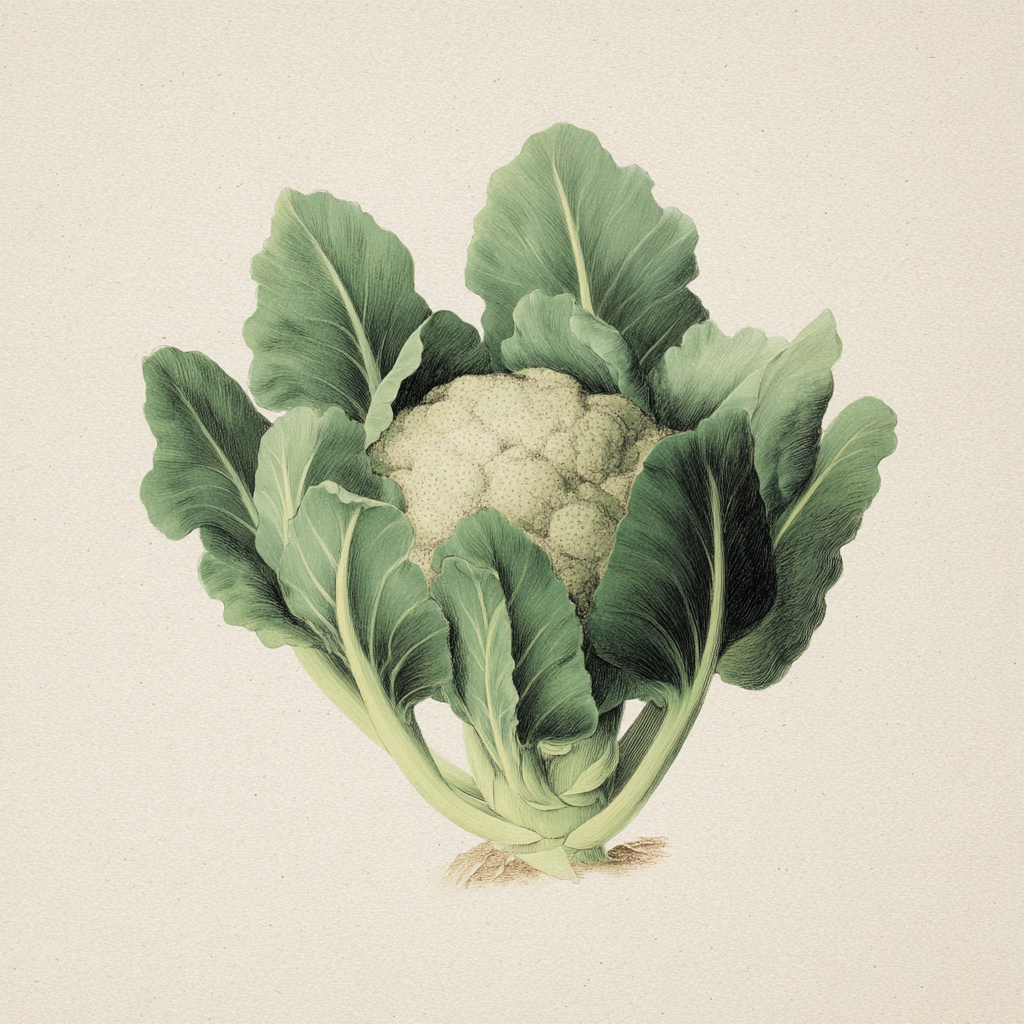
Cauliflower
VegetableBrassica oleracea var. botrytis
Have seeds for this? Add to inventory →Cauliflower is one of the more demanding brassicas, requiring consistent cool temperatures and even moisture to form tight, white curds. Blanching the curd by tying leaves over it protects colour and flavour.
Native Range
- Origin
- Cauliflower is a cultivated form of Brassica oleracea, whose wild coastal ancestors are native to western and Mediterranean Europe.
- Native Habitat
- Wild Brassica oleracea grows on maritime cliffs, rocky coastal soils, and open calcareous seaside habitats.
- Current Distribution
- Cultivated globally; does not occur as a native plant in this form.
Growing Conditions
Sunlight
Full Sun
Water Needs
Moderate
Soil
Rich, well-draining loam; pH 6.0 - 7.0
Spacing
18 - 24 inches
Days to Maturity
80 - 100 days from transplant
Growing Zones
Thrives in USDA Zones 3 - 10
Companion Planting
When to Plant
Start Indoors
6 - 8 weeks before last frost
Transplant
2 - 4 weeks before last frost
Harvest
80 - 100 days from transplant; harvest before curd separates
Phenology (Natural Timing Cues)
Start Indoors
Start cauliflower indoors 6-8 weeks before the last frost date. Cauliflower is more sensitive to growing checks than most brassicas - heat during curd formation causes loose, discoloured, or absent curds, so the timing of the whole season depends on getting the start right.
- Deciduous trees are still bare or showing only the faintest bud swell.
- Forsythia has not reached full bloom.
- Dandelions have not reached heavy bloom.
Transplant
Transplant spring cauliflower while cool conditions prevail. For autumn cauliflower, aim to transplant with 80-100 days of cool growing weather ahead - any sustained heat during curd formation will reduce quality significantly.
- Forsythia is blooming (spring transplant).
- Early dandelions are beginning to bloom (spring transplant).
- Soil is workable and not waterlogged (spring transplant).
- Summer heat has broken and nights are reliably cool (autumn transplant).
- At least 80-100 frost-free days remain before first frost (autumn transplant).
Start Dates (Your Location)
Based on your saved growing zone and this plant's timing notes.
Typical Last Frost
Set your growing zone to see personalized calendar dates.
Organic Growing Tips
Tie outer leaves over developing curds to blanch them white and protect from frost.
Side-dress with compost or compost tea monthly - cauliflower is a heavy feeder.
Use dill interplanted to attract parasitic wasps that prey on caterpillar pests.
Rotate all brassicas strictly - never grow in the same ground more than once every 4 years.
Common Pests
- Cabbage White Caterpillar
- Aphids
- Clubroot
- Whitefly
- Downy Mildew
All pest management in Garden uses safe, organic, non-toxic methods only. No synthetic pesticides, ever.
Taxonomy
- Kingdom
- Plantae
- Family
- Mustard family (Brassicaceae)
- Genus
- Brassica
- Species
- Brassica oleracea var. botrytis
Natural History
Cauliflower is a variety of Brassica oleracea selected for the dense curd - a mass of undeveloped flowering tissue that is the edible harvest. The variety name botrytis, from the Greek for "bunch of grapes," describes the curd's clustered appearance. The crop's likely origin is in Arab agricultural tradition: the botanist Ibn al-'Awwam described a vegetable matching cauliflower in his 12th-century Sevillian agricultural treatise Kitab al-Filaha, and it appears to have reached Italy via Cyprus and the eastern Mediterranean during the 16th century before moving north into France and England. The pure white curd familiar from modern commerce is maintained by blanching - excluding light from the developing head prevents chlorophyll formation and keeps the curd pale. In Victorian kitchen gardens, producing a perfect white cauliflower was considered one of the highest tests of gardening skill, and competitions for the finest specimens were a serious horticultural pursuit. Romanesco, the striking green fractal-headed type, is an Italian selection that represents a distinct visual and culinary tradition within the same species.
Traditional Use
Cauliflower arrived in European gardens relatively late and through Arab agricultural knowledge, becoming established in Italy in the 16th century before reaching France and England. Its history is that of a luxury vegetable - demanding, temperature-sensitive, and prized by skilled gardeners - rather than a working-class staple.
Parts Noted Historically
Arab Agricultural and Culinary Origins - Curd
The earliest recognizable description of cauliflower appears in the 12th-century Arab agricultural treatise Kitab al-Filaha by Ibn al-'Awwam, written in Seville under Moorish rule. Arab cultivation in Sicily and the eastern Mediterranean is thought to have been the conduit through which the vegetable reached Italian Renaissance gardens. This Arab agricultural origin is shared with several other vegetables that entered European food culture via Moorish Spain and the Arab Mediterranean.
Italian Renaissance Kitchen Garden Traditions - Curd
Cauliflower was established in Italian kitchen gardens by the 16th century, particularly in Sicily and the south. Italian preparations including whole roasted cauliflower and the Sicilian tradition of pasta con cavolfiore - cauliflower pasta with raisins, pine nuts, and saffron - represent a distinct regional tradition that treats cauliflower as a substantive ingredient rather than just a side vegetable.
Victorian Kitchen Garden Traditions - Curd
By the 19th century, cauliflower had become a prestige kitchen garden vegetable in Britain and France, demanding enough in its requirements to function as a test of gardening skill. Victorian kitchen gardeners developed careful blanching techniques, selecting outer leaves to tie over developing curds and timing harvests precisely. Competitive vegetable showing placed cauliflower among the most celebrated winter crops.
Cauliflower is food-safe in any quantity. It contains goitrogens that in very large sustained quantities may affect thyroid function; cooking reduces these significantly and normal dietary amounts are not a concern.
This information is provided for historical and educational purposes only and is not medical advice. Always consult a qualified healthcare professional before making decisions related to your health.
Morphology (Plant Structure & Identification)
Root System
Branching brassica root system that needs firm, fertile soil and steady moisture. Growth checks often show later as poor curd formation.
Stem
Short thick central stem holding broad leaves around the developing curd. Plants remain more compact than broccoli but need similar fertility.
Leaves
Large waxy blue-green leaves curl around the center. Some varieties naturally wrap leaves over the curd, while others need tying for blanching.
Flowers
The curd is a mass of undeveloped flowering tissue. If overmature or stressed, it separates into ricey branches and may open into yellow brassica flowers.
Fruit
Produces slender seed pods after flowering if allowed to bolt. The harvested crop is the dense immature curd before it loosens.
Known Varieties
Common cultivars worth knowing
- Best for: traditional white curds
Snowball
Classic white cauliflower type with compact heads and good garden reliability.
- Best for: main-season crops
Amazing
Hybrid white cauliflower with strong wrapper leaves and uniform heads.
- Best for: colorful harvests
Cheddar
Orange cauliflower with good color and mild flavor.
- Best for: visual interest
Graffiti
Purple cauliflower that keeps vivid color best when lightly cooked.
- Best for: specialty harvests
Romanesco
Green fractal-headed type with nutty flavor and striking structure.
Loading photo submission…