
Butternut Squash
VegetableCucurbita moschata
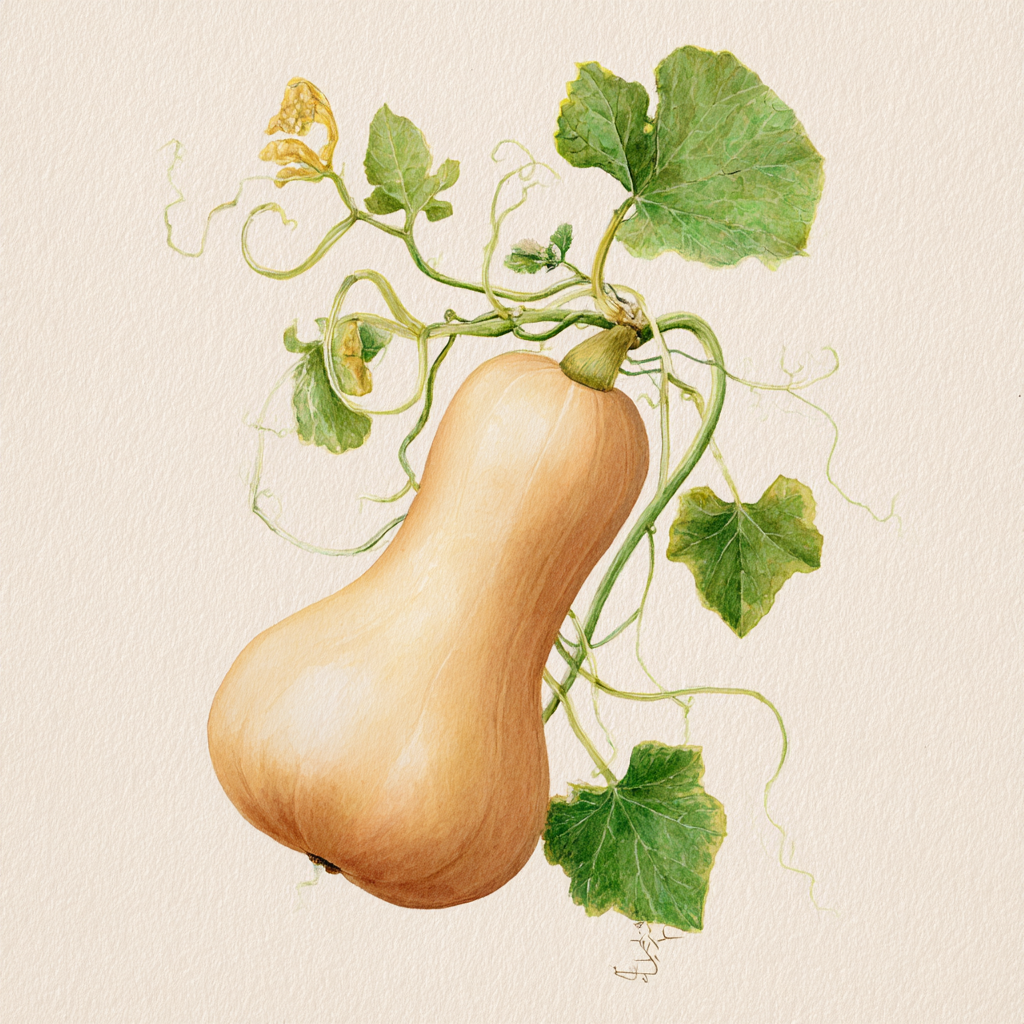
Have seeds for this? Add to inventory →Butternut squash is a prolific winter squash with sweet, orange flesh that stores well through winter. It forms a key part of the Three Sisters polyculture, its large leaves shading the soil to suppress weeds and retain moisture.
Native Range
- Origin
- Cucurbita moschata is a tropical American squash domesticate with wild ancestry and cultivation history centered in warm regions of the Americas.
- Native Habitat
- Wild and feral relatives favor warm open ground, disturbed soils, field margins, and seasonally moist tropical habitats.
- Current Distribution
- Widely cultivated in suitable growing regions worldwide; not native outside its region of origin.
Growing Conditions
Sunlight
Full Sun
Water Needs
Moderate
Soil
Rich, well-draining loam; pH 6.0 - 6.8
Spacing
24 - 36 inches
Days to Maturity
80 - 100 days from direct sow
Growing Zones
Thrives in USDA Zones 3 - 11
Companion Planting
Good Companions
Keep Away From
When to Plant
Start Indoors
3 - 4 weeks before last frost
Direct Sow
1 - 2 weeks after last frost, soil 60°F+
Harvest
80 - 100 days; harvest before first frost
Phenology (Natural Timing Cues)
Start Indoors
Start butternut squash indoors only 3-4 weeks before the last frost date - just enough of a head start without growing plants so large they become rootbound before transplant. In long-season climates, direct sowing is often better.
- Dandelion bloom is fading.
- Lilacs are close to bloom.
- Night temperatures are approaching 50°F outdoors.
Direct Sow
Direct sow butternut squash only when soil has warmed to at least 65°F - cold soil stalls germination and weak early seedlings never fully recover their early-season lag.
- Lilacs have faded.
- Soil feels warm several inches down, not just at the surface.
- Tender annual weeds and grasses are growing strongly.
- Night temperatures reliably stay above 55°F.
Transplant
Transplant butternut squash only into warm soil - squash stall badly in cool conditions and a chilled root system delays vine establishment by weeks.
- Lilacs have faded.
- Oak leaves are near full size.
- Soil is warm several inches down.
- Night temperatures stay above 55°F.
Start Dates (Your Location)
Based on your saved growing zone and this plant's timing notes.
Typical Last Frost
Set your growing zone to see personalized calendar dates.
Organic Growing Tips
Plant borage nearby to repel squash bugs and attract bees for better pollination.
Check the base of stems weekly for vine borer eggs and crush them on sight.
Grow nasturtiums at the edges of your squash patch to act as a sacrificial trap crop for aphids.
Fill planting holes with compost before transplanting and mulch thickly around plants — butternut squash are heavy feeders that thrive when soil organic matter is high and moisture is consistent throughout the season.
Common Pests
- Squash Vine Borer
- Squash Bug
- Cucumber Beetle
- Powdery Mildew
All pest management in Garden uses safe, organic, non-toxic methods only. No synthetic pesticides, ever.
Taxonomy
- Kingdom
- Plantae
- Family
- Gourd family (Cucurbitaceae)
- Genus
- Cucurbita
- Species
- Cucurbita moschata
Natural History
Cucurbita moschata, the species that includes butternut squash, was first domesticated in the lowlands of northern South America and Central America, with archaeological evidence of cultivation stretching back at least 4,000 years. Along with corn and beans, squash was one of the Three Sisters of Indigenous American agriculture - a companion planting system in which squash vines shade soil to suppress weeds and retain moisture while corn and beans provide structure and nitrogen. After the Columbian Exchange, Cucurbita moschata spread rapidly through South and Southeast Asia and Africa, where it became a dietary staple under various regional names; the large buff-skinned squashes common in South Asian and West African cooking are typically C. moschata forms. "Butternut" as a specific variety is a 20th-century development: the familiar pear-shaped squash was bred in 1944 by Charles Leggett in Stow, Massachusetts, crossing two existing varieties to produce the uniform, smooth-skinned, orange-fleshed type now dominant in Western markets. The sweetening of butternut after harvest is a genuine post-harvest process - during curing and storage, starches convert to sugars, which is why fully cured butternuts are noticeably sweeter than freshly harvested ones.
Traditional Use
Butternut squash as a variety is a 20th-century creation, but the Cucurbita moschata species it belongs to has a deep agricultural history across the Americas, South and Southeast Asia, and Africa. The traditions built around this squash reflect a plant that became genuinely central to food cultures far beyond its origin.
Parts Noted Historically
Indigenous American Three Sisters Agriculture - Fruit, seeds, and flowers
Squash was cultivated alongside corn and beans across much of the Americas in the Three Sisters system, one of the most studied examples of traditional polyculture. The squash provided ground cover and soil moisture retention while corn gave structure for bean vines and beans fixed nitrogen. Squash seeds were eaten roasted, flowers were used in cooking, and mature flesh was dried and stored as winter food.
South and Southeast Asian Traditions - Mature fruit
After the Columbian Exchange, Cucurbita moschata became a significant food crop across South and Southeast Asia, where buff and green-skinned winter squash now appear in a wide range of regional dishes. Indian, Thai, Indonesian, and Filipino cuisines all incorporate C. moschata forms extensively - often prepared with spice, coconut, and slow-cooking methods quite different from Western preparations.
West and Central African Traditions - Mature fruit and seeds
Pumpkins and squash of the Cucurbita genus, including C. moschata, became central to West and Central African cooking after their post-1492 introduction. The seeds were incorporated into soups and stews, the flesh became a major calorie source, and in some traditions the immature leaves are eaten as a cooked green.
North American Storage and Winter Cooking Traditions - Mature fruit
Winter squash including C. moschata forms were central to Indigenous North American food systems and were adopted rapidly by European settlers as a storable, productive crop. The tradition of baking and mashing sweet winter squash - which developed into pumpkin pie culture - draws on C. moschata and related species alongside the more commonly cited C. pepo, the traditional pie pumpkin.
Butternut squash is food-safe in any quantity. On rare occasions, bitter-tasting cucurbits indicate elevated cucurbitacin content, a naturally occurring compound that can cause nausea in large amounts. A noticeably bitter butternut should not be eaten; ordinary sweet butternut has negligible cucurbitacin levels.
This information is provided for historical and educational purposes only and is not medical advice. Always consult a qualified healthcare professional before making decisions related to your health.
Morphology (Plant Structure & Identification)
Root System
Wide-spreading fibrous roots feed near the soil surface and extend well beyond the crown. Vines benefit from compost-rich soil and mulch that protects shallow feeder roots.
Stem
Long trailing vines with thick, angular stems and tendrils. Vines root lightly at nodes when soil is moist and can cover a large bed by midsummer.
Leaves
Large, rough, lobed leaves on long petioles. Leaves shade soil heavily but are prone to powdery mildew late in the season.
Flowers
Large yellow-orange male and female flowers on the same plant. Female flowers have a small squash-shaped ovary behind the blossom and need pollinator visits for full fruit set.
Fruit
Tan, hard-rinded squash with a bulbous seed cavity and solid neck. Fruit is harvested mature when skin resists a fingernail and the stem begins to dry.
Known Varieties
Common cultivars worth knowing
- Best for: storage, general use
Waltham Butternut
Classic open-pollinated butternut with good storage and reliable flavor.
- Best for: roasting, small households
Honeynut
Small, very sweet butternut type bred for rich flavor and personal-size fruit.
- Best for: limited space
Butterbush
Compact bush-type butternut for smaller gardens.
- Best for: consistent harvests
Tiana
Hybrid butternut with uniform fruit and strong productivity.
- Best for: small gardens, early harvest
Ponca
Short-vined butternut with smaller fruit and good flavor.
Related Articles
Loading photo submission…