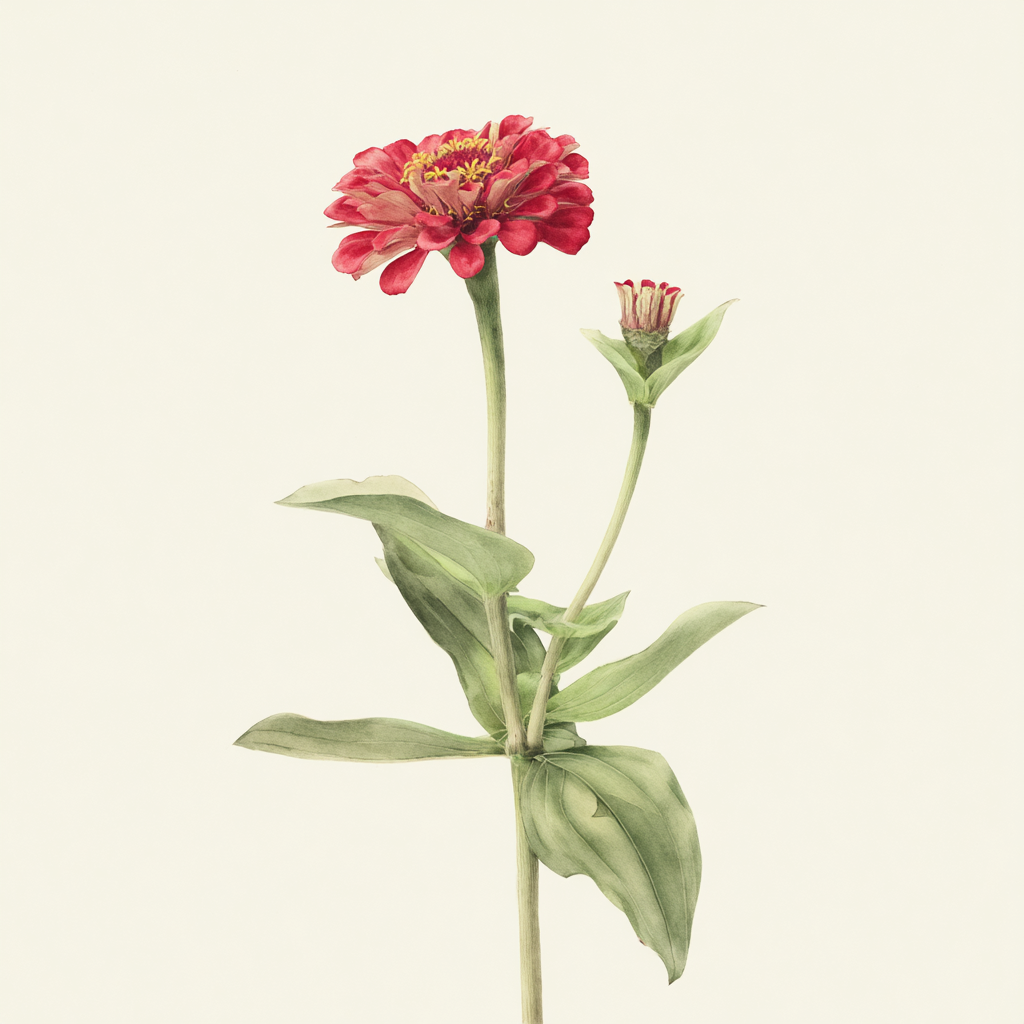
Zinnia
FlowerZinnia elegans
Have seeds for this? Add to inventory →Zinnias are easy-to-grow, heat-loving annuals that produce a continuous succession of vibrant flowers from midsummer through first frost. They are outstanding butterfly magnets and attract beneficial insects that prey on common pest species.
Native Range
- Origin
- Common garden zinnia is native to Mexico.
- Native Habitat
- Dry open grasslands, scrub, rocky slopes, and sunny disturbed ground.
- Current Distribution
- Widely cultivated in gardens worldwide; not native outside its region of origin.
Growing Conditions
Sunlight
Full Sun
Water Needs
Low
Soil
Well-draining loam; pH 5.5 - 7.0
Spacing
6 - 18 inches
Days to Maturity
60 - 70 days from direct sow to full flower
Growing Zones
Thrives in USDA Zones 3 - 11
Companion Planting
When to Plant
Direct Sow
After last frost; direct sow only - dislikes root disturbance
Harvest
Cut stems when outer petals are just opening; plants produce more when regularly cut
Phenology (Natural Timing Cues)
Direct Sow
Zinnias are warm-season annuals that dislike root disturbance and should be direct-sown where they are to grow. Germination requires warm soil (70 - 80°F) and seedlings that emerge into still-cool conditions are prone to damping off. The right moment is when soil is fully warm from sustained spring sun, not just surface-warm from a single warm day. Sowing too early into cold or wet soil is the most common mistake - the seeds sit and rot, or produce weak seedlings that cannot establish. In warm zones, zinnias can be succession-sown through summer to keep fresh flowers coming, though they slow during peak heat and bounce back as temperatures moderate.
- Lilacs have fully faded.
- Soil is consistently warm in a sunny bed - 70°F or above.
- Tender annual weeds are growing quickly and steadily.
- Daytime temperatures are reliably above 65°F.
Start Dates (Your Location)
Based on your saved growing zone and this plant's timing notes.
Typical Last Frost
Set your growing zone to see personalized calendar dates.
Organic Growing Tips
Space generously for good air circulation - powdery mildew is the main threat in humid climates.
Cut flowers frequently - the more you cut, the more the plants produce throughout the season.
Direct sow where they are to grow - zinnias resent transplanting and establish faster from seed in situ.
Sow into compost-enriched soil and allow spent plants to break down in place over winter — decomposing zinnia biomass feeds earthworms and soil fungi, building the organic matter that makes the whole bed more productive the following season.
Common Pests
- Powdery Mildew
- Aphids
- Spider Mites
- Bacterial Spot
All pest management in Garden uses safe, organic, non-toxic methods only. No synthetic pesticides, ever.
Taxonomy
- Kingdom
- Plantae
- Family
- Daisy family (Asteraceae)
- Genus
- Zinnia
- Species
- Zinnia elegans
Natural History
Zinnia elegans is native to Mexico, where single-flowered wild forms grow in dry scrub and disturbed habitats. The plant was cultivated by Aztec gardeners before European contact - it appears in the records of Francisco Hernández, Philip II's court physician, who surveyed New World plants in Mexico in the 1570s and described a flower the Aztecs called cempaxochitl or similar (though this name now applies most specifically to marigold). Spanish explorers returned seeds to Europe, where early specimens were so unimpressive - single, rather dull flowers on lanky stems - that German gardeners reportedly called them Wanderunfreude (without joy) and the French gave them the dismissive nickname fleur de mal aimée (flower of ill repute). The genus was named for Johann Gottfried Zinn (1727-1759), a German botanist and physician at Göttingen who provided the first thorough botanical description of the plant and died at only 32, making him one of the younger scientists commemorated in a plant genus name. The transformation of zinnia from obscure Mexican wildflower into the dominant summer bedding annual of North America was largely the work of David Burpee and the W. Atlee Burpee Company, who began intensive zinnia breeding in the early 20th century. Burpee's Giants of California (1920), the Dahlia-flowered type (1920s-30s), and continued selection through mid-century produced the large-headed, double-bloomed, intensely coloured plants that redefined the genus in gardens worldwide. By the 1950s zinnia had become the best-selling annual flower seed in the United States. NASA grew zinnias (Zinnia hybrida) on the International Space Station in 2015-2016, and astronaut Scott Kelly shared photographs of the first flowers to bloom in microgravity.
Traditional Use
Zinnia's story moves from Aztec garden plant to European curiosity to North American breeding triumph - one of the clearest examples in horticulture of a plant transformed almost beyond recognition by deliberate human selection.
Parts Noted Historically
Aztec Garden Origin - Flowers
Aztec gardeners cultivated zinnia as one of many ornamental and ceremonial flowers in the chinampas (floating gardens) of the Valley of Mexico. Francisco Hernández described it in his survey of New World plants conducted for Philip II in the 1570s. The Aztec horticultural tradition was sophisticated and extensive: the Tenochtitlan royal gardens maintained by Moctezuma II included dedicated flower gardens alongside medicinal plant collections, and the cultivation of ornamental plants for ceremony and aesthetics was a significant cultural practice. Zinnia in its wild single-flowered form was part of this tradition centuries before European contact.
European Introduction and Early Reputation - Flowers
The Spanish physician and naturalist Antonio José Cavanilles published the first formal botanical description of zinnia in his Icones et Descriptiones Plantarum (1791-1801), by which point the plant had been in European botanical gardens for about two centuries. Early European gardeners were unimpressed: without the double-flowered forms that later breeding produced, zinnia in its wild form was considered ungainly, briefly flowered, and unsuitable for the garden displays fashionable in European horticulture. The German name Widerstand and the French dismissal as fleur de mal aimée reflected genuine horticultural disappointment rather than cultural prejudice.
Burpee and the American Breeding Transformation - Flowers
David Burpee, who took over the W. Atlee Burpee Company in 1915, identified zinnia as a breeding target and began systematic work to produce larger, more double, more stable flowers. His Giants of California (around 1920) were significantly larger than anything previously available, and the subsequent Dahlia-flowered and Cactus-flowered types transformed the market. Burpee devoted personal attention to zinnia throughout his career, pursuing the elusive white zinnia for years - the first reliable white, Polar Bear, was released in 1954. By the mid-20th century zinnia was the best-selling annual flower seed in America, a transformation from European also-ran achieved within a single generation of focused selection.
Day of the Dead and Ongoing Mexican Tradition - Flowers
In Mexico, zinnia flowers are used alongside marigolds (cempasúchil) in Día de los Muertos (Day of the Dead) observances, placed on home altars (ofrendas) and cemetery graves as offerings to the dead during the November 1-2 celebrations. The specific cultural significance of orange and yellow flowers in this tradition connects to pre-Columbian beliefs about the colours associated with the sun, gold, and the passage between the living and the dead. Zinnia's Mexican origin and its role in an ongoing ceremony that has deep pre-Columbian roots gives it a cultural continuity that its transformation by North American plant breeders did not entirely displace.
Zinnia is a safe ornamental plant with no significant toxicity. As a member of the Asteraceae, it may cause contact reactions in people sensitive to the daisy family.
This information is provided for historical and educational purposes only and is not medical advice. Always consult a qualified healthcare professional before making decisions related to your health.
Morphology (Plant Structure & Identification)
Root System
Fibrous annual roots that establish quickly in warm soil but dislike crowding in containers.
Stem
Upright branching stems, often slightly rough or hairy, with strong nodes and good regrowth after cutting.
Leaves
Opposite oval to lance-shaped leaves with rough texture and no leaf stalk or a very short one.
Flowers
Composite flower heads in single, semi-double, or double forms, with broad ray florets surrounding a central disk.
Fruit
Flattened achenes attached to spent florets; mature seed is usually harvested from dry brown flower heads.
Known Varieties
Common cultivars worth knowing
- Best for: cut flowers
Benary's Giant
Tall cutting zinnia with large double blooms and strong stems.
- Best for: summer beds
State Fair
Large-flowered, heat-tolerant mix with sturdy plants.
- Best for: continuous harvest
Cut and Come Again
Branching heirloom mix that reblooms well after cutting.
- Best for: humid climates
Zahara
Compact disease-resistant series with single or double blooms.
- Best for: edging
Profusion
Low, spreading hybrid series known for clean foliage and steady bloom.
- Best for: floral design
Queen Lime
Muted green, rose, and blush cutting types with unusual colors.
Loading photo submission…