Watermelon
FruitCitrullus lanatus
Have seeds for this? Add to inventory →Watermelons are sprawling warm-season vines that require a long, hot growing season to produce their large, sweet fruits. They thrive in sandy, well-draining soil and need consistent pollinator activity for good fruit set.
Native Range
- Origin
- Watermelon is an African domesticate derived from Citrullus lineages native to Africa.
- Native Habitat
- Dry sandy ground, savanna margins, seasonally arid riverbeds, and warm open disturbed soils.
- Current Distribution
- Widely cultivated in warm climates; not native outside its region of origin.
Growing Conditions
Sunlight
Full Sun
Water Needs
Moderate
Soil
Sandy, well-draining loam; pH 6.0 - 6.8
Spacing
36 - 60 inches
Days to Maturity
70 - 90 days from transplant
Growing Zones
Thrives in USDA Zones 6 - 11
Companion Planting
When to Plant
Start Indoors
3 - 4 weeks before last frost
Transplant
2 weeks after last frost, soil 70°F+
Harvest
Check tendril near fruit is dry; thump fruit for a hollow sound
Phenology (Natural Timing Cues)
Start Indoors
Watermelon starts should be brief - 3 to 4 weeks only - because, like zucchini, the plant grows rapidly and root-bound starts transplant poorly and lose their momentum advantage. The sole purpose of indoor starting is to gain a week or two in zones where outdoor soil does not reliably reach 70°F until late spring. Starting too early produces a pot-bound plant that stalls badly at transplant; starting too late has little advantage over direct sowing into warm soil.
- Dandelion bloom is fading and lilacs are blooming or beginning to fade.
- Outdoor soil is warming but not yet at 70°F in a sunny bed.
- The last expected frost is 3 - 4 weeks away and transplant weather is approaching.
Direct Sow
Direct sowing is the standard approach in warm, long-season climates where soil reaches 70°F+ reliably by late spring. Sowing into soil below 70°F means slow, uneven germination and seedlings that stall rather than establish. The cue for direct sowing is the same as for transplanting: soil is genuinely warm several inches down, not just surface-warm from a sunny day, and overnight temperatures are consistently above 60°F. In short-season zones, direct sowing is risky because the 70 - 90 day maturity period may not fit between warm soil and first autumn frost.
- Lilacs are well past bloom and early summer warmth is established.
- Soil is warm several inches down even in the morning.
- Warm-season weeds and grasses are growing vigorously.
- Overnight temperatures are consistently above 60°F.
Transplant
Watermelon transplants are even more heat-sensitive than tomato transplants because any cold check during establishment costs vine growth days that cannot be recovered, and vine growth duration directly determines whether fruit has time to mature before autumn. The minimum soil temperature for transplanting is 70°F - not 60°F as for tomatoes. Cold setbacks at transplant can delay the first flower by two or more weeks, which in short-season climates can mean the difference between ripe fruit and unripe fruit at first frost.
- Lilacs are well past bloom and early summer heat is settled.
- Soil is warm several inches down.
- New vine growth stays firm and upright after hardening off.
- Nights are consistently above 60°F.
Start Dates (Your Location)
Based on your saved growing zone and this plant's timing notes.
Typical Last Frost
Set your growing zone to see personalized calendar dates.
Organic Growing Tips
Plant on black plastic mulch to maximise soil warmth and accelerate fruiting in short seasons.
Hand-pollinate early morning flowers if bees are scarce using a small paintbrush.
Plant borage and marigolds throughout the patch to attract pollinators and repel cucumber beetles.
Water deeply but infrequently; reduce watering 2 weeks before harvest to concentrate sugars.
Common Pests
- Cucumber Beetle
- Aphids
- Squash Bug
- Fusarium Wilt
- Alternaria Blight
All pest management in Garden uses safe, organic, non-toxic methods only. No synthetic pesticides, ever.
Taxonomy
- Kingdom
- Plantae
- Family
- Gourd family (Cucurbitaceae)
- Genus
- Citrullus
- Species
- Citrullus lanatus
Natural History
Watermelon (Citrullus lanatus) was domesticated in Africa, though the precise location and timing have been substantially revised by recent research. The long-dominant view placed origin in the Kalahari Desert of southern Africa. Genetic and archaeological work now points more strongly to northeast Africa - the Nile Valley, Sudan, and the wider horn of Africa region - as the key domestication zone. Watermelon seeds and rinds from Egyptian sites date to approximately 3,500-3,000 BCE, and New Kingdom Egyptian tomb paintings show large oval fruits closely resembling watermelons being cultivated. Watermelon seeds were found among the grave goods of Pharaoh Tutankhamun (13th century BCE). A related species, Citrullus mucosospermus, was independently domesticated in West Africa as the egusi melon, grown primarily for its edible seeds rather than watery flesh. Arab traders carried watermelon from North Africa through the Mediterranean and across the Islamic world during the medieval period, and it appears in 10th-century records from Moorish Spain. It reached China by around 1000 CE via Arab trade along the Silk Road. The Quran mentions watermelon in a hadith tradition as a food of Paradise. Spanish and Portuguese colonists brought it to the Americas in the 16th century, where it naturalised so readily in warm climates that some early explorers genuinely believed it native. In the American South the fruit became deeply embedded in summer food life, and its cultural history in the United States includes a painful chapter of racial caricature following the Civil War, when racist imagery weaponised watermelon against Black Americans, though the fruit had genuine and deep significance in Black American foodways that existed independent of and before these caricatures.
Traditional Use
Watermelon has been a human food plant for five thousand years, moving from northeast Africa through the Arab world to China, the Americas, and every warm climate on earth - with an additional American cultural history that is more complex than the fruit itself.
Parts Noted Historically
Ancient Egyptian Documentation - Fruit and seeds
Watermelon seeds and peel fragments from Egyptian sites in the Nile Delta and Upper Egypt date to approximately 3,500-3,000 BCE, making Egypt the earliest documented cultivation site by a substantial margin. New Kingdom tomb paintings at sites including the Valley of the Kings depict large oval fruits in garden and market contexts. Watermelon seeds placed in the tomb of Tutankhamun (c.1323 BCE) as provisions for the afterlife reflect both the fruit's practical food value and its status as a worthy grave good. The Ebers Papyrus (c.1550 BCE) mentions watermelon among cultivated plants, though not in a specifically medicinal context.
Arab World, the Quran, and Medieval Spread - Fruit
Arab agricultural writing from the medieval period includes detailed watermelon cultivation instructions. A hadith tradition records the Prophet Muhammad eating watermelon with fresh dates and praising it as a fruit of Paradise, giving watermelon religious resonance in Muslim food culture. The Arab botanist and agronomist Ibn al-Awwam described watermelon cultivation in 12th-century Seville in his Kitab al-Filaha. Arab traders carried it east to Persia, Central Asia, and via the Silk Road to China by around 1000 CE, and west across North Africa and into Moorish Spain, making Arab commerce the primary vector of watermelon's spread from its African origin across the Old World.
American Introduction and Rapid Spread - Fruit and seeds
Spanish and Portuguese colonists introduced watermelon to the Americas in the 16th century, and it spread through warm regions faster than almost any introduced plant. Accounts from Spanish Florida (1576) and Virginia (1629) both describe watermelons being grown, and by the time later European explorers moved inland through the Southeast and Southwest they found watermelons growing in what appeared to be wild stands - the fruit had spread ahead of European colonists through Indigenous trade networks and bird dispersal. The seed was traded from community to community across the continent at extraordinary speed, and watermelon was documented growing in Massachusetts by 1629.
American South and the Racial Caricature History - Fruit
Watermelon was a genuinely important food in the lives of enslaved African Americans in the antebellum South, grown in small garden plots and eaten in summer as one of the few pleasures available. After the Civil War and emancipation, this association was systematically weaponised: racist caricature images depicting Black Americans with watermelons proliferated in the post-Reconstruction era as part of a broader project of dehumanisation designed to discredit political and social equality. This caricature history is distinct from - and was imposed over - the actual food significance of watermelon in Black American culture, which had nothing degrading in it. Understanding this history is part of understanding why the fruit carries the cultural weight it does in American life.
Watermelon fruit, seeds, and rind are all safe foods. The fruit is around 92% water and extremely low in calories; seeds are edible raw or roasted. Pickled watermelon rind is a traditional Southern US food.
This information is provided for historical and educational purposes only and is not medical advice. Always consult a qualified healthcare professional before making decisions related to your health.
Morphology (Plant Structure & Identification)
Root System
Wide-spreading roots with a deeper taproot than many cucurbits once established. Roots need warm, well-drained soil and steady moisture during fruit sizing.
Stem
Long trailing vines with tendrils that sprawl across the ground. Vines are more delicate than squash and resent rough handling.
Leaves
Deeply lobed, rough-textured leaves on long petioles. Leaves are smaller and more cut than squash leaves.
Flowers
Yellow male and female flowers appear separately on the same vine. Female flowers have a tiny melon-shaped ovary behind the blossom.
Fruit
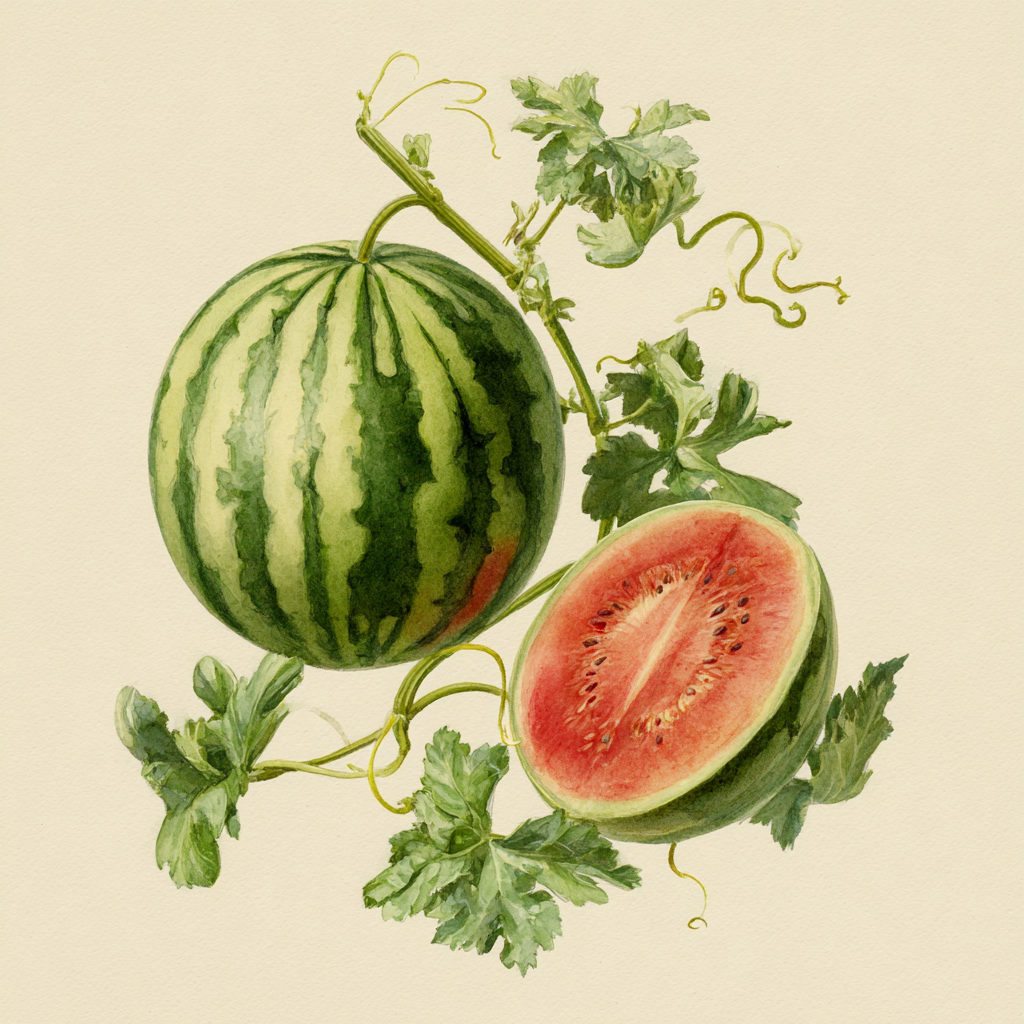
Large smooth-rinded pepo with sweet watery flesh and many seeds unless seedless. Rind patterns range from solid dark green to striped or mottled.
Known Varieties
Common cultivars worth knowing
- Best for: small gardens, short seasons
Sugar Baby
Small icebox watermelon with dark rind and early maturity.
- Best for: general garden use
Crimson Sweet
Classic striped watermelon with red flesh and reliable production.
- Best for: large gardens
Charleston Gray
Large oblong melon with pale rind and good disease resistance.
- Best for: heirloom gardens
Moon and Stars
Heirloom with dark rind marked by yellow spots.
- Best for: early harvests, novelty fruit
Yellow Doll
Small early watermelon with sweet yellow flesh.
Loading photo submission…