Thyme
HerbThymus vulgaris
Have seeds for this? Add to inventory →Thyme is a compact, drought-tolerant perennial herb whose antimicrobial essential oils deter many garden pests while attracting bees. It thrives in lean, well-draining soil and is an excellent ground cover in the herb or vegetable garden.
Native Range
- Origin
- Common thyme is native to the western Mediterranean region and southern Europe.
- Native Habitat
- Dry rocky slopes, limestone scrub, garrigue, open banks, and thin well-drained soils.
- Current Distribution
- Widely cultivated in dry, mild climates; not native outside its region of origin.
Growing Conditions
Sunlight
Full Sun
Water Needs
Low
Soil
Well-draining, lean sandy or loamy soil; pH 6.0 - 8.0
Spacing
12 - 18 inches
Days to Maturity
Harvest lightly from first year; do not harvest more than one-third at a time
Growing Zones
Thrives in USDA Zones 4 - 10
Companion Planting
Good Companions
Keep Away From
No known antagonists
When to Plant
Transplant
Spring after last frost
Direct Sow
After last frost, surface sow as seeds need light to germinate
Harvest
Harvest regularly to maintain compact growth; cut before flowering for best flavour
Phenology (Natural Timing Cues)
Direct Sow
Thyme seed is tiny and germinates slowly and unevenly, making outdoor direct sowing a project that requires patience. The seeds need light to germinate and should be pressed onto a smooth surface rather than covered. The requirement is consistent surface moisture without heavy rain or rough watering that would wash seed away - and mild temperatures so the seedbed does not dry out between waterings. In practice, many gardeners find nursery divisions or cuttings far more reliable than sowing from seed. The phenological window for direct sowing is late spring: warm enough for germination (60 - 75°F soil), not so hot that the surface dries quickly between events, and with settled enough weather for the slow process of germination and establishment to proceed without disruption.
- Peak dandelion bloom has passed and late spring warmth has settled in.
- Soil surface is lightly warm and not crusting between rain events.
- Light, steady spring rains or reliable gentle watering can maintain surface moisture.
- No heavy downpours expected that would wash tiny seeds from position.
Transplant
Thyme transplants best after cold, wet spring conditions have passed, for the same reason as rosemary and sage - its woody roots are far more susceptible to rot in cold, soggy soil than to drought. The reliable window is late spring: soil is warming and drying well between rain events, nighttime temperatures are above 45°F, and the plant will root into warm, well-draining soil rather than sitting in cold wet ground. Transplanting too early into poorly-draining soil is the most common failure mode for young woody Mediterranean herbs.
- Dandelion bloom is past peak.
- Soil is workable and drains well after rain rather than staying persistently soggy.
- New growth on established perennial herbs nearby is firm, not soft or chilled.
- Nighttime temperatures are reliably above 45°F.
Start Dates (Your Location)
Based on your saved growing zone and this plant's timing notes.
Best Planting Window
Spring window
After your last frost
Plant once frost risk has passed and spring conditions are settled.
Autumn window
Usually skip autumn planting
Use spring unless you have locally grown nursery stock and enough mild weather for roots to establish.
Planting Method
Use nursery-grown planting stock rather than treating this as a standard seed-starting crop.
Critical Timing Note
Plant after cold risk has passed so roots can establish without chilling or stalling.
Organic Growing Tips
Plant thyme as a low border alongside brassica beds to mask host-plant scents from flying pests.
Divide established plants every 3 years to prevent woody centres and maintain productivity.
Harvest just before flowering when essential oil content - and flavour - is at its peak.
Thyme is excellent as a living mulch between larger plants, suppressing weeds and retaining moisture.
Common Pests
All pest management in Garden uses safe, organic, non-toxic methods only. No synthetic pesticides, ever.
Taxonomy
- Kingdom
- Plantae
- Family
- Mint family (Lamiaceae)
- Genus
- Thymus
- Species
- Thymus vulgaris
Natural History
The genus name Thymus and the common name thyme both derive from the Greek thymon, which itself traces to thyein, meaning to make a burnt offering or to sacrifice by burning - thyme was burned as incense in Greek temples, and its smoke was considered sacred. A parallel etymology connects it to thymos, meaning courage or spirit, which explains the medieval European tradition of embroidering sprigs of thyme onto the scarves and banners sent to knights going to war, particularly in southern France and Provence. The primary antiseptic compound in thyme's essential oil, thymol, was first isolated in 1719 by the German chemist and physician Caspar Neumann in Berlin - but the empirical knowledge that thyme preserved food, inhibited spoilage, and had some effect on wounds was embedded in Mediterranean practice centuries before the chemistry was understood. Traces of thyme - or the closely related Thymbra spicata - have been found in Egyptian mummy wrappings from as early as 1400 BCE, and Sumerian cuneiform tablets from around 3000 BCE record thyme among medicinal plant prescriptions. Charlemagne's Capitulare de Villis (c.812 CE) required thyme among the plants grown on all imperial estates. In the 19th century, thymol isolated from thyme oil became one of the first antiseptics validated by Pasteur-era germ theory, and Listerine mouthwash, developed by Joseph Lawrence in 1879 and first sold commercially in 1914, contained thymol as its primary active antiseptic - a connection that links the ancient Mediterranean aromatic directly to modern oral hygiene practice.
Traditional Use
Thyme is one of the few herbs where the aromatic intuition of ancient Mediterranean cooks - that this plant preserved food and had power over infection - has been substantially confirmed by the isolation of thymol and its demonstrable antiseptic properties.
Parts Noted Historically
Greek Temple Incense and the Courage Tradition - Flowering tops
Thyme burning in Greek temples served both religious and practical purposes: the smoke was sacred, and thymol's antimicrobial properties may have helped suppress infection in spaces crowded with animals and sacrificial blood. The parallel etymology connecting thyme to thymos (courage) generated a distinct cultural tradition: medieval European knights received embroidered thyme sprigs from women as talismans of bravery, and the plant appears in chivalric literature as a symbol of the virtues associated with courageous action. Laura, the muse of Petrarch's sonnets (14th century), was described with thyme in several of his poems. This courage association is documented most strongly in southern France and the Provençal troubadour tradition.
Ancient Egypt and Sumerian Records - Leaves
Cuneiform tablets from Sumer, dated to approximately 3000 BCE, include thyme among a list of plant prescriptions - one of the oldest written pharmacological records of any specific plant. In Egypt, analysis of mummy wrappings has found compounds consistent with thyme or the closely related Thymbra spicata, used in the embalming process. The antimicrobial properties of thymol would have made such resins genuinely useful for preservation, suggesting empirical knowledge of its properties centuries before any chemical analysis was possible.
Medieval Monastery and Household Use - Leaves and flowering tops
Charlemagne's Capitulare de Villis of around 812 CE listed thyme among plants required on all imperial estates - evidence of its established importance in Carolingian Frankia. Monastery gardens grew it as both a culinary herb and a fumigant: bunches were burned to clear air and strewn on floors to release antiseptic oils underfoot. John Gerard described it extensively in his 1597 Herball as useful for coughs and chest complaints, referencing Dioscorides and Galen while adding his own observations. Thyme became a component of the classic French bouquet garni and fines herbes traditions that codified the essential herb palette of French cooking.
Thymol Isolation and Listerine - Leaves
Caspar Neumann's isolation of thymol from thyme oil in 1719 was one of the earliest isolations of an active compound from a plant - predating most of what we call modern pharmacology. The compound's antiseptic properties were investigated more rigorously in the 19th century, and thymol became an accepted surgical antiseptic in the Lister era of germ theory. Joseph Lawrence's 1879 formulation, licensed to Lambert Pharmacal Company and marketed as Listerine from 1914 onward, was built around thymol, eucalyptol, menthol, and methyl salicylate - all plant-derived compounds. Listerine's original positioning was as a surgical antiseptic and multipurpose household cleaner before it was repositioned as a mouthwash, making thyme's antiseptic reputation one of the more continuously documented in the history of any plant.
Culinary thyme used in cooking is safe with a continuous use history of thousands of years. Thyme essential oil is a concentrated form that should not be taken internally undiluted; applied to skin it can cause irritation.
This information is provided for historical and educational purposes only and is not medical advice. Always consult a qualified healthcare professional before making decisions related to your health.
Morphology (Plant Structure & Identification)
Root System
Fine shallow roots on woody crowns, adapted to well-drained lean soil. Plants decline in heavy wet ground.
Stem
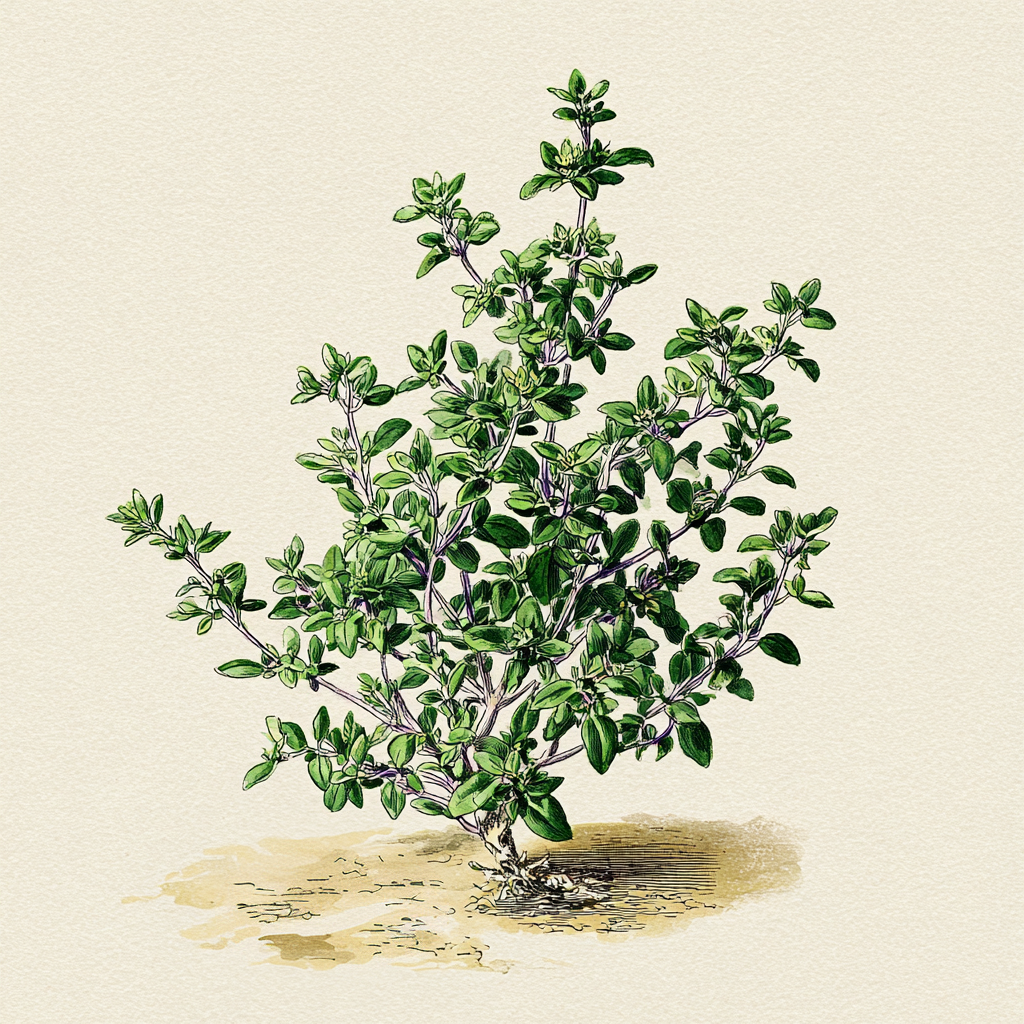
Low woody stems branch densely and can creep or mound depending on type. Older centers may become woody and sparse.
Leaves
Tiny opposite leaves with rolled edges and a strong savory aroma. Leaf size and scent distinguish culinary thyme from creeping ornamental types.
Flowers
Small pink, lavender, or white two-lipped flowers appear in clusters and attract bees and small pollinators.
Fruit
Produces tiny dry nutlets after flowering. Culinary types are often propagated from divisions or cuttings for consistent flavor.
Known Varieties
Common cultivars worth knowing
- Best for: general cooking
English Thyme
Standard culinary thyme with balanced savory flavor.
- Best for: classic herb blends
French Thyme
Fine-leaved culinary type with strong aroma.
- Best for: fish, vegetables, tea
Lemon Thyme
Citrus-scented thyme with bright flavor.
- Best for: paths, pollinators
Creeping Thyme
Low mat-forming thyme with flowers and groundcover habit.
- Best for: edible borders
Silver Thyme
Variegated culinary thyme with ornamental silver-edged leaves.
Loading photo submission…