Spinach
VegetableSpinacia oleracea
Have seeds for this? Add to inventory →Spinach is a fast-growing cool-season green that can be harvested as baby leaves or left to full size. It bolts quickly in summer heat, so it is best grown in the cool shoulder seasons or under the shade of taller plants.
Native Range
- Origin
- Spinach is an Old World leafy crop native to southwestern and central Asia, with early cultivation associated with Persia and surrounding regions.
- Native Habitat
- Wild and weedy relatives occur in cool-season open ground, saline or disturbed soils, and seasonally moist habitats.
- Current Distribution
- Widely cultivated in cool-season growing regions worldwide; not native outside its region of origin.
Growing Conditions
Sunlight
Partial Shade
Water Needs
Moderate
Soil
Rich, moist, well-draining loam; pH 6.5 - 7.0
Spacing
6 inches after thinning
Days to Maturity
40 - 50 days from sowing
Growing Zones
Thrives in USDA Zones 2 - 10
Companion Planting
Keep Away From
When to Plant
Direct Sow
4 - 6 weeks before last frost; again in late summer for autumn harvest
Harvest
40 - 50 days; cut outer leaves for cut-and-come-again
Phenology (Natural Timing Cues)
Direct Sow
Spinach is one of the most cold-tolerant vegetable crops and can be sown into soil that is barely workable - seeds germinate in soil as cool as 35 - 40°F, though slowly at that temperature. The crop's limitation is at the other end: when days lengthen past roughly 14 hours and temperatures warm, spinach shifts to producing a seed stalk and leaf quality collapses within days. The spring window is defined not by when it can go in (very early) but by how long it will last before heat and day length trigger bolting. An autumn sowing is often the better and longer season in most climates: sown when summer heat eases, spinach grows through autumn and can be harvested into early winter, and in mild zones it overwinters to provide early spring leaves before anything else is producing.
- Forsythia is blooming or just coming into bloom.
- Early dandelions are just opening.
- Soil is workable and crumbles - even if it is still quite cool.
- For autumn sowing: tomato and pepper foliage is beginning to show heat fatigue and nights are dropping toward 60°F.
Start Dates (Your Location)
Based on your saved growing zone and this plant's timing notes.
Typical Last Frost
Set your growing zone to see personalized calendar dates.
Organic Growing Tips
Grow under floating row cover to exclude leaf miners while still allowing light and water through.
Interplant with strawberries, which enjoy similar cool, moist conditions and shade each other beneficially.
Succession sow every 2 weeks through autumn for fresh harvests until hard frost.
Use compost-rich soil to support rapid leaf growth and harvest before summer heat triggers bolting.
Common Pests
- Aphids
- Leaf Miners
- Slugs
- Downy Mildew
All pest management in Garden uses safe, organic, non-toxic methods only. No synthetic pesticides, ever.
Taxonomy
- Kingdom
- Plantae
- Family
- Amaranth family (Amaranthaceae)
- Genus
- Spinacia
- Species
- Spinacia oleracea
Natural History
Spinach (Spinacia oleracea) is native to central and southwestern Asia, with Persia - modern Iran - as the most likely centre of origin. The earliest clear written record appears in a Chinese document from 647 CE recording that the King of Nepal sent spinach seeds to the Tang Emperor as a diplomatic gift, where it was called "Persian herb" (bōcài, a name Chinese cooks still use). Arab traders carried it westward, and it appeared in Moorish Spain by around 1000 CE, introduced through Al-Andalus more than two centuries before it spread through the rest of northern Europe. The Arab agronomist Ibn al-Awwam described spinach cultivation in 12th-century Seville in his Kitab al-Filaha, treating it as an important cool-season crop suited to Andalusian winters. The English word "spinach" traces this route: via Old French espinache, from Spanish espinaca, ultimately from Arabic isfanaj and Persian isfenaj. By the 14th century spinach had spread through France, Germany, and England, appearing in kitchen garden inventories and Lenten cookery records. The iron-and-strength reputation that Popeye cartoons later enshrined has a peculiar documentary history: a widely repeated claim holds that the reputation stemmed from a decimal point error in an 1870 nutritional analysis by German chemist Erich von Wolf, who supposedly recorded 35 mg of iron per 100g rather than 3.5 mg. Food historians have questioned whether this specific error actually occurred in the form described, but the broader cultural construction of spinach as a strength food was real and was enthusiastically exploited in Popeye cartoons from 1929 onward.
Traditional Use
Spinach travelled from Persia to China to Moorish Spain to northern Europe over roughly a thousand years, and the trail of its movement is one of the better-documented diffusion histories of any vegetable.
Parts Noted Historically
Persian Origin and Arab Agricultural Scholarship - Leaves
The oldest written records of spinach are Chinese documents from 647 CE identifying it as a plant from Persia, but Arab agronomical writing is the richest early source. Ibn al-Awwam, writing in 12th-century Seville, devoted detailed attention to spinach in his Kitab al-Filaha, describing optimal planting seasons, soil requirements, and the plant's cooling qualities in humoral terms. Arab scholars classified it as a cooling, moistening food suited to hot, dry constitutions - the standard humoral analysis that governed medieval Mediterranean medical thinking on food plants.
Moorish Spain and European Introduction - Leaves
Spinach reached southern Spain through Al-Andalus by around 1000 CE, nearly two centuries before it appeared in French or English records. Its introduction to northern Europe followed the gradual transmission of Moorish agricultural knowledge during and after the Reconquista. By the 14th century spinach appeared in French court recipes and English household records. It became particularly important as a Lenten food: it grew abundantly in the cool weather of early spring and was acceptable on fast days, making it one of the most reliable sources of fresh greens during the pre-Easter period when many other vegetables were not yet producing.
Catherine de Medici and French Culinary Tradition - Leaves
Catherine de' Medici, the Florentine who married Henry II of France in 1533, is credited - though the story may be partly apocryphal - with popularising spinach at the French court by insisting her Florentine cooks prepare it for her. Dishes prepared "à la Florentine" traditionally include spinach in the French culinary tradition, a naming convention said to commemorate this Medici connection. Whether or not the personal story is accurate, spinach did become a foundational vegetable in French court and bourgeois cooking, appearing in timbales, soufflés, gratin dishes, and as a standard accompaniment to eggs, fish, and poultry.
The Iron Myth and Popeye - Leaves
Spinach acquired its modern identity as an iron-rich strength food through a combination of nutritional science, popular culture, and possibly numerical error. A widely cited claim holds that a decimal point mistake in an 1870 German nutritional analysis overstated spinach's iron content tenfold, and that this error propagated through popular literature for sixty years. Food historians have found the specific error difficult to trace precisely, but the cultural result is clear: by the late 19th century spinach had a strong health reputation that Popeye cartoons from 1929 onward amplified into a global myth. The cartoons were themselves partly a promotional response to the US spinach industry's desire to increase consumption, making spinach one of the few vegetables with a documented marketing campaign behind its popular image.
This information is provided for historical and educational purposes only and is not medical advice. Always consult a qualified healthcare professional before making decisions related to your health.
Morphology (Plant Structure & Identification)
Root System
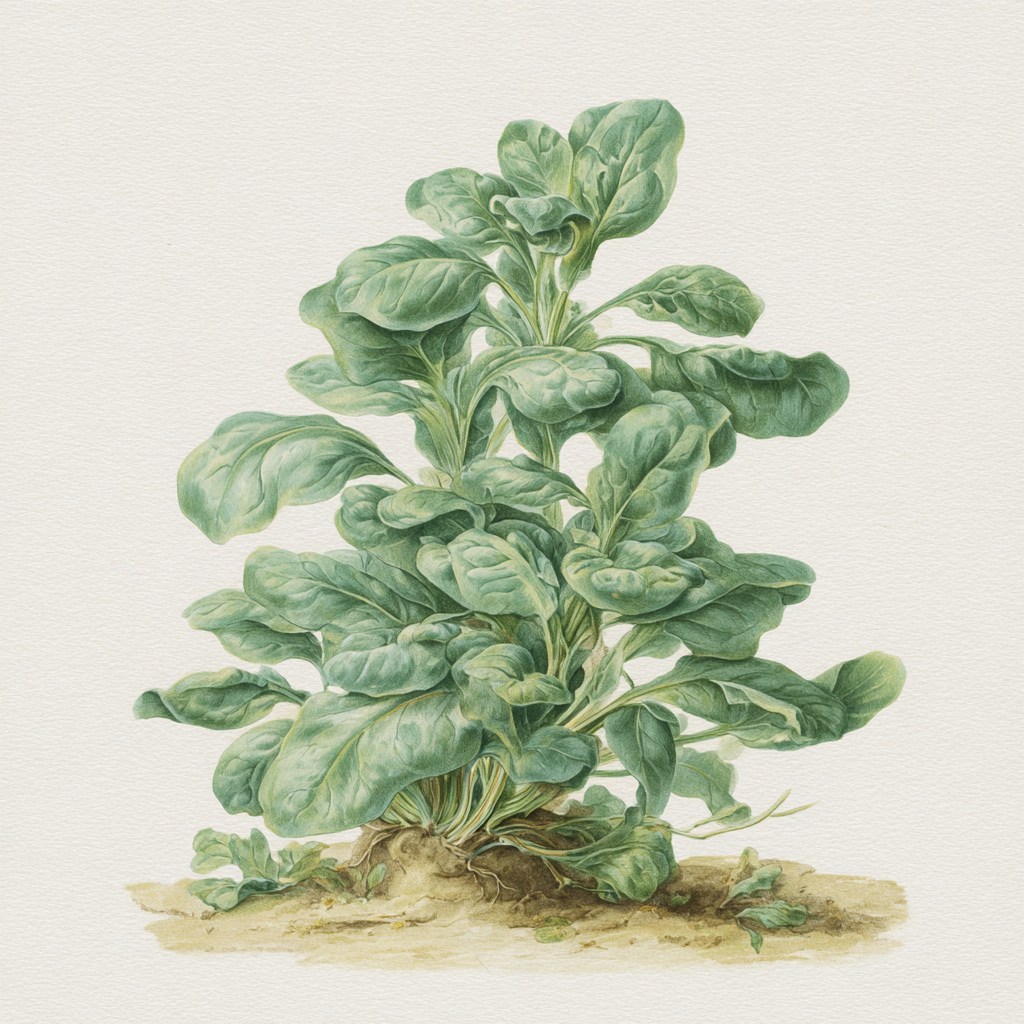
Shallow to moderately deep taproot with fine feeder roots. Even moisture matters because leaves lose quality quickly when roots dry out.
Stem
Compact crown during leaf production, followed by a quickly elongating seed stalk when plants bolt. Bolting makes leaves smaller and more bitter.
Leaves
Smooth or savoyed leaves form a low rosette. Leaf shape ranges from rounded to arrow-shaped, with thicker texture than many salad greens.
Flowers
Small greenish flowers appear on separate male and female plants in many varieties. Flowering is triggered by long days and heat.
Fruit
Produces small dry seed clusters, sometimes smooth and sometimes prickly. The harvested crop is the tender leaf rosette before bolting.
Known Varieties
Common cultivars worth knowing
- Best for: spring and fall crops
Bloomsdale
Classic savoyed spinach with crinkled leaves and good cold tolerance.
- Best for: baby leaf, fresh salads
Space
Smooth-leaf hybrid with upright growth and easy washing.
- Best for: extended harvests
Tyee
Semi-savoy type with strong disease resistance and slow bolting.
- Best for: winter and early spring greens
Giant Winter
Large-leaved cold-hardy spinach for overwintering in mild climates.
- Best for: steady harvests
Regiment
Productive smooth to semi-savoy hybrid with reliable uniform leaves.
Related Articles
Understanding Your Growing Zone
Getting Started • 4 min read
Building Great Garden Soil
Soil & Compost • 6 min read
How to Water Your Vegetable Garden
Watering & Feeding • 5 min read
Extending Your Growing Season
Seasonal Growing • 6 min read
What to Grow in Autumn and Winter
Seasonal Growing • 5 min read
Loading photo submission…