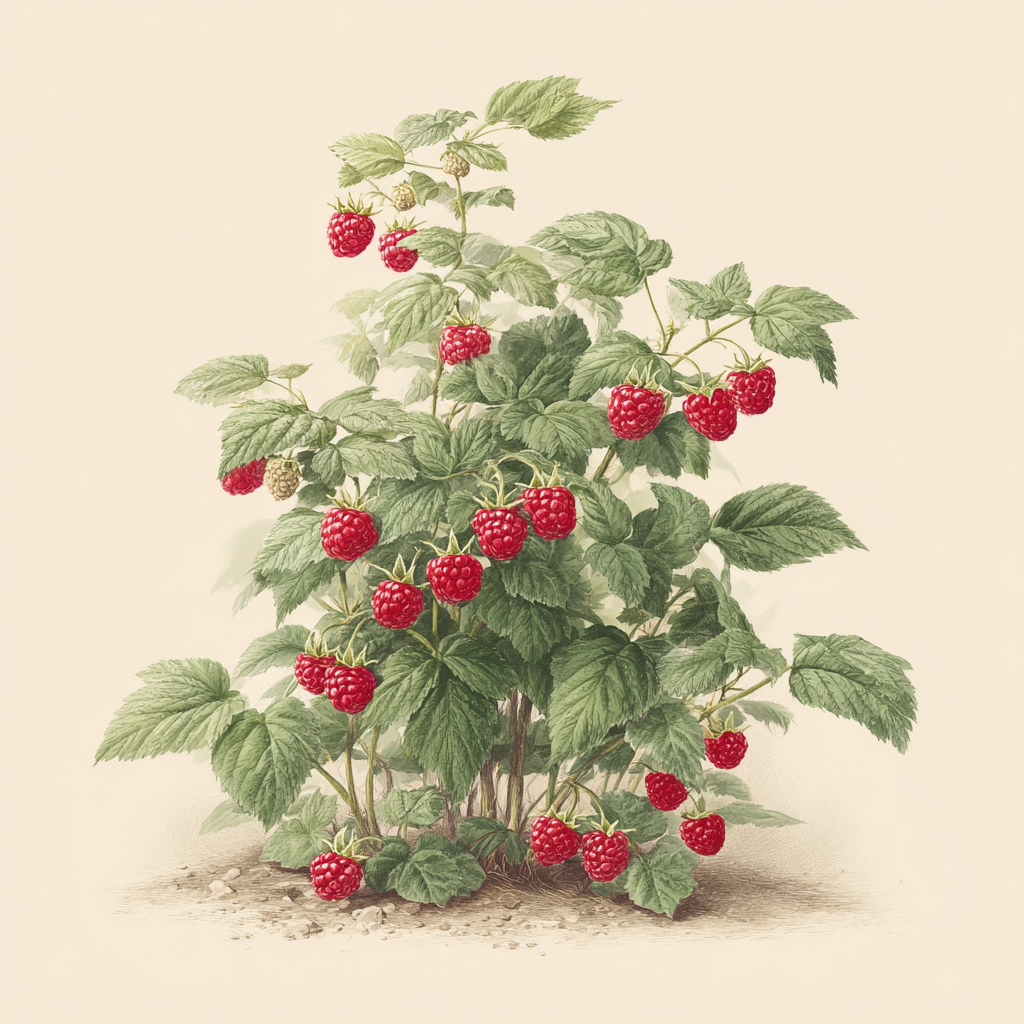
Raspberry
FruitRubus idaeus
Have seeds for this? Add to inventory →Raspberries are productive cane fruits that spread vigorously by suckers and produce summer or autumn crops depending on variety. They are easy to grow organically and highly rewarding, producing fruit for up to 10 years from well-tended canes.
Native Range
- Origin
- Cool temperate regions of North America and northern Eurasia, with complex ancestry involving both continents in modern garden varieties
- Native Habitat
- Forest openings, burned or cut-over woods, old fields, ravines, streambanks, talus slopes, and light-gap habitats with adequate moisture and partial sun
- Current Distribution
- Native across much of cool temperate North America and cultivated widely in temperate gardens and farms worldwide.
Growing Conditions
Sunlight
Full Sun
Water Needs
Moderate
Soil
Rich, well-draining, slightly acidic loam; pH 5.5 - 6.5
Spacing
18 - 24 inches in rows; 6 feet between rows
Days to Maturity
Summer varieties: year 2; Autumn varieties: first year from planting
Growing Zones
Thrives in USDA Zones 3 - 10
Companion Planting
When to Plant
Transplant
Bare-root canes in late autumn to early spring while dormant
Harvest
Summer: July - August; Autumn: August - October; harvest when fully ripe and detach easily
Phenology (Natural Timing Cues)
Transplant
Raspberries establish best from dormant bare-root canes planted while the crown is still fully dormant or only just beginning to wake. The reason is that a dormant cane has minimal water demand from its canopy while roots are getting established - planting after strong sucker growth and leafing out creates a situation where the canopy is already drawing on root reserves before the root system has spread into surrounding soil. In practice this means the spring window closes quickly: once canes begin actively leafing out, bare-root planting becomes noticeably more stressful. For autumn planting, the window opens when canes go fully dormant - leaves dropped, growth stopped - and closes when hard frost makes soil unworkable. In very cold zones, late autumn planting of bare-root canes can expose them to winter kill before roots have spread; spring planting is safer there.
- Forsythia is beginning to bloom and early dandelions are just opening (spring planting).
- Raspberry cane buds are swelling but have not yet opened into leaf.
- Soil is workable, crumbles cleanly, and is not waterlogged.
- For autumn planting: leaf drop on deciduous trees is well underway and raspberry canes have stopped new growth.
Start Dates (Your Location)
Based on your saved growing zone and this plant's timing notes.
Best Planting Window
Spring window
Late winter to early spring
Plant while dormant, before buds break and before active top growth begins.
Autumn window
Late autumn after leaf drop
Plant while dormant, after leaves have dropped and before the ground freezes.
Planting Method
Plant dormant bare-root canes. Named varieties are propagated vegetatively so the fruiting plant stays true to type.
Critical Timing Note
Plant while dormant and before bud break so roots establish before leaves demand water.
Typical Harvest Window
July to September
Organic Growing Tips
Cut out all old fruited canes at ground level after harvest; tie in only the strongest new canes.
Plant garlic and chives along the row to deter aphids from colonising cane tips.
Mulch heavily with compost or woodchip to retain moisture and suppress weed competition.
Do not plant near blackberries - they can cross-pollinate and share virus diseases.
Common Pests
- Raspberry Beetle
- Aphids
- Spider Mites
- Botrytis (Grey Mould)
- Cane Blight
All pest management in Garden uses safe, organic, non-toxic methods only. No synthetic pesticides, ever.
Taxonomy
- Kingdom
- Plantae
- Family
- Rose family (Rosaceae)
- Genus
- Rubus
- Species
- Rubus idaeus
Natural History
The species name idaeus means "of Mount Ida" - the sacred mountain in Crete (and a separate Mount Ida in northwestern Turkey near ancient Troy) where, according to Greek mythology, the nymph Ida pricked her finger while picking berries for the infant Zeus, turning the originally white fruits red with her blood. Pliny the Elder recorded this legend in his Naturalis Historia, explaining why the raspberry growing wild on Mount Ida was named after it. Whether Pliny invented the etymology or inherited it, he made Rubus idaeus one of very few food plants whose Latin name is embedded in a specific divine origin story. Wild raspberries grow naturally in forest clearings, scrub edges, and disturbed ground across cool temperate Europe, Asia, and North America - the same light-gap ecology that suits their garden behaviour. John Parkinson described raspberries in Paradisi in Sole (1629), and by the 17th century named cultivated varieties were being selected by English garden writers. The distinction between summer-fruiting raspberries (which fruit on second-year floricanes) and autumn-fruiting primocane varieties (which fruit on current-year growth) is central to cultivation and pruning, and autumn-fruiting varieties capable of being mown to the ground after harvest were largely a 20th-century development. Heritage (1969, New York State Agricultural Experiment Station) became the standard autumn variety in North America; Autumn Bliss (1984, East Malling Research, England) served the same role in Britain.
Traditional Use
Raspberries are native to the same cool temperate zones where European garden culture developed, and their history moves from Pliny's Greek legend through 17th-century English garden cultivation to a Victorian cottage garden staple and the modern cane fruit industry.
Parts Noted Historically
Greek Mythological Origin and Classical Writing - Berries
Pliny the Elder's version of the Mount Ida origin story - the nymph who bled on white raspberries, turning them red - is the founding narrative for the plant's name. Whether this was a pre-existing myth or a story Pliny constructed to explain the species name is uncertain, but it placed raspberries in the same symbolic territory as other Greek sacred foods. Pliny also noted raspberries growing wild on the mountain and treated them as a known fruit without extensive cultivation instructions, suggesting they were gathered wild rather than formally grown in classical Roman gardens.
European Cultivation and Parkinson's Paradisi - Berries
John Parkinson's Paradisi in Sole Paradisus Terrestris (1629) - a title whose pun means "Park-in-Sun's Earthly Paradise" - described raspberries under cultivation and noted different forms. By the early 17th century English kitchen gardeners were growing raspberries as a named fruit crop distinct from wild-gathered canes. The cottage garden raspberry bed, supported on stakes or wires and cut back systematically each year, became a standard feature of English productive garden design from the 17th century onward. William Cobbett described the raspberry as an essential cottage garden crop in Rural Rides (1830).
Raspberry Leaf in Traditional Midwifery - Leaves
Raspberry leaf tea has one of the longest continuous documented uses of any plant preparation in European midwifery, appearing in household receipt books and herbal texts from the 17th century onward as a preparation recommended in the latter stages of pregnancy and for labour. The tradition spans British, North American, and European folk medicine and appears in domestic medicine guides well into the 20th century. John Gerard mentioned raspberry leaves in his 1597 Herball, and the use persists in contemporary herbal practice. The historical record is specific and consistent enough that it generated clinical research interest in the 20th century, though results on mechanisms and dosing remain inconclusive.
British Preserves and Victorian Garden Tradition - Berries
Raspberries were among the most important summer fruits for Victorian household preservation, valued for their high pectin content and their flavour in jams, jellies, vinegars, and syrups. Raspberry vinegar - raspberries steeped in malt vinegar, then strained and sweetened - was a household staple used diluted as a cooling summer drink and a sore throat remedy, documented in household recipe books from Mrs Beeton's Book of Household Management (1861) backward to 17th-century receipt books. The short shelf life of fresh raspberries made domestic processing essential, and every cottage garden patch was expected to contribute to the summer jam-making calendar.
Raspberry fruit is a safe, well-documented food. Raspberry leaf preparations have a long traditional use history but are generally discussed with specific guidance around pregnancy, where the existing evidence is mixed and professional advice varies.
This information is provided for historical and educational purposes only and is not medical advice. Always consult a qualified healthcare professional before making decisions related to your health.
Morphology (Plant Structure & Identification)
Root System
Perennial crown and spreading roots send up new suckers each year. Patches expand unless canes are contained or thinned.
Stem
Biennial canes, often prickly, grow vegetatively first and fruit in a later season depending on type. Fruited canes die and should be removed.
Leaves
Compound leaves with three to five toothed leaflets, pale undersides, and a slightly wrinkled surface.
Flowers
Small white five-petaled flowers form on fruiting laterals and attract bees. Flower position helps distinguish summer and fall cropping habits.
Fruit
Aggregate berries made of many drupelets detach from the central core when ripe, leaving a hollow center.
Known Varieties
Common cultivars worth knowing
- Best for: fall harvests
Heritage
Classic everbearing red raspberry with reliable fall crops.
- Best for: fresh eating
Caroline
Flavorful primocane red raspberry with strong yields.
- Best for: summer crops
Tulameen
Large summer-bearing raspberry known for excellent flavor.
- Best for: yellow berries
Anne
Yellow fall-bearing raspberry with sweet mild flavor.
- Best for: jams, specialty fruit
Jewel
Black raspberry with rich flavor and firm berries.
Loading photo submission…