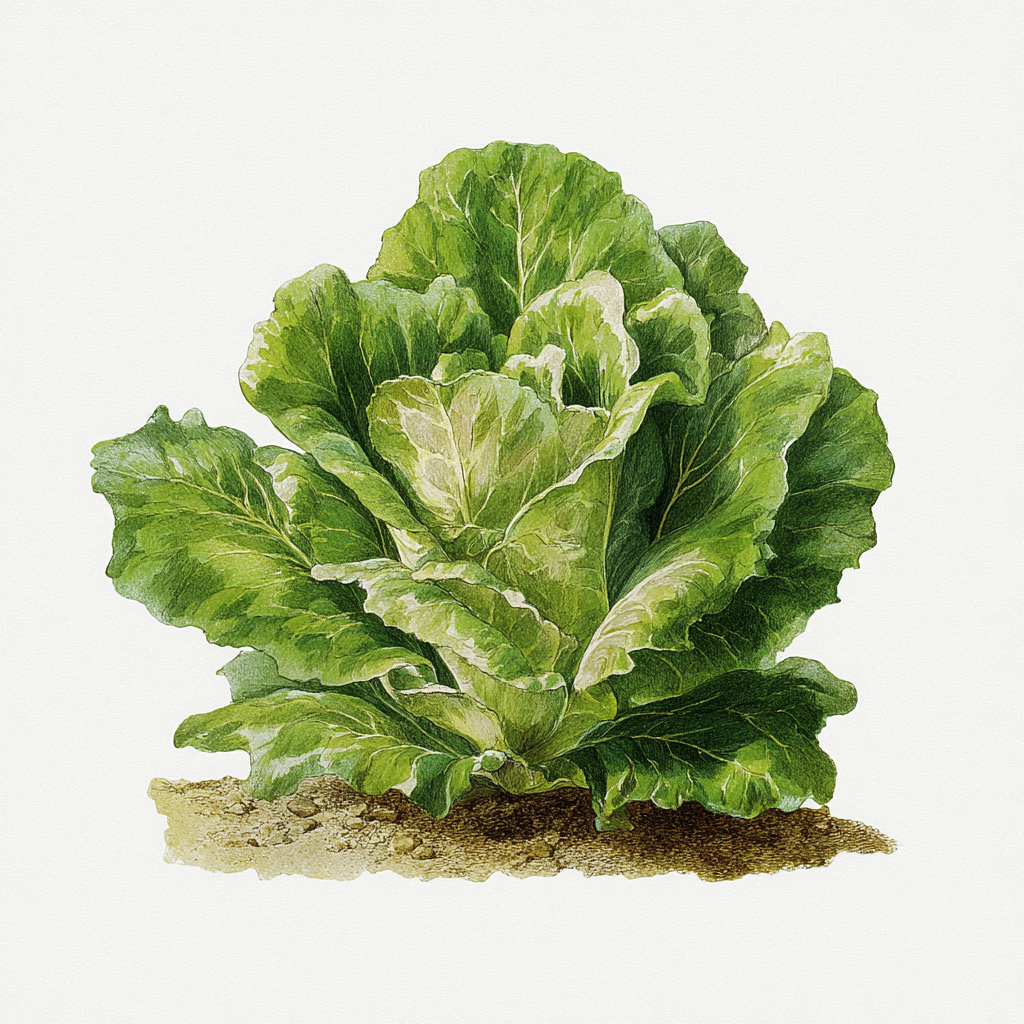
Lettuce
VegetableLactuca sativa
Have seeds for this? Add to inventory →Lettuce is a cool-season green that grows quickly and can be harvested as cut-and-come-again leaves throughout spring and autumn. It tolerates light shade in summer, which actually extends its season in hot climates.
Native Range
- Origin
- Lettuce is an Old World crop derived from wild Lactuca lineages native to the Mediterranean basin and western Asia.
- Native Habitat
- Wild relatives occur in sunny disturbed ground, rocky slopes, field edges, and seasonally dry open habitats.
- Current Distribution
- Widely cultivated in cool-season growing regions worldwide; not native outside its region of origin.
Growing Conditions
Sunlight
Partial Shade
Water Needs
Moderate
Soil
Rich, moist, well-draining loam; pH 6.0 - 7.0
Spacing
6 - 12 inches
Days to Maturity
45 - 60 days from sowing
Growing Zones
Thrives in USDA Zones 2 - 10
Companion Planting
When to Plant
Direct Sow
4 - 6 weeks before last frost; again in late summer for autumn harvest
Harvest
45 - 60 days from sowing; begin cut-and-come-again at 30 days
Phenology (Natural Timing Cues)
Direct Sow
Lettuce has two reliable sowing windows: early spring while conditions are cool and moist, and late summer as heat eases for an autumn crop. Between these windows, summer heat causes bolting - leaves turn bitter and the plant rushes to flower before you can harvest. Lettuce seed needs light to germinate, so surface sow or barely cover. Succession sow every 2 - 3 weeks within cool windows for steady cut-and-come-again harvest rather than one glut that bolts simultaneously.
- Forsythia is blooming or early dandelions are opening (spring sowing).
- Soil is workable, cool, and holds steady moisture.
- Daytime temperatures are reliably below 75°F.
- Summer heat has eased and first cool nights are returning (autumn sowing).
Start Dates (Your Location)
Based on your saved growing zone and this plant's timing notes.
Typical Last Frost
Set your growing zone to see personalized calendar dates.
Organic Growing Tips
Sow radishes between lettuce rows as a quick crop and aphid trap.
Apply diatomaceous earth as a targeted barrier only around individual plant bases to deter slugs and cutworms — it harms all insects including beneficial ones, so avoid scattering it widely.
Interplant with tall companions like corn or sunflowers to provide afternoon shade and prevent bolting.
Work compost and worm castings into beds before sowing — lettuce grown in biologically active soil produces sweeter, more tender leaves and is naturally more resistant to aphid pressure.
Common Pests
- Slugs
- Aphids
- Leaf Miners
- Cutworms
All pest management in Garden uses safe, organic, non-toxic methods only. No synthetic pesticides, ever.
Taxonomy
- Kingdom
- Plantae
- Family
- Daisy family (Asteraceae)
- Genus
- Lactuca
- Species
- Lactuca sativa
Natural History
Lactuca sativa was domesticated from wild Lactuca serriola, a prickly weedy species native to the Mediterranean, western Asia, and the Canary Islands. The ancient Egyptians were growing cultivated lettuce as far back as 4500 BCE, and tomb paintings at Saqqara from around 2700 BCE depict a tall, upright lettuce closely associated with the fertility god Min - the connection was likely to the plant's milky white latex, which held symbolic significance. The Greeks and Romans were sophisticated lettuce growers; Pliny the Elder described nine varieties in the 1st century CE, and the physician Galen wrote about lettuce's sleep-promoting properties in the 2nd century CE. Modern crisphead lettuce (iceberg) was developed in California in the early 20th century; its extraordinary shipping and keeping qualities transformed commercial lettuce production but represented a significant trade-off in flavor compared with older European heading types. Lactuca sativa's sensitivity to heat - the bolting mechanism is driven by photoperiod and temperature together - directly reflects its origin in cool-season Mediterranean growing windows.
Traditional Use
Lettuce has been associated with cooling, mild sedation, and digestive ease since ancient Egypt, where its milky latex had symbolic significance. It is one of the few vegetables with a documented sensory pharmacology: the bitter sesquiterpene lactones in lettuce latex have been studied for mild sedative properties.
Parts Noted Historically
Ancient Egypt and the God Min - Leaves and latex
Egyptian tomb paintings at Saqqara dating to around 2700 BCE depict a tall cultivated lettuce associated with the fertility god Min. Lettuce cultivation is documented from at least 4500 BCE in Egypt. The milky white latex of the plant was likely central to its sacred associations. The Ebers Papyrus includes references to plants in the Lactuca group in its medical preparations.
Greek and Roman Cultivation - Leaves
Pliny the Elder described nine distinct lettuce varieties in Naturalis Historia (77 CE), reflecting the depth of Roman horticultural interest. The physician Galen wrote about lettuce's sleep-promoting qualities in the 2nd century CE. Roman emperor Augustus reportedly benefited so greatly from eating lettuce during an illness that his physician Antonius Musa had a statue erected - an unusual monument to the cooling powers of a salad green.
Lactucarium and 19th-Century Botanical Medicine - Milky latex
The dried latex of wild lettuce (Lactuca virosa) was collected in the 18th and 19th centuries as lactucarium - sometimes called "lettuce opium" for its supposed calming properties. Lactucarium appeared in the British, French, and American pharmacopeias in the 19th century. Modern analysis has identified lactucin and lactucopicrin, bitter sesquiterpene lactones, as the compounds responsible for the reported effects.
Passover Seder and Bitter Herbs Tradition - Leaves
Romaine lettuce, which becomes progressively bitter from tip to stem base, is the most commonly used form for the maror (bitter herbs) eaten at the Jewish Passover Seder - a ritual food tradition continuous for more than 2,000 years. The requirement for bitter herbs connects the plant directly to ancient Near Eastern lettuce cultivation and reflects how ordinary lettuce bridged the sacred and the everyday in the ancient Mediterranean world.
Garden lettuce leaves are safe to eat. Concentrated latex preparations from wild lettuce (Lactuca virosa) are a separate historical and botanical topic.
This information is provided for historical and educational purposes only and is not medical advice. Always consult a qualified healthcare professional before making decisions related to your health.
Morphology (Plant Structure & Identification)
Root System
Shallow fibrous roots concentrated near the surface, making lettuce quick to respond to water stress. Plants need even moisture because roots do not forage deeply.
Stem
Very short stem during the edible rosette stage. When bolting begins, the stem elongates rapidly and leaves become more bitter.
Leaves
Leaves vary by type: looseleaf forms are open and ruffled, romaine forms upright ribs, butterheads make soft cups, and crispheads form dense hearts. Leaf edges and color help identify types before harvest.
Flowers
Small yellow composite flowers appear on tall branched seed stalks after bolting. Flowering signals the end of prime leaf quality.
Fruit
Produces small dry seed-like fruits with a light pappus for wind dispersal. The edible crop is the leaf rosette, not a fleshy fruit.
Known Varieties
Common cultivars worth knowing
- Best for: early harvests, cut-and-come-again
Black Seeded Simpson
Fast, reliable looseleaf lettuce with light green frilled leaves.
- Best for: small gardens, tender salads
Buttercrunch
Butterhead type with tender leaves, compact heads, and better heat tolerance than many lettuces.
- Best for: romaine hearts, Caesar salads
Parris Island Cos
Classic romaine with upright leaves, crisp ribs, and dependable heads.
- Best for: salad mixes
Red Sails
Red-bronze looseleaf variety that adds color and performs well in cool weather.
- Best for: containers, small servings
Little Gem
Small romaine-butterhead type with dense, sweet mini heads.
Related Articles
Planning Your First Vegetable Garden
Getting Started • 5 min read
Establishing a Garden Bed
Getting Started • 6 min read
How to Water Your Vegetable Garden
Watering & Feeding • 5 min read
Extending Your Growing Season
Seasonal Growing • 6 min read
What to Grow in Autumn and Winter
Seasonal Growing • 5 min read
How and When to Harvest Vegetables for Best Flavour
Harvesting & Storage • 5 min read
Loading photo submission…