Kale
VegetableBrassica oleracea var. sabellica
Have seeds for this? Add to inventory →Kale is a cold-hardy brassica that sweetens after frost and can overwinter in mild climates. It is one of the most nutritionally dense vegetables and remarkably easy to grow organically.
Native Range
- Origin
- Kale is a cultivated form of Brassica oleracea, whose wild coastal ancestors are native to parts of western and Mediterranean Europe.
- Native Habitat
- Wild Brassica oleracea occupies maritime cliffs, coastal grasslands, rocky calcareous soils, and salt-exposed open habitats.
- Current Distribution
- Cultivated globally; does not occur as a native plant in this form.
Growing Conditions
Sunlight
Full Sun
Water Needs
Moderate
Soil
Rich, well-draining loam; pH 6.0 - 7.5
Spacing
18 - 24 inches
Days to Maturity
55 - 75 days from transplant
Growing Zones
Thrives in USDA Zones 3 - 10
Companion Planting
Keep Away From
When to Plant
Start Indoors
6 - 8 weeks before last frost
Transplant
2 - 4 weeks before last frost
Direct Sow
3 months before first autumn frost
Harvest
55 - 75 days; harvest outer leaves and plant continues producing
Phenology (Natural Timing Cues)
Start Indoors
Start kale indoors 6 - 8 weeks before last frost so seedlings are stocky and ready to go out while outdoor conditions are still cool. Kale is a cold-tolerant brassica that actually benefits from a frost after transplanting, which sweetens the leaves. Starting too late means missing the cool-season window before summer heat causes bolting and leaf quality drops.
- Deciduous trees are still bare or just at earliest bud swell.
- Forsythia has not yet reached full bloom.
- Early dandelions are not yet blooming.
- Overnight temperatures outdoors are still regularly dropping well below freezing.
Direct Sow
Direct sow kale for the autumn crop when summer heat is clearly easing but seedlings still have 10 - 12 weeks before first hard frost to reach usable size. Sown too late, seedlings barely grow before cold sets in; sown too early, they face lingering heat stress and poor germination. In cool climates, a spring direct sowing also works when soil is workable and frosts are still likely.
- Summer heat is clearly easing - cool nights are becoming regular.
- First cool-season weeds and volunteer greens are germinating again.
- Daytime temperatures are reliably below 85°F.
- First hard frost is roughly 10 - 12 weeks away (for autumn sowing).
Transplant
Transplant kale into cool soil early enough that plants build size before summer heat drives bolting. Kale is more cold-tolerant than most brassicas and can go out while light frosts are still possible - frost actually sweetens the leaves. The goal is to get transplants established and growing in cool conditions, not to wait for settled warm weather as you would for nightshades.
- Forsythia is blooming or has just peaked.
- Early dandelions are beginning to flower.
- Soil is workable and drains cleanly after rain.
- Light frosts are still possible but hard freezes have ended.
Start Dates (Your Location)
Based on your saved growing zone and this plant's timing notes.
Typical Last Frost
Set your growing zone to see personalized calendar dates.
Direct Sow
Autumn
This uses autumn or first-frost timing, so keep the planting note as written.
Organic Growing Tips
Use floating row covers from transplant to exclude cabbage white butterflies.
Spray Bacillus thuringiensis (Bt) to control caterpillars without harming beneficial insects.
Plant garlic nearby to repel aphids; interplant with nasturtiums as a trap crop for caterpillars.
Top-dress with compost or worm castings mid-season and rotate brassicas to a new bed each year — feeding the soil prevents nutrient depletion and rotation breaks the disease cycles that weaken plants.
Common Pests
- Cabbage White Caterpillar
- Aphids
- Cabbage Looper
- Harlequin Bug
- Flea Beetle
All pest management in Garden uses safe, organic, non-toxic methods only. No synthetic pesticides, ever.
Taxonomy
- Kingdom
- Plantae
- Family
- Mustard family (Brassicaceae)
- Genus
- Brassica
- Species
- Brassica oleracea var. sabellica
Natural History
Brassica oleracea is one of the most extraordinary examples of artificial selection in botany - a single wild coastal species whose different cultivated forms include kale, cabbage, broccoli, cauliflower, kohlrabi, Brussels sprouts, and collard greens, each representing selection pressure applied to a different part of the plant over centuries. Wild Brassica oleracea still grows on the limestone sea cliffs of Britain and Brittany; it is a modest, unremarkable small shrub that gives little hint of its descendants. Kale and collard-type forms - selected for leafy growth rather than heads or modified flower buds - are among the oldest domesticated brassicas, likely cultivated around the Mediterranean from Greek and Roman times. In Scotland, kale was so fundamental to the peasant diet for centuries that the kitchen garden was called a kail yard, and the word kail was used generically for any cooked greens. The phrase "dinner o' kail" was simply the Scots word for the evening meal. The 21st-century kale revival - driven by interest in its glucosinolate chemistry, mineral density, and eye pigments - is historically unusual in restoring a medieval peasant staple to elite cultural status.
Traditional Use
Kale is among the oldest cultivated brassicas, grown in some form since Greek and Roman times. For most of European history it was a winter staple food for peasant populations in northern climates - the kail yard was the kitchen garden itself - rather than an elite vegetable.
Parts Noted Historically
Ancient Greek and Roman Cultivation - Leaves
Pliny the Elder's Naturalis Historia describes multiple forms of Brassica oleracea including loose-leafed types consistent with kale or colewort. Cato's De Agricultura (160 BCE) discusses brassica cultivation in terms suggesting a range of leaf types were grown. Colewort - the name used in Britain for loose-leafed brassicas through the medieval period - appears in Roman agricultural writing as a significant garden crop.
Scottish Kail Yard and Northern Winter Food - Leaves
In Scotland, the kitchen garden derived its name - kail yard - entirely from the centrality of kale to the rural diet. Kale and oats were the primary winter foods for much of the Scottish population through the medieval and early modern periods. The word kail was used as a generic term for any cooked green vegetable. The phrase "come in for your kail" was an invitation to dinner. This intimate relationship between kale and everyday Scottish life is documented in household records, poetry, and the Kailyard School of literature in the 19th century.
Italian Lacinato and Tuscan Tradition - Leaves
Lacinato kale - cavolo nero, dinosaur kale, or Tuscan black kale - is a distinct Italian type with long bumpy dark leaves that predates the curly northern European forms. It appears in Italian agricultural records from at least the 18th century in Tuscany, where it is essential in ribollita soup and braised winter greens preparations. The variety name Lacinato is associated with a village near Florence.
World War II Victory Garden Promotion - Leaves
During World War II, the British government promoted kale cultivation as part of the Dig for Victory campaign because it was cold-hardy, productive through winter, nutritionally dense, and grew in almost any garden. The Ministry of Food distributed kale cultivation guidance widely. This wartime emphasis kept kale in common allotment use through the latter 20th century and provided the horticultural foundation for its global revival as a health food in the 2010s.
This information is provided for historical and educational purposes only and is not medical advice. Always consult a qualified healthcare professional before making decisions related to your health.
Morphology (Plant Structure & Identification)
Root System
Strong branching root system with a central taproot and many feeder roots. Plants anchor well and keep drawing nutrients during cool weather.
Stem
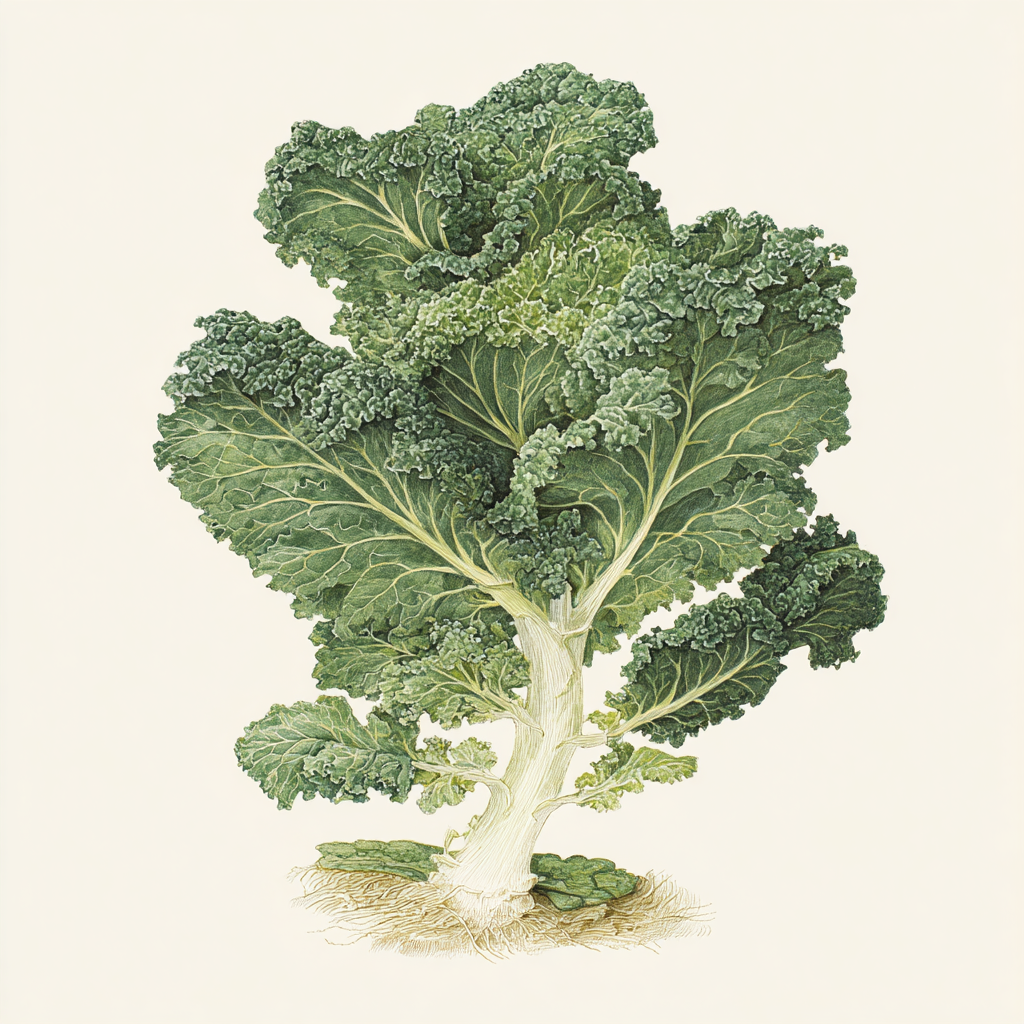
Upright central stem that lengthens as lower leaves are harvested. Older plants can become woody at the base but continue producing tender leaves near the top.
Leaves
Large leaves vary from curled and ruffled to flat, bumpy, or strap-like depending on type. Leaf texture, blue-green color, and waxy surface are useful for distinguishing varieties.
Flowers
Yellow four-petaled brassica flowers appear on tall stalks when plants bolt or overwinter into spring. Flower buds resemble small raab and signal a shift away from leaf production.
Fruit
Produces slender seed pods called siliques after flowering. The harvested crop is the leaf, usually picked from the outside while the growing tip remains intact.
Known Varieties
Common cultivars worth knowing
- Best for: soups, sauteing
Lacinato
Dark blue-green Italian kale with long bumpy leaves and excellent flavor.
- Best for: winter harvests
Winterbor
Very curly hybrid with strong cold tolerance and high yields.
- Best for: salads, quick cooking
Red Russian
Flat, tender leaves with purple stems and mild flavor.
- Best for: small gardens, freezing
Vates Blue Curled
Compact curled type with reliable production and good cold tolerance.
- Best for: early greens, cold climates
Dwarf Siberian
Hardy, broad-leaved type that grows quickly in cool conditions.
Related Articles
Understanding Your Growing Zone
Getting Started • 4 min read
Organic Pest Control: The Layered Approach
Pest & Disease • 6 min read
Identifying and Treating Common Fungal Diseases
Pest & Disease • 7 min read
Extending Your Growing Season
Seasonal Growing • 6 min read
What to Grow in Autumn and Winter
Seasonal Growing • 5 min read
How and When to Harvest Vegetables for Best Flavour
Harvesting & Storage • 5 min read
Loading photo submission…