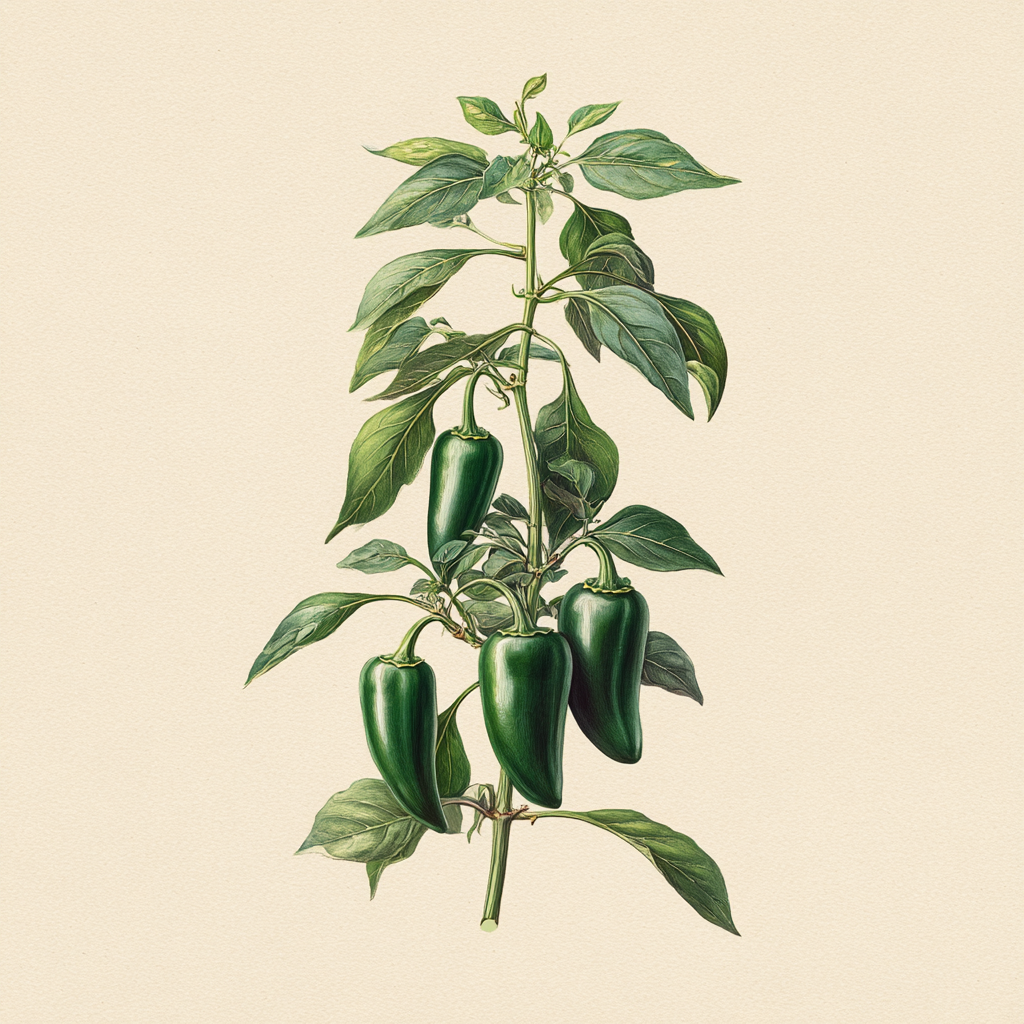
Jalapeño Pepper
VegetableCapsicum annuum
Have seeds for this? Add to inventory →Jalapeño peppers are prolific warm-season producers of medium-heat fruit used fresh, pickled, or roasted. They share the same cultivation requirements as sweet peppers but are slightly more heat-tolerant.
Native Range
- Origin
- Capsicum annuum is native to the tropical and subtropical Americas, with domestication centered in Mexico and long movement through Indigenous American agriculture.
- Native Habitat
- Wild and semi-wild peppers occur in warm open woodland edges, thickets, disturbed soils, and frost-free seasonal habitats.
- Current Distribution
- Widely cultivated in suitable growing regions worldwide; not native outside its region of origin.
Growing Conditions
Sunlight
Full Sun
Water Needs
Moderate
Soil
Rich, well-draining loam; pH 6.0 - 6.8
Spacing
18 - 24 inches
Days to Maturity
70 - 80 days from transplant
Growing Zones
Thrives in USDA Zones 5 - 11
Companion Planting
When to Plant
Start Indoors
8 - 10 weeks before last frost
Transplant
After last frost, soil 65°F+
Harvest
70 - 80 days; harvest green or leave to ripen red
Phenology (Natural Timing Cues)
Start Indoors
Jalapeños need 8 - 10 weeks indoors to reach transplant-ready size because they germinate slowly and grow at a measured pace even with good warmth. They demand the same high germination temperatures as sweet peppers (80 - 90°F) and share the same starting window. Starting too early produces overgrown, root-bound plants that stall at transplant; starting too late means missing the warmest outdoor production weeks when fruit set is most productive.
- The last expected frost date is 8 - 10 weeks away.
- Early dandelions are just coming into bloom.
- Deciduous trees are just beginning to show early bud movement.
- Outdoor soil remains too cold for pepper roots to make useful growth.
Transplant
Jalapeños need genuinely settled warm conditions before transplanting - a warm week followed by a cold snap will halt growth and reduce the season's total fruit set. Look for a consistent pattern of warm nights and fully active warm-season growth, not just the first mild days after last frost. Jalapeños tolerate heat better than sweet peppers but still respond poorly to cold soil, which slows root development and delays fruiting by weeks.
- Lilacs have fully faded and their leaves are near full size.
- Soil in the planting bed feels warm at depth, not just warm at the surface.
- Tender annual weeds are growing quickly without cold setback.
- Night temperatures stay reliably above 55°F with no cold spells in the forecast.
Start Dates (Your Location)
Based on your saved growing zone and this plant's timing notes.
Typical Last Frost
Set your growing zone to see personalized calendar dates.
Organic Growing Tips
Interplant with basil and marigolds to create a fragrant barrier against aphids and flea beetles.
Apply kaolin clay spray to deter flea beetles from pitting the foliage of young plants.
Water consistently at the base and mulch with compost to retain even moisture — uneven moisture causes blossom end rot, while compost mulch feeds soil biology and keeps roots cool through summer heat.
Harvest fruits regularly, even green, to encourage the plant to set more flowers.
Common Pests
- Aphids
- Flea Beetle
- Spider Mites
- Pepper Weevil
- Bacterial Spot
All pest management in Garden uses safe, organic, non-toxic methods only. No synthetic pesticides, ever.
Taxonomy
- Kingdom
- Plantae
- Family
- Nightshade family (Solanaceae)
- Genus
- Capsicum
- Species
- Capsicum annuum
Natural History
Capsicum annuum was domesticated in Mexico and Central America, with archaeological evidence from the Tehuacan Valley placing pepper cultivation at around 6,000 years ago. The jalapeño takes its name from Xalapa (also spelled Jalapa), the capital of the Mexican state of Veracruz, where this medium-heat thick-walled pepper was the characteristic market variety. Capsaicin - the alkaloid responsible for chili heat - is produced by the placenta tissue that holds the seeds and serves as a deterrent to mammalian consumption while leaving birds unaffected, because birds lack the TRPV1 receptor that detects capsaicin. This evolutionary strategy allows birds to disperse seeds unharmed while discouraging mammals that would crush them. The word chipotle comes from the Nahuatl chilpoctli - smoked chili - and refers specifically to a smoke-dried ripe red jalapeño, a preservation technology that creates an entirely different flavor profile from the fresh green form. The Scoville scale, developed in 1912 by pharmacist Wilbur Scoville at Parke-Davis pharmaceutical company, was designed to standardize capsaicin preparations for muscle-rub products; it placed the jalapeño at 2,500-8,000 Scoville Heat Units.
Traditional Use
Jalapeño is a specific Veracruz market selection of a pepper species with 6,000 years of Mesoamerican agricultural history. The capsaicin compound that defines its heat has a traceable chemistry reaching from Aztec food culture to modern pharmaceutical use.
Parts Noted Historically
Mesoamerican Capsicum Agriculture - Fruit
Capsicum annuum peppers were central to Aztec and pre-Aztec Mesoamerican food culture. Bernardino de Sahagún's 16th-century Florentine Codex - the most comprehensive record of Aztec material culture - documents many pepper varieties, their colors, heat levels, and market roles. Peppers seasoned everything from meat stews to cacao drinks. Spanish observers were struck enough to call all chili varieties pimienta (pepper), confusing them with the black pepper already in trade from Asia.
Veracruz Regional Identity and Chipotle - Fruit
The jalapeño's identity is tied to Xalapa, Veracruz, where it was the standard market pepper for centuries. Veracruz cuisine developed distinct uses for the jalapeño fresh, pickled en escabeche, and smoke-dried as chipotle. The chipotle tradition - transforming the ripe red jalapeño into a smoky dried product through a wood-smoke drying process - represents a distinct preservation technology with pre-Columbian roots, still centered in the Veracruz and Oaxaca regions.
Post-Columbian Global Chili Spread - Fruit
Columbus brought Capsicum seeds back from his first voyage in 1493. Within 50 years, chili peppers had spread to Africa, India, Southeast Asia, and China - one of the fastest documented food-plant dispersals in history. In India, chili transformed the spice culture entirely; in Sichuan, it created the ma la (numbing-spicy) flavor profile that now defines the cuisine. The global speed of adoption speaks to the power of capsaicin - a flavor sensation with no Old World equivalent.
Scoville Scale and Pharmaceutical Capsaicin - Fruit
Wilbur Scoville's 1912 organoleptic test for capsaicin concentration was developed at Parke-Davis in Detroit to standardize capsaicin preparations used in topical muscle rubs - not to rank food. The scale placed jalapeños at 2,500-8,000 SHU. Modern HPLC analysis replaced the taster-panel method, but the Scoville unit persists as the standard language of chili heat. Purified capsaicin is now used in licensed pharmaceutical topical preparations for nerve-related pain management, completing the cycle from Aztec spice to pharmaceutical ingredient.
Capsaicin is a potent irritant to eyes, skin, and mucous membranes. Handle cut jalapeños carefully and wash hands thoroughly before touching the face. The heat is concentrated in the placenta and seeds, not the flesh.
This information is provided for historical and educational purposes only and is not medical advice. Always consult a qualified healthcare professional before making decisions related to your health.
Morphology (Plant Structure & Identification)
Root System
Moderately shallow fibrous roots that establish slowly in cool soil. Plants perform best when roots stay warm, evenly moist, and well aerated.
Stem
Branching, semi-woody stems with a compact upright habit. Main branches often form a Y shape and may need support once loaded with fruit.
Leaves
Smooth, oval to lance-shaped leaves with a glossy green surface. Leaf droop during heat can be temporary, but pale or spotted leaves signal stress or disease.
Flowers
Small white, five-petaled flowers borne at branch nodes. Flowers are self-pollinating but set better with warmth, gentle movement, and low stress.
Fruit
Thick-walled tapered peppers, usually harvested glossy green and 2 - 3 inches long or left to ripen red. Fine corking lines on the skin are common and often indicate mature fruit.
Known Varieties
Common cultivars worth knowing
- Best for: short seasons
Early Jalapeño
Earlier strain that helps short-season gardeners get ripe harvests.
- Best for: general garden use
Jalapeño M
Common open-pollinated type with medium heat and dependable green fruit.
- Best for: mild salsa, fresh eating
Tam Jalapeño
Milder selection from Texas A&M with classic jalapeño shape and less heat.
- Best for: stuffing, pickling
Mucho Nacho
Large hybrid jalapeño with thick walls and heavy yields.
- Best for: large peppers
Craig's Grande
Large-fruited jalapeño type with good size for roasting or stuffing.
Loading photo submission…