
Eggplant
VegetableSolanum melongena
Have seeds for this? Add to inventory →Eggplant is a heat-loving member of the nightshade family that produces glossy, richly flavoured fruit. It needs a long, warm growing season and performs best in well-enriched soil with consistent moisture.
Native Range
- Origin
- Eggplant is an Old World domesticate derived from Solanum lineages native to South and Southeast Asia.
- Native Habitat
- Wild relatives occur in warm scrub, woodland margins, disturbed ground, and tropical to subtropical open habitats.
- Current Distribution
- Widely cultivated in warm growing regions worldwide; not native outside its region of origin.
Growing Conditions
Sunlight
Full Sun
Water Needs
Moderate
Soil
Rich, well-draining loam; pH 5.5 - 6.5
Spacing
18 - 24 inches
Days to Maturity
70 - 85 days from transplant
Growing Zones
Thrives in USDA Zones 5 - 11
Companion Planting
Keep Away From
When to Plant
Start Indoors
8 - 10 weeks before last frost
Transplant
After last frost, soil 65°F+
Harvest
70 - 85 days; harvest while skin is still glossy
Phenology (Natural Timing Cues)
Start Indoors
Eggplant needs a longer indoor lead than most warm-season crops - 8 to 10 weeks before last frost - because it germinates slowly and grows at a measured pace even with good warmth. It also demands higher germination temperatures (80 - 90°F) than tomatoes or peppers. Start eggplant earlier than your other nightshades so all three are transplant-ready at the same outdoor window.
- The last expected frost date is 8 - 10 weeks away.
- Early dandelions are just beginning to bloom and trees are still in early bud.
- Outdoor soil remains cold enough that nightshades planted outside would barely grow.
Transplant
Eggplant is the most heat-demanding of the common nightshades and punishes early transplanting more severely than tomatoes or peppers. A single cold night can permanently stunt growth in a way tomatoes would shrug off. Wait until soil is genuinely warm at depth - not just a warm surface after a sunny day - and warm-season conditions are settled into a steady pattern, not just a brief warm spell.
- Lilacs are well past bloom and their leaves are near full size.
- Oak leaves are approaching full size.
- Night temperatures stay reliably above 60°F with no cold spells forecast.
- Warm-season weeds are growing actively without cold setback.
- Soil holds warmth through the night in the planting bed.
Start Dates (Your Location)
Based on your saved growing zone and this plant's timing notes.
Typical Last Frost
Set your growing zone to see personalized calendar dates.
Organic Growing Tips
Use row covers for the first 3 - 4 weeks after transplanting to exclude flea beetles.
Plant tarragon nearby - its essential oils are reported to deter various eggplant pests.
Hand-pick Colorado potato beetle larvae from the undersides of leaves daily during peak season.
Enrich soil generously with compost before planting — eggplant grown in biologically active, humus-rich soil produces stronger plants with better pest and disease resistance, and benefits from a worm casting top-dress mid-season.
Common Pests
All pest management in Garden uses safe, organic, non-toxic methods only. No synthetic pesticides, ever.
Taxonomy
- Kingdom
- Plantae
- Family
- Nightshade family (Solanaceae)
- Genus
- Solanum
- Species
- Solanum melongena
Natural History
Solanum melongena was domesticated in South Asia, where wild relatives (Solanum insanum) are still found. Records of cultivation in China appear from around the 5th century BCE, and the plant became thoroughly integrated into Chinese cooking during the Tang dynasty (618-907 CE). The word eggplant itself reflects European encounters with early round white varieties that resembled eggs hanging from the plant - the English name was in use by the 18th century - while the French and southern European name aubergine derives from the Arabic al-badinjan, tracing the plant's westward spread through Arab trade routes. Arab traders brought eggplant from India to the Islamic world by around the 7th century CE, and it entered Moorish Spain and North Africa in the same period, giving rise to the food traditions that produced baba ghanoush, moussaka, and ratatouille. The extraordinary diversity in fruit size, shape, and color - from tiny round Thai pea eggplants to the large Italian teardrop forms to slender Japanese types - reflects thousands of years of regional selection across South Asia, Southeast Asia, China, and the Middle East.
Traditional Use
Eggplant traveled from South Asia to China, through the Islamic world, and into the Mediterranean, acquiring a distinct culinary identity in each region. Its history traces the connected food cultures of Asia, the Middle East, and Europe across more than two millennia.
Parts Noted Historically
South Asian Origin and Indian Cuisine - Fruit
Eggplant was first cultivated in India and became one of the most widely used vegetables across Indian regional cuisines, from the mustard-oil baingan bharta of the north to curried brinjal dishes of the south. Classical Sanskrit medical texts including the Charaka Samhita described it as a cooked vegetable; raw eggplant was generally considered indigestible in classical Indian food culture, a view that shaped how the vegetable was prepared throughout its range.
Tang Dynasty China - Fruit
Eggplant was a favored vegetable in Tang dynasty China (618-907 CE) and dishes featuring it are documented in period texts. Chinese cooks developed specific techniques - steaming and slow braising - that suited its texture. The agricultural encyclopedia Qimin Yaoshu, compiled around 535 CE, describes eggplant cultivation, placing its Chinese presence well before the Tang refinement of its preparation.
Islamic World and Arab Trade Routes - Fruit
Arab traders spread eggplant from India westward across the Islamic world from the 7th century onward. Medieval Arab cookbooks including the 13th-century Andalusian Manuscrito Anónimo describe dozens of eggplant preparations. The Arabic name al-badinjan passed into Spanish (berenjena), Italian (melanzana), French (aubergine), and English (in the form aubergine), making it one of the few vegetables whose name directly traces its travel route through successive languages.
Mediterranean Cuisines - Fruit
After its Moorish introduction to Spain and spread to Italy, Greece, and the Levant, eggplant transformed Mediterranean cooking. The three dishes most closely associated with Mediterranean eggplant - baba ghanoush (Lebanese), moussaka (Greek/Ottoman), and caponata (Sicilian) - each reflect regional appropriations of the vegetable into existing flavor traditions. Greek moussaka in its current layered form was codified in the early 20th century by Nikolaos Tselementes but draws on Ottoman-era layered eggplant dishes traceable centuries earlier.
Eggplant fruit is safe to eat cooked. Raw eggplant contains solanine at low levels, particularly concentrated in the skin. The calyx and leaves are not edible.
This information is provided for historical and educational purposes only and is not medical advice. Always consult a qualified healthcare professional before making decisions related to your health.
Morphology (Plant Structure & Identification)
Root System
Fibrous root system that needs warm, loose soil and steady moisture. Roots are less forgiving of cold, compacted conditions than tomatoes.
Stem
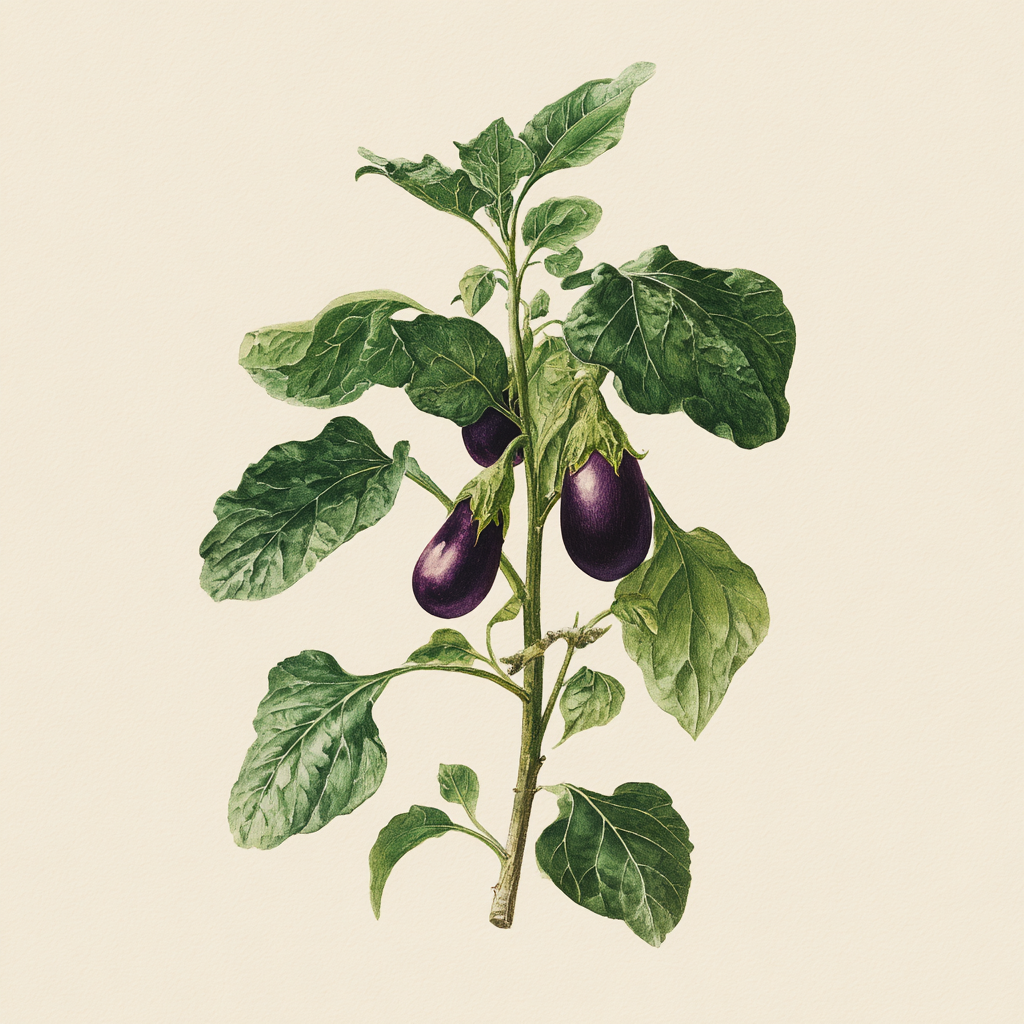
Upright branching stems become semi-woody and may carry small prickles depending on variety. Plants often need support when fruit are large.
Leaves
Large, broad, slightly fuzzy leaves with wavy margins and sometimes purple veins. Flea beetle damage appears as many small shot holes in young leaves.
Flowers
Purple to lavender star-shaped flowers with yellow anthers, usually borne singly or in small clusters. Flowers can drop when nights are cool or plants are stressed.
Fruit
Glossy berries harvested immature while skin is shiny and seeds are pale. Shapes range from long and slender to round, oval, or teardrop, with colors including purple, white, green, and striped forms.
Known Varieties
Common cultivars worth knowing
- Best for: general garden use
Black Beauty
Classic large dark-purple eggplant with broad fruit and dependable yields.
- Best for: grilling, stir-fries
Ichiban
Long Japanese hybrid with slender tender fruit and early production.
- Best for: roasting, specialty cooking
Rosa Bianca
Italian heirloom with round lavender-white fruit and creamy texture.
- Best for: visual interest, Mediterranean dishes
Listada de Gandia
Striped purple-and-white heirloom with attractive oval fruit.
- Best for: containers, small harvests
Fairy Tale
Compact plant with small striped fruit that stay tender when harvested young.
Loading photo submission…