
Colorado Potato Beetle
A distinctive beetle with cream wings boldly striped in black, about 10 mm long. Both adults and the bright orange-red larvae cause severe defoliation of nightshade family plants. It can develop resistance to insecticides rapidly, making organic management approaches more durable than chemical options.
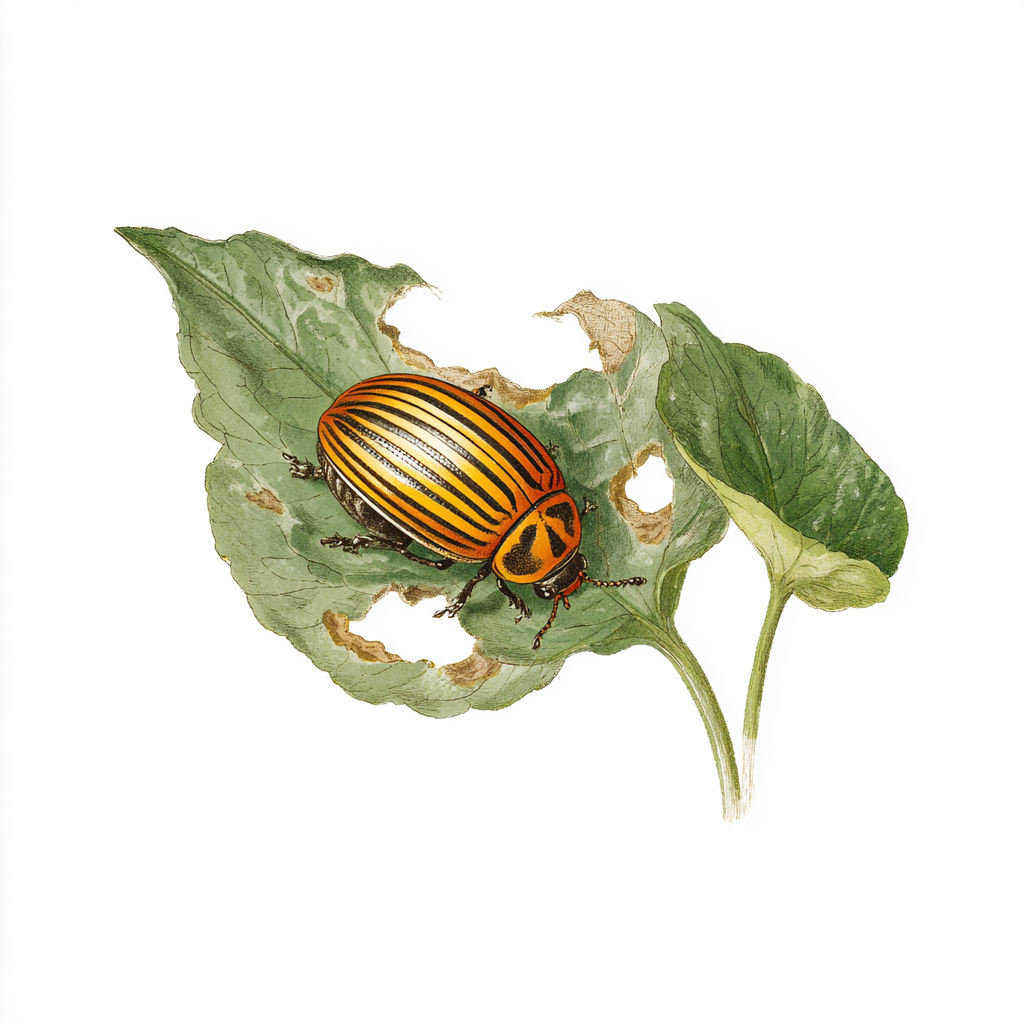
Symptoms to Look For
- Leaves eaten from the margins inward, leaving only the main veins in severe cases
- Bright orange-red larvae in clusters on the undersides of leaves
- Rows of bright yellow-orange eggs laid in neat clusters on leaf undersides
- Rapid defoliation advancing up the plant and spreading between plants
- Striped adults visible on foliage from late spring through summer
Affected Plants
Organic Solutions
Hand-Picking
Check leaf undersides daily for yellow-orange egg clusters and remove them. Larvae and adults can be shaken or brushed into a container of soapy water. In a small garden, this daily routine prevents populations establishing.
Bacillus thuringiensis var. tenebrionis
The tenebrionis strain of Bt specifically targets Colorado potato beetle larvae. Apply as a spray when small larvae first hatch. Coverage of leaf undersides is essential. More effective on young larvae than on adults.
Deep Mulch
A deep straw or wood chip mulch (15+ cm) makes it significantly harder for adults emerging from the soil in spring to reach plants. Combined with row covers, this physical strategy prevents the first wave of spring pressure.
Kaolin Clay
Spray kaolin clay onto all plant surfaces starting at transplant time. The particle film deters adults from feeding and interferes with egg-laying. Reapply after rain or every 7–10 days.
Row Covers
Cover transplants with fine mesh from the day of planting until the first emergence wave passes — typically two to three weeks. Ensure covers are sealed at edges so adults cannot crawl under.
Organic Remedies
Prevention
- Rotate nightshade family crops on a 3–4 year cycle - adults overwinter in the top 5 cm of soil near where crops grew the previous season
- Plant nasturtiums, marigolds, and dill near nightshade crops to attract parasitic wasps and predatory insects that naturally regulate Colorado potato beetle populations
- Time transplanting so plants are large and resilient before the main adult emergence in late spring
- Create beneficial insect habitat — parasitic wasps, lacewings, and predatory stinkbugs are major natural enemies of Colorado potato beetle. A diverse, flowering garden perimeter is your most durable defence
Garden, by Willowbottom recommends only organic, wildlife-friendly solutions. No synthetic pesticides, no harmful chemicals - ever.