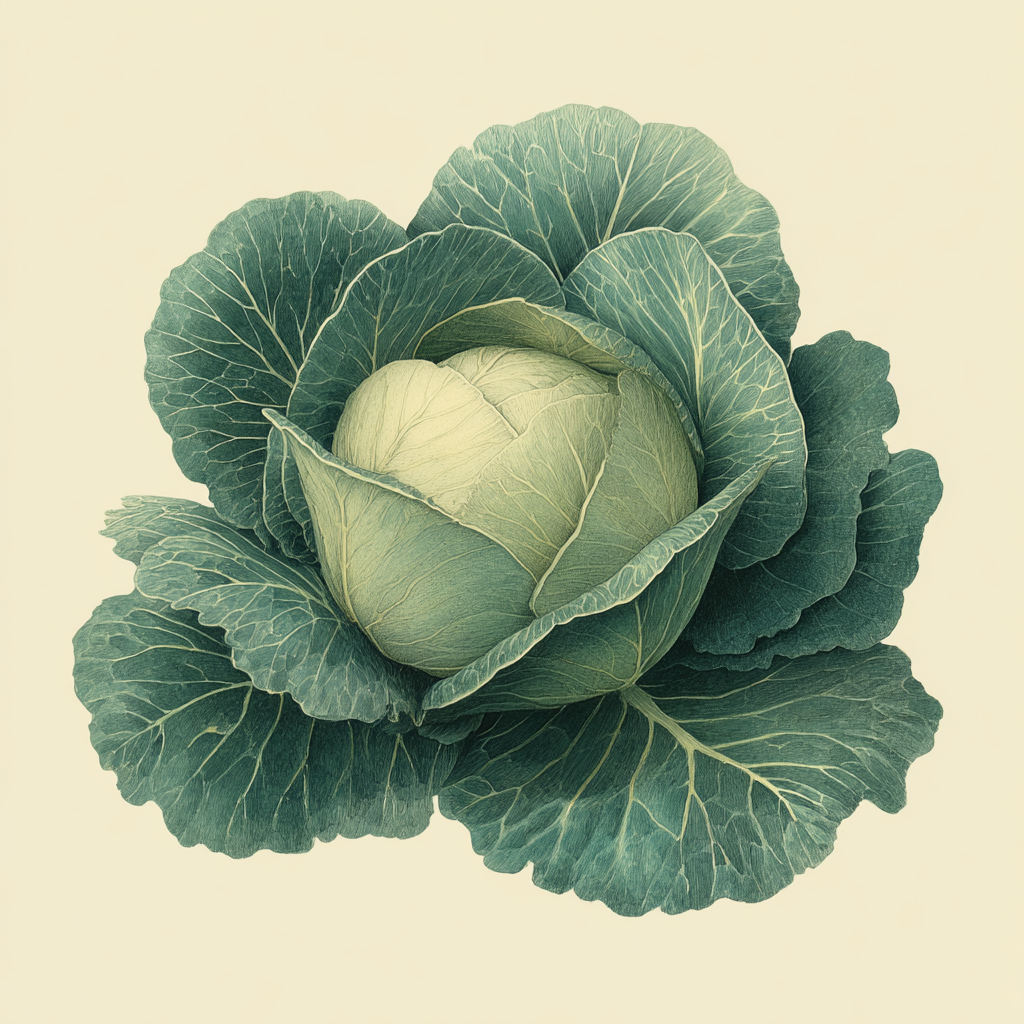
Cabbage
VegetableBrassica oleracea var. capitata
Have seeds for this? Add to inventory →Cabbage is a hardy cool-season brassica producing dense heads of crisp leaves used fresh or fermented into sauerkraut. It benefits enormously from aromatic companion herbs that confuse and deter its many pest species.
Native Range
- Origin
- Cabbage is a cultivated head-form of Brassica oleracea, whose wild ancestors are native to coastal western and Mediterranean Europe.
- Native Habitat
- Wild Brassica oleracea favors open maritime cliffs, rocky coastal soils, and calcareous seaside grasslands.
- Current Distribution
- Cultivated globally; does not occur as a native plant in this form.
Growing Conditions
Sunlight
Full Sun
Water Needs
Moderate
Soil
Rich, firm, well-draining loam; pH 6.0 - 7.5
Spacing
18 - 24 inches
Days to Maturity
70 - 100 days from transplant
Growing Zones
Thrives in USDA Zones 3 - 10
Companion Planting
When to Plant
Start Indoors
6 - 8 weeks before last frost
Transplant
2 - 4 weeks before last frost
Harvest
70 - 100 days; harvest when heads are firm and dense
Phenology (Natural Timing Cues)
Start Indoors
Start cabbage indoors 6-8 weeks before the last frost date - while outdoor conditions are still firmly winter, well before spring growth advances.
- Deciduous trees are still bare or showing only early bud swell.
- Forsythia has not reached full bloom.
- Dandelions have not reached heavy bloom.
Transplant
Transplant spring cabbage while soil is still cool and early bloom signals have just arrived. For autumn cabbage, allow 70-100 days of cool growing weather before the first frost.
- Forsythia is blooming (spring transplant).
- Early dandelions are blooming (spring transplant).
- Soil is workable and consistently cool (spring transplant).
- Summer heat has broken and first cool nights have returned (autumn transplant).
- At least 70-100 days remain before expected first frost (autumn transplant).
Start Dates (Your Location)
Based on your saved growing zone and this plant's timing notes.
Typical Last Frost
Set your growing zone to see personalized calendar dates.
Organic Growing Tips
Interplant with a diverse mix of aromatic herbs to disguise the scent signals that attract butterflies.
Use row covers from transplant to exclude egg-laying by cabbage white and cabbage moth.
Apply diatomaceous earth as a targeted barrier only around individual plant bases — it harms all insects including beneficial ones, so use it sparingly and precisely rather than scattering across the bed.
Side-dress with compost or worm castings mid-season and rotate brassicas to new ground every 4 years — feeding the soil keeps plants robust and rotation prevents the clubroot spore buildup that persists for over a decade.
Common Pests
- Cabbage White Caterpillar
- Cabbage Looper
- Aphids
- Harlequin Bug
- Clubroot
All pest management in Garden uses safe, organic, non-toxic methods only. No synthetic pesticides, ever.
Taxonomy
- Kingdom
- Plantae
- Family
- Mustard family (Brassicaceae)
- Genus
- Brassica
- Species
- Brassica oleracea var. capitata
Natural History
Cabbage is a head-forming selection of Brassica oleracea - the same species that, under different selective pressures, gave rise to kale, broccoli, cauliflower, kohlrabi, Brussels sprouts, and collards. Its wild ancestor still grows on chalk and limestone sea cliffs along the Atlantic coast of western Europe, from southern England and Wales through northern France to the Iberian Peninsula, where the loose leafy non-heading form survives in exposed coastal conditions. The Greeks and Romans both cultivated brassicas extensively: Cato the Elder, writing in the 2nd century BCE, was a famous advocate who claimed cabbage could cure a remarkable range of ailments, and Pliny the Elder called it one of the most important vegetables of the Roman diet. The dense heading characteristic - overlapping leaves forming around a compressed growing point - was developed over centuries of selection and gave cabbage its defining practical advantage: a hard head that stores well, travels well, and ferments readily. This made it one of the most important winter food crops of northern and central Europe for centuries. The discovery that fermented cabbage could prevent scurvy - by preserving enough vitamin C through fermentation - had significant practical consequences: Captain Cook carried over two tonnes of sauerkraut on his Pacific voyages in the 1770s and reported virtually no scurvy cases.
Traditional Use
Cabbage has been one of the most economically important vegetables in human food history - not primarily for its fresh flavor but for its storability, productivity, and fermentation potential. It fed northern and central European populations through winters for centuries, and fermented cabbage traditions arose independently across Europe and East Asia, producing some of the most culturally significant foods in their respective cuisines.
Parts Noted Historically
Ancient Greek and Roman Traditions - Leaves and heads
Brassica cultivation was central to ancient Greek and Roman agriculture. Cato the Elder devoted significant space to cabbage in De Agri Cultura (2nd century BCE), recommending it for a wide range of household purposes. Pliny the Elder called it one of the most important vegetables of the Roman diet. These classical references helped embed cabbage deeply in European food culture through the medieval period and beyond.
European Sauerkraut and Fermented Cabbage Traditions - Heads
The tradition of fermenting shredded cabbage with salt into sauerkraut is documented across Germany, Austria, Poland, and the Czech Republic from at least the medieval period. In central Europe, sauerkraut became a winter staple of profound importance - a means of preserving a dense calorie and nutrient source through months when fresh food was unavailable. Captain Cook's Pacific voyages (1768-1779) demonstrated its effectiveness against scurvy; he carried over two tonnes of it and reported virtually no scurvy cases among his crew.
Korean Kimchi Traditions - Leaves and heads
Though kimchi predates the introduction of chilli pepper to Korea, napa cabbage kimchi became the defining form after the Columbian Exchange introduced chilli to Korea in the late 16th or early 17th century. Kimchi is now a national cultural institution: UNESCO added kimjang - the communal tradition of making and sharing kimchi - to its Intangible Cultural Heritage list in 2013. Koreans consume an estimated 1.85 million tonnes of kimchi annually.
Eastern European Bigos and Stuffed Cabbage Traditions - Heads and leaves
In Poland, bigos - a hearty stew made with sauerkraut, fresh cabbage, various meats, and mushrooms - is among the closest things to a national dish. Stuffed cabbage leaves (gołąbki in Polish, holubtsi in Ukrainian, sarma across the Balkans) appear across central and eastern Europe under various names, filled with rice, meat, or grain mixtures. These traditions reflect centuries of cabbage as a foundation ingredient across the region.
Cabbage is food-safe in any quantity in normal cooking. Raw cabbage contains goitrogens which in very large quantities may affect thyroid function; cooking neutralizes most of these. People on blood-thinning medications are advised to keep their intake of high-vitamin-K leafy greens including cabbage consistent rather than dramatically variable.
This information is provided for historical and educational purposes only and is not medical advice. Always consult a qualified healthcare professional before making decisions related to your health.
Morphology (Plant Structure & Identification)
Root System
Branching brassica roots with a central taproot and many feeder roots. Firm soil helps plants anchor and form dense heads.
Stem
Short thick stem supports tightly overlapping leaves. If left too long or stressed, heads may split as the stem keeps growing.
Leaves
Broad waxy leaves wrap inward to form round, flat, pointed, or savoyed heads. Outer wrapper leaves are tougher and protect the head.
Flowers
Yellow four-petaled flowers appear on tall stalks in the second year or after bolting. Flowering follows head formation if plants overwinter.
Fruit
Produces slender seed pods after flowering. The harvested crop is the compact head of layered leaves.
Known Varieties
Common cultivars worth knowing
- Best for: fresh eating, general use
Copenhagen Market
Classic round green cabbage with uniform medium heads.
- Best for: early harvests
Early Jersey Wakefield
Pointed early cabbage with tender heads.
- Best for: slaws, small gardens
Red Acre
Compact red cabbage with dense heads and good color.
- Best for: winter harvests
January King
Hardy semi-savoy cabbage with purple-green winter heads.
- Best for: sauerkraut, storage
Brunswick
Large flat storage cabbage suited to kraut and long keeping.
Related Articles
Loading photo submission…