Onion
VegetableAllium cepa
Have seeds for this? Add to inventory →Onions are biennial crops grown as annuals, forming bulbs in response to day length. Their pungent scent deters many pests and makes them excellent companions for a wide range of vegetables.
Native Range
- Origin
- Onion is an ancient Allium domesticate associated with Central and southwestern Asian wild ancestry.
- Native Habitat
- Wild Allium relatives grow in dry open slopes, rocky ground, and steppe-like habitats with pronounced seasonal dormancy.
- Current Distribution
- Widely cultivated in suitable growing regions worldwide; not native outside its region of origin.
Growing Conditions
Sunlight
Full Sun
Water Needs
Moderate
Soil
Rich, well-draining loam; pH 6.0 - 7.0
Spacing
4 - 6 inches
Days to Maturity
100 - 120 days from transplant; 60 - 80 days from sets
Growing Zones
Thrives in USDA Zones 3 - 10
Companion Planting
When to Plant
Start Indoors
10 - 12 weeks before last frost
Transplant
4 - 6 weeks before last frost
Direct Sow
Plant sets 4 weeks before last frost
Harvest
When tops fall over naturally; cure 2 - 3 weeks before storage
Phenology (Natural Timing Cues)
Start Indoors
Onions need a very early start - 10 to 12 weeks before last frost - because bulb size at harvest is directly determined by how many leaves the plant has built before day length triggers bulbing. Each leaf corresponds roughly to one ring of the future bulb; a plant that enters the bulbing phase with only 6 leaves will produce a much smaller bulb than one with 12. Starting late costs final size that cannot be recovered later in the season.
- Deciduous trees are still bare with no visible bud movement.
- Forsythia has not yet started blooming.
- Early dandelions are not yet in bloom.
- The last expected frost date is 10 - 12 weeks away.
Direct Sow
Onion sets (small dried bulbs from the previous season) go in as soon as cool spring soil is workable. Sets are more forgiving than transplants or direct seed - they carry stored energy and will push through a light frost. The goal is to get them rooted and establishing before spring warmth accelerates top growth at the expense of root development.
- Forsythia is beginning to bloom.
- Early dandelions are appearing.
- Soil is workable and drains cleanly after rain without remaining sticky.
- Hard freezes have become infrequent, though light frosts are still possible.
Transplant
Transplant onion seedlings into cool, workable soil as early as conditions allow. Onions are cold-tolerant and benefit from going out early because the cool spring period builds leaves before day length triggers bulbing. Each additional week of growth in cool soil contributes directly to bulb size at harvest; transplanting late into warm soil shortens this window and reduces final yield.
- Forsythia is blooming.
- Soil is workable and still cool but not frozen or sticky.
- Cool-season weeds are starting active growth.
- Light frosts are still possible but hard freezes have ended.
Start Dates (Your Location)
Based on your saved growing zone and this plant's timing notes.
Typical Last Frost
Set your growing zone to see personalized calendar dates.
Organic Growing Tips
Interplant with carrots - each deters the other's primary fly pest through aromatic confusion.
Mulch lightly to retain moisture without keeping soil overly wet, which promotes neck rot.
Cure bulbs thoroughly in a warm, airy place before storage to prevent rot.
Avoid overhead irrigation; use drip lines to keep foliage dry and reduce disease.
Common Pests
- Onion Thrips
- Onion Fly
- Downy Mildew
- Neck Rot
All pest management in Garden uses safe, organic, non-toxic methods only. No synthetic pesticides, ever.
Taxonomy
- Kingdom
- Plantae
- Family
- Onion family (Amaryllidaceae)
- Genus
- Allium
- Species
- Allium cepa
Natural History
Allium cepa, the common bulb onion, likely originated from wild relatives in Central Asia - possibly modern Uzbekistan, Pakistan, or Afghanistan - though no truly wild form of A. cepa has been definitively identified, suggesting domestication may have occurred early enough to obscure the wild ancestor. Onions appear in ancient Egyptian records from the 3rd millennium BCE and were depicted in tomb paintings. Herodotus recorded that an inscription at the Great Pyramid of Khufu listed the quantities of onions, radishes, and garlic consumed by the builders. Onion bulbs were found in the tomb of Ramesses IV around 1160 BCE. The ancient Greeks and Romans grew onions extensively; Pliny the Elder listed multiple varieties in Naturalis Historia. Bulbing in Allium cepa is governed by photoperiod - the length of daylight triggers bulb formation - which is why short-day, intermediate-day, and long-day onions must be matched to latitude rather than treated as interchangeable.
Traditional Use
Onion has been documented as a cultivated food plant since the earliest written records. Its preservation qualities, pungency, and year-round storage made it one of the most strategically important food crops in the ancient world - valued alongside garlic and leek as the foundational trio of alliums.
Parts Noted Historically
Ancient Egypt and the Pyramid Workers - Bulbs
Onions appear in Egyptian tomb paintings and inscriptions from the 3rd millennium BCE. Herodotus recorded an inscription at the base of the Great Pyramid of Khufu listing quantities of onions, radishes, and garlic consumed by the builders. Bulbs were found in the tomb of Ramesses IV (c. 1160 BCE). Some accounts suggest the layered structure of the onion held symbolic significance in Egyptian culture.
Roman Agricultural Tradition - Bulbs
Pliny the Elder described numerous onion varieties in Naturalis Historia, distinguishing them by flavor, size, and storage quality. Roman military provisioning relied heavily on onions for their durability on campaign. The Roman cookbook Apicius uses onions across a wide range of preparations, and the diversity of variety types Pliny describes shows that careful selection was already practiced in the 1st century CE.
Medieval European Household and Food Tradition - Bulbs
Onions were a cornerstone of medieval European food at every social level, appearing in the earliest surviving cookbooks alongside bread and meat. The 1390 English cookbook Forme of Cury includes onions in numerous preparations. In peasant economies, onions and alliums provided the primary flavoring for grain-based meals throughout northern Europe. Hanging braids of cured onions became a storage tradition documented in household records and depicted in paintings from the medieval period onward.
French Regional Onion Culture - Bulbs
France developed distinct regional onion varieties bred for specific culinary roles. The Roscoff pink onion of Brittany became the subject of one of the more colorful episodes in vegetable trade history: Breton onion sellers (Johnnies) who cycled through Britain selling strings of onions from their bikes, a tradition documented from the 1820s and continued into the 20th century. The image of the Breton onion man became one of the most persistent British caricatures of French identity.
Onions are toxic to dogs and cats. Safe as food for people, though cutting releases lachrymatory factor - a sulfur compound that causes eye irritation.
This information is provided for historical and educational purposes only and is not medical advice. Always consult a qualified healthcare professional before making decisions related to your health.
Morphology (Plant Structure & Identification)
Root System
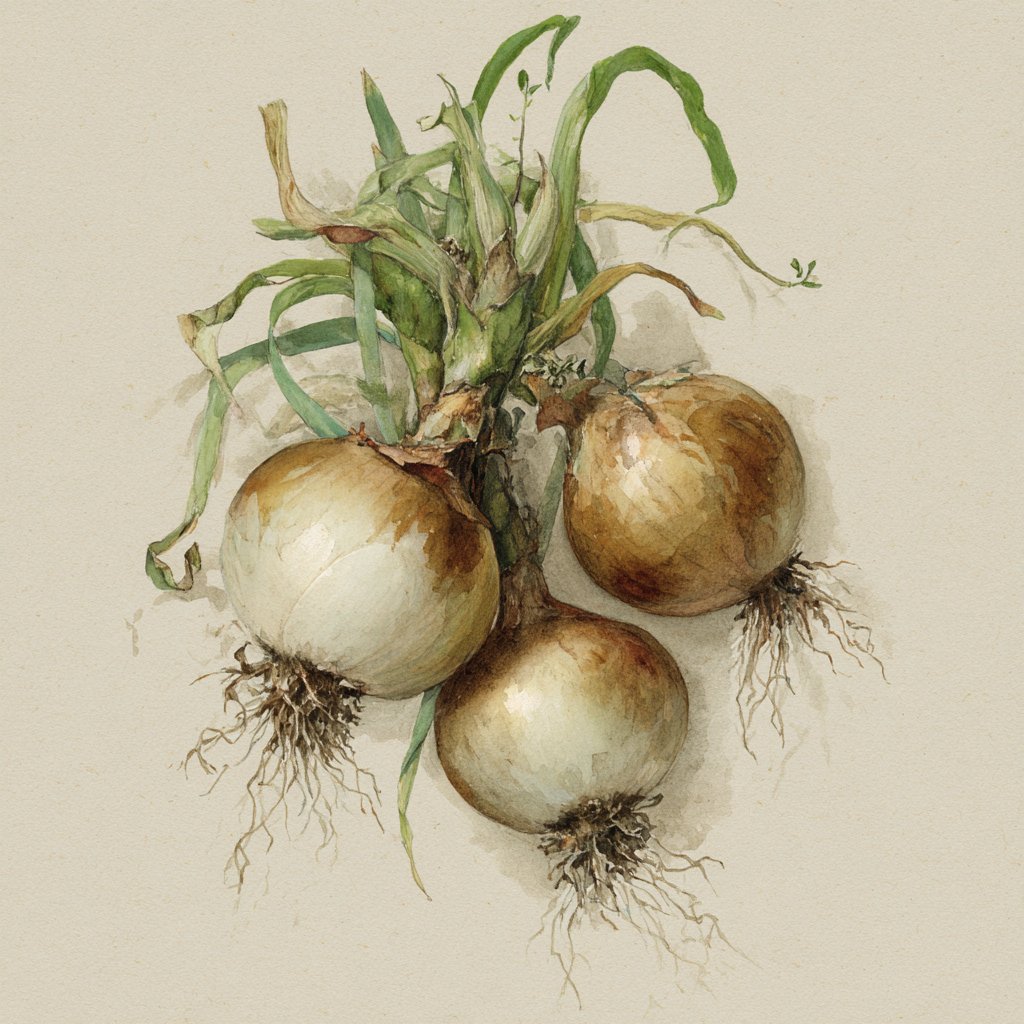
Shallow fibrous roots spread from the basal plate and do not compete well with weeds. Even moisture and loose surface soil matter because roots stay near the top few inches.
Stem
The true stem is a small basal plate at the bottom of the bulb. The upright green top is formed by overlapping leaf bases that swell into bulb scales.
Leaves
Hollow, round, blue-green leaves with a waxy surface. Strong upright leaves feed bulb growth; bent or fallen tops are a maturity cue.
Flowers
Second-year plants send up a hollow flowering stalk topped with a round umbel of many small white to pale lavender flowers.
Fruit
Produces small black seeds in dry capsules after flowering. The harvested onion bulb is made of swollen leaf bases arranged in layers.
Known Varieties
Common cultivars worth knowing
- Best for: fresh eating
Walla Walla
Large sweet long-day onion with mild flavor and limited storage life.
- Best for: warm regions, sweet onions
Yellow Granex
Short-day sweet onion type associated with Vidalia-style production.
- Best for: storage
Patterson
Long-day yellow storage onion with firm bulbs and strong keeping quality.
- Best for: salads, fresh use
Red Burgundy
Red onion with mild flavor and attractive rings.
- Best for: scallions, overwintering
Evergreen Hardy White
Bunching onion grown for green stalks rather than large bulbs.
Related Articles
Loading photo submission…